buildings academic - RTR-Imperium-Surrectum/ris-wiki GitHub Wiki
6 levels, each replacing the one before it: you upgrade in place rather than building alongside.
Small School (Civic) → Academy (Civic) → Great Academy (Civic) → Mouseion and the Great Library → Library of Pergamum → Plato's Academy
| Level | Cost | Build time | Minimum settlement | Upgrades to | |
|---|---|---|---|---|---|
 |
Small School (Civic) | 4,000 | 4 | city | Academy (Civic) |
 |
Academy (Civic) | 8,000 | 6 | large city | Great Academy (Civic) |
 |
Great Academy (Civic) | 12,000 | 8 | huge city | — |
 |
Mouseion and the Great Library | 14,000 | 5 | city | — |
 |
Library of Pergamum | 12,000 | 5 | city | — |
 |
Plato's Academy | 10,000 | 5 | city | — |
Costs in denarii, build time in turns.
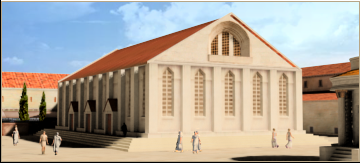
Staying in a settlement with an educational institution can have positive effects on the trait and ancillaries your characters receive.
The Ludus is a training school where leaders can acquire the basic skills of government before they assume the weighty responsibilities of command. Teaching ranges from the purely philosophical to the practical skills of waging war and producing good governance.
Towns with an Academy will tend to be well run because of the pool of educated men that is produced.
An Academy can be upgraded as the settlement grows. History
Roman education began in the home: Quintilian recommended that the parents begin teaching basic literacy and numeracy skills early in life (Quint. Inst. Or. 1.1.8). Traditionally Romans were educated within their own home, by the parents, but as the city came to be exposed to Hellenistic ideals, it became more common for specialised teachers to be employed. Initially, the practical skills of reading, writing and mathematics dominated, while social 'mores' were discussed through heroic examples. The example, given by Plutarch, of Cato the Elder, who taught his own son personally, while possibly apocryphal, is also instructive. The biography claims that in addition to teaching basic skills, he wrote his 'origines' a history of the Italian peoples, so that his son might learn the mos maiorum (Plut. Cat. Mai. 20.7).
More generally, an elite child would be given over a paedagogus at the age of seven, to tutor them more fully in a curriculum of myths, poetry and laws. Those families who could not afford a private tutor would send their children to a school run by a magister, or litterator (Hor. Ep. 2.3.325-330; Petron. Sat. 58.7).
Later, at the age of ten or eleven, a male child was despatched to a Grammaticus, who would teach a youth to speak and write in a more refined manner, as well as how to analyse and compose poetry.
| Cost | 4,000 denarii |
| Build time | 4 turns |
| Minimum settlement | city |
| Upgrades to | Academy (Civic) |
Requirements: all of these must hold before this level can be built.
- You play a Phoenician, Indian, Egyptian, Iberian, Libyan, Caucasian, Arab, Ethiopian, Anatolian, Iranian, Greek, Western Hellenistic, Eastern Hellenistic or Roman faction
- Forum or a higher level is built here
- Government Building (Dependency, Indirect Rule, Direct Rule or Homeland)
- Only one civic building allowed
What it does
- taxable income -7 to -3, depending on how many settlements your empire holds
- Gives access to various traits and followers
Show 3 effects that apply only in some circumstances
- allows recruiting Diplomats, only when you play a Phoenician, Indian, Egyptian, Iberian, Libyan, Caucasian, Arab, Ethiopian, Anatolian, Iranian, Greek, Western Hellenistic, Eastern Hellenistic or Roman faction and Dependency, Indirect Rule, Direct Rule or Homeland is built here
- up to 1 Diplomat can be recruited in this settlement, only when you play a Phoenician, Indian, Egyptian, Iberian, Libyan, Caucasian, Arab, Ethiopian, Anatolian, Iranian, Greek, Western Hellenistic, Eastern Hellenistic or Roman faction and this settlement is not your capital
- up to 4 Diplomats can be recruited in this settlement, only when you play a Phoenician, Indian, Egyptian, Iberian, Libyan, Caucasian, Arab, Ethiopian, Anatolian, Iranian, Greek, Western Hellenistic, Eastern Hellenistic or Roman faction and this settlement is your capital
Religious belief: spreads 28 beliefs, by how much depending on what the region already believes.
Show the 28 beliefs
- Aeolian +1
- Arab +1
- Arcadian +1
- Armenian +1
- Assyrian +1
- Bosporan +1
- Cappadocian +1
- Carian +1
- Cilician +1
- Dorian +1
- Egyptian +1
- Epirote +1
- Ethiopian +1
- Greco-Bactrian +1
- Iberian +1
- Indian +1
- Ionian +1
- Iranian +1
- Italic +1
- Judaean +1
- Libyan +1
- Lycian +1
- Macedonian +1
- Mesopotamian +1
- Northwest Greek +1
- Paphlagonian +1
- Phoenician +1
- Pisidian +1
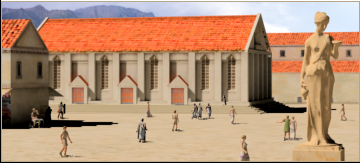
A Scriptorium holds many laboriously copied books, and the learning to be gained here can improve the skills of present and future leaders alike. Built upon the solid educational foundations of an Academy, this place brings together many teachers and thinkers who, through cogent argument and disputation, impart knowledge to all those willing to listen and learn.
History
Elite youths would go on to a higher level of education, under the Rhetor, who would teach them how to compose and deliver oratory, alongside a more general curriculum. Initially this can be seen in the practice of youths following around a prominent orator and politician in his daily actions.
More commonly, especially in the late Republic, a young man would be educated more formally. One exercise involved the composition of speeches to either persuade an audience to adopt a course of action (suasoria), or to address a particular point of law (controversia). Suasoriae were often based on historical or mythological events: eg. Should Agamemnon sacrifice Iphigenia at Aulis? Should Cicero beg M. Antonius for mercy, having been sentenced to death? (Sen. Mai. Suas. 3, 6). Controversiae usually involved a strict recounting of the specific details in a given case.
Oratory was immensely important for a member of the elite. Not only would he be expected to engage in public debate in the Senate, but he would also be called upon to assist his friends and clients in legal disputes. In order to match the achievements of his ancestors, he would need to persuade the assembled populace to elect him as a magistrate. In addition to the content, the audience would observe the adherence of a man to the principles of rhetorical delivery: his expression, his movements and the variety of his voice. To be successful politically, a man would need not only an extensive knowledge of law, historical and mythological exempla, and precedents, but also a persuasive demeanour and a strong voice.
| Cost | 8,000 denarii |
| Build time | 6 turns |
| Minimum settlement | large city |
| Upgrades to | Great Academy (Civic) |
Requirements: all of these must hold before this level can be built.
- You play a Phoenician, Indian, Egyptian, Caucasian, Arab, Ethiopian, Anatolian, Iranian, Greek, Western Hellenistic, Eastern Hellenistic or Roman faction
- Large Forum or a higher level is built here
- Government Building (Dependency, Indirect Rule, Direct Rule or Homeland)
- Only one civic building allowed
What it does
- taxable income -10 to -6, depending on how many settlements your empire holds
- Gives access to various traits and followers
Show 5 effects that apply only in some circumstances
- +1 public order (law), only when the region has Papyrus, or Papyrus Supply (Rural) or Parchment Exports (Urban) is built somewhere in your empire
- allows recruiting Diplomats, only when you play a Phoenician, Indian, Egyptian, Iberian, Libyan, Caucasian, Arab, Ethiopian, Anatolian, Iranian, Greek, Western Hellenistic, Eastern Hellenistic or Roman faction and Dependency, Indirect Rule, Direct Rule or Homeland is built here
- up to 1 Diplomat can be recruited in this settlement, only when you play a Phoenician, Indian, Egyptian, Iberian, Libyan, Caucasian, Arab, Ethiopian, Anatolian, Iranian, Greek, Western Hellenistic, Eastern Hellenistic or Roman faction and this settlement is not your capital
- up to 4 Diplomats can be recruited in this settlement, only when you play a Phoenician, Indian, Egyptian, Iberian, Libyan, Caucasian, Arab, Ethiopian, Anatolian, Iranian, Greek, Western Hellenistic, Eastern Hellenistic or Roman faction and this settlement is your capital
- Law bonus due to paper resource: papyrus or parchment (livestock), only when the region has Papyrus, or Papyrus Supply (Rural) or Parchment Exports (Urban) is built somewhere in your empire
Religious belief: spreads 28 beliefs, by how much depending on what the region already believes.
Show the 28 beliefs
- Aeolian +2
- Arab +2
- Arcadian +2
- Armenian +2
- Assyrian +2
- Bosporan +2
- Cappadocian +2
- Carian +2
- Cilician +2
- Dorian +2
- Egyptian +2
- Epirote +2
- Ethiopian +2
- Greco-Bactrian +2
- Iberian +2
- Indian +2
- Ionian +2
- Iranian +2
- Italic +2
- Judaean +2
- Libyan +2
- Lycian +2
- Macedonian +2
- Mesopotamian +2
- Northwest Greek +2
- Paphlagonian +2
- Phoenician +2
- Pisidian +2
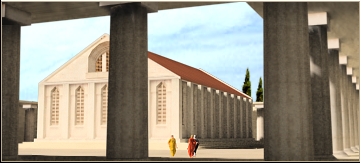
This province has become a centre for learning and philosophical debate; and intelligent and tolerant man might learn much here.
The Academia attracts wise teachers, keen to pass on their learning to all potential leaders who know that greatness is found in the mind as well as the sword-arm. This kind of educational establishment is only found in the largest cities of an empire and represents the very finest training ground for the ruling elite. Individuals trained here will gain a solid understanding of all human wisdom, including the arts of war, statesmanship and good government. A great city with a Ludus Magna will tend to be superbly run because of the talented and educated men that can always be found here.
History
By the Late Republic, it became more fashionable for important men to associate with Philosophers. Greek philosophers joined the entourage of famous Romans. Panaetius, later head of the Stoa, was well acquainted with P. Cornelius Scipio Aemilianus in Rome during the 140s. Cato the Younger housed a number of Stoic philosophers at his own expense.
The strong influence of Hellenistic philosophy on Roman literature emphasises a strong tradition of higher education. The epic poem de rerum natura by T. Lucretius Carus is a notable example of Epicurean philosophy. Cicero's philosophical works incorporate aspects of several schools, synthesising Hellenistic ideas in a more Roman fashion. Q. Sextius founded a philosophical school whose tenets were described as 'Greek in words, but Roman in character.'
By the Late Republic, the sons of prominent men would often explore the Greek East, studying in academic locations such as Athens or Rhodes. Cicero studied under numerous scholars, including Apollonius of Rhodes. His son went to Athens, studying under Cratippus, the head of the Peripatetic school.
| Cost | 12,000 denarii |
| Build time | 8 turns |
| Minimum settlement | huge city |
Requirements: all of these must hold before this level can be built.
- You play a Phoenician, Indian, Egyptian, Caucasian, Anatolian, Iranian, Greek, Western Hellenistic, Eastern Hellenistic or Roman faction
- Great Forum or a higher level is built here
- Government Building (Dependency, Indirect Rule, Direct Rule or Homeland)
- Only one civic building allowed
What it does
- taxable income -14 to -10, depending on how many settlements your empire holds
- Gives access to various traits and followers
Show 5 effects that apply only in some circumstances
- +2 public order (law), only when the region has Papyrus, or Papyrus Supply (Rural) or Parchment Exports (Urban) is built somewhere in your empire
- allows recruiting Diplomats, only when you play a Phoenician, Indian, Egyptian, Iberian, Libyan, Caucasian, Arab, Ethiopian, Anatolian, Iranian, Greek, Western Hellenistic, Eastern Hellenistic or Roman faction and Dependency, Indirect Rule, Direct Rule or Homeland is built here
- up to 2 Diplomats can be recruited in this settlement, only when you play a Phoenician, Indian, Egyptian, Iberian, Libyan, Caucasian, Arab, Ethiopian, Anatolian, Iranian, Greek, Western Hellenistic, Eastern Hellenistic or Roman faction and this settlement is not your capital
- up to 5 Diplomats can be recruited in this settlement, only when you play a Phoenician, Indian, Egyptian, Iberian, Libyan, Caucasian, Arab, Ethiopian, Anatolian, Iranian, Greek, Western Hellenistic, Eastern Hellenistic or Roman faction and this settlement is your capital
- Law bonus due to paper resource: papyrus or parchment (livestock), only when the region has Papyrus, or Papyrus Supply (Rural) or Parchment Exports (Urban) is built somewhere in your empire
Religious belief: spreads 28 beliefs, by how much depending on what the region already believes.
Show the 28 beliefs
- Aeolian +3
- Arab +3
- Arcadian +3
- Armenian +3
- Assyrian +3
- Bosporan +3
- Cappadocian +3
- Carian +3
- Cilician +3
- Dorian +3
- Egyptian +3
- Epirote +3
- Ethiopian +3
- Greco-Bactrian +3
- Iberian +3
- Indian +3
- Ionian +3
- Iranian +3
- Italic +3
- Judaean +3
- Libyan +3
- Lycian +3
- Macedonian +3
- Mesopotamian +3
- Northwest Greek +3
- Paphlagonian +3
- Phoenician +3
- Pisidian +3
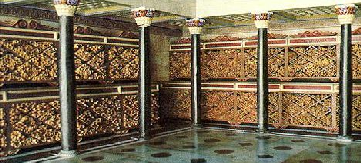
The Royal Library of Alexandria, the largest library of the ancient world, was built during the reign of Ptolemy II of Egypt. The Library was likely created after his father had built what would become the first part of the Library complex, the temple of the Muses - the Mouseion, the home of music or poetry, a philosophical school and library like Plato's school of philosophy, also a gallery of sacred texts. The Latin word museum is derived from this. Initially the Library was closely linked to a "museum," or research center, that seems to have focused primarily on editing texts. Libraries were important for textual research in the ancient world, since the same text often existed in several different versions of varying quality and veracity. The editors at the Library of Alexandria are especially well known for their work on Homeric texts. All visitors to Alexandria were required to surrender all books, scrolls as well as any form of written media in their possession which were listed under the heading "books of the ships"; these writings were then swiftly copied by official scribes. Sometimes the copies were so precise that the originals were put into the Library, and the copies were delivered to the unsuspecting previous owners.
This building complex can be improved as the settlement grows in size and importance.
| Cost | 14,000 denarii |
| Build time | 5 turns |
| Minimum settlement | city |
Requirements: no faction you can play is able to build this level.
What it does
- +3 public order (law)
- +1 trade income
- +1 population health
- -12 taxable income
- Gives access to various traits and followers
Show 3 effects that apply only in some circumstances
- allows recruiting Diplomats, only when you play a Phoenician, Indian, Egyptian, Iberian, Libyan, Caucasian, Arab, Ethiopian, Anatolian, Iranian, Greek, Western Hellenistic, Eastern Hellenistic or Roman faction and Dependency, Indirect Rule, Direct Rule or Homeland is built here
- up to 1 Diplomat can be recruited in this settlement, only when you play a Phoenician, Indian, Egyptian, Iberian, Libyan, Caucasian, Arab, Ethiopian, Anatolian, Iranian, Greek, Western Hellenistic, Eastern Hellenistic or Roman faction and this settlement is not your capital
- up to 4 Diplomats can be recruited in this settlement, only when you play a Phoenician, Indian, Egyptian, Iberian, Libyan, Caucasian, Arab, Ethiopian, Anatolian, Iranian, Greek, Western Hellenistic, Eastern Hellenistic or Roman faction and this settlement is your capital
Religious belief: spreads 1 belief, by how much depending on what the region already believes.
- Macedonian +3
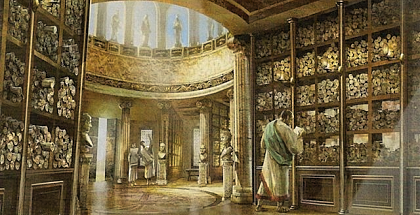
Pergamum was home to a library said to house approximately 200,000 volumes, according to the writings of Plutarch. Built by Eumenes II and situated at the northern end of the Acropolis, it became one of the most important ancient libraries. Historical accounts claim that the library possessed a large main reading room, lined with many shelves. An empty space was left between the outer walls and the shelves to allow for air circulation. This was intended to prevent the library from becoming overly humid in the warm climate of Anatolia and can be seen as an early attempt at library preservation. Manuscripts were written on parchment, rolled, and then stored on these shelves. A statue of Athena, the goddess of wisdom, stood in the main reading room. Pergamum is credited with being the home and namesake of parchment (charta pergamena). Prior to the creation of parchment, manuscripts were transcribed on papyrus, which was produced only in Alexandria. When the Ptolemies of Egypt refused to export any more papyrus to Pergamum, King Eumenes II commanded that an alternative source be found. This led to the production of parchment, which is made out of a thin sheet of sheep or goat skin. Parchment reduced the Roman Empire's dependency on Egyptian papyrus and allowed for the increased dissemination of knowledge throughout Europe and Asia. The introduction of parchment also greatly expanded the holdings of the Library of Pergamum.
| Cost | 12,000 denarii |
| Build time | 5 turns |
| Minimum settlement | city |
Requirements: no faction you can play is able to build this level.
What it does
- taxable income -14 to -10, depending on how many settlements your empire holds
- Gives access to various traits and followers
Show 6 effects that apply only in some circumstances
- +3 public order (law), only when the region has Papyrus, or Papyrus Supply (Rural) or Parchment Exports (Urban) is built somewhere in your empire
- +1 public order (law), only when the region has no Papyrus and neither Papyrus Supply (Rural) nor Parchment Exports (Urban) is built anywhere in your empire
- allows recruiting Diplomats, only when you play a Phoenician, Indian, Egyptian, Iberian, Libyan, Caucasian, Arab, Ethiopian, Anatolian, Iranian, Greek, Western Hellenistic, Eastern Hellenistic or Roman faction and Dependency, Indirect Rule, Direct Rule or Homeland is built here
- up to 1 Diplomat can be recruited in this settlement, only when you play a Phoenician, Indian, Egyptian, Iberian, Libyan, Caucasian, Arab, Ethiopian, Anatolian, Iranian, Greek, Western Hellenistic, Eastern Hellenistic or Roman faction and this settlement is not your capital
- up to 4 Diplomats can be recruited in this settlement, only when you play a Phoenician, Indian, Egyptian, Iberian, Libyan, Caucasian, Arab, Ethiopian, Anatolian, Iranian, Greek, Western Hellenistic, Eastern Hellenistic or Roman faction and this settlement is your capital
- Law bonus due to paper resource: papyrus or parchment (livestock), only when the region has Papyrus, or Papyrus Supply (Rural) or Parchment Exports (Urban) is built somewhere in your empire
Religious belief: spreads 1 belief, by how much depending on what the region already believes.
- Macedonian +2
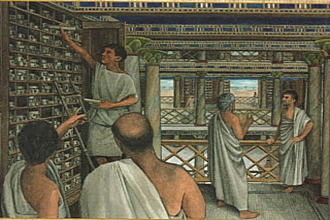
The Academy was founded by Plato in ca. 385 BC in Athens. It persisted throughout the Hellenistic period as a sceptical school. The site was located near Colonus, 6 stadia (1 mile) from the Dipylon gates. Before being a school, the Academy contained a sacred grove of olive trees dedicated to Athena, the goddess of wisdom. The archaic name Hekademia evolved into Academy, linked to the Athenian hero "Akademos".
At the time of Plato, the academy was a beautiful park for gymnastics. Within this park Plato opened a school for those inclined to attend his instructions. The Academy was not a school teaching an orthodox doctrine, or an association of members expected to subscribe to the theory of ideas. The formal instruction was restricted to mathematics. Plato's influence was that of an intelligent critic of method, not a technical mathematician. By his criticism of method, his formulation of broader problems, and arousing interest in mathematics among philosophers, he gave a great impulse to the development of the science.
The Head of the Academy was elected for life by a majority vote. The first few to lead were: Plato, Speuisppus, Xenocrates, Polemon, Crates and Crantor. Aristotle was a member for many years but never became its Head.
This building complex can be improved as the settlement grows in size and importance.
| Cost | 10,000 denarii |
| Build time | 5 turns |
| Minimum settlement | city |
Requirements: no faction you can play is able to build this level.
What it does
- -8 taxable income
- Gives access to various traits and followers
Show 6 effects that apply only in some circumstances
- +3 public order (law), only when the region has Papyrus, or Papyrus Supply (Rural) or Parchment Exports (Urban) is built somewhere in your empire
- +1 public order (law), only when the region has no Papyrus and neither Papyrus Supply (Rural) nor Parchment Exports (Urban) is built anywhere in your empire
- allows recruiting Diplomats, only when you play a Phoenician, Indian, Egyptian, Iberian, Libyan, Caucasian, Arab, Ethiopian, Anatolian, Iranian, Greek, Western Hellenistic, Eastern Hellenistic or Roman faction and Dependency, Indirect Rule, Direct Rule or Homeland is built here
- up to 1 Diplomat can be recruited in this settlement, only when you play a Phoenician, Indian, Egyptian, Iberian, Libyan, Caucasian, Arab, Ethiopian, Anatolian, Iranian, Greek, Western Hellenistic, Eastern Hellenistic or Roman faction and this settlement is not your capital
- up to 4 Diplomats can be recruited in this settlement, only when you play a Phoenician, Indian, Egyptian, Iberian, Libyan, Caucasian, Arab, Ethiopian, Anatolian, Iranian, Greek, Western Hellenistic, Eastern Hellenistic or Roman faction and this settlement is your capital
- Law bonus due to paper resource: papyrus or parchment (livestock), only when the region has Papyrus, or Papyrus Supply (Rural) or Parchment Exports (Urban) is built somewhere in your empire
Religious belief: spreads 1 belief, by how much depending on what the region already believes.
- Ionian +3
| Trait | Building | Points | Chance |
|---|---|---|---|
| Administrator | Small School (Civic) or above | +1 | 1–5% |
| Aspiring Politician | Great Academy (Civic) | +1 | 1–2% |
| Cultured | Small School (Civic) or above | +1 | 1–2% |
| Cultured | Academy (Civic) or above | +1 | 3% |
| Cultured | Great Academy (Civic) | +1 | 2–3% |
| Curious about Humanities | Small School (Civic) or above | +1 | 1–3% |
| Curious Cartographer | Small School (Civic) or above | +1 | 1–3% |
| Dedicated Trainer | Small School (Civic) or above | +1 | 2% |
| Dioiketes | Great Academy (Civic) or above | +1 | 3% |
| Draughtsman | Academy (Civic) or above | +1 | 1–2% |
| Draughtsman | Great Academy (Civic) | +1 | 1% |
| Engineer | Small School (Civic) or above | +1 | 1–2% |
| Engineering Schools | Small School (Civic) or above | +1 | 6–100% |
| Epistates Komes | Small School (Civic) | +1 | 2–3% |
| Epistates Komes | Academy (Civic) or above | +1 | 5% |
| Eutaksian | Small School (Civic) | +1 | 60% |
| Fluent Speaker | Small School (Civic) or above | +1 | 1–2% |
| Fluent Speaker | Academy (Civic) or above | +1 | 1–2% |
| Fluent Speaker | Great Academy (Civic) | +1 | 2% |
| Fond of Linguistics | Small School (Civic) or above | +1 | 1–3% |
| Fond of Ribald Rhymes | Academy (Civic) or above | +1 | 1% |
| Fresh Diplomat | Small School (Civic) | +1 | 20–30% |
| Fresh Diplomat | Academy (Civic) | +1 | 10–35% |
| Fresh Diplomat | Great Academy (Civic) | +1 | 10–40% |
| Good Ambusher | Small School (Civic) or above | +1 | 1–2% |
| Good Scout | Small School (Civic) or above | +1 | 1% |
| Gymnasiarches | Small School (Civic) | +1 | 2% |
| Hydraulikos | Small School (Civic) or above | +1, +2 | 15–33% |
| Interested in Military Arts | Small School (Civic) or above | +1 | 2–4% |
| Ioeutes | Academy (Civic) or above | +1 | 5% |
| Komogrammateus | Small School (Civic) | +1 | 2–3% |
| Komogrammateus | Academy (Civic) or above | +1 | 5% |
| Lawyer | Small School (Civic) | +1 | 5% |
| Lawyer | Academy (Civic) | +1 | 10% |
| Lawyer | Great Academy (Civic) | +1 | 15% |
| Likes Sciences | Small School (Civic) or above | +1 | 1–3% |
| Mercatores - Local Merchant | Great Academy (Civic) | +1 | 10% |
| Negotiatores - Local Lender | Small School (Civic) | +1 | 2–5% |
| Outgoing | Academy (Civic) or above | +1 | 2% |
| Pezon Taksies | Small School (Civic) | +1 | 50% |
| Philosophically Inclined | Small School (Civic) or above | +1 | 1–2% |
| Philosophically Inclined | Academy (Civic) or above | +1 | 2% |
| Philosophically Inclined | Great Academy (Civic) | +1 | 1% |
| Plausible | Academy (Civic) or above | +1 | 2% |
| Resourceful | Small School (Civic) or above | +1 | 1% |
| Respected Advisor | Academy (Civic) or above | +1 | 2% |
| Restrained | Academy (Civic) or above | +1 | 1% |
| Sphairopoios | Small School (Civic) or above | +1, +2 | 15–50% |
| Tactful | Small School (Civic) or above | +1 | 2% |
| Tactful | Academy (Civic) or above | +1 | 2% |
| Tedious Speaker | Great Academy (Civic) | +1 | 1% |
| Thaumatopoios | Small School (Civic) or above | +1, +2 | 15–100% |
| Understanding of Logistics | Academy (Civic) or above | +1 | 1–2% |
| Understanding of Logistics | Great Academy (Civic) | +1 | 1% |
| Understanding of Strategy | Small School (Civic) or above | +1 | 1% |
| Understanding of Strategy | Great Academy (Civic) | +1 | 1–2% |
| Understands Mathematics | Academy (Civic) or above | +1 | 1% |
| Understands Mathematics | Great Academy (Civic) | +1 | 1% |
| Understands Natural Philosophy | Small School (Civic) or above | +1 | 1–2% |
| Understands Natural Philosophy | Academy (Civic) or above | +1 | 1–2% |
| Understands Natural Philosophy | Great Academy (Civic) | +1 | 1–2% |
| Understands Tactics | Small School (Civic) or above | +1 | 1% |
| Understands Tactics | Academy (Civic) or above | +1 | 2–3% |
| Understands Tactics | Great Academy (Civic) | +1 | 2% |
| Well-informed | Academy (Civic) or above | +1 | 2% |
All the retinue members (253)
| Member | Building | Chance |
|---|---|---|
| Abydenus | Academy (Civic) or above | 40% |
| Acoreus | Academy (Civic) or above | 40% |
| Aeneas - The Tactician’s | Small School (Civic) or above | 1% |
| Agallis of Corcyra | Small School (Civic) or above | 20% |
| Agatharchides | Academy (Civic) or above | 20–40% |
| Agricultural Expert | Small School (Civic) or above | 1% |
| Agriculturalist | Small School (Civic) or above | 2% |
| Agriculture Treatise | Small School (Civic) or above | 1% |
| Aiskhylos - Tragedies | Small School (Civic) or above | 1% |
| Andronicus of Cyrrhus | Great Academy (Civic) or above | 40% |
| Antigonus of Sokho | Small School (Civic) or above | 5% |
| Antiochos of Athens | Small School (Civic) or above | 20% |
| Antipater of Tarsus | Small School (Civic) or above | 40% |
| Appolonius | Academy (Civic) or above | 20–40% |
| Appolonius of Rhodes | Academy (Civic) or above | 20–40% |
| Appolonius of Rhodes - Argonautika | Academy (Civic) or above | 1% |
| Aratus | Academy (Civic) or above | 40% |
| Archimedes | Academy (Civic) or above | 20–40% |
| Architect | Small School (Civic) or above | 2% |
| Aristarchus | Small School (Civic) or above | 20–40% |
| Aristarchus of Samoodrysians | Mouseion and the Great Library or above | 40% |
| Ariston | Small School (Civic) or above | 40% |
| Ariston of Chios | Small School (Civic) or above | 20–40% |
| Aristophanes | Small School (Civic) or above | 20–40% |
| Aristophanes - Comedies of Demosthenes | Small School (Civic) or above | 1% |
| Aristotle - Nicomachic | Small School (Civic) or above | 1% |
| Aristotle - Organon | Small School (Civic) or above | 1% |
| Armourer | Library of Pergamum | 2% |
| Artapanus of Alexandria | Small School (Civic) or above | 5% |
| Asclepiades | Academy (Civic) or above | 40% |
| Asclepiodotus the Philosopher | Great Academy (Civic) or above | 40% |
| Astrologer | Small School (Civic) or above | 5% |
| Astrologer | Mouseion and the Great Library or above | 2% |
| Astrologer | Library of Pergamum | 2% |
| Astronomy Scholar | Small School (Civic) or above | 1% |
| Astronomy Scholar | Great Academy (Civic) or above | 1% |
| Astronomy Scholar | Mouseion and the Great Library | 1% |
| Astronomy Scholar | Plato's Academy or below | 1% |
| Athenian Rhetorician | Great Academy (Civic) or above | 4% |
| Attalus of Rhodes | Academy (Civic) or above | 40% |
| Babylonian Historian | Academy (Civic) or above | 3% |
| Berossus | Small School (Civic) or above | 40% |
| Biographer | Small School (Civic) or above | 1–2% |
| Bion of Borysthenes | Small School (Civic) or above | 40% |
| Blacksmith | Library of Pergamum | 2% |
| Caius Gracchus | Academy (Civic) or above | 40–80% |
| Callimachus of Cyrene | Small School (Civic) or above | 20–80% |
| Callistratus | Academy (Civic) or above | 40% |
| Carneades | Academy (Civic) or above | 80% |
| Cassius Dionysius of Utica | Small School (Civic) or above | 40% |
| Chirugeon | Small School (Civic) or above | 2% |
| Chirugeon | Academy (Civic) or above | 1% |
| Chirugeon | Mouseion and the Great Library | 1% |
| Chrysippus | Small School (Civic) or above | 20–80% |
| Chrysippus - Logika | Small School (Civic) or above | 1% |
| Chrysippus - Peri Tykhes | Small School (Civic) or above | 1% |
| Cleanthes of Assos | Academy (Civic) or above | 40% |
| Clearchus of Soli | Small School (Civic) or above | 40% |
| Cleitarchus - Histories | Small School (Civic) or above | 1% |
| Colotes of Lampsacus | Small School (Civic) or above | 40% |
| Comedian | Plato's Academy or above | 2% |
| Crates of Mallus | Library of Pergamum or above | 40% |
| Critolaus of Phaselis | Academy (Civic) or above | 40% |
| Ctesibius | Small School (Civic) or above | 20–80% |
| Decimus Silanus | Academy (Civic) or above | 40% |
| Demosthene - Discourses of Aristophanes | Small School (Civic) or above | 1% |
| Diodorus Siculus | Great Academy (Civic) or above | 40% |
| Diogenes of Babylon | Small School (Civic) or above | 40% |
| Diogenes' Pot | Small School (Civic) or above | 2% |
| Dionysius of Cyrene | Small School (Civic) or above | 40% |
| Dionysius Thrax | Academy (Civic) or above | 40% |
| Diophanes of Nicaea | Small School (Civic) or above | 40% |
| Discourses by Isocrates | Small School (Civic) or above | 1% |
| Doctor | Small School (Civic) or above | 1–2% |
| Doctor | Mouseion and the Great Library | 1% |
| Educated Slave | Small School (Civic) or above | 2% |
| Epic Composer | Great Academy (Civic) | 1% |
| Epimachus of Athens | Small School (Civic) or above | 40% |
| Erasistratus | Small School (Civic) or above | 20–80% |
| Eratosthenes | Academy (Civic) or above | 20–80% |
| Euclid | Great Academy (Civic) or above | 40% |
| Euripides - Tragedies | Small School (Civic) or above | 1% |
| Fabius Pictor | Small School (Civic) or above | 20–80% |
| Foreign Affairs Scholar | Great Academy (Civic) | 1% |
| Foreign Affairs Scholar | Great Academy (Civic) | 1% |
| Foreign Affairs Scholar | Mouseion and the Great Library | 1% |
| Foreign Affairs Scholar | Mouseion and the Great Library | 2% |
| Foreign Dignitary | Small School (Civic) or above | 2% |
| Foreign Dignitary | Mouseion and the Great Library or above | 2% |
| Freeman Clerk | Small School (Civic) or above | 4% |
| Geminus of Rhodes | Great Academy (Civic) or above | 40% |
| Geographer | Small School (Civic) or above | 2% |
| Geographer | Great Academy (Civic) | 2% |
| Geographer | Mouseion and the Great Library | 2% |
| Geographer | Library of Pergamum | 2% |
| Geography Scholar | Small School (Civic) or above | 2% |
| Geography Scholar | Great Academy (Civic) or above | 1% |
| Geography Scholar | Mouseion and the Great Library | 1% |
| Geography Scholar | Plato's Academy or below | 1% |
| Geomancer | Small School (Civic) or above | 2% |
| Geomancer | Academy (Civic) or above | 2–3% |
| Geomancer | Library of Pergamum | 2% |
| Geometer | Academy (Civic) or above | 2–3% |
| Geometer | Mouseion and the Great Library | 2% |
| Geometer | Plato's Academy or above | 2% |
| Gnaeus Naevius | Small School (Civic) or above | 40–80% |
| Gorgias - Discourses | Small School (Civic) or above | 1% |
| Herillus of Carthage | Small School (Civic) or above | 40% |
| Hermarchus of Mytilene | Small School (Civic) or above | 40% |
| Hermogenes of Priene | Academy (Civic) or above | 40% |
| Herodas | Small School (Civic) or above | 20–80% |
| Herodotus - Histories | Small School (Civic) or above | 1% |
| Hesiod - Works and Days | Small School (Civic) or above | 1% |
| Hieronymos of Kardia - Historiai | Academy (Civic) or above | 1% |
| Hieronymus | Small School (Civic) or above | 20–80% |
| Hipparchus of Nicea | Academy (Civic) or above | 40% |
| Historian | Small School (Civic) or above | 2% |
| Historian | Academy (Civic) or above | 3% |
| Historian | Mouseion and the Great Library | 2% |
| Homer - Iliad | Small School (Civic) or above | 1% |
| Homer - Odyssey | Small School (Civic) or above | 1% |
| Homerus of Byzantium | Small School (Civic) or above | 40% |
| Inventor | Academy (Civic) or above | 2% |
| Inventor | Academy (Civic) | 2% |
| Inventor | Mouseion and the Great Library | 2% |
| Isidore of Charax | Academy (Civic) or above | 40% |
| Iunius Pennus | Academy (Civic) or above | 80% |
| Kallimachos - Epigrammata | Academy (Civic) or above | 1% |
| Leech | Small School (Civic) or above | 20% |
| Leech | Small School (Civic) or above | 20% |
| Librarian | Small School (Civic) or above | 1–2% |
| Librarian | Mouseion and the Great Library or above | 2% |
| Lore Keeper | Academy (Civic) or above | 1% |
| Lucilius | Small School (Civic) or above | 20–80% |
| Lucius Afranius | Small School (Civic) or above | 40% |
| Lucius Livius Andronicus - Odussia | Small School (Civic) or above | 1% |
| Lucius Taruntius Firmanus | Academy (Civic) or above | 40% |
| Lucretius Carus | Academy (Civic) or above | 20–80% |
| Lutatius Catulus | Academy (Civic) or above | 20–80% |
| Lynceus of Samos | Small School (Civic) or above | 40% |
| Mago - De Agricultura | Small School (Civic) or above | 1% |
| Mago, The Father of Agriculture | Small School (Civic) or above | 40% |
| Marcus Pacuvius | Academy (Civic) or above | 40% |
| Marcus Porcius Cato - De Re Rustica | Small School (Civic) or above | 1% |
| Marcus Terentius Varro | Great Academy (Civic) or above | 40% |
| Marcus Terentius Varro - Rerum rusticarum | Small School (Civic) or above | 1% |
| Marcus Tullius Cicero | Academy (Civic) or above | 40–80% |
| Master Smith | Library of Pergamum | 2% |
| Mathematician | Small School (Civic) or above | 1% |
| Mathematician | Mouseion and the Great Library | 2% |
| Mathematician | Plato's Academy or above | 2% |
| Military Engineer | Academy (Civic) or above | 4% |
| Military Engineer | Mouseion and the Great Library | 2% |
| Military Treatise | Small School (Civic) or above | 1% |
| Mining Engineer | Small School (Civic) or above | 2% |
| Mining Engineer | Academy (Civic) or above | 2% |
| Mining Engineer | Library of Pergamum | 2% |
| Natural Philosopher | Great Academy (Civic) | 3% |
| Orator | Plato's Academy | 1% |
| Panaetius | Small School (Civic) or above | 20–80% |
| Persaeus of Citium | Academy (Civic) or above | 40% |
| Persian Physician | Great Academy (Civic) or above | 1% |
| Persian Surgeon | Great Academy (Civic) or above | 1% |
| Phaedimus of Bisanthe | Academy (Civic) | 20% |
| Philinus of Agrigentum | Small School (Civic) or above | 20% |
| Philo Mechanicus | Academy (Civic) or above | 40% |
| Philo of Larissa | Plato's Academy or above | 40% |
| Philodemus of Gadara | Great Academy (Civic) or above | 40% |
| Philosopher | Small School (Civic) or above | 3% |
| Philosopher | Academy (Civic) or above | 3% |
| Physician | Small School (Civic) or above | 2% |
| Physician | Mouseion and the Great Library | 2% |
| Plato - Laws | Small School (Civic) or above | 1% |
| Plato - Politeia | Small School (Civic) or above | 1% |
| Plato - Statesman | Academy (Civic) or above | 1% |
| Plato - Symposion | Small School (Civic) or above | 1% |
| Playwright | Academy (Civic) or above | 3% |
| Playwright | Library of Pergamum or above | 2% |
| Playwright | Plato's Academy or above | 2% |
| Poet | Small School (Civic) or above | 2% |
| Poet | Mouseion and the Great Library or above | 2% |
| Political Treatise | Small School (Civic) or above | 1% |
| Polybius | Academy (Civic) or above | 50% |
| Polybius | Academy (Civic) | 20% |
| Polybius - Historiai | Academy (Civic) or above | 1% |
| Porcius Cato | Great Academy (Civic) | 80% |
| Porcius Cato | Great Academy (Civic) or above | 40% |
| Posidippus | Small School (Civic) or above | 40% |
| Posidonius of Rhodes | Academy (Civic) or above | 20–80% |
| Priestess of Athena | Library of Pergamum or above | 2% |
| Ptolemaic Farming Advisor | Great Academy (Civic) or above | 1% |
| Ptolemaic Farming Advisor | Mouseion and the Great Library | 1% |
| Publius Clodius | Small School (Civic) or above | 40–80% |
| Publius Nigidius Figulus | Great Academy (Civic) or above | 40% |
| Publius Ovidius Naso | Small School (Civic) or above | 40% |
| Quintus Ennius | Small School (Civic) or above | 20–80% |
| Quintus Ennius - Annales | Small School (Civic) or above | 1% |
| Rhetorician | Small School (Civic) or above | 2% |
| Rhetorician | Great Academy (Civic) or above | 4% |
| Satirist | Plato's Academy or above | 2% |
| Scholar Apprentice | Small School (Civic) or above | 1–2% |
| Scribe | Small School (Civic) or above | 2% |
| Scribe | Academy (Civic) or above | 3% |
| Scribe | Mouseion and the Great Library or above | 2% |
| Scribe Steward | Small School (Civic) or above | 3% |
| Sculptor | Small School (Civic) or above | 2% |
| Sculptor | Library of Pergamum | 2% |
| Seleucus of Seleucia | Small School (Civic) or above | 40% |
| Sempronius Gracchus | Academy (Civic) or above | 40–80% |
| Siege Engineer | Small School (Civic) or above | 2% |
| Sophist | Small School (Civic) or above | 2% |
| Sophocles - Tragedies | Academy (Civic) or above | 1% |
| Sostratus of Cnidus | Small School (Civic) or above | 40% |
| Sotades | Academy (Civic) | 20% |
| Sotion of Alexandria | Great Academy (Civic) or above | 40% |
| Sphaerus of Borysthenes | Small School (Civic) or above | 40% |
| Strategist | Great Academy (Civic) or above | 1% |
| Strato | Academy (Civic) or above | 20–80% |
| Sudines | Small School (Civic) or above | 40% |
| Surveyor | Plato's Academy or above | 1% |
| Synhalus | Small School (Civic) or above | 40% |
| Tactician | Great Academy (Civic) or above | 1% |
| Terrence | Small School (Civic) or above | 20–80% |
| Themison of Laodicea | Academy (Civic) or above | 40% |
| Theocritos - Idylles | Academy (Civic) or above | 1% |
| Theodosius of Bithynia | Academy (Civic) or above | 40% |
| Theophanes of Mytilene | Small School (Civic) or above | 40% |
| Thoukydides - Peloponnesian War | Small School (Civic) or above | 1% |
| Tiberius Gracchus | Small School (Civic) or above | 40–80% |
| Timaeus | Academy (Civic) or above | 80% |
| Timocharis of Alexandria | Small School (Civic) or above | 40% |
| Titus Livius | Academy (Civic) or above | 40–80% |
| Titus Maccius Plautus - Commoediae | Small School (Civic) or above | 1% |
| Translator | Small School (Civic) or above | 2% |
| Treatise on Politics | Small School (Civic) or above | 1% |
| Treatise on Sieges | Small School (Civic) or above | 1% |
| Tutor | Small School (Civic) or above | 1% |
| Valerius Catullus | Academy (Civic) or above | 20–80% |
| Virgilius | Academy (Civic) or above | 20–80% |
| Weaponsmith | Library of Pergamum | 2% |
| Wise Man | Mouseion and the Great Library or above | 2% |
| Wise Man | Library of Pergamum or above | 2% |
| Wise Mentor | Small School (Civic) or above | 1% |
| Wrestler | Plato's Academy or above | 2% |
| Xenophon - Anabasis | Small School (Civic) or above | 1% |
| Xenophon - Oikonomikos | Small School (Civic) or above | 1% |
| Xenophon - Peri Hippikes | Academy (Civic) or above | 1% |
| Zeno | Small School (Civic) or above | 20–80% |
| Zeno - Ethika | Small School (Civic) or above | 1% |
| Zeno - Peri Hellenikes Paideias | Academy (Civic) or above | 1% |
| Zeno - Peri Pathon | Small School (Civic) or above | 1% |
| Zeno of Sidon | Great Academy (Civic) or above | 40% |
| Zenodotus | Mouseion and the Great Library or above | 40% |