Architecture - alexherrero/crickets GitHub Wiki
Crickets is a toolkit of composable plugins for Claude Code and Antigravity. Its architecture is the machinery that builds those plugins, lets them compose, and lets them reach into AgentM — the capabilities themselves come after.
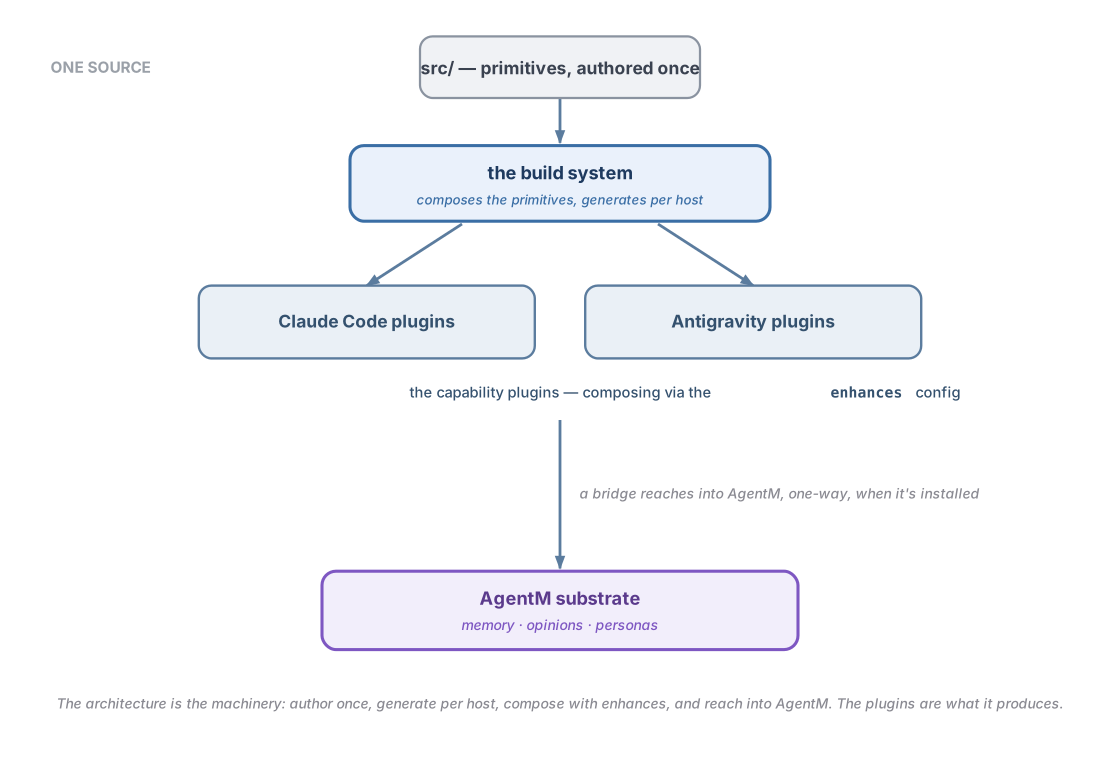
Underneath the plugins, crickets is four systems:
- The build system — every primitive is authored once; the build composes it and generates a native plugin, and a check fails if the generated copies ever drift from the source. → Build & distribution · design
- Per-host generation — the build targets each host's surface, so the same primitive lands correctly in Claude Code and in Antigravity. → Host adapters
-
The
enhancesconfig — a manifest model that lets one plugin add to another when both are installed, without either reaching into the other's code. → Customization model · design - Reaching into AgentM — a one-way bridge crickets uses to find and use AgentM's memory, opinions, and personas when AgentM is installed, and to skip gracefully when it isn't. → Harness interface · design
Crickets stands on the AgentM substrate; see AgentM's architecture to read more about what's underneath.
The capabilities crickets ships — built, generated, and composed by the systems above:
- Development-lifecycle — the dev loop: plan, work, review, release, and the rest of a feature's life.
- Code review — adversarial review of a change: assume there's a bug and prove otherwise.
- Design — writing design docs at the right size, from a quick sketch to a full architecture.
- Developer safety — the safety net for an autonomous session: stop/redirect controls, a recoverability check, auto-saved work.
- Wiki — keeping the docs true to the code, in your house voice.
- GitHub projects — mirroring your plans and progress onto a GitHub board, one way.
- Maintenance — keeping a shipped codebase healthy: dependency repair, security patches, tech-debt tracking.
- Conventions — the house standards for testing, releasing, docs, and more, kept in one place.
- Token audit — measuring what a session costs, with a live meter.
- Privacy — keeping secrets and personal data out of what gets committed or shared.
- Research — bringing in what the agent hasn't seen: codebase search, web lookups, scheduled learning (designed, not yet built).
- Diagnostics — analyzing failures and suggesting what went wrong; it diagnoses, it doesn't fix (designed, not yet built).
- Reporting — the operator-facing digest of what autonomous work did (designed, not yet built).
- Obsidian vault — keeps the vault in a synced folder.
- vault-git — git-backed vault storage: history and off-device backup (forthcoming).