crickets privacy - alexherrero/crickets GitHub Wiki
Note
LAUNCHED (lifted 2026-06-24, AG Phase 3; originally approved 2026-06-23) · locked 2026-06-28 (final AG design sweep). child-design — the privacy capability (keep secrets + personal information out of what gets committed and pushed, and keep good privacy practice in the code). status: launched (lifted into tracked wiki/designs/ 2026-06-24, AG Phase 3). Points up at the crickets HLD.
privacy is the capability that keeps secrets and personal information out of what gets committed and pushed — and, with a review skill, keeps good privacy practice in the code itself. It holds the conventions for safe stand-ins, scans a diff for leaks, blocks a push that would ship one, and reviews the code for privacy-engineering mistakes. The leak scan is deterministic (regex / pattern, never LLM judgment) — the property the rest of the portfolio leans on.
privacy works in three layers — proactive (don't compose a secret), detect (scan the diff), enforce (block the push) — plus a review layer for privacy practice. The detect and enforce layers run client-side at the pre-push hook, and again in CI, where check-no-pii.sh --all + gitleaks run as two independent scanners. That CI pass is a back-stop that reduces single-pattern blind spots: by the time CI fails the secret is already in pushed history, so the hook is the primary block and CI back-stops both it and the scrubber. The primitives:
| Primitive | Kind | Status | What it does |
|---|---|---|---|
pii-patterns |
rule | delivered | Proactive stand-in conventions (RFC-2606 domains · $HOME · env-var refs · 555-01xx) — never compose a real secret/PII. |
check-no-pii.sh |
script | delivered | The deterministic detector — regex/gitleaks patterns over the diff (email · path · openai/github/gitlab/aws keys · phone). |
pii-scrubber |
skill | delivered | Interactive remediation — run the detector, surface findings file:line, redact, loop until clean. |
pre-push hook |
hook | delivered | Mandatory enforcer — blocks a push carrying a finding. |
privacy-review |
skill | delivered | Review the codebase's privacy practices (data minimization · PII-in-logs · retention · consent) — not string scanning. |
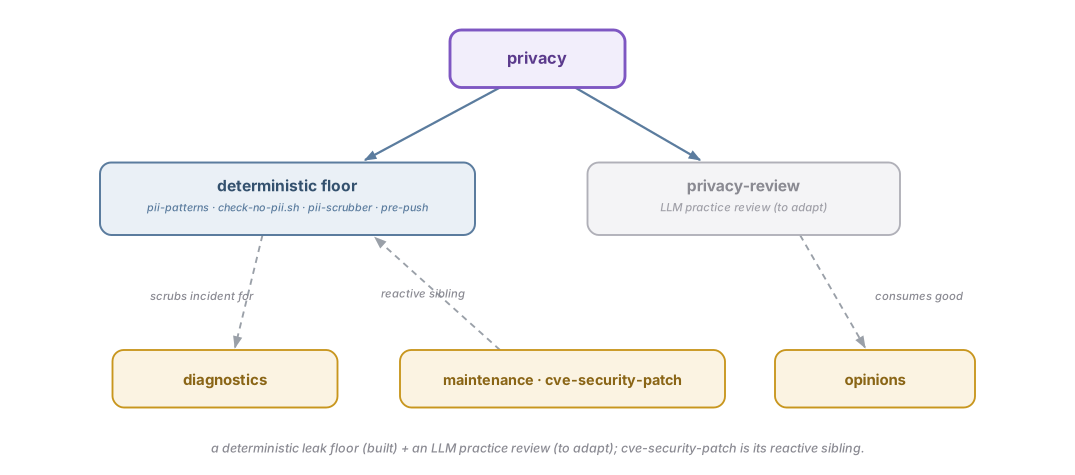
A deterministic leak floor (delivered — regex, never LLM) and an LLM privacy-practice review (to adapt); the floor scrubs incidents for diagnostics; maintenance's cve-security-patch is its reactive sibling.
The leak scan is rule-based and deterministic — the same input yields the same finding, reproducibly. That reproducibility is what lets other capabilities compose it as a guard: the same patterns gate every push, and diagnostics scrubs a failure-incident body before it lands in memory.
privacy declares the pre-push hook, but development-lifecycle's finalize step (pr_helpers.py, the "PII GUARD" ordering invariant) uses it — privacy owns the patterns + the detector; the hook is shared push-surface infrastructure.
A second angle. The string scanner stops a leaked secret; it can't catch a structural privacy mistake — a personal field flowing into a logger, a store with no deletion path, data collected beyond its consented purpose, PII sent to a third-party SDK — because the defect is in the shape of the code, not a literal value in the diff. privacy-review is an LLM-assisted adversarial review of a diff/PR for privacy-engineering practice, modeled on its sibling security-auditor in code-review: it reports falsifiable findings — PRIVACY-RISK <file>:<line> [ASVS-id / OWASP-P#] — never prose, and never fixes.
What it checks — the practices, each keyed to a standard: PII into a log / telemetry / third-party sink · no retention or deletion path · incomplete erasure (right-to-be-forgotten) · purpose-limitation + consent reuse · data minimization (over-collection + over-return) · PII in URLs / client storage · plaintext personal data at rest · production data in test fixtures · unscoped access to personal data.
Adapted from reputable prior art (not vendored — the adapt-don't-import discipline): OWASP ASVS V8 Data Protection (the primary anchor — each requirement is already a testable assertion, so every finding cites an ASVS id), OWASP Top 10 Privacy Risks (the ranked taxonomy), the NIST Privacy Framework (the category structure), and ICO data-protection-by-design guidance.
Deterministic-first. The mechanizable checks (PII-in-URL, PII-in-client-storage, plaintext columns, third-party sinks) shell out to grep / a small Semgrep taint pack; the LLM judges only the non-mechanical practices (purpose limitation, consent scoping, retention adequacy, erasure completeness) — so the deterministic floor holds and the model reasons only where it must.
Shipped 2026-07-07 (PLAN-wave-d-tokens-and-privacy, crickets #166) — src/privacy/skills/privacy-review/SKILL.md (nine practices, four Semgrep-mechanized + five LLM-judged) plus src/privacy/scripts/privacy-taint-pack.yml (the four mechanizable pattern categories); the deterministic pii-scrubber stays the floor.
privacy implements part of done — a change that leaks a secret or PII is not finished; the pre-push gate is one of the deterministic checks the done standard rests on. The privacy-review skill consumes good (what good privacy practice looks like) and how-we-engineer (the review discipline), reviewing the code against those standards. (Hardwired today; requesting an opinion by name is the Phase-3/4 registry work — the Opinions design.)
-
diagnostics's incident-body scrub surface — shipped 2026-07-07. privacy scrubs git ranges and arbitrary text bodies now:
src/privacy/scripts/scrub_text.pybridges to agentm'sprivacy_scrub.scrub_pii()(the same rules, reused not forked), and diagnostics'writer.pycalls it explicitly at the crickets call site before everykind: failure-incidentwrite. -
maintenance's
cve-security-patchis privacy's reactive sibling — privacy owns proactive static patterns; maintenance acts on advisories. Two halves of supply-chain / secret hygiene, opposite triggers.
-
standalone —
requires: []; privacy ships alone. -
leans on the opinions — implements part of
done(the leak-free-push gate); theprivacy-reviewskill consumesgood+how-we-engineer(agentm Opinions). -
the
pre-pushhook is shared with development-lifecycle — its finalize routine enforces it as an ordering invariant. - composed by diagnostics — the incident-body scrub (a designed surface, above).
- pairs with maintenance — proactive static to its reactive advisory.
- Points up at the crickets HLD; the requires/enhances mechanics are in crickets-composition.
The capability is renamed pii → privacy (the bare concern-noun; capabilities: [privacy] is already declared, from the Phase-2 hygiene pass). The plugin directory has already moved to src/privacy/ (Wave A renames, 2026-07-06); capabilities: [pii, privacy] still dual-declares both names so existing references resolve. The primitive doc-titles (pii-patterns, pii-scrubber) follow at the v6.0 rename (the composition rename mechanism).
-
privacy-reviewshipped 2026-07-07 — the practice checklist, adapted from OWASP ASVS V8 / Top-10 Privacy Risks / NIST Privacy Framework / ICO, is LLM-assisted practice review, distinct from the deterministic string scanner, which stays the trustworthy floor. -
The incident-body scrub surface shipped 2026-07-07 —
scrub_text()gives diagnostics' deterministic-scrub composition a scan-arbitrary-text entry point beyond privacy's git-range scan. -
The
donegate is still hardwired;privacy-review's opinions are now real.privacy-reviewdeclaresopinions: [good, how-we-engineer]and renders both via the markdown-render-step grammarPLAN-opinion-consumer-grammarlanded — requestingdoneby name is still Phase-3/4 registry work. -
Re-audit triggers: flip
pii→privacynaming at v6.0 (the plugin directory already moved;capabilities:dual-declares both — only the primitive doc-titles remain).
- crickets
src/privacy/(live) —rules/pii-patterns.md·skills/pii-scrubber/SKILL.md·skills/privacy-review/SKILL.md·scripts/check-no-pii.sh·scripts/scrub_text.py·scripts/privacy-taint-pack.yml·templates/hooks/pre-push -
privacy-reviewprior art (adapted from): OWASP ASVS V8 Data Protection (the testable-requirement anchor) · OWASP Top 10 Privacy Risks v2 · NIST Privacy Framework · ICO data-protection-by-design; output contract modeled oncode-review'ssecurity-auditor; mechanizable checks lean on a Semgrep taint pack. (ThePrivacy-Data-Protection-Skillsagent-skill repo was a format/coverage reference only — verified against the OWASP/NIST/ICO authorities.) -
Composed by / paired with: diagnostics (incident scrub) · maintenance (the reactive
cve-security-patchsibling) -
Up: crickets HLD · composition · agentm Opinions (
done/good/how-we-engineer)
2026-07-07 — privacy-review + Semgrep taint pack + scrub_text() surface shipped, opinion-wiring retrofitted (PLAN-wave-d-tokens-and-privacy, crickets #166). src/privacy/skills/privacy-review/SKILL.md ships nine practices (four Semgrep-mechanized, five LLM-judged) under the PRIVACY-RISK <file>:<line> [ASVS-id] contract; src/privacy/scripts/privacy-taint-pack.yml covers the four mechanizable categories (PII-in-URL, PII-in-client-storage, plaintext-columns, third-party-sinks); src/privacy/scripts/scrub_text.py bridges to agentm's privacy_scrub.scrub_pii() (same rules, not forked) and gives diagnostics' writer.py an explicit call site before every kind: failure-incident write, closing the incident-body scrub gap this doc had flagged. privacy-review also declares opinions: [good, how-we-engineer], retrofitted in the same session once PLAN-opinion-consumer-grammar (crickets #167) landed the markdown-render-step grammar this binding was deferring on — a real connection, not hardwired prose. Also corrected two facts this doc still carried from before the Wave A renames: governs: now points at src/privacy/ (src/pii/ no longer exists on disk) and the References section drops the stale "live; → src/privacy/" framing. Re-audit triggers cleared: adapt + build privacy-review; build the incident-body scrub surface; wire opinion_request for privacy-review. Still open: flip pii → privacy doc-titles at v6.0; wire done by name (Phase-3/4 registry work).
2026-06-28 — lock-down sweep (operator review). Converted the layers mermaid to a house-style hand-SVG (diagrams/crickets-privacy.svg). Confirmed the deterministic leak floor (built) + the LLM privacy-review (to adapt), and that cve-security-patch is its reactive sibling. No content change. Locked as a v5–v8 guidepost.
2026-06-23 — added the layers diagram (diagram backfill). Per the every-design-carries-a-diagram rule.
2026-06-23 — authored from the seeded stub (grounded against the live src/pii/ plugin); revised on operator review. All four leak-side primitives are delivered — pii-patterns (rule), check-no-pii.sh (the deterministic detector), pii-scrubber (skill), the pre-push hook (mandatory enforcer); listed as a table. Named the deterministic-by-contract invariant (regex / pattern, never LLM) and resolved the pre-push home (privacy declares it; development-lifecycle's finalize uses it). Added two operator-requested pieces: (1) an Opinions-it-consumes clause — privacy implements part of done, the privacy-review skill consumes good + how-we-engineer (a clause the other designs should carry too); (2) a second angle — a privacy-review skill for privacy practice (data minimization, PII-in-logs, retention, erasure, consent, third-party sinks): an LLM-assisted adversarial review with falsifiable PRIVACY-RISK file:line [ASVS-id] findings, adapted from OWASP ASVS V8 / Top-10-Privacy-Risks / NIST Privacy Framework / ICO (a prior-art investigation, 2026-06-23), deterministic-first (mechanizable checks shell out to grep / a Semgrep taint pack; the LLM judges only the non-mechanical practices), distinct from the deterministic pii-scrubber floor ([PENDING-IMPL]). Also surfaced the incident-body scrub surface diagnostics needs and the cve-security-patch pairing with maintenance. Re-audit: adapt + build privacy-review; build the incident-scrub surface; wire opinion_request; flip the name at v6.0.