crickets github projects - alexherrero/crickets GitHub Wiki
Note
LAUNCHED (lifted 2026-06-24, AG Phase 3; originally approved 2026-06-23) · locked 2026-06-28 (final AG design sweep). child-design — the github-projects capability (one-way deterministic board-sync — project a vault project's roadmap/plan/progress onto a GitHub Project board). status: launched (lifted into tracked wiki/designs/ 2026-06-24, AG Phase 3). Points up at the crickets HLD.
github-projects projects vault state onto a GitHub Project board — a one-way, deterministic, idempotent sync where the vault stays the source of truth and the board is the generated human mirror. It is platform-bound (github-) and keeps its name. It declares [board-sync].
The renderer, model, drift detector, schema, templates, DC-2 field-mirroring, and native sub-issue nesting are all delivered (see Design):
| Primitive | Kind | What it does |
|---|---|---|
project_sync.py |
script | The single idempotent write path — renders each vault item to a GitHub Issue and reconciles it (create / update / noop). |
project_model.py |
script | The board model — the taxonomy + the Version→Feature→Sub-feature→Plan→Task parent chain + the materialization partition. |
check_project_sync.py |
script | The drift detector — fails the gate when the board body diverges from the rendered source, or an issue has no backing vault item. |
check_status_invariant.py |
script | The status invariant — fails the gate when a row's status disagrees with its issue's open/closed state. A separate reader; the body detector above is never modified. |
project_schema.json |
rule | The board-shape contract — the parent chain + the DC-2 field set (Track · Type · Priority · Start · Target · Status). |
| per-type templates | template | The locked kickoff / progress / closeout triads (task · plan · feature · sub-feature) + single-line forms (version · idea · backlog-item · promotion). |
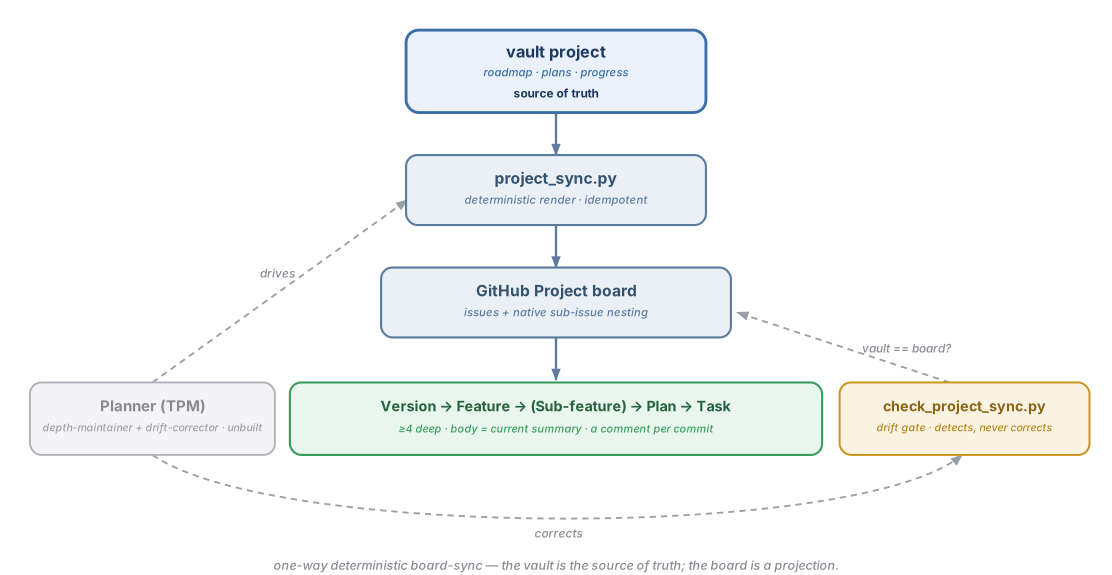
One direction only — the vault is authored; project_sync.py renders it to nested issues (≥4 levels deep; each work item carries a kept-current summary body + a comment per commit); check_project_sync.py detects drift but never corrects. The Planner (TPM) persona's depth-maintainer + drift-corrector (AG Wave D) drives the write path to hold the depth floor + correct drift.
The sync runs vault → board and never back. project_sync.py is a single write path that converges — running it twice changes nothing the second time — so it is safe to re-run on every plan-state change. The render is fully deterministic: the script owns all structure (field order, YYYY-MM-DD dates, the commit/entity links built from a SHA or id, the gh posting); the only model-supplied part is the human sentences in the template {{placeholders}}. A human reads the board for a glance; the vault is where the state actually lives.
Every taxonomy type — version · feature · sub-feature · plan · task (plus top-level backlog-item · idea · bug) — renders to one real GitHub Issue (not a draft card, so the nesting + Gantt roll-up work), and the parent chain becomes native GitHub sub-issue nesting: Version → Feature → Sub-feature → Plan → Task.
What materializes when is the central partition (DC-1): everything feature-and-up — Versions, Features, Sub-features (+ top-level Backlog-items / Ideas) — is mirrored the moment it exists, started or not (it is the human-facing roadmap and must always be visible). Plan + Task issues materialize only for the active plan, at work-start — future plans/tasks live implicitly under their already-materialized feature until picked up, to bound issue volume. Never pre-persist task breakdowns; always persist features-and-up.
A live plan's board reaches at least four levels — Version → Feature → Plan → Task — always, with Sub-feature an optional fifth. Flattening to epic- or feature-level is drift (an under-populated source), not a simplification. The always-on roadmap tier (feature-and-up) is the floor for unstarted work; the moment a plan goes active, Plan + Task complete the ≥4 chain beneath it.
A version is a one-line About. A work item (task / plan / feature / sub-feature) carries two surfaces:
-
The issue body — a kept-current summary. ① Kickoff (
Goal · Done-whenfor a task,Goal · Why-it-mattersfor a feature) at start, ② current progress summary that reflects where the work stands right now, and ③ Closeout (Outcome · Landed/Shipped-link · date) at ship. The body answers what is this, and where does it stand — at a glance. -
A comment per commit — the granular trail. Each commit posts a GitHub issue comment — a timeline entry (
{date} ([sha](commit-url)): {summary}, the commit link built deterministically from the SHA). The comments answer what happened, commit by commit. (Altitude follows the unit: a task comments per commit, a plan per task, a feature per plan shipped.)
The two surfaces reconcile differently, both idempotently:
-
The body summary is re-rendered from the source and byte-compared to the live body each sync → create / update (
gh issue edit --body) / noop. Whole-body replacement means any out-of-band edit on GitHub is overwritten on the next sync, and an unchanged state is a clean noop. - The per-commit comments are append-only, posted once per commit SHA. Idempotency is by SHA-keyed dedupe: before posting, the sync checks whether a comment for that commit already exists (the comment carries its SHA; the vault source records which SHAs are posted) → post only if absent. So re-running never double-posts a commit's comment.
Shipped (0.2.0). The per-commit update lands as a
gh issue commentpost (post_comment(), SHA-keyed dedupe via a hidden<!-- board:sha:… -->marker) alongside the whole-body reconcile — the body stays the kept-current summary; the comment trail is the granular per-commit timeline, exactly as designed here.
Three things the board-write path must honor — a message voice, a roll-up altitude, and a set of operational rules:
The message voice — plain English for a non-technical human. Every per-commit line and every roll-up summary is written for the owner glancing at the board, not in commit-ese. The rules: no file / function / script names, no code identifiers, no config keys; describe the user-visible value or the concrete change; never name an external project / author / tool as a source (the silent-source rule — strip it from the public board); don't echo the conventional-commit type ("docs:" / "refactor:" still did something — say what). Approved substitutions: vault → "notes folder", plugin / bundle → "add-on", harness / engine → "the tool", wiki → "documentation site", ADR / decision-record → "decision notes", persona → "role", crickets → "the suite / project", a release bump → "Cut release X bundling the above." A drafting agent reads each commit's diff; a critic pass enforces this voice and catches leaked jargon.
The roll-up altitude (which comment lands where). A comment-per-commit lands on the lowest materialized work item — the Plan in the common case (Tasks materialize only when a plan is actively broken down). Summaries cascade up as each unit completes: a plan-completion summary (≤2 plain paragraphs) on its Feature, and a feature-landing summary (≤2 plain paragraphs) on its Version. The reader gets per-commit detail at the bottom and a human digest at every level above.
Operational rules the build must get right:
-
Resolve + dedupe via the issues-LIST API, never search.
gh issue list --searchhits the search index, which lags minutes for just-created issues — so a re-run after a partial failure would create duplicates. List-and-match-by-exact-title (and list-comments-and-match-by-marker) are immediately consistent. Items are reused by exact title (or a stable id), created only if absent. -
SHA-keyed comment dedupe via a hidden marker. Each comment ends with
<!-- board:<key> -->(key =sha:<short>for a commit,plansum:<id>/verland:<id>for a roll-up); the sync skips a comment whose marker is already present, so re-running never double-posts. -
Idempotent recovery. A transient
401 Bad credentialson a Project mutation is expected at scale; because every step is find-or-create / skip-if-present, re-running simply converges with zero duplicates. - Cross-check commit coverage. A drafting agent can silently drop a commit — diff the expected SHA set against what was drafted before posting.
-
Adding a board Track is non-destructive only if done right. Add a single-select option by re-submitting every existing option with its
idplus the new one without an id (the option input acceptsid); replacing options without ids orphans every item's value. Verify zero items changed before / after. -
At scale, pace under GitHub's content-creation secondary limit. A bulk backfill (hundreds–thousands of comments) trips GitHub's anti-abuse limit (~80 content-writes/min and
500/hour) — the error is8s apart** (~450/hour), and on a "too quickly" error wait a long fixed cooldown (~120s) and retry patiently — rapid exponential retries re-poke the cooldown and extend the penalty. A full-history backfill (~1,100 comments) takes ~1.5–2 hours of paced posting; the normal active-work path (a few commits per plan) never approaches the limit, so this pacing only matters for one-shot backfills.GraphQL: was submitted too quickly (addComment). Pace comment posts **≥
Status is a custom Project field — Todo → In Progress → Done, plus Parked — moved at the phase transitions, not free-floating:
-
work-start (
/plan) → In Progress + the ① kickoff; -
while working → stays In Progress; a comment posts per commit, the body summary stays current;
-
ship → the ③ closeout → Done → the issue is closed.
-
deliberately deferred → Parked → the issue is closed as
NOT_PLANNED(post --park). Not a phase transition but a decision about the work, which is why it rides a flag rather than a lifecycle stage. Applies to any type, including a Version or Backlog-item adjudicated out of an arc.
Container items (Version) carry no status thread — they roll up child status natively; pre-work cards (Backlog-item / Idea) are static, ordered by Priority, with no thread until promoted. This is why nothing used to close them (2026-08-02): the close-out step covered the shipping Plan and its parent Feature, so a Version whose era had fully landed, and a Backlog-item some later plan quietly fulfilled, both stayed open indefinitely. /release's close-out now reaches both — a fulfilled backlog row records a promotion to whatever actually shipped it and closes; a container whose scope has landed closes only after naming where any still-live child scope moved.
Track's semantic (2026-07-08 — PLAN-board-tracking-model): Track now carries dispatch tier (T0-Mechanical … T4-Deep, straight from crickets' routing_table.py vocabulary) for fleet-dispatched work, not version. Version membership was already redundant on this field — it's the parent-chain hierarchy (project_model.py's type/parent fields) that actually determines version grouping, confirmed before this change so nothing was lost by repurposing it. Existing items keep their historical version-name Track values untouched (no retroactive relabel — those values were always historical labels, never the real membership mechanism); only new fleet-dispatched items populate Track with a tier going forward, via board_sync.py's set_item_tier() (agentm-side control-plane) writing item.track ahead of a post. sync_fields() itself is unchanged — it already pushes whatever item.track holds to the real board, once the option exists.
Built and wired (as of 0.2.0–0.2.5). The shipping path writes the issue body + open/closed state, the DC-2 Project fields (Track · Type · Priority · Start · Target · Status, via sync_fields()), and native sub-issue nesting (via sync_nesting() / sync_all_nesting(), the GraphQL addSubIssue mutation — gh issue itself has no sub-issue subcommand) — all idempotent, all exercised against real boards (agentm #223/#224, crickets #142/#150–152), including a case-mismatch idempotent-skip bugfix (display-case field labels vs. gh's lowercased value keys, project_sync.py:519–521) found and closed live. The Status field now moves at the same progress/closeout transitions described below; the hierarchy project_model.py models is the same tree sync_nesting() actually links.
check_project_sync.py is the detector: a board body that differs from the rendered source is update drift, an issue with no backing vault item is orphan drift — it fails the gate but does not auto-correct, and this module itself is never modified by anything below.
Body ownership. The model above assumes the vault owns every body it tracks, which is what makes update drift safe to correct. Some issues break that assumption: a human writes a full issue — scope, out-of-scope, rationale, cross-impacts — and every template here renders a one-line digest, so re-rendering it is a deletion. An item may declare body_owner: "github" to say the live body is authoritative. Such an item is tracked in the vault (so it is not an orphan), syncs status and board membership normally, and never produces a body write: plan_item_action resolves it to noop once materialized, before the body comparison, and an unreadable live body does not defeat that — not knowing what a human wrote is the strongest reason to leave it alone, the inverse of the vault-owned case. CREATE is unaffected; an item with no issue has no human body to protect yet. Because the guard produces no drift line at all, compute_body_owned() reports these separately from compute_drift() — they are correctly configured rather than drifting, so folding them into the drift list would fail this gate forever, while dropping them entirely would make a tracked item indistinguishable from an untracked one. Auto-correction + holding the depth floor as plans churn is the job of the Planner (TPM) persona — the renamed (was the "V5-11 PM chief-of-staff") depth-maintainer + drift-corrector that drives this deterministic write path. It does not own the write path — github-projects owns project_sync.py; the Planner is the intelligence above it.
Shipped (AG Wave D): the corrector logic itself — depth_maintain.py (materializes a collapsed Feature→Plan or Plan→Task gap when the match is unambiguous — slug-equals-feature-id, an explicit fields.plan_slug, or the Plan's own task checklist; flags anything it can't safely infer) and drift_correct.py (independently re-derives update/orphan drift and acts: update gets the same idempotent project_sync.py post a manual re-sync already does, orphan is never auto-closed or edited — surfaced for operator judgment). planner_maintain.py composes both into one entrypoint, and /work//release now call it at the same graceful-skip board-sync gate they already call project_sync.py post from.
Still open: the actual persona-activation dispatch — a runtime that reads the Planner's own modes: [loop, sub-agent]/triggers: frontmatter and routes into this script automatically — doesn't exist yet. A grounding check against agentm (where that plumbing and the Planner's manifest both live) found the shape-validation-only persona_resolve.py/persona_compile.py pipeline never branches on modes:, and no call site wires triggers: to an invocation. Until that dispatcher ships, depth + drift correction run at the one workflow-step gate this repo already has wired to board-sync (/work, /release) plus explicit invocation (/planner-maintain) — not yet "the Planner activates and this runs" end-to-end. When the dispatcher ships, it calls this same script.
None — github-projects mirrors, it does not judge. It projects whatever state the vault holds; whether that state is good, done, or correctly prioritized is the planning personas' call (the Planner above it), not the projection's.
-
requires development-lifecycle — it mirrors that loop's roadmap / plan / progress artifacts; the board is meaningless without the phase state that feeds it, and the
/workcommit hook is what drives the per-commit ② line. -
driven by the Planner (TPM) persona — the depth-maintainer + drift-corrector logic (
depth_maintain.py/drift_correct.py/planner_maintain.py, AG Wave D) composesgithub-projects(softenhances) to hold the ≥4 depth floor + correct drift; it drives the write path, never owns it. The logic ships; true persona-activation dispatch (agentm'smodes:/triggers:runtime) does not yet — see Risks. -
consumed by the Operator dashboard (designed) — a unified read-only
/status(plans + board + phase transitions + health) extendsqueue-statusand reads board-sync; see Personas. -
routes per repo — agentm items → Project #2, crickets items → Project #5 (split 2026-06-02); each item lands on its own repo's board.
dev-setupis intentionally vault-only (no mirror; its absence is not drift). - Points up at the crickets HLD; the requires/enhances mechanics are in crickets-composition.
-
The
requirestarget is renamed — it requireddeveloper-workflows; that capability is nowdevelopment-lifecycle(the spine rename), so therequires:edge re-points. Mechanical — the spine group declares bothdeveloper-workflowsanddevelopment-lifecycleso the edge keeps resolving (the composition rename mechanism). - The capability name itself is stable (platform-bound, keeps
github-projects).
-
Persona-activation dispatch doesn't exist yet. The depth-maintainer + drift-corrector logic shipped (AG Wave D —
depth_maintain.py/drift_correct.py/planner_maintain.py), wired into/work//release's existing board-sync gate plus explicit invocation. What's still missing is a runtime that reads the Planner'smodes:/triggers:frontmatter and activates it automatically as the persona itself — that dispatcher lives in agentm and is shape-validation-only today (confirmed by a live grounding check this same plan ran). Until it ships, "the Planner runs" means the workflow-step gate + explicit/planner-maintain, not true persona activation. -
Manual net-new-Feature creation is an undocumented gap. No automated entrypoint creates a brand-new Feature from scratch —
sync_fields/sync_nestingoperate on an item already inboard-items.jsonwith an existing issue. Today materializing a net-new Feature is a manual four-stepghsequence:gh issue create→gh project item-add→gh project item-edit(Type/Track/Status) →gh api graphql(addSubIssuenesting) — confirmed live staging this same plan (both boards' Wave-D features were materialized this way). A future Planner enhancement could absorb this into the depth-maintainer, but it is out of scope for the Planner's first cut (depth-maintenance today only fills in a missing intermediate level — Plan under an existing Feature, Task under an existing Plan — not a missing top-level Feature itself). -
The Operator
/statusdashboard is designed, not built — it consumes board-sync but lives closer to the persona / queue-status surface. -
Re-audit triggers: wire real persona-activation dispatch once agentm's
modes:/triggers:runtime ships (callplanner_maintain.pyfrom it); decide + build the automated net-new-Feature-creation entrypoint if the operator wants one; reconcile against the github-projects rethink; build the unified/statuswhen the Operator surface lands.
- crickets
src/github-projects/—project_sync.py·project_model.py·check_project_sync.py·project_schema.json· the per-type template set; declares[board-sync] -
The conventions: DC-1 (
v4-41-project-human-source.md) — the materialization partition + the progress altitudes (task = per commit, plan = per task, feature = per plan shipped) + the title-in-plain-language / link-everything rules -
The boards: agentm → Project #2 · crickets → Project #5 (split 2026-06-02);
dev-setupvault-only -
Rethink in flight (2026-06-19):
RESEARCH-FINDINGS-github-projects-rethink-20260619.md·HANDOFF-github-projects-rethink-20260619.md, in the agentm vault project'scompleted/since the projects migration - Up / consumed by: crickets HLD · composition · Personas (Planner — drives this; Operator — reads it) · development-lifecycle
2026-09-22 — depth maintenance reads agentm's plan list (github-projects 0.6.0; agentm-vault part 15, crickets task 100). depth_maintain.py and planner_maintain.py scanned a --harness-dir for PLAN-<slug>.md. Since the projects migration that directory holds no plans, so neither found one. Both now take --project-root (default: cwd) and match the plans agentm lists for it (scripts/project_homes.py plans). A task tasks/NNN-<verb-slug>/plan.md matches a Feature by its full name or its verb-slug, because board items predate numbered names. A verb-slug two tasks share is left out and named on stderr, never guessed. --harness-dir is gone. The board ledger's default stays beside project.json, the repo's own gitignored .harness/: both repos already point items_source at the project's desk/board-items.json, and a default in agentm's desk/ would have sent any test fixture that forgot items_source into the real vault (operator's ruling, 2026-09-22). The schema's examples name desk/. Re-audit if a repo without items_source wants its ledger in the vault.
2026-08-02 — issue state becomes the checked invariant; Parked joins the status model (PLAN-board-roadmap-reconciliation). Two boards showed roughly 35 open issues while the roadmap declared every arc complete, under fully green checks. The cause was structural, not neglect: check_project_sync diffs rendered issue bodies, and status appears in no template — so a row left Todo whose issue closed months ago is zero drift by construction. The gate did exactly what it promises; nothing checked the other axis at all. Ruling: board-items.json stays the write surface and the source of truth, and GitHub issue state becomes a checked invariant over it — the one fact both records observe independently, so a disagreement is information rather than a rendering artifact. Shipped as check_status_invariant.py: a non-Done row with a closed issue is drift; a Done or Parked row with an open issue is drift. Verified against the pre-sweep vault — the exact state where the body gate reported PASS — it flags precisely the 19 known-stale rows and nothing else. Why not make the board authoritative, or derive status from GitHub: both invert the vault-is-truth doctrine this design rests on, and GitHub has only two states, so Todo, In Progress and Parked would collapse into "open" and the offline distinctions would be lost. Why not a prose-parity gate against the roadmap: ROADMAP-MASTER.md is gitignored, so CI could never read it, and parsing free-prose ✅ marks rots. Why a separate module rather than widening compute_drift: this design already states the drift oracle is never modified from below, and drift_correct.py, report_drift.py and project_sync.py all route through its behavior — the same reasoning that put drift_correct.py beside it rather than inside it. Parked was added to the Status field on both projects via the additive procedure this document's own operational rules already name (line 81): every existing option resubmitted with its id, the new one appended without one. Zero item churn across all 371 items; every pre-existing option id unchanged. It carries a park stage — Status → Parked, issue closed as NOT_PLANNED — so deliberately deferred work leaves the open-issue count honest while staying queryable and visibly distinct from what shipped. Why a --park flag rather than a --type <itype>-park update: parking records a decision about the work, not progress on it — it folds no template content and posts no comment, so apply_update's seam is the wrong one. Why NOT_PLANNED rather than leaving parked issues open: an open issue nobody intends to work is precisely what produced the original complaint. Three live behaviors are recorded here because they surprised this work. The boards run a built-in auto-close workflow, and it runs in both directions: setting Status → Done closes the linked issue (which is why board status and issue state agreed perfectly before any of this began), and closing an issue forces its Status to Done. The second direction is why park closes before it writes Status, inverting the order every other stage uses — a Parked written first is overwritten moments later by the close, so the park reports success while the board reads Done. Found live, on all six items parked in this very sweep: correct in the vault, correctly closed as NOT_PLANNED, and every one showing Done on the board. Parked sticks perfectly well on an already-closed issue, so closing first simply leaves the workflow nothing to react to. Third, gh issue close discards --comment when the issue is already closed, so no close-with-comment path may assume the comment landed. Re-audit triggers: if a third record ever observes the same rows, revisit whether pairwise invariants still suffice; if GitHub gains a richer issue state, revisit the Parked → NOT_PLANNED mapping; and if the auto-close workflow is ever turned off, the explicit-close requirement in /release's widened close-out stops being belt-and-braces and becomes load-bearing.
2026-08-01 — body_owner: "github" lets an item be tracked without being rewritten (PLAN-board-body-ownership). Found reconciling agentm board #2: five real, open, hand-written issues (#324, #278, #277, #276, #275) sat in the board but not the vault source, so every drift run called them orphans. Adding them is the obvious fix and was a trap — orphan is inert (never auto-corrected), but a vault-backed item reclassifies to update, which drift_correct.py does execute, and the render is one line against bodies carrying 12–25 lines of scope and rationale. Quieting the drift report is what armed the destruction. The edit was made, caught in a dry-run, and reverted before anything was overwritten. Why an ownership flag rather than a richer template: copying that prose into board-items.json would duplicate the source of truth and recreate the drift one level up, with nothing enforcing the copy stays current. All sixteen templates are one line deliberately — the board body is a rendered digest, and the gap was never expressive power, it was that the model had no way to say who owns a body. Why the guard lives in plan_item_action: it is the one pure function project_sync, drift_correct and report_drift all route through; three per-driver checks would be three copies that drift apart, the exact failure this repo's parity gates exist to catch. Why current_body=None does not defeat it: for a vault-owned item, an unreadable live body means "don't assume no-op"; for a github-owned one the same premise inverts. Both cases are pinned by adjacent tests so the asymmetry reads as intentional. Why compute_body_owned() is a separate list: a body-owned item is correctly configured, not drifting — in the drift list it would fail the board-sync gate forever, and absent from every report it would look untracked. Sequencing lesson, recorded because it nearly bit: the flag is meaningless to a plugin copy that predates it. Proved against a scratch vault copy that installed 0.3.6 still emits gh issue edit 324 with the one-line render once the vault carries the items, so the vault backfill must follow the guard being installed, never merely merged. Re-audit trigger: if a template ever grows a real multi-section body, revisit whether ownership should become per-field rather than per-item; and if a second body_owner value is ever needed, the validation that currently raises on anything but "github" is the place to widen.
2026-07-08 — Track repurposed for dispatch tier (PLAN-board-tracking-model task 2, agentm Autonomy arc). Closes the 2026-06-19 A1 verdict + the 2026-07-03 field-taxonomy rethink (ROADMAP-MASTER § ⑫): both left the by-agent/by-capability tracking-model question open "until teams exist to track." The Autonomy arc's control-plane provided that evidence — its real N1 dispatch showed there is no agent-identity concept anywhere in the substrate (Agent View names a session <plan>-<task>, never an agent), so the decision was no net-new by-agent tracking; repurpose Track for dispatch tier instead of version. Verified before touching anything live: version membership already comes from the parent-chain hierarchy (project_model.py's type/parent), so Track's version-tracking role was pure denormalized redundancy — repurposing it loses no real information. Built add_select_options.py (a new, deliberately separate one-off migration tool — never wired into sync_fields()'s routine per-post sync, which by design still never creates options) implementing the safe additive procedure this doc's own operational rules already named (line 81): every existing option resubmitted with its id + color + description untouched, the five tier options (T0-Mechanical … T4-Deep) appended without ids. Dry-run-verified against both real fields before executing, then live-executed (2026-07-08): agentm Project #2 — 18 existing options → 23 (the 5 tier options added); crickets Project #5 — 7 existing options → 12. Both verified by re-fetching after the mutation: zero existing option ids changed, and a live gh project item-list spot-check confirmed real items (V4, Hardening I, V6, V7, FRIDAY) still show their original Track values, byte-identical to before. board_sync.py (agentm-side control-plane) gained set_item_tier(), writing item.track into board-items.json ahead of a post call so the already-existing sync_fields() push picks it up — no change to sync_fields() itself. Still open: a full end-to-end proof (a real fleet-dispatched item's Track actually landing as a tier value on the live board via sync_fields()) needs a real dispatched Task item to exist under a materialized plan — the natural next real-world verification, not manufactured here against an already-real, unrelated work item. Why not migrate existing items' Track values to tier retroactively: they're historical version labels on hand-authored work that was never fleet-dispatched — a tier value would be meaningless there, not more correct. Re-audit trigger: if a real agent/persona-identity concept is ever added to the dispatch substrate, the by-agent question reopens — this decision was made against "no such concept exists," not against "it exists but isn't worth tracking."
2026-07-06 — the Planner (TPM) depth-maintainer + drift-corrector ships (AG Wave D, tasks 2–4). depth_maintain.py materializes a collapsed Feature→Plan or Plan→Task gap when the match is unambiguous (slug-equals-feature-id, an explicit fields.plan_slug, or a materialized Plan's own task checklist) and flags anything it can't safely infer — never fuzzy-title-guesses a Feature-to-plan-file match. drift_correct.py independently re-derives update/orphan drift (never parses check_project_sync.compute_drift's string lines, never modifies that module) and acts: update reuses project_sync.py's existing post body-sync; orphan is surfaced for operator judgment and never auto-closed, per this design's own carried-forward constraint. planner_maintain.py composes both (persisting the depth pass's write before the drift pass's own disk re-read — a real ordering bug the task's own end-to-end test caught before the fix) and is wired into /work//release's existing board-sync gate plus a new /planner-maintain explicit-invocation command. What did not ship: true persona-activation dispatch — a live grounding check against agentm (where the Planner's team-coordinator.md manifest and the persona_resolve.py/persona_compile.py activation plumbing both live, out of this crickets-side plan's authority) found that plumbing validates a persona's modes:/triggers: frontmatter for shape only; no dispatcher branches behavior on modes: [loop, sub-agent], and no call site wires triggers: to an invocation. So the sections above describing "the Planner drives this" describe the logic that now exists, not yet a persona that autonomously activates it — re-audit when agentm ships that dispatcher (it should call planner_maintain.py directly).
2026-07-06 — reconciled to as-built (AG Wave D, task 1). The DC-2 field-mirroring (sync_fields()) and native sub-issue nesting (sync_nesting()/sync_all_nesting()) sections above previously read as [PENDING-IMPL]/"no live callers yet" — stale since group.yaml 0.2.0 (both shipped, unit-tested and dry-run-tested) and 0.2.1/0.2.2/0.2.5 (three live bugfixes found exercising the write path against real boards: the Status-default-sync fix, the item-list pagination + case-fold fixes, and the CREATE-path item-add threading fix). The per-commit comment path (post_comment(), SHA-keyed dedupe) was likewise already shipped in 0.2.0, not still a "designed delta." All three sections rewritten to as-built framing; the "Built vs designed" honest-split language retired since there is no longer an undelivered split for these three mechanics. Also documented, as a newly-named (not newly-created) gap: no automated entrypoint materializes a net-new Feature from scratch (gh issue create → item-add → field-edit → addSubIssue nest remains a manual four-step sequence) — confirmed live during this same plan's staging research; named for a future Planner enhancement, not built here. The Planner (TPM) depth-maintainer + drift-corrector itself remains unbuilt as of this amendment (tasks 2–4 of the same plan build it) — re-audit this log again once those ship.
2026-06-28 — lock-down sweep (operator review). Converted the board-sync mermaid to a house-style hand-SVG (diagrams/crickets-github-projects.svg); and, per operator review, stripped the how-we-got-here narrative from the message-voice / operational-rules section — it now documents the board-write spec directly (the dogfood that produced it stays recorded in this log, not the body). The folded ADR 0016/0025 records and the newest-first log are unchanged. Locked as a v5–v8 guidepost.
2026-06-28 — flagged native sub-issue nesting as designed-not-wired (critique W7). The honest split now records that the parent-chain links producing the ≥4-deep tree, the Gantt roll-up, and child-status roll-up are [PENDING-IMPL] — modeled + validated in project_model.py but not emitted; the mechanism is a GraphQL addSubIssue / gh api call (gh issue has no sub-issue subcommand). Re-audit: wire the sub-issue links when the depth tree is built.
2026-06-26 — board-reflection dogfood: the message voice + operational spec. Hand-ran the full Version→Feature→Plan→per-commit + cascading-summaries discipline on both boards (agentm #2 issues #95–#106, crickets #5 issues #37–#51) ahead of the wiring, and folded the learnings into the body (see "The message voice + the 2026-06-26 dogfood"): the plain-English message voice (operator-approved substitution vocabulary; silent-source-stripped), the roll-up altitude (per-commit on the lowest materialized item; summaries cascade plan→feature→version), and the operational rules (resolve / dedupe via the issues-LIST API not search; hidden-marker SHA-dedupe; idempotent recovery from a transient 401; commit-coverage cross-check; non-destructive Track-option add; content-creation rate-limit pacing for bulk backfills — ~8s/post + a patient 120s cooldown on "submitted too quickly", since rapid retries extend GitHub's anti-abuse penalty). Why not just wire what was drafted: the dogfood caught a search-index duplication hazard, a silently-dropped commit, the safe Track-add method, and GitHub's ~500/hr content-creation limit (a full-history backfill is a ~1.5–2 hr paced grind) — all build-breaking if unlearned. Re-audit trigger: GitHub changes the sub-issue or single-select-option API, or the voice spec is revised.
2026-06-24 — folded ADRs 0016 / 0025 into this design (AG Phase 4, move-and-retire).
0016 — Project surface split: separate agentm + crickets GitHub Projects (2026-06-03). crickets gets its own GitHub Project (#5); 17 issues transferred from agentm's Project (#2). Operator-personal items stay in agentm. Cross-repo dependencies ride the issue graph, not the Project layer. Why not stay as a guest on agentm's Project: post-decoupling the repos have independent release cadences. Why not cross-list operator-personal: fuzzy comment-timeline ownership; pick one canonical home. Why not wait for GitHub native cross-Project dependencies: issue graph already covers the substance. Cross-repo: the agentm side of this decision lives in the agentm-foundations-hld Amendment log (0008). Re-audit triggers: GitHub ships native cross-Project dependencies; crickets re-couples to agentm; >5 cross-repo deps in one Version Issue feels noisy.
0025 — One-way vault → GitHub-Project board synthesis (2026-06-14). Vault is the single source of truth; GitHub Project board is a generated mirror (never editable peer). requires: developer-workflows. Flat Type taxonomy. Materialization boundary: features-and-up always; Plan + Task only for the active plan. Six frozen board columns; only Type and project_surface are code-enforced enums. Single deterministic idempotent render+write path in project_sync.py. Why not requires: agentm: couples a board plugin to the whole harness. Why not two writable stores: requires conflict resolution; one-way write + idempotent re-sync needs none. Why not enumerate Track/Priority/Status in code: those vocabularies shift across the V4–V7 arc; free-form lets conventions evolve without code churn. Why not materialize all Plans/Tasks always: floods the board with speculative structure. Re-audit triggers: any nondeterminism enters the render path; a second writer to GitHub is added; a downstream consumer depends on a specific Status/Track/Priority vocabulary.
2026-06-23 — authored, reviewed, and finalized. github-projects is the one-way, deterministic, idempotent board-sync — the vault stays the source of truth, the GitHub Project is the generated human mirror; it declares [board-sync] and mirrors, it does not judge (no opinion). Every taxonomy type renders to one GitHub Issue with native sub-issue nesting (Version→Feature→Sub-feature→Plan→Task); the DC-1 materialization partition keeps features-and-up always on the board (the roadmap, started or not) and adds Plan+Task only for the active plan at work-start. The depth floor is ≥4 (Version→Feature→Plan→Task, Sub-feature an optional fifth) — epic-level is drift. Each work item carries two surfaces: a kept-current summary body (① kickoff + current progress + ③ closeout, whole-body byte-compare reconcile) and a per-commit GitHub comment as the granular trail. Status is mirrored at lifecycle transitions (Todo→In Progress→Done, Done closes the issue). The Planner (TPM) persona (renamed from the V5-11 PM chief-of-staff; now a persona, unbuilt) drives this write path to hold depth + correct drift — it does not own it.
Built vs designed: the renderer (project_sync.py), model (project_model.py), drift detector (check_project_sync.py), schema, and templates ship, writing the issue body + open/closed state. Designed-not-wired ([PENDING-IMPL]): the per-commit gh issue comment + SHA-keyed dedupe (operator decision — a comment, not the as-built body line; the body becomes the current summary), the DC-2 field writes incl. the Status-field transition (operator-gated backfill — argv builders with no live callers), and the Planner depth-maintainer / drift-corrector. Routes per repo (agentm→#2, crickets→#5; dev-setup vault-only). Re-audit: build the per-commit comment + dedupe; wire the DC-2 field writes; build the Planner; reconcile against the 2026-06-19 board-sync rethink (these are the pre-rethink mechanics); re-point requires→development-lifecycle; build the Operator /status.