crickets diagnostics - alexherrero/crickets GitHub Wiki
Note
LAUNCHED (lifted 2026-06-24, AG Phase 3; originally approved 2026-06-23) · locked 2026-06-28 (final AG design sweep). child-design — the diagnostics capability (failure analysis + hypothesis generation + cross-session failure-pattern memory), parent crickets HLD. status: launched (lifted into tracked wiki/designs/ 2026-06-24, AG Phase 3). Points up at the crickets HLD.
diagnostics is the capability that makes sense of failures. When something breaks — a CI run, a test, a stack trace at runtime — it reads the output, classifies the failure, proposes ranked hypotheses for the cause, and remembers the pattern so the next occurrence is faster to resolve. It is the Troubleshooter/SRE persona's composition. It is a diagnosis engine — it analyzes and remembers, it never fixes; repair is a caller's job (development-lifecycle's /bugfix, maintenance's dependency fixer). It pairs the observability command /observe with a failure-analysis engine.
Diagnosis runs as a loop:
-
observe — instrument the system so a failure leaves usable signal (
/observe, delivered). -
diagnose — when it breaks, read the logs, classify the failure, and propose ranked hypotheses (
/diagnose, delivered 2026-07-06). - remember — write the failure as an incident to memory, so the pattern is recallable.
- recall — on the next failure, surface prior similar incidents before re-deriving.
The failure-diagnosis engine depends on agentm's memory system — cross-session failure-pattern memory is the recall engine put to work.
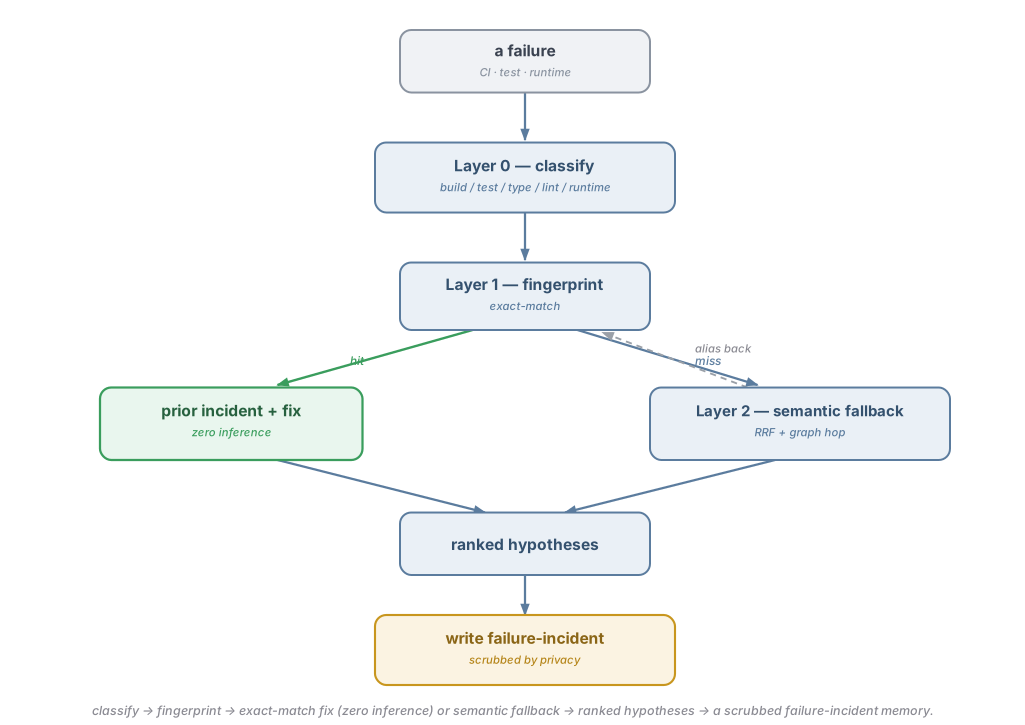
Deterministic-first: classify, then a fingerprint exact-match (a hit returns the prior fix with zero inference); only a miss falls to semantic recall; the incident is scrubbed + written, and a drifted match aliases back so the next recurrence is an exact hit. As-built (2026-07-06): the diagram's Layer 2 "RRF + graph hop" is the diagram's original aspiration, not what shipped — see the /diagnose section and the amendment log below.
The discipline for adding observability to code, so a failure leaves usable signal for /diagnose to read.
-
Entry: invoked when instrumenting a production path — typically while building a feature, and again from
/launchbefore go-live. - Exit: structured logging, RED metrics (rate · errors · duration), OpenTelemetry spans, and symptom-based alerts wired; a test request confirms metrics emit.
- Automated: log events (not strings); RED metrics on new paths; trace spans; symptom-based alerting (an infra-only alert with no symptom check is rejected).
-
Artifacts: none in memory —
/observeinstruments the codebase itself.
(/observe lives here; /launch in development-lifecycle calls it before go-live — a soft cross-capability reference.)
Takes a failure and returns ranked causes, remembering each one. It never mutates code — it emits hypotheses and logs an incident; the fix is a caller's.
-
Entry:
/diagnose <log-or-failure-input>— invoked when something breaks (a red CI run, a failing test, a runtime stack trace), directly or by a repair caller. - Exit: the failure classified, 2–3 ranked hypotheses (each with a confidence signal + a suggested next probe), and one failure-incident written to memory.
- Automated: the recall ladder below — classify → recall (fingerprint-first) → generate → write — never a fix.
- Enhancements: hypothesis verification — ask the adversarial reviewers real bug, or an assumption? (code-review).
-
Artifacts: one
kind: failure-incidentmemory entry per run, via the save path → the configured memory backend (the device-local store, or<vault>/…when agentm is mounted).
Shipped 2026-07-06 (PLAN-wave-c-diagnostics, crickets #153) — src/diagnostics/scripts/classify.py (namespace from exit code/tool/structured output, no inference) + diagnose.py (the end-to-end pipeline) + commands/diagnose.md. Hypothesis generation is deterministic, not an LLM call: a Layer-2 candidate ranks by its recall score; a cold-start miss falls back to a generic namespace/error-class hypothesis. See the recall-ladder section below for what Layer 2 actually calls.
/diagnose doesn't re-reason from scratch each time — it recalls deterministically first, and infers only when nothing matches. The recall ladder, over a corpus of kind: failure-incident entries:
-
Layer 0 — classify (free, deterministic). Read the error namespace —
build·test·type·lint·runtime— from the exit code, the emitting tool, and parsed structured output (a rule id likeTS2345, a failing-test id, an exception class). No inference; the cheapest layer, and it picks the fingerprint's namespace. -
Layer 1 — fingerprint exact-match (the "seen this exact failure?" lookup). Normalize the error signature from stable fields only — error class + the top in-app frame(s) (file basename · symbol · line), with volatile tokens stripped (absolute paths, PIDs, timestamps, hashes, addresses) — and hash it (
fingerprint, with a versionedfp_algo). As-built (2026-07-06):save_entry(fingerprint=...)(agentm #234) does writefingerprintas a frontmatter key, populating the real indexedentry_meta.fingerprintcolumn — but that column only updates on an asyncdraincycle, too late to guarantee an immediate same-fingerprint-hit within one session. Layer-1's actual read path is a diagnostics-owned sidecar (<vault>/_meta/diagnostics-fingerprints.json, keyed<project>::<fingerprint>→ entry path), written synchronously by the same call that writes the incident.entry_meta.fingerprintstill gets a real value for other future SQL-side consumers; diagnostics itself never reads it back. Either way: an exact-match lookup returning the prior incident with zero inference, short-circuiting Layer 2 entirely on a hit. -
Layer 2 — semantic fallback (only on a miss). A genuinely new or drifted failure falls through to the V6 hybrid path: an exact metadata prefilter (
kind: failure-incident· project ·status: active), then a similarity/keyword merge. As-built: this calls agentm's existingrecall.query()as-is — a linear-weighted merge (sim*0.7 + keyword*0.3), not literal RRF fusion, and no knowledge-graph hop (neither is implemented anywhere in agentm's recall engine today, despite this section's original framing). Building true RRF fusion + asame-root-cause/supersedesgraph hop is real future work, not something this build silently dropped — it was never there to call.
It gets more deterministic with use. When Layer 2 finds a drifted match that is the same failure, the new signature attaches as an additional fingerprint alias on the existing incident — so the next recurrence collapses to a Layer-1 exact hit. The corpus leans less on inference over time, not more. The flip side is the cold start: a genuinely new failure — or an empty corpus — gets pure Layer-2 inference, so the deterministic win is recurrence-only. Early on, diagnostics is an LLM diagnoser with a growing memory; it sharpens as the corpus fills — the same accumulate-and-compound curve as the rest of memory.
A failure-incident is one markdown entry (symptom · root cause · fix/workaround · outcome), kind: failure-incident — a new kind, distinct from kind: fix because an incident may have no fix yet — superseded via the existing evolve primitive. It leans on the agentm memory engine by name (recall + the metadata table + the save path), one-way; agentm never depends back on diagnostics. Because the body is captured from logs + stack traces, it is deterministically scrubbed of secrets and PII before it lands — a regex/pattern pass (the privacy scrubber), never an LLM judgment and never optional on a log capture.
Shipped 2026-07-06 (PLAN-wave-c-diagnostics) — the fingerprint normalizer (fingerprint.py), the recall ladder (classify.py + recall_ladder.py + fingerprint_index.py), the self-reinforcing alias mechanism, the scrubbed writer (writer.py), and /diagnose (diagnose.py) all landed together, crickets #153. See the Layer-1/Layer-2 bullets above for the as-built architecture (a sidecar for Layer-1, not entry_meta.fingerprint directly; no RRF/graph-hop in Layer-2).
A scheduled pass could run health checks against projects during idle/dream cycles and append a report — still diagnosis, not repair. This leans on agentm's scheduler, which is designed-not-built (the Experience design). diagnostics names the interface and defers the slice.
[PENDING-IMPL] — build the scheduled health pass once the agentm scheduler ships (documenter); on-demand /diagnose ships first.
diagnostics analyzes and remembers; it never fixes. Repair is always a caller's job, by composition:
-
maintenance(the renamedgithub-ci) owns reactive known-breakage repair — itsdependabot-fixercalls the diagnose engine to classify a red-CI failure, then runs its own bounded dependency-fix loop. -
development-lifecycleowns defect repair —/bugfixmay call the diagnose engine for its Analyze step, then fixes under the loop.
The shape they share is find-cause → fix → verify — a shared shape, not a shared concern. The lock: diagnostics = the engine; maintenance + development-lifecycle = the callers; no capability both diagnoses and repairs. This is also where github-ci's reframe lands — maintenance is the caller-home for dependency repair, diagnostics is the primitive-home for diagnosis.
On-demand /diagnose: classify → recall (fingerprint-first) → rank hypotheses → log a failure-incident — shipped 2026-07-06. Scheduled health passes remain deferred (see below) — they now wait only on being built, /diagnose having landed to have something to schedule.
diagnostics requests how-we-engineer by name — writer.py's _build_body() calls opinion_resolve("how-we-engineer") (via agentm_bridge.py's path-fallback to agentm's opinion_resolver.py) and folds the resolved base+supplement into the written incident's ## Opinion: how-we-engineer section; its deterministic-first discipline (classify before hypothesize, recall before infer) is that opinion applied to diagnosis. Graceful-skip (the section is simply omitted) when agentm is unresolvable — never blocks the incident write. It also composes code-review's good when it asks the reviewers to verify a hypothesis — that binding stays hardwired prose today; the markdown-prose consumer grammar it would need is a separate, unlocked design gap (see agentm-opinion-registry.md's Migrations section).
-
enhances
development-lifecycle(soft) — failure analysis strengthens/reviewand/work;/bugfix's Analyze step may call the diagnose engine. -
composed by
maintenance—dependabot-fixercalls the diagnose engine, then runs its own dependency-fix loop (the repair stays in the caller). -
enhances
code-review(soft) — diagnosis can ask the adversarial reviewers to verify a hypothesis. -
enhanced by
privacy— incident bodies are run through privacy's deterministic secret/PII scrubber before the memory write. Shipped 2026-07-07:writer.pycalls privacy'sscrub_text()(src/privacy/scripts/scrub_text.py, a bridge to agentm'sprivacy_scrub.scrub_pii()) explicitly and visibly at the write site — redundant-but-idempotent alongside agentm's own mandatorysave_entry()-levelscrub_pii()gate forkind="failure-incident", so the write path stays correct even if that internal gating ever changes. -
leans on the agentm memory engine by name —
recall+ the V6-11 SQLite metadata table (the fingerprint index) + the save path; one-way, agentm never depends back. Introduces thefailure-incidentkind into the openkindtaxonomy (agentm Memory System). - leans on the agentm scheduler (designed-not-built) for the scheduled-health slice only (Experience design).
- Points up at the crickets HLD; the requires/enhances mechanics are in crickets-composition; the Troubleshooter/SRE persona is in agentm Personas.
-
Fingerprint mis-calibration — determinism cuts both ways. A too-loose signature under-groups (two distinct failures share a
fingerprint→ Layer-1 confidently returns the wrong prior fix); a too-tight one over-groups (a real recurrence misses and silently degrades to inference). Determinism makes a bad fingerprint more dangerous than a fuzzy semantic match — it's served with confidence and short-circuits the fallback. A Layer-1 hit is therefore a strong prior, not gospel — the hypotheses are still verified — backed by a human/auto fingerprint override + the alias mechanism. Thefp_algonormalization is the lever: who owns the volatile-token strip list, and bumpingv1 → v2invalidates + re-derives the corpus's fingerprints — settle ownership + cadence before incidents accrete. -
Secrets / PII in incidents — a deterministic scrub on write is mandatory. Logs + stack traces routinely carry tokens, keys, absolute paths, PII; an incident write persists them. Every write runs through privacy's deterministic scrubber first (regex/pattern, not LLM judgment) — never optional on a log capture. Shipped 2026-07-07 —
writer.pycalls privacy'sscrub_text()explicitly before everykind: failure-incidentwrite (see Dependencies, above). -
Layer-1 must be project-scoped. Two projects sharing an error class + frame must never collide. As-built: the sidecar keys on
<project>::<fingerprint>, so this is resolved at the storage layer, not via a SQLWHEREclause —entry_meta's ownprojectcolumn (derived from the entry'sgroup:frontmatter) also scopes it for any future SQL-side consumer. - The greenfield is real — the diagnose engine + the recall ladder were the heaviest build of the new capabilities; now shipped.
-
/bugfixcoupling is a phasing call — composition is the design; whether/bugfix's Analyze wires to the engine on day one or after diagnostics proves out is still a build-phase decision, deliberately out of scope for the first slice. - The scheduled slice is blocked on the unbuilt agentm scheduler — named and deferred, unchanged by this ship.
-
RRF fusion + the knowledge-graph hop are not built — Layer 2 calls agentm's existing linear-weighted
recall.query()as-is. Real future work if Layer-2 recall quality proves insufficient in practice, not a silently-dropped requirement of this slice. -
Re-audit triggers: calibrate the fingerprint (over/under-grouping) on a real incident corpus and settle
fp_algoversion-bump ownership; add a failure-incident retention / consolidation policy (one-off incidents accrete as noise) before volume; decide whether Layer 2 needs real RRF + a graph hop once usage reveals whether the linear-weighted merge under-performs; sequence the engine before its callers (dependabot-fixer+/bugfixkeep inline diagnosis until they're wired to call the engine); confirmmaintenanceis the dependency-repair caller-home when thegithub-cirename lands.
-
The observability command:
/observe(observe.md) — the instrumentation discipline -
The memory substrate it leans on: agentm
harness/skills/memory/scripts/{recall,save,vec_index}.pyviasrc/diagnostics/scripts/agentm_bridge.py(siblings-not-layers path-fallback, mirroringfind_process_seam.py) · the V6-11 SQLite metadata table (thefingerprintexact-match column, populated bysave.pybut read back by other future consumers, not by diagnostics' own Layer-1 — see the Layer-1 bullet above) — agentm Memory System - The scheduler (designed-not-built): agentm Experience design
-
Siblings: crickets HLD · development-lifecycle (
/observe's caller via/launch;/bugfixcalls the engine) ·maintenance(the renamedgithub-ci;dependabot-fixercalls the engine) · composition · agentm Personas (Troubleshooter/SRE) · agentm Memory System
2026-09-13 — the bridge runs agentm's code with agentm's own sibling modules (diagnostics 0.1.7). agentm's scripts bare-import their siblings, at module level and inside functions, and a bare import returns whatever sys.modules already holds under that name. crickets ships modules under some of the same names (this plugin's fingerprint.py, the wiki plugin's vault_layout.py), so a shared process such as the unit suite could hand one to agentm: recall.query imports lifecycle inside the call, lifecycle imports vault_layout, and a pinned save_entry() imports vault_layout too. Every load and every call in agentm_bridge.py (query_semantic, write_failure_incident, opinion_resolve) now runs inside _agentm_names, which puts agentm's scripts dir first on sys.path and sets aside same-named modules loaded from other files, then puts them back. scripts/test_diagnostics_agentm_bridge.py pins each call against a stand-in agentm. diagnose.py already loaded its own fingerprint.py under a private name it never registers, so a /diagnose run was not affected. Why not rename the crickets modules: agentm's script list keeps growing, and a rename covers only the names that clash today. Re-audit trigger: a new bridge function that calls agentm without _call.
2026-07-07 — the incident-body scrub surface shipped (PLAN-wave-d-tokens-and-privacy, crickets #166). writer.py now calls privacy's scrub_text() explicitly at the crickets call site before every kind: failure-incident write — closing the gap this doc had flagged (privacy scrubbed git ranges only). A design finding surfaced during that plan's build, worth recording here since it changes what "mandatory" meant in practice until this shipped: agentm's save_entry() already ran a mandatory scrub_pii() gate for kind="failure-incident" one layer down (landed 2026-07-05), so incident writes were already scrubbed transitively even before this explicit call site existed — the explicit call is a second, redundant-but-idempotent scrub, not the sole one. Re-audit trigger: none open on this surface.
2026-07-06 — how-we-engineer now requested by name (PLAN-wave-d-opinion-wiring task 1). writer.py's _build_body() calls agentm_bridge.opinion_resolve("how-we-engineer") (a new bridge function, path-fallback to agentm's top-level scripts/opinion_resolver.py, distinct from the existing memory-engine bridge dir) and folds the resolved base+supplement into a ## Opinion: how-we-engineer section in every written incident. Graceful-skip (section omitted) when agentm is unresolvable, matching the resolver's own never-raise contract — the incident write is never blocked on this. good (composed via code-review when verifying a hypothesis) stays hardwired prose; it has no runtime render step to wire into, the same gap the registry design's Migrations section now documents for 7 other bindings across the portfolio. Re-audit trigger: revisit if a markdown-prose consumer grammar is ever locked, extending real wiring to the good composition too.
2026-07-06 — /diagnose shipped (PLAN-wave-c-diagnostics, crickets #153; agentm #234). All [PENDING-IMPL] markers on the engine flip — the fingerprint normalizer, the classify → recall → rank → write pipeline, the self-reinforcing alias mechanism, and the scrubbed writer all landed together. Two real divergences from this doc's original framing, corrected here rather than silently: (1) Layer-1's actual read path is a diagnostics-owned sidecar (<vault>/_meta/diagnostics-fingerprints.json), not SELECT ... WHERE fingerprint = :fp against entry_meta — that column only populates on an async drain, too late for an immediate same-fingerprint-hit guarantee; entry_meta.fingerprint still gets a real value (agentm #234 added it as an optional frontmatter field) for other future SQL-side consumers, just not for diagnostics' own read path. (2) Layer 2 calls agentm's existing recall.query() (a linear-weighted sim*0.7 + keyword*0.3 merge) as-is — no RRF fusion, no knowledge-graph hop; neither exists in agentm's recall engine today, so this was never something to call, not something dropped. The scheduled health pass (line "Scheduled health passes") remains deliberately out of scope. Re-audit trigger: revisit whether Layer 2 needs real RRF + a graph hop once usage reveals whether the linear-weighted merge is good enough in practice.
2026-07-06 — cleared both substrate blockers (AG Wave B, wiki-authorship pass on agentm's side). V6-11 (the indexed fingerprint + project columns Layer-1 needs) and the agentm runner (what a future scheduled health pass would fire on) both shipped 2026-07-06 — see agentm's memory index and runner designs. Neither was this capability's own build — the diagnose engine, the fingerprint normalizer, and the recall ladder remain greenfield — but downgrading "designed, blocked on unbuilt substrate" to "designed, own build still ahead" throughout this doc reflects that the blockers are gone, not that diagnostics itself shipped. Also resolved the project-scoping risk this doc had flagged as a fingerprint-string-folding problem: V6-11's project column lets Layer-1 filter on it directly instead. Re-audit trigger: flip [PENDING-IMPL] when the engine + ladder ship.
2026-06-28 — lock-down sweep (operator review). Converted the failure-analysis mermaid to a house-style hand-SVG (diagrams/crickets-diagnostics.svg). Confirmed the layered pipeline (classify → fingerprint exact-match → hit/zero-inference or semantic fallback → ranked hypotheses) and the failure-incident memory scrubbed by privacy. No content change. Locked as a v5–v8 guidepost.
2026-06-23 — added the recall-ladder diagram (diagram backfill). Per the every-design-carries-a-diagram rule.
2026-06-23 — added an Opinions-it-consumes clause (portfolio backfill). Made explicit which opinions diagnostics leans on (how-we-engineer; good via code-review) — a standard Design clause adopted across the capability designs.
2026-06-23 — authored, reviewed, and finalized.
The diagnostics capability: a diagnosis engine that never fixes — /observe (instrumentation, delivered) + /diagnose (failure analysis, greenfield). When something breaks it classifies the failure, ranks hypotheses, and logs a kind: failure-incident to memory. Repair is a caller's job by composition — maintenance (the renamed github-ci, via dependabot-fixer) and development-lifecycle (/bugfix) call the engine; no capability both diagnoses and repairs. (Why not a diagnostics-and-repair merge: it re-creates the seam the lifecycle merge just removed, /bugfix is loop-wired, and dependency-repair is a maintenance concern.) /observe's home is settled here.
Cross-session failure memory is a deterministic-first recall ladder: Layer 0 classify (build/test/type/lint/runtime) → Layer 1 fingerprint exact-match via the V6-11 indexed column (zero-inference short-circuit) → Layer 2 semantic fallback (RRF + a graph hop), with self-reinforcing fingerprint aliases (more deterministic with use), on a new kind: failure-incident. Risk-hardened against its own failure modes: fingerprint mis-calibration (a Layer-1 hit is a strong prior, not gospel), a mandatory deterministic PII/secret scrub on incident-write (privacy's regex/gitleaks scrubber — a [PENDING-IMPL] incident-body surface), and project-scoped Layer-1 (the V6-11 project column resolves this — see Risks). Built-vs-designed: /observe delivered; V6-11 shipped 2026-07-06 (the fingerprint + project columns Layer-1 needs exist now) and the agentm runner shipped the same day (so a future scheduled health pass has something to run on) — the diagnose engine + recall ladder themselves stay greenfield, no longer blocked on either substrate. Re-audit triggers: calibrate the fingerprint + settle fp_algo ownership; ship the privacy incident-scrub surface before the first write; add a failure-incident retention policy; sequence the engine before its callers; flip [PENDING-IMPL] as the engine lands; confirm maintenance is the dependency-repair caller-home at the github-ci rename.