crickets wiki - alexherrero/crickets GitHub Wiki
Note
LAUNCHED (lifted 2026-06-24, AG Phase 3; originally approved 2026-06-23) · locked 2026-06-28 (final AG design sweep). child-design — the wiki capability (opinionated, template-driven wiki maintenance in the operator's voice). status: launched (lifted into tracked wiki/designs/ 2026-06-24, AG Phase 3). Points up at the crickets HLD.
wiki keeps the documentation tree true to what the code does, structured by Diátaxis, and written in the operator's voice — a write-executor scoped to wiki/, a deterministic linter, and a template + voice-learning skill, driven at phase boundaries. It enforces the documentation convention (the Diátaxis structure, owned by conventions) and applies the operator's voice (an agentm opinion). It renames wiki-maintenance → wiki (bare noun) and declares [wiki].
A wiki earns trust only if it stays true to the code, consistently structured, and in one voice — otherwise it rots into stale, shapeless prose nobody reads. wiki is the system that holds those three: a deterministic structure floor, opinionated authoring, a drift watch, and a voice-learning loop — all scoped to wiki/ and driven at phase boundaries. It enforces the documentation convention (Diátaxis, from conventions) and writes in the operator's voice (an agentm opinion).
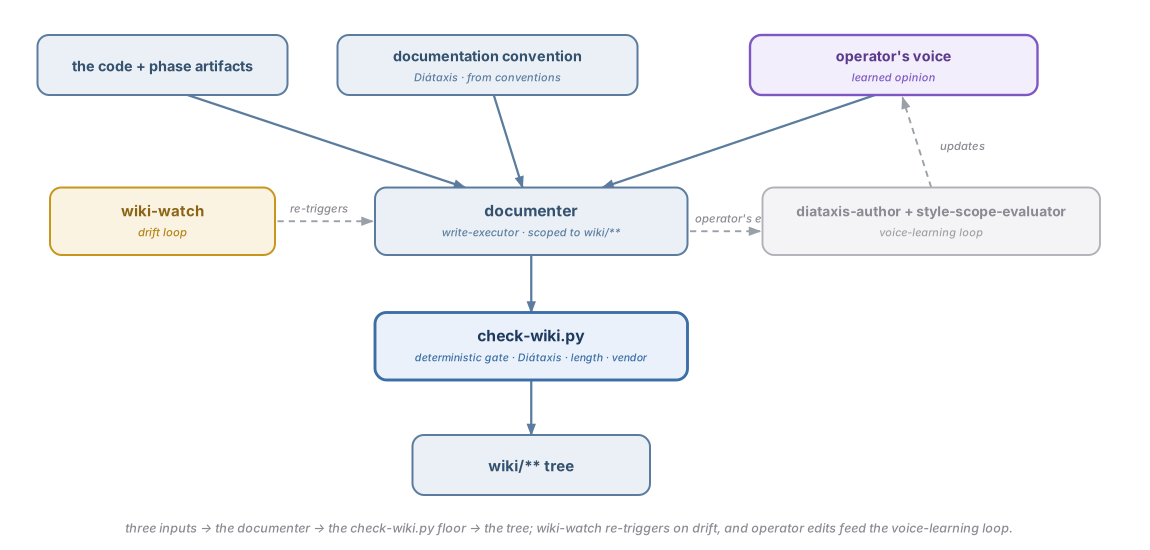
The documenter authors each page from three inputs — the code + phase artifacts, the documentation convention (Diátaxis structure, from conventions), and the operator's voice — then the deterministic check-wiki.py gate must pass before it lands in wiki/**. The wiki-watch loop re-triggers on drift; the operator's edits feed the voice-learning loop back into the voice.
Docs that drift from the code are worse than no docs — they read as authoritative and quietly mislead. A wiki earns its keep only when three properties hold: it is true to what the code does, structured so a reader lands on the right kind of page, and written in one voice. wiki exists to make those hold automatically, at phase boundaries, instead of resting on a human remembering to update a page. The trajectory it serves is a navigable knowledge base that compounds.
The structure standard is a modified Diátaxis — the documentation convention owned by conventions, which wiki enforces. We keep Diátaxis's per-page discipline but reshape the tree, because stock Diátaxis has no home for the documents an engineering wiki actually accumulates: design docs, decision records, architecture overviews, and runbooks.
Kept from standard Diátaxis — the page modes. Every page is exactly one mode — tutorials · how-to · reference · explanation — and never blends them (the single-mode rule), under length ceilings and a naming style. The mode is what makes a reader land on the right kind of page.
Changed — a fixed six-section frame, not four mode-folders. The tree is six sections in fixed order: How-to · Reference · Architecture · Designs · Explanation · Operational. The differences from stock Diátaxis:
- Tutorials fold into How-to — too few to earn a section of their own; task docs live in How-to.
- Three sections are added that Diátaxis has no slot for: Architecture (system overviews), Designs (the "why we built X" design docs — decision records live in each design's amendment log), and Operational (runbooks + ops).
-
Two are conditional: Architecture renders only when a repo declares
wiki/architecture.yml; Operational renders only on non-public visibility (public wikis suppress it). The other four are always present. - The audience-tag layout is retired — sections group by intent, not by reader.
The canonical definition lives in conventions (the documentation domain); wiki is its executor — check-wiki.py is the gate, the templates encode it, the diataxis-author skill authors against it, and a per-repo .diataxis-conventions.md overrides it.
Four parts, in the order they run:
-
A deterministic floor.
check-wiki.pyenforces thedocumentationconvention mechanically — single-mode, length (with a soft-warning carve-out for pages whose length is genuinely necessary — worked scenarios, troubleshooting), the vendor gate — in CI (wiki-sync.yml). Structure is a gate, not an LLM's mood. -
Opinionated authoring. The
documenteragent — hard-scoped towiki/**(+Home.md/_Sidebar.md/project.json), never touching code — authors each page from the code, the documentation convention, and the voice, in templates, preview-before-write. Since 2026-07-16 every drafted page also runs theprose-passskill before its preview (Gemini simplifies with the voice pack inlined verbatim; the documenter fact-checks and applies; degradation announced, never blocking — see the 2026-07-16 amendment). -
A drift watch.
wiki-watchruns one cycle that detects doc-worthy changes and re-dispatches thedocumenter, so docs follow the code instead of waiting on a human. -
A voice-learning loop. When the operator edits a page,
diataxis-authorgeneralizes the lesson,style-scope-evaluatorrecommends a scope (global / per-project / per-repo), and the confirmed lesson lands in a voice overlay. The voice is learned and stored, not hardcoded — which is how the docs sound like the operator across repos.
The floor guarantees structure; authoring + watch keep the docs true to the code; the voice loop keeps them consistent — the three properties, held without a human in the loop.
| Primitive | Kind | What it does |
|---|---|---|
documenter |
agent | The write-executor — creates / updates / prunes pages; hard-scoped to wiki/** (+ the three index files); never touches code. |
check-wiki.py |
script | The deterministic gate — enforces the documentation convention (Diátaxis single-mode · length · vendor). |
diataxis-author |
skill | The authoring + voice-learning skill — templates, the single-mode rule, the edit-driven style-capture loop. |
wiki-author · wiki-watch
|
skill | Authoring entry + the one-cycle drift watch. |
diataxis-evaluator · style-scope-evaluator
|
agent | Read-only judges for the ambiguous mode-classification + voice-scope calls. |
composer.py (in diataxis-author)
|
module | The manifest → page transform (compose_page): load each templates/sections/<name>.md, strip its <!-- SECTION --> opinion comment, resolve voice, concatenate in manifest order — deterministic; leaves <…> author-fill placeholders intact. |
/wiki-init · /wiki-watch · /recent-wiki-changes
|
command |
Init (idempotent, preview-first provisioning: scaffolds the six-section IA + per-folder sidebars + landings, drops a parameterized wiki-sync.yml into the target's .github/workflows/, wires the gate per the distribution split; warns on billed Actions minutes when the target isn't public) · the drift watch · the recent-changes digest. |
wiki-sync.yml |
workflow | The publish deployment — one workflow, two jobs: lint-wiki (the check-wiki gate, on push + PR) then update-wiki (needs: lint-wiki; rsync -a mirror of wiki/ to the GitHub wiki — add/edit/rename/delete; fails loudly on case-insensitive dupe basenames; graceful-skip when the wiki is disabled; self-heals on the next green push). Between the rsync and the commit, wiki_publish_transform.py strips YAML frontmatter and rewrites relative asset links to raw-asset URLs — the two publish-time fixes GitHub Wiki rendering needs (below); a final smoke-check step curls the published Home page and one rewritten asset URL before the run is declared green. Publishing is deployment, lint-gated — not CI. |
wiki_publish_transform.py |
script | The publish-time transform update-wiki runs on the freshly-rsynced checkout — idempotent, .md-scoped, leaves wiki-internal page links and [[wikilinks]] untouched. Referenced by path in this repo's own workflow (same pattern as check-wiki.py); vendored into a consuming repo's .github/scripts/ by vendor_gate.py. |
wiki enforces the documentation convention (conventions) — the objective Diátaxis structure, one-way: wiki reads + gates it, never authors it. It genuinely consumes the operator's voice (the learned prose style, real overlay machinery — style_resolver.py + the diataxis-author learning loop). It does not yet consume good: a 2026-07-07 grounding pass (PLAN-opinion-consumer-grammar task 4) found no prose in any shipped src/wiki/ file stating a good-shaped standard (hostile-read / failing-test / defect / no-issues-found) — documenter.md explicitly disclaims the closest candidate role ("not a style reviewer and not a quality judge"), and diataxis-evaluator.md judges Diátaxis mode classification, not content quality. "A page is good when it is true, single-mode, and findable" was this design's own aspirational gloss on good, not a citation of a real binding. See composition's Amendment log for the full finding. The split that stands: the structure is objective + gate-backed → a convention; the voice is subjective + learned → a genuinely-consumed opinion; good is neither — not yet grounded. (Voice: hardwired/overlay today, request-by-name is Phase-3/4 registry work. good: no site to wire until one is authored — see the Opinions design.)
-
requires conventions — consumes + enforces the
documentationconvention (the Diátaxis structure);check-wiki.pyis that convention's gate. wiki tools the standard; conventions owns it. -
enhances development-lifecycle's
documentation— thedocumenterruns at the loop's phase boundaries to keep docs in step with the code. -
consumes the operator's voice (agentm Opinions) — the subjective prose voice (a learned overlay). Does not yet consume
good— no real prose site exists to wire (2026-07-07 grounding pass; see Amendment log). - the Maintainer persona's drift detector (designed) — a proactive docs-drift loop depends on the agentm scheduler; this capability is its write surface. See Personas.
- Points up at the crickets HLD; the requires/enhances mechanics are in crickets-composition.
-
The capability rename
wiki-maintenance→wiki(bare noun); the group declares both names ([wiki-maintenance, wiki]) so existing references resolve (the composition rename mechanism). -
The
enhancestarget re-points — it enhanceddeveloper-workflows:documentation; that capability is nowdevelopment-lifecycle. - The plugin directory (
src/wiki-maintenance/) follows the rename at v6.0.
- All delivered — the agents, commands, scripts, skills, and the CI workflow ship today; the rename is mechanical.
-
The
documentationconvention home is new — the Diátaxis standard + its gate (check-wiki.py) ship in wiki today; landing the standard as thedocumentationdomain in conventions is the structural lift (conventions owns it, wiki keeps enforcing). Until then the standard lives in wiki's skill + linter. - The Maintainer drift detector is designed, not built — its proactive loop waits on the agentm scheduler.
- Phase-5 conformance sweep — the wiki conformance pass (analyze the tree against the foundations + the classification spine) is driven through this capability; it is scheduled work, not yet run.
-
Foundational GitHub-wiki rendering assumptions — the whole IA rides on three live-verified GitHub Wiki behaviors: page links resolve by basename only (folders don't namespace), case-insensitively, and GitHub renders the nearest
_Sidebar.mdto the viewed page. These give the collapse/expand nav trick and the silent-clobber failure modecheck-wikiguards (the case-insensitive basename-dupe check). Two more, confirmed live and now handled at publish time (wiki_publish_transform.py, above): GitHub Wiki does not render YAML frontmatter (displayed as raw text above the H1 until stripped), and it serves pages at flat URLs, so a tree-relative asset link that resolves in a git checkout 404s until rewritten toraw.githubusercontent.com/wiki/<owner>/<repo>/<path>. Re-audit if GitHub changes wiki rendering or migrates off Gollum. -
Re-audit triggers: flip
wiki-maintenance→wiki+ re-point theenhancesedge at v6.0; build the Maintainer drift loop when the scheduler lands; run the Phase-5 conformance sweep.
- crickets
src/wiki-maintenance/(→src/wiki/) — agents (documenter,diataxis-evaluator,style-scope-evaluator) · commands (/wiki-init,/wiki-watch,/recent-wiki-changes) · scripts (check-wiki.py,wiki_init.py,wiki_watch_*,vendor_gate.py) · skills (diataxis-author,wiki-author,wiki-watch) ·wiki-sync.yml; declares[wiki] -
Up / enhances: crickets HLD · composition · development-lifecycle · conventions (the
documentationconvention it enforces) · Personas (Maintainer) · agentm Opinions (good+ the voice)
2026-09-22 — wiki-watch keeps its cursors in the project's desk/ (wiki 0.12.0; agentm-vault part 15, crickets task 100). resolve_state_dir asked agentm's harness_memory.py vault-state-path, a verb agentm deleted in V5-3, so every cycle had quietly fallen back to the repo's .harness/wiki-watch/. Its comments still named the vault harness directory the projects migration dissolved. The cursors, pending set and audit log now live in <desk>/wiki-watch/, where <desk> is the project's own desk/ as agentm names it (scripts/project_homes.py home desk). With no desk — agentm absent, no vault for the project, or a desk that does not exist — a cycle skips and writes nothing. The repo-local fallback and state-dir --local are gone. An empty cursor still re-surfaces the tree, as the never-drop invariant wants; neither repo had a state directory to carry over. Why not keep the repo-local fallback: crickets composes no project layout, and a second home for the same cursors is how a watcher double-dispatches. Re-audit if a standalone wiki install needs the watcher without agentm.
2026-07-16 — the prose-pass skill wired into the documenter (operator escalation of the same-day session rule). Every page the documenter drafts now runs the design plugin's prose-pass skill after drafting and before the preview-before-write step: Gemini (via agy, driven by scripts/prose_pass.py) simplifies with the resolved voice pack — the committed base style floor ⊕ the latest-dated docs-prose-style genre overlay, glob-resolved at runtime and passed as an explicit --overlay (the script's own default overlay is design-doc-prose, wrong for a wiki page) — inlined verbatim; the documenter generates the fact-guard list first (the draft's technical claims, grounded against the code the page describes), fact-checks Gemini's result against it per the skill's Step 2, restores operator-authored lines verbatim, and previews the post-pass text. Frontmatter, headings, table structures, and the Document History section stay byte-identical by mechanical contract. The primitive lives in the design plugin (shipped 2026-07-16, prose_pass.py + the prose-pass skill) and is reached by sibling-plugin resolution — deliberately NOT a hard requires: (wiki stays standalone: true); an absent primitive degrades identically to an absent agy. Degradation is graceful AND announced: relay the PROSE-PASS-DEGRADED marker verbatim, run the skill's own Claude-only fallback pass, continue — never blocks authoring, never silent. diataxis-author + wiki-author document the step and cross-reference the documenter; the machinery is not duplicated. The documenter's no-network tools contract gains one named exception for the agy shell-out (same operator-sanctioned transport as code-review's cross-review.sh). Why not house the primitive in wiki: design owns prose authoring (the proving instance was a design doc) and wiki is one caller of two; sibling resolution + announced degradation preserves wiki's standalone contract where a hard dependency would break it. Re-audit trigger: wiki growing a hard requires: on design, the documenter's no-network contract changing, or the Antigravity host inversion (there the host model is already Gemini — roles invert) being built.
2026-07-13 — publish-time frontmatter strip + asset-link rewrite (V8 proving-ledger dispatch, fix lane L6, findings F10/F11). Two GitHub-Wiki-only rendering gaps, confirmed live with curl against the currently-published wiki before writing any code: frontmatter isn't rendered (shows as raw text above the H1), and a tree-relative asset link resolves fine in a git checkout but 404s once the page is served at its flat wiki URL. New wiki_publish_transform.py runs on the freshly-rsynced checkout, between rsync and commit, and fixes both — idempotent, .md-scoped, leaves wiki-internal page links and [[wikilinks]] alone. Wired into both this repo's own wiki-sync.yml (referenced directly, src/wiki/scripts/wiki_publish_transform.py) and the template wiki-init drops into a consuming repo (vendored copy, .github/scripts/wiki_publish_transform.py — vendor_gate.py gained vendor_transform() alongside its existing vendor_gate(), and wiki_init.py's plan_ci/provision_ci/--resync-gate report and (re)vendor it the same way they already did for check-wiki.py). A post-push smoke-check step curls the published Home page and one rewritten asset URL, failing the job loudly if either doesn't 200. Paired with alexherrero/agentm#304, which carries the same fix for agentm's own wiki-sync.yml (agentm and crickets each hold an independent copy of the transform script — no cross-repo sharing mechanism exists between the two repos as peers; check-cross-repo-script-parity.py covers check-wiki.py/check-no-pii.sh but compares rule-letter/pattern-kind contracts, a shape this script doesn't have). Why not fix at source: the frontmatter is load-bearing in-repo (governance/gate tooling reads it); relative paths are correct and necessary for a git checkout, they only break once flattened onto a wiki URL. Re-audit trigger: GitHub Wiki starts rendering frontmatter natively, or changes the raw.githubusercontent.com/wiki/... asset-URL scheme this transform depends on.
2026-07-07 — corrected the good binding claim; no real prose site exists (PLAN-opinion-consumer-grammar task 4 grounding pass). A grounding pass across every substantive src/wiki/ file (documenter.md, diataxis-author/SKILL.md, diataxis-evaluator.md, wiki-author/SKILL.md) for prose stating a good-shaped standard found none. documenter.md explicitly disclaims the closest candidate role ("not a style reviewer and not a quality judge"); its own adversarial framing ("find what wasn't documented") is a completeness standard, not good's content-quality one; diataxis-evaluator.md classifies Diátaxis mode, not quality. Reworded "Opinions + conventions it consumes" and the matching Dependencies bullet above — this design's own "a page is good when it is true, single-mode, and findable" was an aspirational gloss written into the design, never actually baked into a shipped file, and the design previously stated the good consumption as settled fact alongside the (genuinely real) voice-overlay consumption. The voice claim is untouched — style_resolver.py + the diataxis-author learning loop are real and unaffected by this finding. Why not author the missing prose here: out of this plan's scope (the consumer grammar, not net-new opinion-standard content) — deferred to whoever next substantively touches wiki. Re-audit trigger: if a future change adds real good-shaped prose to a shipped src/wiki/ file, reclassify this as a grounded binding and wire it via the now-proven markdown-prose consumer grammar (composition).
2026-06-30 — Decisions section retired: six-section frame. The added-section set drops from four to three (Architecture · Designs · Operational); decision records now live in each living design's ## Amendment log, not a standalone Decisions section. The frame is now How-to · Reference · Architecture · Designs · Explanation · Operational (four always-present, Architecture + Operational conditional). wiki_init.py, check-wiki, the templates, and the documenter/migrate.py ADR-routing drop decisions/ in the same pass (defined authoritatively in the conventions documentation domain). Why not keep an empty Decisions section: a universally-empty always-present section is drift that re-scaffolds itself. Re-audit trigger: a durable decision-artifact class with no living-design home.
2026-06-28 — lock-down sweep (operator review). Converted the system mermaid to a house-style hand-SVG (diagrams/crickets-wiki.svg); rewrote the structure section to spell out the modified Diátaxis — the seven-section frame and its differences from stock Diátaxis; and repointed the two loose ADR citations (the Diátaxis-spec seed; the seven-section cross-reference) at the conventions documentation domain. The folded-ADR records (0008 / 0018 / 0019) keep their numbers as historical decision IDs (the locked-design fold pattern). Locked as a v5–v8 guidepost.
2026-06-24 — archived diataxis-author.md (AG Wave 2, landmark — vault-archived, not deleted). The launched design that was the canonical record of the diataxis-author skill's internals is moved to <vault>/_vault-archive/ag-design-history/diataxis-author.md (HISTORICAL banner; git + the archive retain the full text). Its still-live shape is held here + in the conventions documentation domain (the Diátaxis canon). Recorded for the living tree, the skill is one skill with five sub-commands:
-
author— live authoring guidance: mode-classify + template-select + filename-style; -
check— drift detection wrappingcheck-wiki.py+ mode-mixed / stale-xref / template-drift / convention-drift signals; -
repair— interactive, preview-first fixes, splitting mode-mixed pages viadocumenter; -
migrate— one-shot legacy → Diátaxis,git mvblame-preserving,wiki/.diataxismarker guards re-runs (subsumed the harnessmigrate-to-diataxispredecessor); -
classify— single-page mode + confidence, heuristic for clear cases, the read-onlydiataxis-evaluatorsub-agent for ambiguous ones.
The documenter is its dispatched write-worker (Diátaxis-aware, scoped to wiki/**); AgentMemory convention I/O reads operator conventions (relocated from _always-load to the on-demand _global store, via the documenter-context resolver) and offers operator-confirmed write-back of judgment calls (silenceable via MEMORY_REVIEW_MODE); a per-repo wiki/.diataxis-conventions.md overrides global conventions. The skill ships inside this capability's plugin (originally seeded from the agentm Diátaxis spec (now the conventions documentation domain); the post-launch pivot reframed it "enforce Diátaxis modes" → "Diátaxis as floor + operator templates/voice," adding the edit-driven voice-capture loop + style-scope-evaluator). Why archive, not delete: it is a named landmark — the most detailed surviving record of the skill's design — worth preserving for context, even though the governing truth is now this living design.
2026-06-24 — subsumed wiki-maintenance-design.md, wiki-design.md, wiki-composer.md, wiki-maintenance-provisioning.md (AG Wave 2, move-and-retire). Four superseded wiki designs whose still-live value lands here; all deleted (git history retains the full PRD text + part files). The three C4-folded ADRs they had absorbed (AG Phase-2) are preserved below with decision + why-not + re-audit, alongside the composer's three operator-locked design calls (contemplated as an ADR but folded into the design body, never minted). The body's parts table gains the wiki-composer + corrects the wiki-sync.yml row; Risks gains the GitHub-wiki rendering assumptions the IA rides on.
-
ADR 0008 — the
diataxis-authorskill (2026-05-22). Shipped as one skill with five sub-commands (author / check / repair / migrate / classify), deterministic Python pipelines + one read-onlydiataxis-evaluatorsub-agent (zero write scope), subsuming the migrate-to-Diátaxis predecessor; write-back split by lesson kind (voice → on-demand<vault>/projects/_global/wiki-style/viastyle_resolver.py, never auto-loaded; structural-naming stays in_always-load). Why not author-only / two Diátaxis skills / read-only memory: author-only misses the maintenance gap; two skills = a mental-model burden; read-only memory taxes the operator per judgment call. Re-audit trigger: a model bump changing how agents consume mode-separated docs, or the four-mode taxonomy being deprecated. -
ADR 0018 — per-folder sidebars: intent-grouped wiki folders with nearest-
_Sidebar.mdnav (2026-06-08). Intent-group folders each carry their own_Sidebar.md; GitHub Wiki renders the nearest one (live-verified) → collapse/expand nav with no platform migration; a<!-- mode: X -->hint preserves mode-enforcement in mixed folders;check-wikirule (j) checks the union of all sidebars for ≤2-click reachability, not "root lists everything." (Superseded-in-spirit by the seven-section taxonomy — now the conventionsdocumentationdomain — for the frame, but the nearest-sidebar mechanism persists.) Why not type-folders / a dynamic JS sidebar / a content heuristic: type-folders contradict intent ordering; a JS sidebar means leaving GitHub Wiki; a content heuristic is fragile. Re-audit trigger: GitHub changing wiki rendering / migrating off Gollum, or wiki-sync flattening the tree. -
ADR 0019 — wiki provisioning: gate-distribution split + supersession-gated retirement (2026-06-10).
wiki-initmakes provisioning one idempotent, preview-first action. Two key calls: (1) gate-distribution split — the agent runscheck-wiki.pyby reference (${CLAUDE_PLUGIN_ROOT}/scripts/check-wiki.py, upgrades for free) while CI vendors a copy into the target's.github/scripts/(GitHub runners have no${CLAUDE_PLUGIN_ROOT}), re-synced via--resync-gate; (2) supersession-gated retirement — installing crickets plugins removes only the~/.claude/standalones an installed crickets plugin supersedes, matched by name and crickets provenance, preview-first / dry-run-default (never touches agentm-native design / memory / doctor). Why not vendor-everywhere / reference-everywhere / blind-removal / name-only matching: vendoring rots on the next move; a referenced CI gate can't resolve a path; blind removal would delete design/memory/doctor; name-only could remove a same-named non-provided standalone. Re-audit trigger: GitHub Actions exposing a runner-visible plugin path (CI could then reference, retiring the vendor half), or a host ceasing to export${CLAUDE_PLUGIN_ROOT}.
The composer's three operator-locked design calls (from wiki-composer.md; folded here, never an ADR). The composer is the manifest → page transform compose_page(manifest): for each section it loads templates/sections/<name>.md, strips the author-facing frontmatter + the single <!-- SECTION … --> opinion comment, resolves voice (base ⊕ overlay via style_resolver.resolve(), emitted as a delete-me author comment after the H1), and concatenates the stripped bodies in manifest order under the page H1 — pure, deterministic (same inputs + lang=en → byte-identical). (1) Scaffold, don't invent — it emits structure + voice-guidance with angle-bracketed <…> author-fill placeholders left intact; best-effort filled pages were rejected (plausible-but-wrong prose + broken reproduction); a surviving <…> is how enforcement detects an unfilled page. (2) Translate downstream — sections are one language-neutral file; the loader carries a lang param defaulted to en; translation runs as a downstream pass on the assembled page (per-language <name>.es.md variants rejected — N× sync cost). (3) Monolith verbatim-fallback — author.py branches on a sections: frontmatter list: present → compose; absent (how-to / tutorial / reference / explanation) → today's verbatim read_text() + voice-comment injection, unchanged; fail-closed on a missing/unparseable section or unknown manifest name (never a partial page). Section schema-v2 is additive over v1 (optional:, heading-variants:, the angle-bracket placeholder convention); check-wiki rules m/n/o enforce section presence+order, heading-variant conformance, and unfilled-placeholder (--strict promotes the last to a failure). Re-audit trigger: the first real non-English page tests whether translate-downstream holds.
2026-06-23 — authored, reviewed, and finalized. wiki keeps the documentation tree true to the code, structured by Diátaxis, and in the operator's voice — a documenter write-executor (hard-scoped to wiki/**), the check-wiki.py deterministic gate, the diataxis-author authoring + voice-learning skill, the diataxis-evaluator + style-scope-evaluator judges, the /wiki-* commands, and wiki-sync.yml; all delivered. The design reads reasoning → structure → maintenance-system → parts: why a wiki (drifted docs mislead; true · structured · one-voice), the Diátaxis structure (owned by the conventions documentation domain, enforced here), the four-part system that holds it (deterministic floor → opinionated authoring → drift watch → voice-learning loop), then the parts.
The central split (operator-ratified): the objective structure is the documentation convention — wiki requires conventions and consumes + enforces it (check-wiki.py is its gate), one-way; the subjective voice is an agentm opinion (a learned overlay), as is good applied to docs. Migrations: wiki-maintenance → wiki + the enhances re-point (developer-workflows → development-lifecycle) at v6.0; the documentation standard lands as a conventions domain. Designed-not-built: the Maintainer drift detector (waits on the agentm scheduler); the Phase-5 conformance sweep. Re-audit: land the documentation domain in conventions; flip the rename + re-point at v6.0; build the Maintainer loop; run the conformance sweep.
2026-07-05 — folds voice-cascade-architecture.md (accepted 2026-06-05, PLAN-r3-voice-mechanism task 3). That vault decision predates the repo's 2026-06-21 ADR retirement and named its own pickup signal as "graduates to a full ADR" — this fold is that graduation, landing here instead per the retirement convention (one atomic change: body + amendment together, standalone file retired). Four locked calls now govern how the operator's voice reaches every surface, not just wiki pages: (1) voice composes as base ⊕ genre-refinement ⊕ project-overlay ⊕ repo-overlay, narrower and more-recent winning a conflict — the same precedence style_resolver.resolve_style() already applied to the wiki genre, generalized to every genre; (2) each layer is a tiny always-on kernel plus an on-demand library — only the kernel (voice-kernel, ~15 lines: the sound-like-the-operator essence + the top anti-slop tells + an index of the library) stays always-loaded, and the detailed genre files load only when their context is active; (3) the kernel lives in the vault as a single always-load entry, since vault recall is the one mechanism that's cross-host and participates in the same learning loop as every other convention; (4) voice is content the vault owns and crickets' style_resolver.py + check-slop.py (PLAN-r3-voice-mechanism tasks 1-2) are the mechanism — one rule pack, two enforcement points, never a second copy. Landed 2026-07-05: the three heavy always-load voice files (docs-prose-style, personal-comms-style, personal-narrative-style) demoted to on-demand genre refinements under projects/_global/wiki-style/, resolved by the existing style_resolver.py for wiki-authoring and by ordinary keyword/cwd recall for free-form chat, commits, and PRs — this is also the structural half of the R0.8 always-load-truncation fix (R0.8 patched the budget/priority symptom; demoting the files removes them from the budget instead of hoping they survive alphabetical truncation). Why not keep voice as a separate #14 base plugin (the decision's own call 4): the mechanism this task actually needed — one resolver, one rule pack — already lives in wiki-maintenance/diataxis-author; standing up a second plugin to hold the same two files would be the independent-copy problem the whole plan exists to close. Re-visit if a non-wiki genre (commit/PR/chat) needs its own resolver rather than riding recall. Re-audit trigger: the kernel growing past ~25 lines (genre detail leaking into the always-on layer — a stdlib line-count check locks this), or a cross-host output-style standard emerging that the vault could write to directly instead of projecting through recall.