units merc_pannonian_cavalry - RTR-Imperium-Surrectum/ris-wiki GitHub Wiki
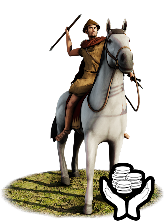
Mercenary. Hired from a regional pool, not recruited from a building.
Class: missile · Category: cavalry · Men per unit: 30
Pannonian Cavalry are light and nimble riders, skilled horsemen thanks to their days of manoeuvring through Pannonia’s rich oak forests. They wear shortened tunics and various hats as were fashionable at the time, allowing them to stay agile, whilst wielding Sibyna spears and javelins to harass and run down their enemies using their expertise in guerilla warfare. Although brave and fearsome, they cannot be expected to survive long in melee.
On occasion, for modern readers it can be quite confusing to differentiate the similarly named and situated Paones and Pannonians. For ancient writers, this already represented a problem, as Appian explained: “the Greeks call them Paeones, the Romans Pannonians, and they include them, as I have noted previously, among the Illyrians […] Their fame comes from as early as the Macedonian period, from the Agriani, who very successfully aided Philip and Alexander, and were one of the lower Paeonian tribes and neighbours of the Illyrians” (Illyr. 14.40–41). Sasel Kos explains that Appian must not have realized that the entire Upper Moesia and part of Dalmatia separated the Pannonians from the Paeones (Sasel Kos, Appian and Illyricum (2005), pp. 108-9). With all that cleared up, let us now explore what it was like to be Pannonian.
The Pannonians were known to be “a large nation along the (River) Ister who extended from the Iapodes to the Dardanians” (Illyr. 22.63). Appian’s outline of their territory aligned nicely with Strabo’s, who further defined them to be a confederation of many tribes and peoples including the Breuci, Andizetes, Ditiones, Pirustae, Maezaei, Daesitiates, as well as some smaller tribes that remain unknown or unnamed (Sasel Kos (2005), p. 376). Their country was rich in oak forests, marshes, and even included some mountains. Their diet was fairly limited due to a lack of fertile soil, unsuitable to grow grapes or olives – much to the horror of Greeks and Romans – which forced the Pannonians to rely on barley and millet to eat and brew into beer (Drnic, Segestica and Siscia (2020), pp. 19-20). Despite all these ‘shortcomings’, Dio Cassius extoled their virtues, as “they are considered the bravest of all men of whom we have knowledge; for they are very high-spirited and bloodthirsty, as men who possess nothing that makes an honourable life worthwhile” (Dio Cass. 49.36). Herodian (2.9.11) has a somewhat different spin on this idea: “Although the men of the Pannonian regions have huge and powerful bodies and are skilful and murderous in battle, they are dull of wit and slow to realize that they are being deceived.” – suggesting a degree of barbaric naivety.
The Pannonians lived as disparate clans across their wooded homeland, “throughout the countryside and villages”, eschewing both collective leaders and dwelling in cities (Illyr. 22.62-3). This relative lack of overarching leadership or centralisation would prove to be somewhat of a boon when Caesar Augustus began a punitive third invasion of the Segestani Pannonian tribe by marching arrogantly through the land of many other tribes of Pannonians. Appian states that the Pannonians could field a total of 100,000 fighting men, but preferred to use hit and run tactics: hiding in the woods and killing Roman soldiers “who did not keep in step”, refusing to come to terms with Octavius even after he burnt any fields and villages he could find on his journey to the Segestani (Illyr. 22.64-6).
Caesar Augustus successfully took the Pannonian town of Segestica, a key supply point for his plans to wage war upon the Bastarnae and Dacians, and what Appian referred to as a “strong-city” (Illyr. 4.22), but failed to pacify the Pannonians as a whole. The Segestani eventually revolted despite a 25-cohort-strong garrison (Sasel Kos, Octavian’s Illyrian War. Ambition and Strategy (2018), p. 43). He faced a painful reminder of the Pannonian’s unbroken will to fight during the Great Illyrian Revolt of 6-9 AD. The Pannonians had used their restive peace with Rome profitably and “two hundred thousand infantry trained to arms, and nine thousand cavalry were being assembled”, the effect of which upon the Roman Legions was felt. “Now all the Pannonians possessed not only a knowledge of Roman discipline but also of the Roman tongue, many also had some measure of literary culture, and the exercise of the intellect was not uncommon among them. And so it came to pass, by Hercules, that no nation ever displayed such swiftness in following up with war its own plans for war, and in putting its resolves into execution. Roman citizens were overpowered, traders were massacred, a considerable detachment of veterans, stationed in the region which was most remote from the commander, was exterminated to a man, Macedonia was seized by armed forces, everywhere was wholesale devastation by fire and sword. Moreover, such a panic did this war inspire that even the courage of Caesar Augustus, rendered steady and firm by experience in so many wars, was shaken with fear” (Vell. II, 110 ).
Now let us examine the Pannonian Cavalry themselves as they are represented in RIS. As is clear from the primary sources previously discussed, the Pannonians did indeed field cavalry, so all that remains is to examine what kind of cavalry they were likely to have been. Much of what we know comes from findings in that important Pannonian town of Segestica. Cavalry was around from at least the early 10th century BC in Pannonia, with initial early Iron Age horse-riding equipment including Scythian style horse-bits with arch-shaped cheek elements (psalia), with bent ends in the shape of the letter S occurring way into the 5th century BC (Drnic (2020), pp. 95-6). The presence of Illyrian-style military helmets and dress pins in the same findings would suggest a military usage of these horse bits, rather than a purely civilian one. Their clothes are based on situla art depictions of warriors wearing shorter tunics, capes and pins to hold them in place, along with iron knives and whetstones (Drnic (2020), p. 97). As for their armament, the Pannonian Cavalry are yet another Illyrian unit that enjoys using spears both for melee and as a throwing weapon as once more, findings of multiple sizes of spearhead dated from the 1st to the 2nd century BC imply different intended uses for their polearms (Drnic (2020), p. 91). Further findings of spear and javelin heads throughout the southeastern Alpine and southern Pannonian regions, especially in the River Kupa, help to cement their ubiquity to the Pannonian warrior and in this case cavalry (Drnic and Dizdar, Segestan Warriors (2018), p. 78).
| Rank in roster | ||
|---|---|---|
| Men per unit | 30 |
█········· 8% |
| Attack | 10 |
██········ 19% |
| Charge bonus | 13 |
█████····· 52% |
| Defence | 14 |
█········· 6% |
| · armour | 1 |
█········· 0% |
| · defence skill | 13 |
█········· 13% |
| · shield | 0 |
█········· 0% |
| Morale | 7 |
█········· 10% |
| Discipline | Normal | |
| Training | Untrained | |
| Upkeep per turn | 512 dn |
██········ 22% |
| Primary | Secondary | |
|---|---|---|
| Attack | 10 | 6 |
| Charge bonus | 13 | 20 |
| Type | thrown · archery | melee · blade |
| Damage | piercing | piercing |
| Projectile | javelin | — |
| Range | 60 | — |
| Ammunition | 7 | — |
| Properties | Thrown | — |
| Primary | Secondary | |
|---|---|---|
| Total | 14 | — |
| Armour | 1 | — |
| Defence skill | 13 | — |
| Shield | 0 | — |
| Hit points | 1 |
| Mount | light horse |
| Ground: scrub / sand / forest / snow | 0 / 0 / -4 / 0 |
| Charge distance | 40 |
| Formations | Square |
Technical stats
| Time between blows (primary / secondary) | 2.5 s / 2.5 s |
| Extra fatigue in hot climates | 0 |
| Spacing between men: close / loose | 2 × 4.8 m / 3.6 × 6.72 m |
| Default ranks | 5 |
In battle: Can form Cantabrian circle · Very good stamina
Mercenaries are hired from a regional pool, not recruited from a building. This unit is offered by 3 pools covering 24 regions, at 3,483 dn to hire and 1 experience.
Mercenary pools: Dalmatia · North Illyria · Pannonia
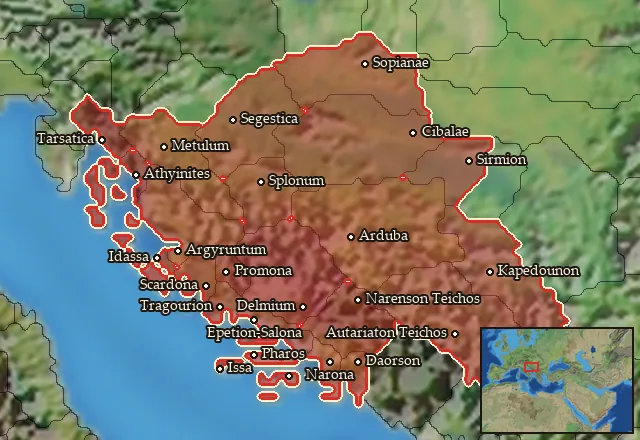
At least one of those pools sells to any faction that has an army in range, with no faction restriction.
The 24 regions where this unit appears in a mercenary pool
Amantinia · Andizetia-Azalia · Autariataia · Breucia · Daesitiatia · Daorsia · Delmatia · Ditionia · Epetia-Salonitis · Hesperos Skordiskia · Iapodia · Issa · Liburnia · Liburnia Orientalis · Liburnia Septentrionalis · Liburnonesoi · Maezaeia · Mania · Melaina Korkyra · Narensia · Savia · Seniensia · Sinus Liburnicus · Tragouria