units merc_knossian_hippeis_late - RTR-Imperium-Surrectum/ris-wiki GitHub Wiki
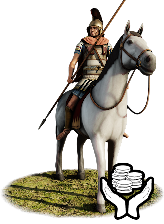
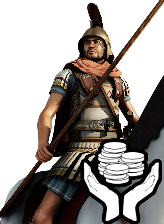
Mercenary. Hired from a regional pool, not recruited from a building.
Class: heavy · Category: cavalry · Men per unit: 30
‘The Knossians contended for the sovereignty of the island, which they alleged belonged to them, on account of both the ancient dignity of the city, and the glory and renown of their ancestors in the heroic age. For some say that Zeus was brought up amongst them, and that Minos, who had the dominion of the seas, was educated by Zeus at Knossos, and excelled all other men in virtuous accomplishments.’ – (Diod. 33.10.1)
These horsemen are the nobles of Knossos, the most famous city of Crete. Unlike other Greek cavalry, the Knossians once fought with the Aspis shield, and now that other Hellenes have adopted this practice, they themselves have abandoned it. Instead, they now fight like the Xystophoroi of Alexander the Great. Their long lance is perfectly suitable for a deadly charge on the battlefield, and metal cuirasses with pteryges have been added to their equipment to protect them in melee. Additionally, their legs are now shielded by bronze greaves and their heads by Boiotian or Konos helmets. The plumes or crests on their helmets, their finely made cloaks, and their expensive golden belts, which depict hunting scenes, are a symbol of their status as the most prestigious class of Knossos. Their ancestors fought at Troy, they fought for king Minos and they fought in Egypt. But, most of all, they have always fought against Gortyn and Lyttos, and every Knossian would rather die than ever submit to these eternal rivals.
After the Lyttian War (221-216 BC), Knossos was weakened. The Lytto-Gortynian victory, with the help of Macedon and Achaia, had destroyed Knossos’ pre-eminent position on the island and had created an Antigonid ‘protectorate’ (cf. Polyb. 7.14.4). At the same time, Itanos at the eastern end of Crete had become an important Ptolemaic base and the powerful merchant republic of Rhodes expanded its influence on the island to further its aims as the protector of free trade in the Aegean and Eastern Mediterranean (Bagnall, Ptolemaic Possessions (1976), pp. 120-121; Polyb. 4.47.1 (Rhodes)). In 206/205 BC, the Rhodians claimed that Cretan pirates had attacked the Dodekanes islands and retaliated by waging war on Olous in northeastern Crete (Diod. 27.3; Coutsinas, Hellenistic Olous (2020), p. 38). Meanwhile, Philip V of Macedon (238-179 BC) was attempting to undermine the Rhodian position and, in 205 BC, he sent Herakleides of Taras, one of his most skilled agents, to sabotage the Rhodian fleet and to incite the whole Cretan League against Rhodes (Polyb. 13.3-4). Around the same time (207/206 BC), Cretan mercenaries had also helped Nabis to become the tyrant of Sparta (Polyb. 13.6.8). Unspecified Cretan pirates now helped Macedon and Sparta to disrupt Rhodian trade (Polyb. 13.8.2), and Knossos’ old ally Aitolia was only too happy to raid other merchant vessels and thus further damage Rhodes’ revenues (Green, Alexander to Actium (1993), p. 305). Bithynia, too, was ready to support the Antigonid king, and enlisted Philip’s help to capture its old ally Kios (another RIS faction). Even though Kios itself was aligned with Aitolia, Philip attacked the city and eventually conquered it, giving it to the Bithynians and forcing Chalkedon and Lysimacheia to end their friendship treaties with Rhodes and Aitolia. This brought Aitolia into the Rhodian coalition, and led to the full outbreak of the so-called Cretan War (Polyb. 15.21-23).
The coalition of Aitolia, Pergamon (Polyb. 16.1.1), Kyzikos (cf. Polyb. 33.13.1-2), Byzantion (Polyb. 16.2.10), and Rhodes sought the help of Rome, but the catastrophic losses in the war against Hannibal meant that the Republic felt too weak to intervene and rejected these advances (Hammond, History of Macedonia (1988), p. 413). The Cretan War is an extremely complex topic, so let us concentrate on what actually happened on Crete: Polyrrhenia, Kera, Rhaukos, Kydonia, Lappa, and Knossos seem to have joined the anti-Macedonian party (Karafotias, Crete in search of a new protector (1966), p. 107). No doubt, Knossos saw the conflict as a welcome opportunity to get rid of the Macedonians and to restore its strong position on the island. Rhaukos was already a dependent ally of Knossos and had to follow its policies, while the others were probably won over by diplomatic means or had their own reasons to fight against the Antigonids (Karafotias (1966), p. 107). Knossos seems to have had some success in the subsequent fighting, but its enemies, led by Gortyn, managed to keep a strong pro-Macedonian Cretan League together (Chaniotis, The Cretan Koinon (2015), p. 381).
While the Cretan War ended in 200 BC, hostilities either continued or were resumed on the island in the years afterwards, when Knossos and Sparta were fighting against Gortyn, Pergamon and the Achaians (Cf. Chaniotis (2015), p. 381). Knossian troops appear to have landed on the Peloponnese and even must have defeated a Roman army when the Senate decided to reinforce its ally Achaia, for several thousand Romans are attested as slaves on Crete soon after (Armstrong, Cretan Women (2006), p. 306). In 192 BC, Nabis of Sparta was defeated and deposed (Liv. 35.35), and Knossos now turned to the Seleucids for help. This was in vain: after the defeat of Antiochos III at Magnesia in 190/189 BC and the Peace of Apameia in 188 BC, the Knossians were forced to accept the superiority of the pro-Achaian Cretan Koinon. The league now turned against Kydonia and its allies, likely Lato, Olous, and Polyrrhenia (something Timo Klär will discuss in his upcoming book: Kreta im Spannungsfeld der hellenistischen Monarchien). In 188 BC, with the Kydonian War underway, the Roman praetor Quintus Fabius Laebo sailed to Crete to free the enslaved Romans and Italics. Upon arrival, he threatened to make war on the Gortyno-Knossian coalition (Liv. 37.30.3). The Cretans boldly dismissed the Roman request, but Labeo would later claim at Rome – as is suggested by the annalist Valerius Antias – that he had received four thousand captives (Liv. 37.60.5-6). In truth, only Gortyn freed some of the captives, confirming that an amicitia (“friendship”) already existed between the mighty polis and Rome – probably because both were allies of the Achaian League (Liv. 37.60.5, Klär, Kreta).
We do not know the outcome of the Kydonian War, but Gortyn and Knossos eventually seem to have arrived at a friendlier agreement, which was the basis for many other Cretan cities to join their new Cretan League once again, just like they had against Lyttos in 221 BC. In 183 BC, Gortyn, Knossos, Lyttos, Phaistos, Rhaukos, Hierapytna (near Itanos), Eleutherna, Aptera (near Kydonia), Polyrrhenia, Sybrita, Lappa, Axos, Pransos, Allaria, Arkades, Keraia, Praisos, Lato, Biannos, Malla, Eronos, Chersonesos (the port city of Lyttos), Apollonia, Elyros, Hyrtakina, Eltynia, Anopolis, Araden, Istron, and Tarrha all signed a treaty in which they promised to send cavalry mercenaries to Eumenes II of Pergamon (r. 197-159 BC; Syll. 627 = IC 4.179). Kydonia is not listed, but seems to have lost most of its allies, while Phalasarna, which was in a civil war, Ptolemaic Itanos, and the now-Rhodian Olous are also missing (Chaniotis (2015), p. 381).
In 170 BC, the ambitious Kydonia, in a desperate attempt to make up for its lost ground, attacked the league member Apollonia on the southwestern coast of the island, which was also its own ally. This behaviour understandably angered the Cretan Koinon. While the Kydoniats achieved a quick victory and annexed Apollonia with its territory, Knossos and Gortyn soon concluded an offensive alliance and declared war on Kydonia. Their troops invaded the territory of Apollonia and prevailed in a pitched battle, forcing the Kydoniats to concede defeat. Knossians and Gortynains disagreed on what to do with Apollonia, however, and immediately went to war with each other over the area in question. Apollonia itself suffered much destruction, and the Archaeological Museum in Herakleion has a collection of lead sling bullets from these attacks which I saw when I visited it. From 169-168 BC, the bloody conflict cost many lives, until Gortyn achieved a decisive victory. To appease the Knossians and to escape their future anger, the Gortynians suggested a new alliance to attack Rhaukos, a town situated between the two grand poleis, a past dependency of Knossos. To avoid a repeat of the Apollonian War, the Gortynians also proposed an equal share of the booty. Rhaukos stood no chance against its neighbours and, after it had been roundly defeated, Knossos and Gortyn built a new border exactly through the centre of the city (cf. Chaniotis (2004), pp. 82-83 for the reconstruction)!
Even though Gortyn and Knossos had now become two of the largest poleis in the whole Greek world thanks to their extended territories, they just could not let go: in 121 BC, Lato and Olous had a conflict over the tiny island of Pyrrha as well as a cliff and an almost unknown sanctuary next to it. Gortyn and Knossos then took sides, with Hierapytna and Itanos in Eastern Crete also becoming involved in the war (Chaniotis (2004), p. 84). This time, Knossos defeated all its enemies and decided that enough was enough: the Cretan League was re-established for good, and we hear of no further war until the Roman conquest of the island (74-67 BC), when the Cretans fought together. Even though they eventually lost, the Romans suffered catastrophic losses too, and had to cede specific rights of autonomy to the Cretan cities (Chaniotis (2004), p. 84).
During these wars, the cavalry of Knossos fought with new equipment. Another stela from the shrine of Glaukos and Kounabi in Eltyna (between Knossos and Gortyn) – probably erected in the 2nd century BC – depicts a Xystophoros with a crested Boiotian helmet, metal cuirass, xiphos, and chlamys. The elite warriors of Knossian (and Gortynian) society had thus adopted the armament of Macedonian cavalry, arguably because of Philip’s impressive and quick victories on the island. To mark them as an elite, we have given them the same golden belts as the earlier Hippeis, based on an incredibly detailed piece from Knossos. Made in the 3rd century BC, it is now in the Archaeological Museum of Heraklion and was brilliantly modelled by our artists. Such a belt would have been worn by a member of the rich Hippeis class, which fought on horseback, as Ephoros of Kyme (ca. 400-330 BC) emphasised (FGrHist 70 F149§18). Their mentality is well illustrated by a 2nd century BC epitaph for a Knossian horseman, which rounds off our description:
‘Tharsymachos, son of Leontios. You did not lose your virtuous name when you died, but the reputation that does you honour raises you up out of the House of Hades, Tharsymachos; and someone of those as yet unborn will sing clearly, recalling that furious cavalry troop when you alone of the Ertaians on windy Elaios broke the troop of the cavalry-cry, devising deeds worthy of your father Leontios and worthy of your noble, much-praised forebears. And for that reason, among the assembly of the perished, glorious Hades has enthroned you alongside Idomeneus, protector of the city.’ – (IC I viii 33 = EHC 4, 2nd or 1st c BC)
| Rank in roster | ||
|---|---|---|
| Men per unit | 30 |
█········· 8% |
| Attack | 13 |
██████···· 57% |
| Charge bonus | 35 |
██████████ 96% |
| Defence | 32 |
█████····· 49% |
| · armour | 13 |
████████·· 75% |
| · defence skill | 19 |
████······ 44% |
| · shield | 0 |
█········· 0% |
| Morale | 13 |
███████··· 70% |
| Discipline | Normal | |
| Training | Highly trained | |
| Upkeep per turn | 1,071 dn |
█████████· 92% |
| Primary | Secondary | |
|---|---|---|
| Attack | 13 | 12 |
| Charge bonus | 35 | 29 |
| Type | melee · blade | melee · blade |
| Damage | piercing | slashing |
| Primary | Secondary | |
|---|---|---|
| Total | 32 | — |
| Armour | 13 | — |
| Defence skill | 19 | — |
| Shield | 0 | — |
| Hit points | 1 |
| Mount | light horse |
| Ground: scrub / sand / forest / snow | -2 / -1 / -7 / -1 |
| Charge distance | 40 |
| Formations | Square · Wedge |
Technical stats
| Time between blows (primary / secondary) | 2.5 s / 2.5 s |
| Extra fatigue in hot climates | 4 |
| Spacing between men: close / loose | 2 × 4.8 m / 3 × 7.2 m |
| Default ranks | 5 |
In battle: Very good stamina
Mercenaries are hired from a regional pool, not recruited from a building. This unit is offered by 2 pools covering 12 regions, at 6,656–7,408 dn to hire and 3–4 experience.
Mercenary pools: Crete · Pergamon
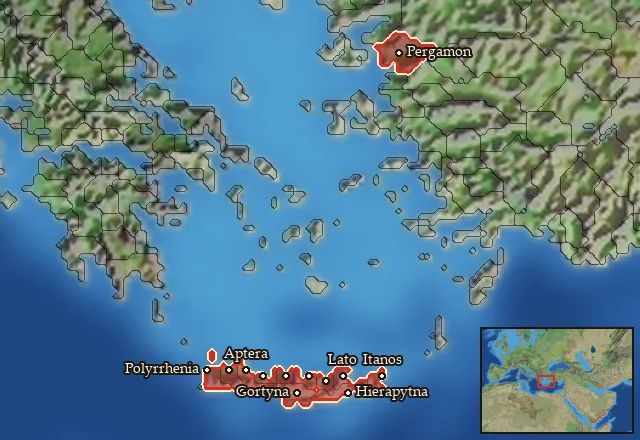
At least one of those pools sells to any faction that has an army in range, with no faction restriction.
Some pools additionally restrict it to Pergamon.