Warp Engine Mechanics - Angel-125/Blueshift GitHub Wiki
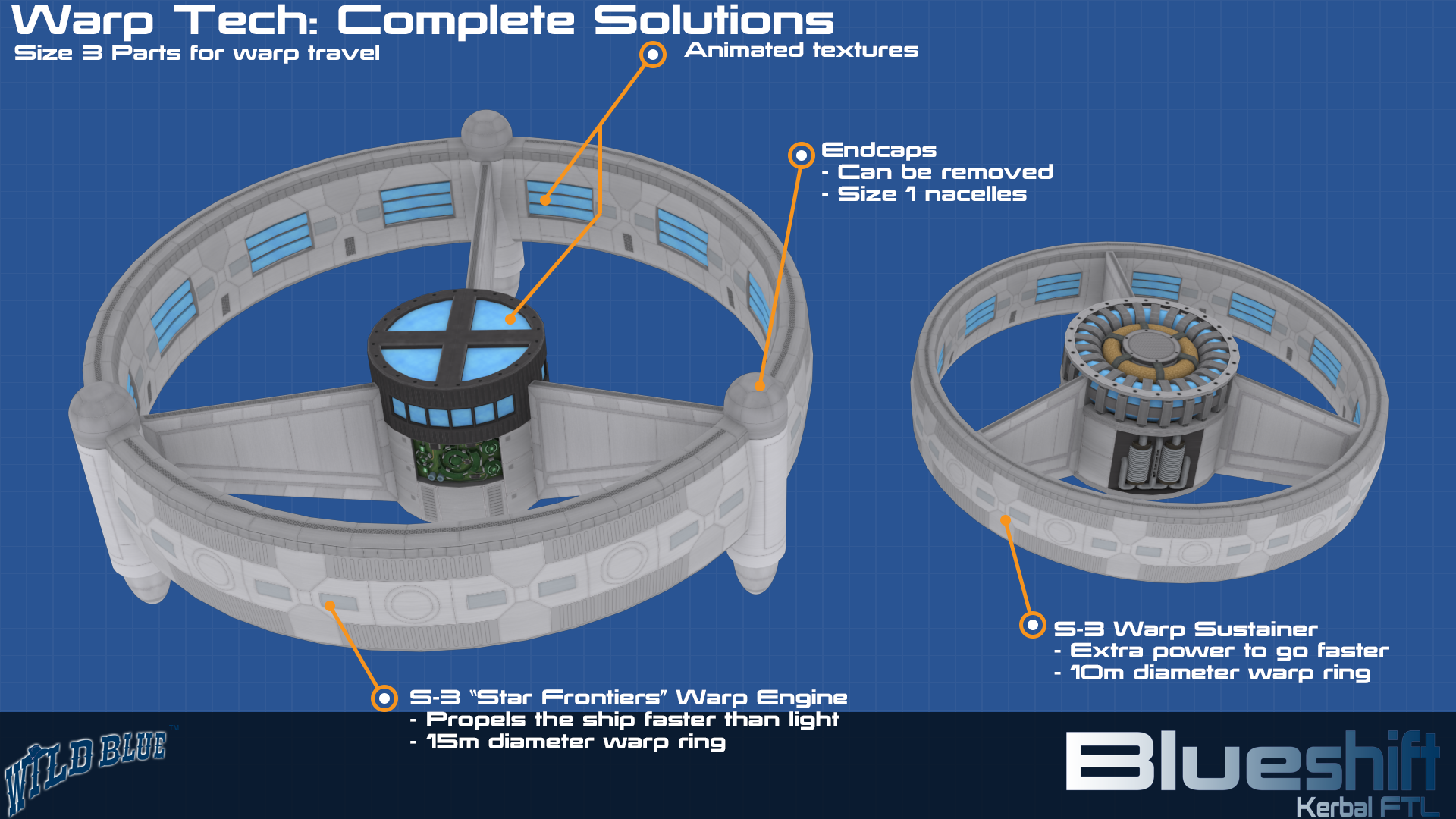
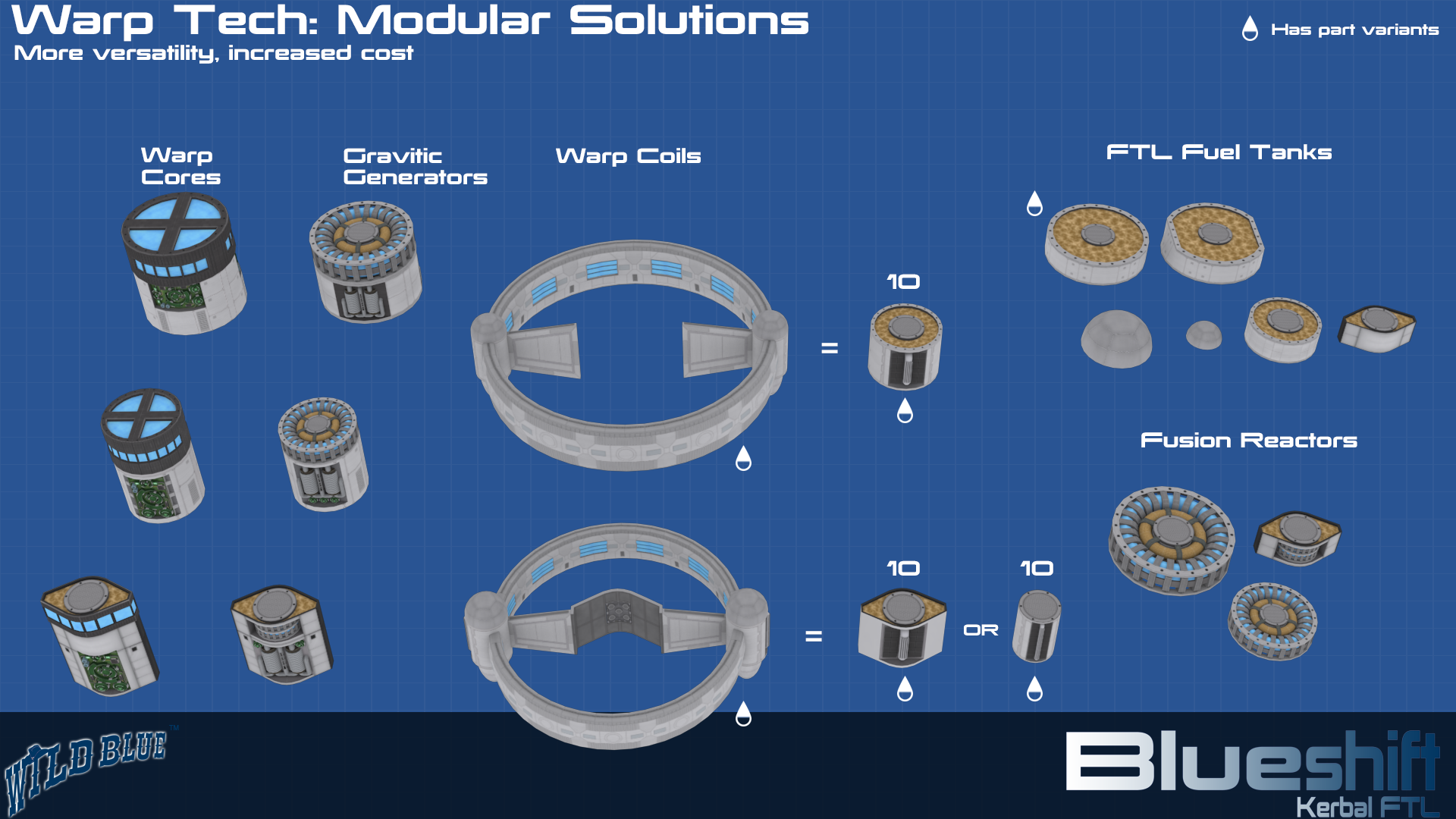
Three components comprise the warp propulsion system: The gravimetric displacement generator (a.k.a. gravitic generator), the warp coil, and the warp engine/warp core. They don’t need to be combined into a single part, letting you mix and match as desired.
Important:
A part must appear on the corresponding table to perform that function.
- Gravimetric Generators Table ➔ for Gravity Wave production.
- Warp Coils Table ➔ for Displacement Impulse and Warp Capacity.
- Warp Engines Table ➔ for faster-than-light (FTL) propulsion.
The only fixed resource is Warp Capacity, which is used by the warp engine to go faster than light, but it's not a resource in the sense of Liquid Fuel and Oxidizer. The resources to produce Warp Capacity can be anything desired; for Blueshift parts though, they involve Fusion Pellets, Electric Charge, Graviolium, and Gravity Waves.
Graviolium
Graviolium is a form of exotic matter. Charging up Graviolium with an Electric Charge enables the substance to alter the fabric of space-time in countless ways. One of the most significant uses is FTL travel; by warping space-time, ships can exceed the speed of light without time-dilatation effects. The act of charging up Graviolium with an Electric Charge produces Gravity Waves that are harnessed for various applications. It also produces a Static Charge, which must be safely discharged via a Plasma Vent or Plasma Contactor before static charge buildup causes adverse effects.
Finding Graviolium

Graviolium can be obtained by mining asteroids and comets, by extracting it from the ground of a few celestial bodies, and by collecting dust-form Graviolium from dust belts orbiting some planets via the Stardust Graviolium Collector.
⛏️ Tip: Graviolium can be extracted with stock drills and stock ISRU harvesters.
No special equipment is needed — your existing mining vessels are already compatible!
🔵 New to warp flight? Check out the Beginner’s Warp Ship Checklist for your first build!
Gravimetric Generators
Part Module: WBIModuleGeneratorFX
Gravimetric Generators produce Gravity Waves by consuming one or more units of Graviolium per second along with other possible resources. Gravity Waves are discharged when the generator is off. For Blueshift parts, 0.00004 units of Graviolium produces 1 unit of Gravity Waves.
Gravity Waves are typically consumed by Warp Coils, but other parts use them as well. Blueshift gravitic generators not only produce Gravity Waves, they also produce Electro Plasma (consumed by Plasma RCS thrusters) and Electric Charge.
Blueshift provides the following Gravimetric Generator parts:
Table: Gravimetric Generators
| Part | Mass (t) | Gravity Waves (out) | Graviolium (in) | Fusion Pellets (in) | Electro Plasma (out) | Electric Charge (out) | Static Charge (out) |
|---|---|---|---|---|---|---|---|
| Mk2 Gravimetric Displacement Generator | 2.6 | 50 | 0.002 | 0.00005 | 1400 | 6 | 0.002 |
| S-2 Gravimetric Displacement Generator | 3.75 | 150 | 0.006 | 0.00015 | 2250 | 9 | 0.006 |
| S-3 Gravimetric Displacement Generator | 5.25 | 250 | 0.01 | 0.000188 | 3750 | 15 | 0.01 |
| S-3 Warp Sustainer | 8.75 | 250 | 0.01 | 0.000188 | 3750 | 15 | 0.01 |
| S-3 Heavy Warp Sustainer | 11.7 | 500 | 0.02 | 0.000376 | 7500 | 30 | 0.02 |
| S-3 Warp Engine | 14 | 250 | 0.01 | 0.000188 | 3750 | 15 | 0.01 |
Tip:
Before flight, make sure the total Gravity Waves produced by your Gravimetric Generators is greater than or equal to the total Gravity Waves required by all of your active Warp Coils.
Top
Warp Coils
Part Module: WBIWarpCoil
Warp Coils generate the warp field that warp engines and warp cores use to go faster than light. They come in a variety of shapes and sizes. Generally, the larger the warp coil, the more powerful it is. Strictly speaking, warp coils don't need to consume resources, but the parts in Blueshift require Gravity Waves in order to function.
There are two key parameters that define a warp coil: Warp Capacity and Displacement Impulse
Warp Capacity
Measured in Kochranes, Warp Capacity is a unit of measurement that determines how well a warp engine or warp core can propel a ship. The more Kochranes a warp coil provides, the faster a ship will go, but it will cost more Gravity Waves to do so. You can increase Warp Capacity by adding more warp coils to your ship. For instance, a single S-1 Warp Coil would give a ship 1 Kochrane of Warp Capacity, while 10 S-1 Warp Coils would give a ship 10 Kochranes of Warp Capacity.
Displacement Impulse
Measured in metric tons, Displacement Impulse represents the amount of mass that a warp coil can safely move without reducing its Warp Capacity. The more warp coils a ship has, the more mass that it can displace. For instance, a single S-1 Warp Coil displaces 2.5 metric tons, while 10 S-1 Warp Coils displace 12.5 metric tons.
Blueshift provides the following Warp Coil parts:
Table: Warp Coils
| Part | Mass (t) | Displacement Impulse (t) | Warp Capacity (Ko) | Gravity Waves Required |
|---|---|---|---|---|
| S-1 Warp Coil | 0.4 | 2.5 | 1 | 5 |
| S-1 Warp Coil (Multi) | 0.8 - 4 | 5 - 25 | 2 - 10 | 10 - 50 |
| S-2 Warp Coil | 0.8 | 10 | 1 | 20 |
| S-2 Warp Coil (Multi) | 1.6 - 8 | 10 - 50 | 2 - 10 | 10 - 50 |
| Mk2 Warp Coil | 0.6 | 2.5 | 1.25 | 5 |
| Mk2 Warp Coil (Multi) | 1.2 - 6 | 5 - 25 | 2.5 - 12.5 | 10 - 50 |
| Mk2 Warp Ring | 3.6 | 25 | 12 | 50 |
| S3-2 Warp Ring | 6 | 100 | 7.5 | 150 |
| S3-Mk3 Warp Ring | 24 | 200 | 40 | 200 |
| S-3 Warp Sustainer | 8.75 | 100 | 7.5 | 150 |
| S-3 Heavy Warp Sustainer | 11.7 | 100 | 10 | 200 |
| S-3 Warp Engine | 14 | 100 | 10 | 200 |
Note:
When calculating total ship mass, include the mass of your warp systems (gravimetric generators, warp coils, and warp engines) along with your payload.
Top
Warp Engines
Part Module: WBIWarpEngine
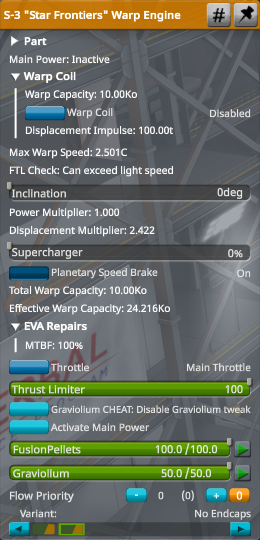
Warp Engines bend space-time to move a ship around. With enough power, they can propel the ship faster than light (light speed is defined as 299,792,458 m/sec). To bend space-time, they need Warp Capacity produced in the ship's warp coils. The exact available Warp Capacity depends upon a number of factors including the total Displacement Impulse, the vessel's mass, whether or not the warp coils are underpowered or overpowered, and so on.
Specifically, the formula used is:
Effective Warp Capacity = Total Warp Capacity * Displacement Multiplier * Power Multiplier
Total Warp Capacity
This is the Warp Capacity provided by all the warp coil parts on the ship.
Displacement Multiplier
This is the total amount of Displacement Impulse provided by all the warp coil parts on the ship, divided by the vessel's current mass. If the ship has more Displacement Impulse than the vessel's mass, then Effective Warp Capacity increases. Similarly, if the ship masses more than the total available Displacement Impulse, then Effective Warp Capacity decreases.
Power Multiplier
This is the total Gravity Waves produced by all the gravimetric displacement generators on the ship, divided by the total Gravity Waves required by all the ship's warp coils. If the ship produces more Gravity Waves than required, then Effective Warp Capacity increases. Similarly, if the ship produces less Gravity Waves than required, then Effective Warp Capacity decreases.
Once the Effective Warp Capacity has been determined, the warp engine/warp core consults its warp curve to figure out how fast it can go. This curve is specific to each warp engine. Each entry in the warp curve consists of two numbers: the Warp Capacity required, and the multiple of light speed produced. A typical warp curve looks like the following:
Sample Warp Curve
warpCurve
{
	key = 1 0
	key = 10 1
	key = 30 3
	key = 50 4
	key = 80 6
	key = 130 8
	key = 210 12
	key = 340 17
	key = 550 25
	key = 890 37
	key = 1440 54
	key = 2330 79
	key = 3770 116
	key = 6100 170
	key = 9870 249
	key = 15970 366
	key = 28540 537
}
Astute readers may notice that the required Warp Capacity increases in a Fibonacci sequence.
Blueshift provides the following warp engines and warp cores:
Table: Warp Engines
| Part | Mass (t) | Description |
|---|---|---|
| Mk2 "Starflight" Warp Core | 2.6 | One of the first warp engines available, the Starflight offers craft built with Mk2 parts the ability to go to warp. |
| S-2 "Planet's Edge" Warp Core | 4 | A step up from the Starflight, the Planet's Edge is a larger warp core for more powerful starships. |
| S-3 "Trek" Warp Core | 6 | Built for some kind of star trek, this warp core is built for some truly deep space exploration. |
| S-3 "Star Frontiers" Warp Engine | 14 | Unlike the previous parts, the Star Frontiers warp engine is fully self-contained and requires no other parts to function properly. |
Top
Traveling During Time Warp
Traveling During Time Warp allows you to use KSP's accelerated time feature while traveling at warp speed. Blueshift ensures that your warp speed stays consistent, while adjusting resource consumption appropriately.
Key Points When Using Time Warp at Warp Speed
-
⏳ Warp Speed Calculation:
Your ship's warp speed is always calculated as if the Time Warp factor is 1×, regardless of the actual time warp. -
🎚️ Throttle Lock:
When Time Warp >1×, your warp engine's throttle is locked at the value it had when time warp was increased.
To adjust throttle, return to Time Warp 1×. -
🔥 Resource Consumption:
Graviolium and Fusion Pellets (and whatever other resources the generators produce and consume) are consumed at a rate proportional to the Time Warp factor.
(Example: At 5×, consumption is 5× faster.) -
🛰️ Real-World Time vs. Game-Time:
You reach destinations faster in real-world time because more in-game time passes each real-world second.
Table: Mk2 Gravimetric Displacement Generator Time Warp Consumptions
Below is an example of how the Mk2 Gravimetric Displacement Generator consumes Graviolium during time warp:
| Time Warp Factor | Graviolium Consumption Rate (Example) |
|---|---|
| 1× | 0.002 units/sec |
| 5× | 0.01 units/sec |
| 10× | 0.02 units/sec |
| 100× | 0.2 units/sec |
Time Warp Effects Visualized
Real-World Time (seconds):
|0s|---|1s|---|2s|---|3s|
At Time Warp 1×:
- 1 second real time = 1 second in-game time
- Warp ship moves normally.
At Time Warp 10×:
- 1 second real time = 10 seconds in-game time
- Warp ship covers 10× more distance in 1 second, but warp speed (velocity per in-game second) stays constant.
Top
Designing A Warp Ship
Blueshift provides a number of parts to choose from when designing a warp ship. The exact combination of parts depends upon what kind of ship you're creating: should it go fast? Should it travel far? Is it a heavy hauler? Warp engines/warp cores require Warp Capacity, which warp coils provide. But warp coils need Gravity Waves, which gravimetric generators provide. Gravimetric generators need Graviolium and Fusion Pellets, which fuel tanks provide. All of these parts have mass, which affects the performance of the ship. In general, the more Warp Capacity you have, the faster the ship will go, and you can provide it by adding more warp coils and/or more gravimetric generators.
Pro Tip:
Right-click your Warp Engine in flight to check if your ship can exceed light speed!
Pro Tip:
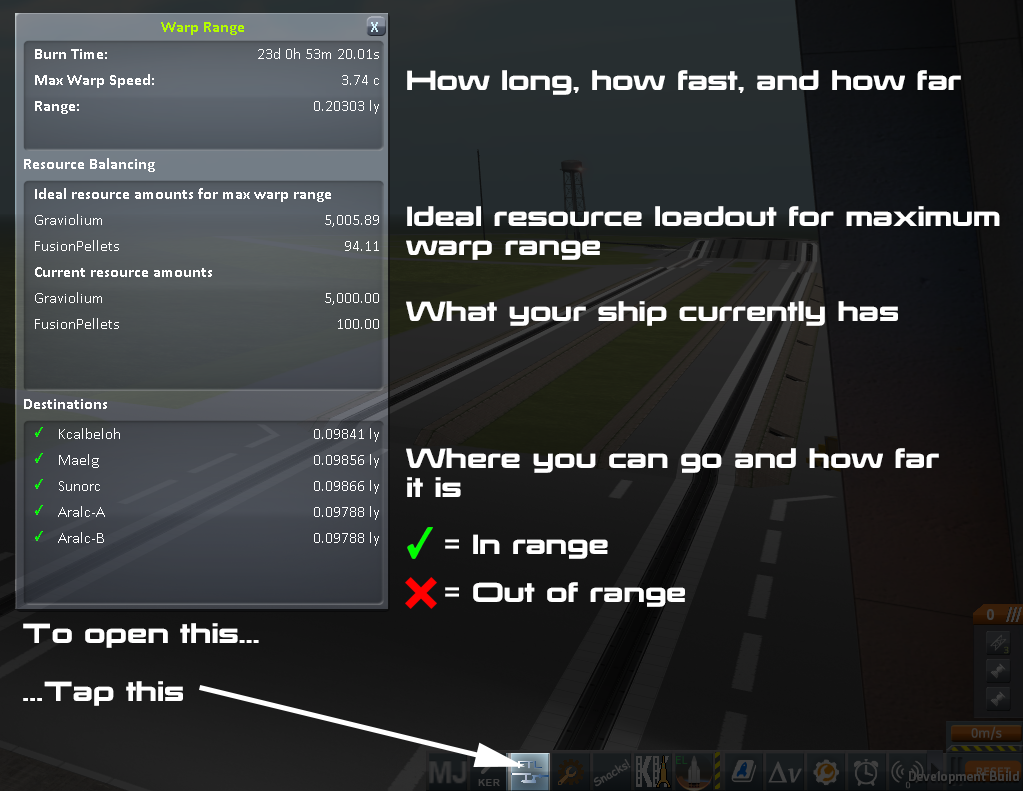
In the VAB, SPH, and in flight, you can tap the FTL app button to show the Warp Range dialog. It's like a delta-v calculator for Warp Ships.
NOTE: The suggested resource loadouts is only available in the VAB/SPH.
Fuel Tanks
Warp engines need Warp Capacity to propel a ship. Warp Coils produce Warp Capacity, but need Gravity Waves to do so. Gravimetric generators produce Gravity Waves but need Graviolium and Fusion Pellets. Without stores of Graviolium and Fusion Pellets, a warp ship is going nowhere. Blueshift provides several specialized fuel tanks for storing Graviolium, Fusion Pellets, or a mixture of both.
Each tank has a maximum capacity based on its size class. The combined amount of Graviolium and Fusion Pellets stored in a tank cannot exceed its total capacity. The table below lists the available fuel tanks that Blueshift provides:
| Fuel Tank Name | Max Storage Capacity (u) |
|---|---|
| Mk2 FTL Propellant Tank | 400 |
| GR-03 Graviolium Tank | 6.25 |
| GR-06 Graviolium Tank | 50 |
| GR-12 Graviolium Tank | 400 |
| GR-25 Graviolium Tank | 1500 |
| GR-375 Graviolium Tank | 3600 |
| Mk3-S3 Adapter Tank | 800 |
| S-1 FTL Endcap Tank | 40 |
| S-2 FTL Propellant Tank | 400 |
| S-2 FTL Propellant Tank | 480 |
| S-3 FTL Propellant Tank | 800 |
| GR-50S Spherical Graviolium Tank | 10880 |
🔵 Note: You can freely divide the tank’s total volume between Graviolium and Fusion Pellets based on mission needs.
📦 Fuel Tank Sizing Tip:
When choosing fuel tanks for your warp ship:
- Use the Mk2 FTL Propellant Tank for very small ships (Mk2 size, small warp cores).
- Use the GR-03 Graviolium Tank or GR-06 Graviolium Tank for micro probes or extremely light warp craft.
- Use the GR-12 Graviolium Tank for small interplanetary ships.
- Use the GR-25 Graviolium Tank for medium-size vessels (S-2 size craft).
- Use the GR-375 Graviolium Tank for large interstellar ships (S-3 size ships, S-3 Warp Engines/Cores).
- Use the GR-50S Spherical Graviolium Tank when you need extremely large Graviolium storage (capital ships or jumpgates).
Additional Options:
- Mk3-S3 Adapter Tank bridges Mk3 to S-3 sizes while carrying fuel.
- S-1, S-2, and S-3 FTL Propellant Tanks are available for their respective fuselage sizes, useful when you need both warp propellant and aerodynamic structure.
Top
Balancing Graviolium and Fusion Pellets for Warp Ships
When designing a warp ship, it’s important to balance the amount of Graviolium and Fusion Pellets so that they are consumed at the same rate and run out at the same time.
This is especially important for long-range, interstellar travel.
Follow these steps:
Step 1: Calculate Total Consumption Rates
- For each gravimetric generator on your ship:
- Find the Graviolium consumption rate (units per second).
- Find the Fusion Pellet consumption rate (units per second).
- Sum all Graviolium consumption rates together.
- Sum all Fusion Pellet consumption rates together.
Example:
Generator A: 0.002 Graviolium/sec, 0.00005 Fusion Pellets/sec
Generator B: 0.001 Graviolium/sec, 0.00002 Fusion Pellets/sec
Total consumption rates:
- Graviolium = 0.002 + 0.001 = 0.003 units/sec
- Fusion Pellets = 0.00005 + 0.00002 = 0.00007 units/sec
Step 2: Find the Consumption Ratio
- Divide the total Graviolium consumption rate by the total Fusion Pellet consumption rate.
Formula:
Consumption Ratio = (Total Graviolium Rate) ÷ (Total Fusion Pellet Rate)
Example:
Consumption Ratio = 0.003 ÷ 0.00007 ≈ 42.857
The ship consumes approximately 42.857 units of Graviolium for every 1 unit of Fusion Pellets.
Step 3: Determine Total Fuel Capacity
- Add together the maximum storage capacity (in units) of all selected fuel tanks.
- This combined capacity must hold both Graviolium and Fusion Pellets.
Example:
Two GR-375 Graviolium Tanks:
2 × 3600 = 7200 units total storage
Step 4: Solve for Fuel Quantities
To split the tank capacity proportionally:
Let:
- G = Graviolium units
- F = Fusion Pellet units
You know:
G + F = Total Tank Capacity
G = (Consumption Ratio) × F
Substituting:
(Consumption Ratio × F) + F = Total Tank Capacity
F = Total Tank Capacity ÷ (Consumption Ratio + 1)
G = Consumption Ratio × F
Example:
Given:
- Total Tank Capacity = 7200 units
- Consumption Ratio = 40
Then:
F = 7200 ÷ (40 + 1) ≈ 175.61 units of Fusion Pellets
G = 40 × 175.61 ≈ 7024.39 units of Graviolium
✅ These quantities ensure both resources run out at the same time.
Step 5: Fill the Tanks
- Fill your fuel tanks with the calculated amounts of Graviolium and Fusion Pellets.
- Ensure the total fits within the combined tank storage limit.
- Your warp ship is now properly balanced for maximum flight range!
Top
How Far Is a Light-Year?
In the real-world, a light-year is based on the speed of light and the length of Earth's sidereal year. But a year in KSP isn't the same a real-world year...
Light-Year Definition in Blueshift
In Blueshift, a Light-Year is defined as:
The distance a ship would travel while moving at the speed of light over the course of the homeworld's (e.g. Kerbin’s) sidereal year.
This ties the concept of a light-year directly to Kerbin’s orbital mechanics, ensuring consistency across different star systems, planetary mods, and game scales.
Calculating a Light-Year in Blueshift
- Kerbin’s sidereal year = 426 days × 6 hours/day × 3600 seconds/hour = 9,201,600 seconds
- Speed of light = 299,792,458 meters/second
- Distance traveled in one sidereal year:
299,792,458 m/s × 9,201,600 s ≈ 2.759 × 10¹⁵ meters
Thus:
1 Light-Year in Blueshift = approximately 2.759 × 10¹⁵ meters.
Top
Calculating Warp Range
Once you have balanced your Graviolium and Fusion Pellets, follow these steps to calculate how far your ship can travel:
Step 1: Calculate Burn Time
Burn time (in seconds):
Burn Time = (Graviolium Loaded) ÷ (Total Graviolium Consumption Rate)
- Use the Graviolium amount loaded into the ship.
- Use the total Graviolium consumption rate (units per second) from all gravimetric generators.
Step 2: Calculate Warp Velocity
Warp velocity (in meters/second):
Warp Velocity = (Warp Capacity in Kochranes) × (Speed of Light)
- Speed of Light (c) ≈ 299,792,458 m/s unless otherwise specified.
Step 3: Calculate Total Distance Traveled
Distance traveled before running out of fuel:
Distance = Warp Velocity × Burn Time
- Result will be in meters.
Step 4: Convert Distance to Light-Years
Light-Years traveled:
Light-Years = Distance ÷ Light-Year Distance
- Light-Year Distance = 2.759 × 10¹⁵ meters (based on Kerbin’s sidereal year)
Example Summary
Suppose:
- Graviolium Loaded = 7067.5 units
- Graviolium Consumption Rate = 0.01 units/sec
- Warp Capacity = 15 Kochranes (~2.5c)
Then:
Burn Time = 7067.5 ÷ 0.01 ≈ 706,750 seconds

Warp Velocity = 2.5 × 299,792,458 ≈ 749,481,145 m/s

Distance = 749,481,145 × 706,750 ≈ 529,757,303,191,250 meters

Light-Years = (529,757,303,191,250) ÷ (2.759 × 10¹⁵) ≈ 0.192 light-years
✅ The ship would travel approximately 0.192 light-years before depleting its resources.
Top
Calculate Flight Time
Thankfully this is pretty straightforward if you already know the Burn Time and the Light-Years traveled. In the above example, we know that the ship will travel 0.192 light-years before it runs out of Graviolium and Fusion Pellets. We also know that the burn time is about 706,750 seconds- which is how long it will take to go the 0.192 light-years. Specifically:
Flight Time = Distance (light-years) × Velocity (c)
Flight Time = 0.192 × 2.5
Flight Time = 0.0768 years
Flight Time = 0.0768 × 9,201,600 sec/year (using the length of Kerbin's Sidereal Year)
Flight Time = 706,764 seconds ≈ 706,750 seconds
⏳ Time Warp Impact on Travel Time
When traveling under warp, you can accelerate time using the in-game Time Warp feature.
This table shows how long it would take to complete a 706,750-second warp journey (about 8.18 Kerbin days) at various Time Warp factors:
| Time Warp Factor | Real-World Seconds | Real-World Minutes | Real-World Hours |
|---|---|---|---|
| 100 | 7,067.5 seconds | 117.8 minutes | ~1.96 hours |
| 1,000 | 706.75 seconds | 11.78 minutes | ~0.20 hours |
| 10,000 | 70.675 seconds | 1.18 minutes | ~0.02 hours |
| 100,000 | 7.0675 seconds | ~0.12 minutes | ~0.002 hours |
🛸 Notes
- At 100,000× Time Warp, the entire warp trip takes just 7 seconds of real-world time.
- Even at 1,000× Time Warp, the trip completes in under 12 minutes real-world time.
- Time Warp makes interstellar travel practical without excessive waiting!
Top
🛸 Before You Fly: Warp Readiness Checklist
- ✅ Confirm total ship mass is less than or equal to your available Displacement Impulse.
- ✅ Confirm total Warp Capacity is sufficient for your intended warp speed.
- ✅ Confirm Gravity Waves produced meet or exceed the total Gravity Waves required by your Warp Coils.
- ✅ Confirm you have a valid Warp Engine (appearing on the Warp Engines table).
- ✅ Confirm you have enough fuel in the tank (and the proportions are set so they run out at the same time).
- ✅ Right-click your Warp Engine during flight to verify lightspeed capability.
For Modders
The guidelines below will hopefully give modders wishing to create parts for Blueshift some insight on how the Blueshift warp tech parts were designed.
Design Rules
Below are some design rules to consider when making your own Warp Tech parts.
Computing Cost
- Normally, as you go down in size categories (Size 3 -> Size 2/Mk2 -> Size 1 -> Size 0) the performance of a warp engine, warp core, or warp coil drops by 25% of the higher-up size category. But you can increase the performance if you also increase the cost. For every percent increase, multiply the unlock and purchase price by an equal percentage. For example, the S-2 Warp Core has 75% of the performance of the S-3 Warp Core instead of the normal 25%. We added 50% performance increase, so we multiply its base costs by 1.5.
- If you want lower-size category parts to have performance closer to the next size category up, simply increase the unlock and purchase cost by the desired performance increase.
Blueshift Specific Rules
- The Size 3 warp tech parts are the baseline standard. The S-3 warp rings are rated for 100 tonnes of Displacement Impulse and between 7.5 and 10 Kochranes of Warp Capacity. The S-3 Warp Core and S-3 Warp Engine have the best performance.
- Ring-shaped warp coils are considered to be more efficient than coils of other shapes and sizes. One ring-shaped coil delivers the same performance of 10 individual non-ring coils but at 75% of the equivalent mass.
- The Mk2 Warp Ring' performance is equal to 12 Mk2/Size 1 warp coils.
- Warp coils punch above their weight; Size 2 coils are rated for 10 tonnes each, and the Mk2 and Size 1 coils are rated for 2.5 tonnes each. A theoretical Size 0 warp coil would rate at 1.25 tonnes of Displacement Impulse and have a Warp Capacity of 0.75.
- Warp cores, which lack the warp rings that engines do, cost 25% less than warp engines.
- Due to their versatility, the purchase price of a non-ring coil is: warp engine cost * 0.15, and the research price is 10x the purchase price. By contrast, the research price of a warp engine or ring-shaped warp coil is 5x the purchase price.