Beginner_Warp_Ship_Checklist - Angel-125/Blueshift GitHub Wiki
🚀 Beginner’s Warp Ship Checklist
Want to build your first warp-capable ship? Follow this checklist carefully!
This guide ensures you have everything needed to break the light barrier safely and reliably.
1. Start with Your Payload Mass
- Determine the payload mass (in metric tons).
- Important: Add the mass of your warp systems (gravimetric generators, warp coils, warp engines).
✅ Total ship mass = payload + warp parts mass.
2. Select Warp Systems
You need three major functions:
- Gravimetric Generator (produces Gravity Waves)
- Warp Coil (creates Warp Capacity and supports ship mass)
- Warp Engine (consumes Warp Capacity to move FTL)
Important:
- A part must appear on the correct table to qualify for a role:
- Gravimetric Generators Table ➔ Gravity Waves Produced
- Warp Coils Table ➔ Displacement Impulse, Warp Capacity, Gravity Waves Required
- Warp Engines Table ➔ Valid Warp Engine
3. Check Displacement Impulse
- Find the Displacement Impulse value of your Warp Coil(s).
- Ensure Displacement Impulse ≥ total ship mass.
✅ If not, add additional warp coils until your mass is supported, or accept the reduced performance of the vessel.
4. Check Warp Capacity (Kochranes)
- Warp Capacity determines how much faster-than-light (FTL) speed you can achieve.
- Add up Warp Capacity from all coils.
✅ ≥ 10 Kochranes is enough for basic FTL.
✅ Add more coils for higher speeds if desired- but bear in mind that more coils means more need for generators.
5. Check Gravity Wave Production
- Add up the Gravity Waves required by all Warp Coils.
- Ensure your Gravimetric Generator(s) produce enough Gravity Waves.
✅ Gravity Waves Produced ≥ Gravity Waves Required.
6. Assemble and Cross-Check
- Confirm you have all required functions (Generator, Coil, Engine).
- Confirm total ship mass, displacement impulse, warp capacity, and gravity wave production are balanced.
✅ If needed, add coils or generators.
🎯 Final Design Must Meet These Requirements
| Category | Requirement |
|---|---|
| Mass Support | Displacement Impulse ≥ Ship Mass |
| Warp Speed | Warp Capacity sufficient for lightspeed (≥ few Kochranes) |
| Power Supply | Gravity Waves Produced ≥ Gravity Waves Needed |
| Functionality | Generator, Coil, and Engine confirmed by tables |
📚 Example
| Item | Part | Function |
|---|---|---|
| Payload | (cargo, other components, etc.) | 100 tons |
| Gravimetric Generator, Warp Coil, Warp Engine | S-3 Warp Engine | 15 tons |
| Extra Warp Coil | S-1 Warp Coil | 2.5 tons |
- Final Mass: 117.5 tons
- Final Displacement Impulse: 150 tons
- Total Warp Capacity: 15 Kochranes
- Gravity Waves: Produced 250 GW, Needed 225 GW ✅ Ready for FTL!
✨ Pro Tips for New Warp Pilots
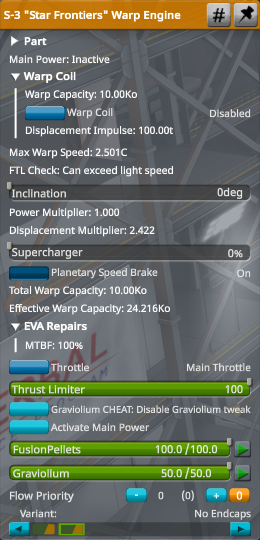
- Multi-role parts (like the S-3 Warp Engine) simplify beginner builds.
- Excess Warp Capacity = faster warp travel.
- Excess Gravity Waves = more stable performance.
- Mass adds up quickly! Plan ahead.
- Right-click on a Warp Engine. It will tell you if your ship can exceed light speed!
📜 Closing Tip
🔵 Cross-reference the correct table.
🔵 Read the correct column.
🔵 Trust the numbers — they never lie.
🚀 Good luck, warp pioneers! See you among the stars!