Table - mbits-mirafra/digitalDesignCourse GitHub Wiki
Excitation table and Characteristic Table
The excitation table has the minimum inputs, which will excite or trigger the flip flop to go from its present state to the next state. It is derived from the truth table. Generally, the operation of each flip-flop is explained with the help of the truth table. The truth table has all the input combinations, for which the flip flop reacts to produce the next state output.
The excitation table consists of two columns for the present state (Qn) and the next state (Qn+1) and one or two columns for each input. The input columns depend on the type of flip-flop.
1. SR Flip Flop
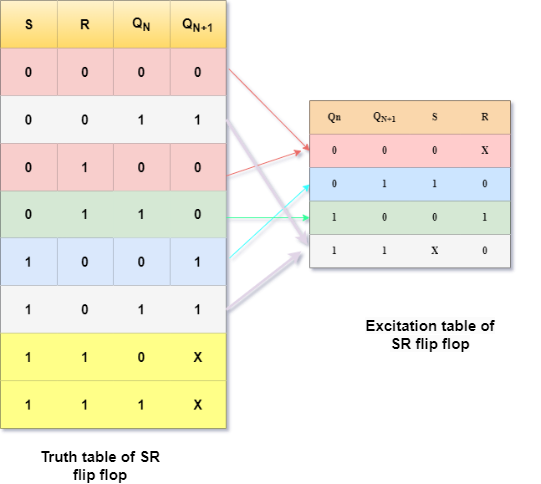
The excitation table of the SR flip-flop can be constructed from the information available in the truth table. In the diagram shown below, the first table shows the truth table, from which the excitation table is derived.
From the truth table, you can observe that when the present state is Qn = 0, the next state becomes Qn+1 = 0 for two input values S = 0, R = 0 and S = 0, R = 1.
From this we can say that, for the state transition from Qn = 0 to Qn+1 = 0, the excitation inputs required are S = 0 and R = 0 or 1. It is filled in the first row of the excitation table. Since R has two values(0 and 1), it is denoted as a don’t care condition(x). Similarly, when you observe the truth table, to obtain the next state output Qn+1 = 1 from the present state input Qn = 0, the required SR inputs are S = 1 and R = 0.
Thus for state transition from 0 to 1, the excitation inputs require are S = 1 and R = 0. It is filled in the second row of the excitation table.
The state transition from the present state Qn = 1 to the next state Qn+1 = 0 happens only when the inputs are S = 0 and R = 1. It is filled in the third row of the excitation table.
In the same way, the state transition from Qn = 1 to Qn+1 = 1 happens at S = 0, R = 0 and S = 1, R = 0.
It is filled in the fourth row of the excitation table as Qn = 1, Qn+1 = 1 and S = x, R = 0. Here x denotes the don’t care condition, as it has two values(0 and 1).
2. JK Flip Flop
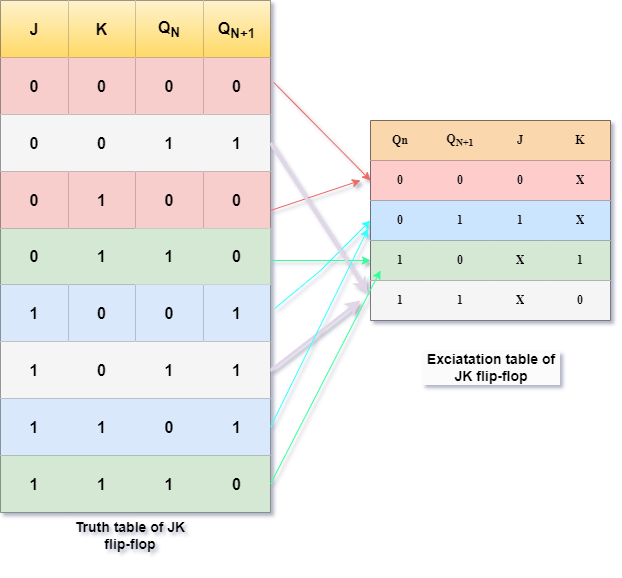
For the JK flip flop, the excitation table is derived in the same way. From the truth table, for the present state and next state values Qn = 0 and Qn+1 = 0, the inputs are J = 0 and K = 0 or 1. Since K input has two values, it is considered as a don’t care condition(x).
Thus the state transition from Qn = 0 to Qn+1 = 0 takes place when J = 0, K = x. It is filled in the first row of the excitation table.
The state transition from present state Qn = 0 to the next state Qn+1 = 1 occur, when the inputs are either J = 1, K = 0 or J = 1, K = 1. Thus the excitation table is filled with datas Qn = 0, Qn+1 = 1, J = 1 and K = x.
Similarly, for the transition of the state from 1 to 0, the inputs are J = 0, K = 1 or J = 1, K = 1. So for this transition, the required inputs are J = x and K =1, as the value of J can be either 0 or 1. For the state transition from Qn = 1 to Qn+1 = 1, the J input can be 0 or 1 but the K input remains at 0. For this transition to occur, the excitation inputs are J = x and K = 0.
3. D Flip Flop
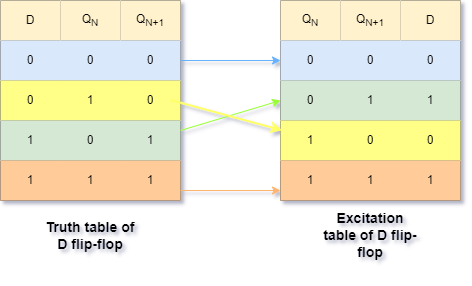
For the state transition from Qn = 0 to Qn+1 = 0, the required excitation input is D = 0, regardless of Qn value. For transition of states from Qn = 0 to Qn+1 = 1, the input required to excite is D = 1.
The state transit from Qn = 1 to Qn+1 = 0 for the input D = 0. For the input D = 1, the state transition takes place from Qn = 1 to Qn+1 = 1.
All the above-mentioned state transitions for D flip flop from the present state(Qn) to the next state(Qn+1) for the corresponding excitation inputs are filled in the table to get the excitation table.
From the truth table, we can observe that, when the T input is 0, there is no change in the state. So for the state transition from the present state to the next state, i.e., from Qn = 0 to Qn+1 = 0 and from Qn = 1 to Qn+1 = 1, the excitation input require is T = 0. It is filled in the first and the fourth row in the excitation table.
Similarly, from the truth table, we can also observe, when T = 1, the state of the flip flop toggles or is complimented. Thus, for the transition of the state from either 0 to 1 or from 1 to 0, the excitation input is T = 1. It is filled in the second and third rows of the excitation table.
4. T Flip Flop
From the truth table, we can observe that, when the T input is 0, there is no change in the state. So for the state transition from the present state to the next state, i.e., from Qn = 0 to Qn+1 = 0 and from Qn = 1 to Qn+1 = 1, the excitation input require is T = 0. It is filled in the first and the fourth row in the excitation table.
Similarly, from the truth table, we can also observe, when T = 1, the state of the flip flop toggles or is complimented. Thus, for the transition of the state from either 0 to 1 or from 1 to 0, the excitation input is T = 1. It is filled in the second and third rows of the excitation table.