Half Subtractor - mbits-mirafra/digitalDesignCourse GitHub Wiki
What is half subtractor?
A half subtractor is a combinational circuit used in digital electronics for subtraction of two single-bit binary numbers. It has two inputs, A and B, and two outputs, the difference (D) and borrow (B-out). The half subtractor circuit outputs the difference between the two input bits and a borrow output, which is used to subtract the next higher-order bit pair in a multi-bit subtraction operation.
Why do we need to learn this topic?
Half subtractor is an important building block in digital electronics and logic design. It is used to subtract two single-bit binary numbers and produce the difference and borrow output. Learning about half subtractors is important because it provides the fundamental knowledge required for understanding more complex subtractors, such as the full subtractor. Additionally, the concepts and techniques used in designing a half subtractor can be applied to other digital circuits, such as adders, multipliers, and more. In summary, learning about the half subtractor is essential for understanding the fundamentals of digital electronics and logic design, and it provides the foundation for more complex digital circuits.
Advantages of half subtractor
- Simple and easy to implement using basic gates like XOR, NAND, and NOT.
- Generates borrow output, which is useful in performing subtraction of multi-bit numbers.
- Provides accurate subtraction results.
Disadvantages of half subtractor
- Can only subtract two single-bit binary numbers.
- Does not account for any borrow from a previous bit position.
- The output from the half subtractor circuit may require additional processing to obtain the final answer.
When is half subtractor used?
Half subtractor is used for the following situation:
- Binary subtraction: It is used in binary subtraction to subtract two binary numbers.
- Error detection: It can be used to detect errors in a binary system. For example, if a bit in a binary number is lost or corrupted, the half subtractor can be used to detect the error.
- Digital signal processing: It is used in digital signal processing to subtract two digital signals. For example, in audio processing, the half subtractor can be used to subtract noise from a signal.
- Logic gate design: It is a fundamental building block for designing more complex logic gates, such as full subtractors and adders.
- Control circuitry: It can be used in control circuitry to perform operations such as counting and timing.
How is half subtractor used?
A half subtractor is a combinational circuit that can be used to subtract two binary bits. To use a half subtractor, you would input two binary bits as the minuend and subtrahend, and then connect the outputs to another circuit that can handle the subtraction result.
For example, let's say you want to subtract 1 (binary 01) from 3 (binary 11). You would input these values into the half subtractor and connect the output of the difference (D) to a circuit that can handle the binary result. In this case, the difference is binary 10, which is equal to decimal 2.
Here is an example of how to use a half subtractor:
Input: A = 1, B = 0 Output: D = 1, B' = 0
In this example, A is binary 1 and B is binary 0. The difference (D) is binary 1, which is the correct result of 1 - 0. The borrow (B') is binary 0.
The circuit diagram and Truth table for half adder is shown below.

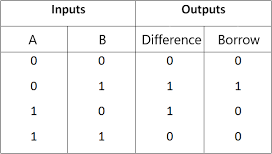
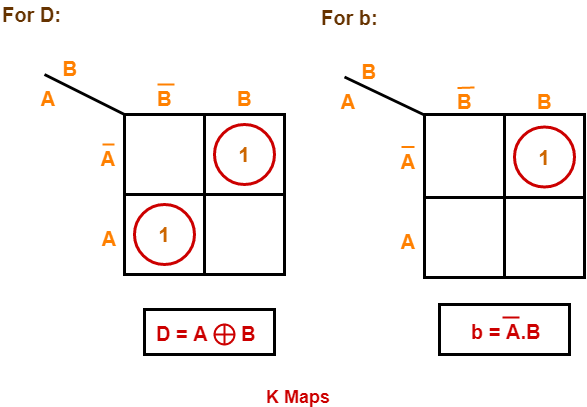
Equations of outputs are:
D=A⊕B
B=A'B
Limitation
Consider the following example
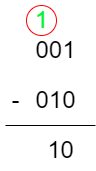
In the example for lsb half subtractor can be used since half subtractor subtracts two binary bits but in case of msb there is a borrow from previous bit which makes it three single bit and half subtractor cannot subtract it. To overcome this Full subtractor can be used.