Bcd Adder - mbits-mirafra/digitalDesignCourse GitHub Wiki
BCD Adder
BCD adder is a combinational circuit which adds two decimal numbers. The BCD-Adder accepts the binary-coded form of decimal numbers. The Decimal-Adder requires a minimum of nine inputs and five outputs.
The BCD-Adder is used in the computers and the calculators that perform arithmetic operation directly in the decimal number system.
An advantage of the Binary Coded Decimal system is each decimal digit is denoted by a group of 4 binary digits and that it allows easy conversion between decimal a base-10 system and binary a base-2 system. A disadvantage is BCD code does not used all the states between binary 1010 for the decimal 10 and binary 1111 for the decimal 15.
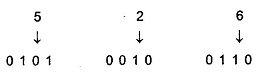
Example: 526 in BCD is written as
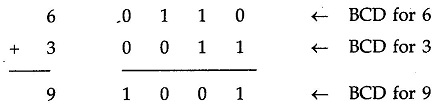
When sum is less than or equal to 9
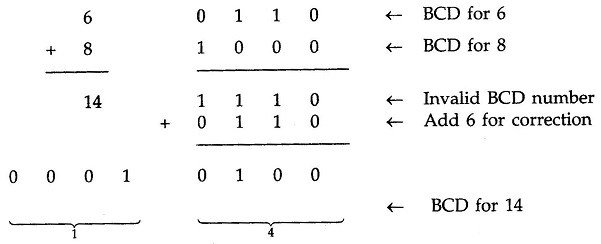
When sum is greater than 9
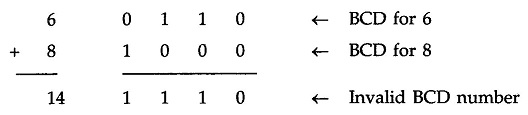
It can be set right by inserting 0110 to the binary sum. This can make an output carry necessarily for the next pair of significant numbers.
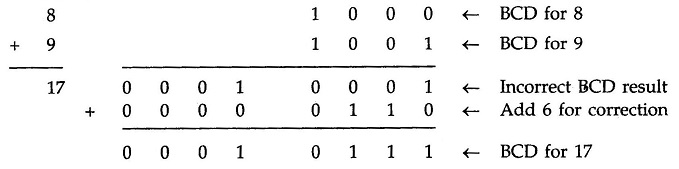
When sum is less than or equals to 9 with carry 1

It can be corrected by adding 0110
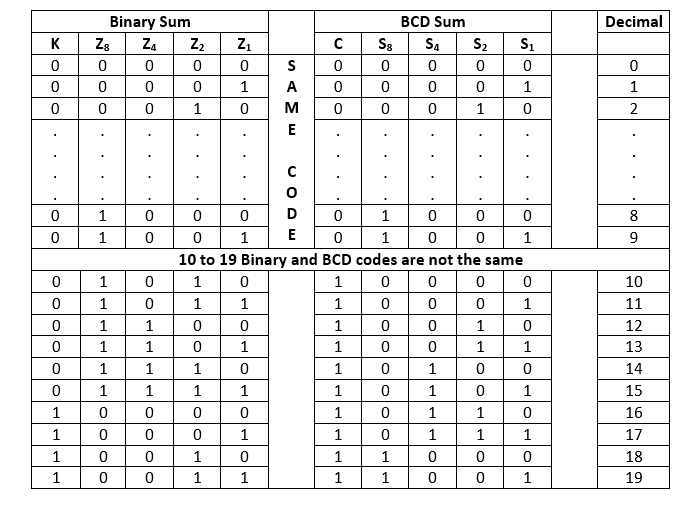
BCD truth table:
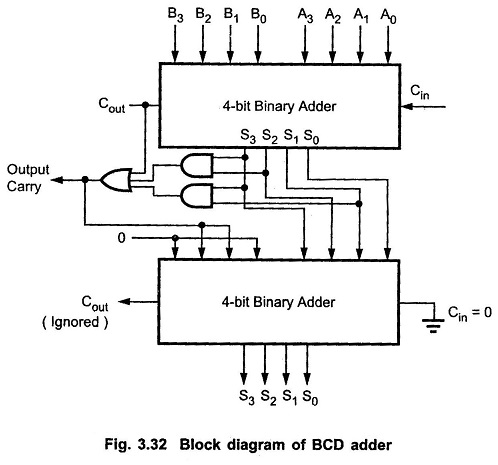
Implementing the BCD adder
- 4-bit binary adder for initial addition
- Logic circuit to detect sum greater than 9 and
- One more 4-bit adder to add 0110 in the sum if sum is greater than 9 or carry is 1.
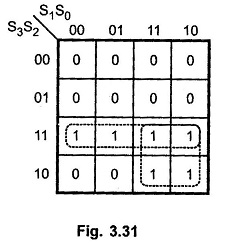
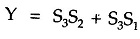
The logic circuit to determine whether the sum is greater than 9
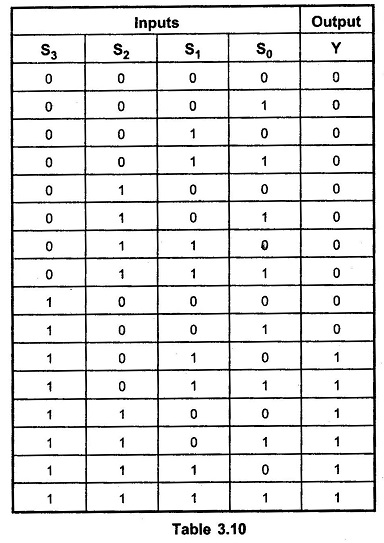
k-map
Logic equation
The block diagram of BCD adder