Testing Conventions - alexherrero/crickets GitHub Wiki
Testing Conventions gives your agent a steady stance on how to test — one it carries the whole time it writes code, not a pass you bolt on at the end. It holds the line on the habits that keep a suite trustworthy: write the failing test before the code, never weaken or delete a test to get a build green, and keep fast unit tests, integration tests, and end-to-end tests at their own distinct scopes. When the agent reaches for a shortcut like a skip marker, it makes sure there's a real, documented reason rather than a quiet "we'll get to it later." So by the time a change reaches review, the tests already reflect what the code actually does. It builds on Development Lifecycle, extending that phase loop with test discipline rather than standing on its own.
How it composes — the plugin's two primitives, the development-lifecycle base it requires, and the AgentM substrate it rests on:
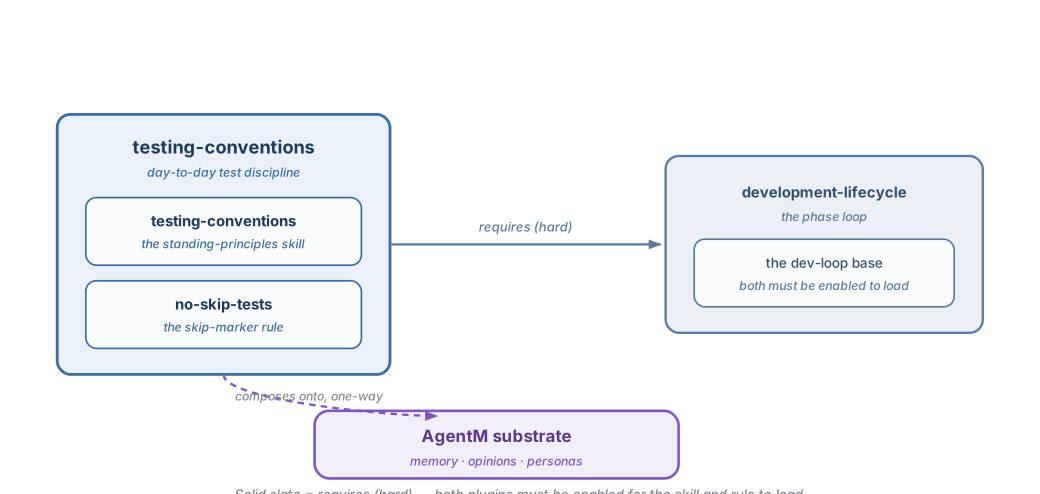
Two pieces work at two different moments. The first is a set of standing principles the agent keeps in mind as it writes: tests are sacred, so it never guts one to make a build pass; verification comes first, so it writes the failing scenario before the code that answers it; and the test pyramid stays intact, so quick unit tests, integration tests, and slower end-to-end tests each keep their own job instead of blurring together. The second watches for the moment the agent goes to skip a test. Skipping isn't banned — but the agent has to say why in the test itself, naming the actual blocker (a missing dependency, an environment it can't reach, a known upstream bug) and pointing at where it's tracked. A vague "TODO" or "flaky" won't do; the reason has to be real and checkable later.
Together they cover both the reflex and the practice — the split-second you reach for a skip, and the way you write and layer tests in the first place. This plugin owns that day-to-day practice. Auditing a finished change for missing test types is a different job, and lives in the Code Review plugin.
| Direction | Plugin | How |
|---|---|---|
| Enhances (soft) | — | None. |
| Enhanced by (soft) | — | None. |
| Requires (hard) | Development Lifecycle | Testing Conventions builds on the development-lifecycle base — both plugins must be enabled for the skill and rule to load. |
| Required by (hard) | — | None. |
Testing Conventions is opinionated, and it will not fit every workflow. Reach for something else if:
- Your team already has its own testing doctrine — a different pyramid shape, a different stance on skip markers — and you don't want a second opinion layered on top.
- You want review-time gap auditing rather than standing practice; that's the
code-reviewplugin'stesting-strategyskill, not this one. - The change is small or throwaway. The verification-first and never-skip principles are deliberately firm, and on a spike or a one-off script they can feel heavier than the work warrants.
Each primitive links to the source that implements it.
| Primitive | Kind | What it does |
|---|---|---|
testing-conventions |
skill | Standing testing principles — tests are sacred, verification first, the 3-layer pyramid. |
no-skip-tests |
rule | Fires on a skip/xfail/xit/pending marker; requires a comment naming the technical blocker plus a tracking link. |
No configuration — the plugin works out of the box.
-
Testing strategy audit — the
code-reviewcompanion that audits a diff for missing test types. - Code Review — the adversarial review plugin this pairs with at review time.
-
Conventions design — the deeper design, including the planned merge of
testing-conventionsandreleasing-conventionsinto a singleconventionsplugin.