agentm opinions and gates - alexherrero/agentm GitHub Wiki
Note
LAUNCHED (lifted 2026-06-24, AG Phase 3; originally approved 2026-06-21) · locked 2026-06-28 (final AG design sweep). child-design — the Opinions pillar, parent agentm HLD. The compose-and-serve path this pillar left [PENDING-IMPL] shipped 2026-07-06 — see the opinion registry design, which governs opinion_resolver.py; status: launched (lifted into tracked wiki/designs/ 2026-06-24, AG Phase 3).
An opinion is opinionated knowledge agentm holds, named so any tool can ask for it — a standard for how to work. It answers a general question: what does done, good, or efficient mean? What does our engineering process look like? Holding the standard once, by name, buys three things:
- quality gets checked, not just asserted;
- one standard serves every caller;
- the standard sharpens over time across agents and tools, without refactoring.
An opinion is deliberately abstract — knowledge that carries the standard; a capability asks for it by name and acts on what comes back.
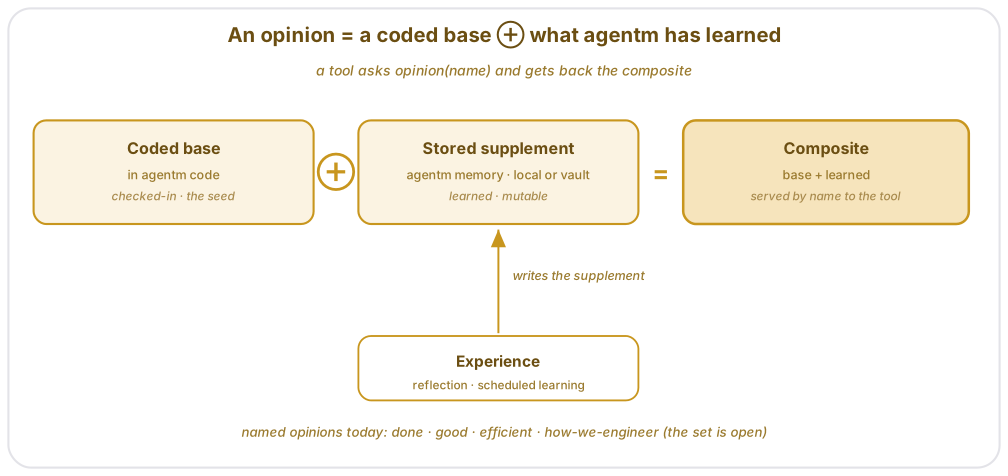
Two things follow from keeping opinions abstract:
-
One opinion serves many tools. The same good is asked for whether
/review, a persona, or a future tool asks — defined once, named once. - An opinion sharpens without touching a tool. Improve the standard and every caller that asks for it gets the better standard for free — this is where Experience feeds in over time (the Experience design).
Opinions are a queryable knowledge surface — a tool names what it needs and the substrate serves it.
Opinions are what make agentm opinionated: a standard for things like done / good / efficient / how-we-engineer (the full catalog is below) that the agent ships with, in code, and then grows in agentm's memory as it learns. The design folds this into existing seams — a coded base, a vault supplement, composed on request and served by name — building entirely on the store and recall path that already exist. The named opinions are listed at the end; this section is the system that holds and serves them.
- The base is in agentm's code, checked in. Each opinion ships as a coded default — the standard the agent starts with. This is why agentm is opinionated out of the box: it already holds a view of what done / good / efficient / how-we-engineer mean. The base changes only by a check-in — it's the durable seed, the same for every install.
-
agentm's memory extends it — and this is the part that learns. A supplement layer in agentm's memory — whichever storage backend the agent is connected to (device-local or the vault), through the storage seam — holds what the agent has added to a base opinion over time (an
opinions/area beside the always-load conventions). Experience (reflection + scheduled learning) writes here; the agent never rewrites the coded base. This layer already exists in spirit — the learned conventions inpersonal/_always-load/are exactly this kind of stored, learned supplement to a coded standard.
On request, agentm folds the coded base ⊕ the vault supplement into one composite and serves that. The tool gets the seed plus everything learned since, as a single opinion — it never sees the two layers, and a bare install (base only) or a seasoned one (base + a rich supplement) is served the same way.
Three things agentm already has carry this, so there is nothing new to invent:
-
By-name lookup rides the seam crickets already uses to reach agentm — the one-way capability bridge (
find_capability.py→capability_resolver.py); a thinopinionlookup rides the same path. -
The base ⊕ overlay fold is the pattern agentm's style system already uses — a base guide composed with a learned overlay (
style_resolver.py); opinions compose the same way. - The supplement's storage, recall, and learning is the memory engine (Memory System).
Built (2026-07-06). The opinion lookup + the base ⊕ supplement fold ship in opinion_resolver.py (see the opinion registry design) — opinion_resolve(name) returns served / base-only / no-opinion / error, never raising. The nine coded bases ship as opinions/<name>.md stubs; the wirings that let a tool call opinion_resolve instead of its own hardwired copy flip one at a time as each consumer's own slice builds (the Opinion slice, design-doc Forward plan, Phase 3 → 4).
The named opinions, listed like capabilities — what each holds, who asks for it, and just enough to fix its shape. The standard itself lives in the opinion entry, not here, and the set is open (these are today's).
| Opinion | What it holds | Serves | Shape |
|---|---|---|---|
| done | a completeness checklist |
/work, /release, conventions gates |
the check battery + the written conventions — is it finished? |
| good | a quality standard |
/review, code-review
|
the adversarial-review contract — does it survive a hostile read? |
| efficient | a cost budget with a quality floor |
token-audit, model routing, /work
|
cheap as the job allows, held above the good floor |
| how we engineer | the process discipline |
/plan, /work, design, /bugfix
|
the phase discipline · the bugfix track · the plan → design → architecture sizing ladder |
| recoverable | the reversibility doctrine |
/work, /release, /bugfix, the push gate |
classify each action recoverable / unrecoverable — proceed on the recoverable, stop on the unrecoverable; can it be undone? (standard lives in developer-safety) |
| private | a leak floor |
development-lifecycle finalize, CI, diagnostics
|
secrets + PII stay out of what's committed — is it safe to commit / share? (deterministic floor lives in privacy) |
| ready | a launch-readiness gate | /launch |
metrics + alerts + a tested rollback + a flag off-switch + a staged rollout — is it ready to ship to real users? |
| simple | the simplest-thing-that-works standard |
/simplify, maintenance
|
Chesterton's Fence + the Rule of 500 — is any of this accidental complexity? |
| worth-knowing | a relevance bar |
research, Experience, the Researcher persona |
is this worth remembering, researching, or surfacing? |
(The phase discipline is agentm's; the phase commands are crickets' — the discipline-vs-tools split; see Dependencies. The full standard behind each opinion lives in its entry. efficient's model-routing lever is specified in model + effort routing — the model × effort tier scale + persona→tier map that turns "cheap as the job allows" into a concrete model + effort pick.)
Note
Retired; nothing runs it. Stage 1's routing left reflection in agentm-vault plan 03, and Stages 2-3 — the dreaming stage, opinion_supplement.py, its console section and verify-opinion-supplements.sh — retired in plan 04. The summary below is the record of what was built; the primary home, the Experience design, carries the same note.
Condensed twin of the fuller section in the Experience design (spec landed 2026-07-07 from ACCUMULATE-LOOP-SPEC-DRAFT.md; Stage 1 built v9.1.0; Stages 2-3 designed to ten locked calls 2026-07-25 and built the same day, PR #380). The one-sentence design: the accumulate loop is the style-learning loop generalized from voice to standards — the same edit-driven, operator-gated capture the wiki system already proved, with a recurrence gate in front and the coded base as an unoverridable floor behind.
-
Route, don't invent (built). No new pipeline — a routing rule inside the existing capture paths targets an opinion supplement when a candidate is standard-shaped.
opinion_routing.pyclassifies deterministically from the candidate's own text and writes to a per-opinion lane atpersonal/_opinions/<name>/; nothing is ever written into a codedopinions/*.md. -
The signal → opinion map is retired. It keyed on sources that emit nothing machine-readable, three of the four living in crickets rather than agentm. Text-shape classification is the sole classifier; Stage 1's existing optional
source:field records origin as provenance, never as a routing key. Voice and prose lessons stay in the style overlay and are never double-captured here. -
Three anti-corruption guards, each with its mechanism. A recurrence gate — the same lesson from two distinct sessions, matched at 0.85 similarity within one opinion's lane, which is its own store. Extend-never-override — a suspected contradiction parks rather than serving, and surfaces as a proposed base change through the cycle digest,
_meta/opinion-base-proposals.json, and the console; applying one means editing the base by hand. Provenance —sessions:, optionalrefs:, and the existingsupersedes:chain, reported by a supplement-health check on thememory freshness+experienceaxis. - Cadence: capture continuous; promotion runs as one new dreaming stage, confirm-gated through a supervised first window before any auto-apply ruling; maintenance stays dreaming's — named owner, no second mechanism.
As-built (2026-07-25, PR #380). Stages 2-3 shipped as one new dreaming stage plus a stdlib-only leaf module (opinion_supplement.py): the recurrence gate, contradiction check, composition, the kind: opinion-supplement registration, the _opinions/ dreaming exclusion, and the health surface (verify-opinion-supplements.sh in check-all.sh + CI). Promotion stays confirm-gated — opinion_promote is not in AUTO_APPLY_STAGES until a fresh operator ruling — and the 0.85 / ~20-entry calibration numbers wait on real lane volume, which is zero today. No change to the compose-and-serve model above — the accumulate loop is entirely how the supplement fills, not how it's served, and composition writes the served <name>.md at exactly the path opinion_resolver._read_supplement already reads, so the resolver is untouched.
-
crickets touches by request, not by wiring. A tool names the opinion it needs and runs its implementation:
/reviewasks for good (runs the adversarial pass);/releaseand/workask for done (run the check battery); any tool can ask for efficient or a process opinion. The crickets side of the wiring is the composition design. - Personas lean on opinions — the "Leans on" column of the Personas design names which surface each persona consults.
- Experience feeds back — reflection + scheduled learning sharpen the surfaces over time (the Experience design).
- Points up at the agentm HLD §Opinions. The V5 unbundling — phase commands moved to crickets — is why agentm owns the discipline while crickets owns the phase tools.
-
The compose-and-serve path shipped 2026-07-06. The coded bases are addressable opinions (
opinions/*.mdstubs), the stored supplement layer folds on request throughopinion_resolver.py(a resolver pattern mirroringgoverns_resolver.py— pure, one-way, never-raise). That code is specified by, and governed by, the opinion registry design; this pillar stays discipline/area-only. What's left: each hardwired consumer (code-reviewembedding good, etc.) still flips to callingopinion_resolveone at a time as its own slice builds — the registry existing doesn't retrofit every caller at once. - Opinion versioning — when a standard shifts (a new check joins the done battery), how do callers that cached the old standard adapt? Open.
- The accumulate loop is retired. Its routing left reflection in agentm-vault plan 03, and its dreaming stage, leaf module and health gate left in plan 04, after the vault series' session 1 retired the lanes it filled. The compose-and-serve path above is untouched.
- Re-audit triggers: flip the request-by-name API to as-built when the registry ships.
-
Coded bases (in agentm / its tools today):
AGENTS.md+harness/principles.md(conventions + engineering discipline) ·scripts/check-all.sh+wiki/reference/CI-Gates.md(the done battery) · cricketscode-review+wiki/explanation/Why-Adversarial-Review.md(the good contract) ·~/.claude/CLAUDE.mdopusplan +heat_policy.py(the efficient levers) · cricketsdevelopment-lifecycle(how we engineer) -
Stored supplement (the learned layer): agentm's memory — whichever backend it's connected to (device-local or the vault, via the seam); e.g. the learned conventions in
personal/_always-load/(docs-prose-style.md) -
The base ⊕ overlay precedent: crickets
wikidiataxis-author—style_resolver.pycomposingstyle/base-style-guide.mdwith a learned overlay; opinions reuse this compose shape -
The by-name seam:
find_capability.py→capability_resolver.py— the one-way bridge a thinopinionlookup rides -
The accumulate loop's full spec: the Experience design § The Experience → Opinions accumulate loop; original source draft at vault
_harness/designs/architecture-governance/ACCUMULATE-LOOP-SPEC-DRAFT.md
2026-09-11 — the accumulate loop retires (agentm-vault plan 04, task 5). Stages 2-3 leave with the dream cycle's shrink: _stage_opinion_supplement(), opinion_supplement.py, console.section_opinion_supplements and scripts/verify-opinion-supplements.sh, with its check-all.sh and CI steps. Stage 1's routing had already left reflection in plan 03. The section above gains a retired note and the risks say so; the Experience design, the primary home, carries the matching entry. Why not keep the stage for a future lane: the vault design's session 1 retired the lanes it filled, and a stage with no lane to read has nothing to promote. Re-audit trigger: a proposal to learn standards from sessions again, which would start from a fresh design.
2026-09-03 — the supplement lanes moved to memory/crystallized/<name>/ (filing-v2 part 3, v9.12.0). The primary home (Experience and dreaming, locked calls 6–7 and its amendment of the same date) carries the decision; this twin records the as-built pointer: opinion_supplement.lane_base() resolves the lane root, and the _opinions/ dreaming exclusion the as-built note above names is now a kind-based exemption wherever a supplement sits. Re-audit trigger: the same as the primary's.
2026-07-25 — Stages 2-3 built; the twin's marker flips to as-built (PR #380, same-day follow-on to the design pass below). All ten locked calls implemented verbatim: opinion_supplement.py (the recurrence gate at 0.85 over per-opinion lanes, two distinct sessions to promote; the narrow direct-negation contradiction check; whole-lane composition), the _stage_opinion_supplement() dreaming stage staging confirm-gated opinion_promote proposals through the existing revert-log path, the KNOWN_KINDS registration, the _opinions/ dreaming exclusion, and the health surface on the memory freshness+experience axis (verify-opinion-supplements.sh, wired into check-all.sh + CI). One field-name reconciliation, ruled in the Experience design's own 2026-07-25 as-built amendment: the design pass's signal_source: is Stage 1's existing source: field — same meaning, an optional origin tag serving as provenance only — so the build kept the one field and this twin now names source:. The compose-and-serve model stays untouched, exactly as the design promised: composition writes the served <name>.md at the path opinion_resolver._read_supplement already reads. Re-audit trigger: the 0.85 / ~20-entry calibration numbers once real lane volume exists; the auto-apply ruling stays open by design (call 9) and opinion_promote joins _ANOMALY_WATCHED_STAGES when it is made.
2026-07-25 — the accumulate loop's Stages 2-3 get an implementable design; condensed twin reconciled (design pass, no code). Primary home is the Experience design, where the ten locked calls and their why-not-the-alternative reasoning live; this twin carries the four-bullet summary. Two changes matter here. The signal → opinion map is retired (operator ruling) — it keyed on sources that emit nothing machine-readable, three of the four living in crickets, so text-shape classification is the sole classifier and an optional signal_source: field records origin as provenance only. Promotion is confirm-gated through a supervised first window (operator ruling) before any auto-apply, since a served supplement is text the agent reads as its own standard. The rest of the twin gains the mechanism behind each guard: the recurrence gate matches at 0.85 within one opinion's per-opinion lane and needs two distinct sessions; a suspected contradiction parks and surfaces as a base-change proposal through the digest, _meta/opinion-base-proposals.json, and the console; provenance is sessions: + optional refs: + the existing supersedes: chain, reported on the memory freshness+experience health axis rather than the "opinions family" the spec named, which does not exist. Nothing changes in the compose-and-serve model above — composition writes the served <name>.md at exactly the path opinion_resolver._read_supplement already reads, so the resolver stays stdlib-only and untouched. Re-audit trigger: flip the [PENDING-IMPL] once Stages 2-3 build.
2026-07-07 — the Experience → Opinions accumulate loop spec landed, condensed twin, design amendment only (PLAN-wave-e-experience task 3, SPEC-FIRST). Lands the condensed twin of ACCUMULATE-LOOP-SPEC-DRAFT.md's contract here (full version in the Experience design, the amendment's primary home) — the operator explicitly approved a go/no-go on the draft before this landing. New subsection "How the supplement grows: the accumulate loop" added after the opinions table: route-don't-invent, the signal→opinion map, the three anti-corruption guards (recurrence gate, extend-never-override, provenance-or-it-didn't-happen), and the cadence (continuous capture, gated promotion, maintenance delegated to dreaming's whole-corpus pass — no second mechanism). Landed verbatim, no redesign. No code ships in this task — the routing rule, signal map, and guards are all [PENDING-IMPL], deferred to a follow-on plan. This closes the "designed, not specified" gap the 2026-06-21/2026-06-24 entries below both named as open. Re-audit trigger: flip this note's [PENDING-IMPL] once the follow-on implementation plan lands.
2026-07-06 — compose-and-serve [PENDING-IMPL] flipped to as-built (AG Wave B leader 2/5). The request-by-name registry this pillar left open ships in opinion_resolver.py + agentm-opinion.sh, governed by the opinion registry design. This pillar's own content (the nine-opinion catalog, the "opinions today" table) needed no change — it already named all nine as of the 2026-06-26 amendment. What's left is per-consumer: each hardwired tool flips to opinion_resolve one at a time. Re-audit trigger: note when the last hardwired consumer flips.
2026-06-28 — lock-down sweep (operator review). Sized the diagram (width/height); confirmed the nine-opinion catalog + the request-by-name model. Log already newest-first. Locked as a v5–v8 guidepost.
2026-06-26 — catalog expanded to nine; the resolver mechanism homed in its own design. The opinions catalog grows from four to nine: added recoverable (the reversibility doctrine, provided by developer-safety), private (the leak floor, provided by privacy), ready (the launch-readiness gate), simple (the simplest-thing-that-works standard), and worth-knowing (the relevance bar the Researcher persona leans on). recoverable and private are promoted from sub-standards folded into other opinions to peer opinions; voice stays a prose-style overlay in style_resolver, not a catalog opinion. The request-by-name mechanism this pillar left as [PENDING-IMPL] is now specified by the new opinion registry child design, which governs opinion_resolver.py; this pillar stays discipline/area-only. Re-audit trigger: revisit the catalog when a new surface is authored; flip the compose-and-serve [PENDING-IMPL] to as-built when the registry ships.
2026-06-24 — pointed efficient's model-routing lever at the routing design. The efficient opinion names "model routing" as a lever it backs; that lever now has a concrete design — model + effort routing (the model × effort tier scale + persona→tier map + the tier: persona-manifest axis). Added a pointer from the opinions-table footnote; one-way (the opinion names the lever, the routing design specifies it). No change to the compose-and-serve model. Re-audit trigger: when the request-by-name registry ships, efficient returns the routing policy as part of its served composite.
2026-06-21 — authored, reviewed, and finalized.
Migrated from the agentm HLD and reframed through operator review into the Opinions pillar: opinions are what make agentm opinionated — a coded base (checked-in, the seed) extended by a learned supplement in agentm's memory (whichever storage backend it's connected to, device-local or the vault), folded into a composite served to a tool by name. The four named opinions (done / good / efficient / how-we-engineer) are listed like capabilities — shape only; each standard lives in its own opinion. The system reuses three existing seams — the capability-resolution bridge (by-name lookup), the style system's base⊕overlay compose (style_resolver.py), and the memory engine (the supplement) — with no new registry or recall path required.
Content-final. The compose-and-serve path shipped 2026-07-06 (see the opinion registry design); status: launched (lifted into tracked wiki/designs/ 2026-06-24, AG Phase 3). Re-audit triggers: flip each hardwired consumer to opinion_resolve as its own slice builds; specify the Experience → Opinions sharpening loop when the weekly field brief lands; settle opinion versioning.