agentm opinion registry - alexherrero/agentm GitHub Wiki
The opinion registry is the thin resolver that makes agentm's opinions addressable by name: a tool or persona asks for
goodordone, and the registry folds the coded base with the learned supplement and serves one composite over the seams agentm already has. Built in AG Wave B (scripts/opinion_resolver.py), realizing the compose-and-serve request-by-name path the opinions pillar had left[PENDING-IMPL]; parent agentm HLD.
An opinion is a standard agentm holds for how to work — what done, good, recoverable, or ready mean. The opinions design says a tool should be able to ask for one by name and get back the coded base folded with everything the agent has learned since. That request-by-name path was the one piece the opinions design had left as [PENDING-IMPL]; this design specifies it, and it shipped in AG Wave B (see the Amendment log).
Today each opinion is hardwired into its tool — code-review carries its own copy of good, the check battery carries done — so no tool can ask agentm for the standard; it carries a private copy. The registry closes that gap. It is the resolver that scans the opinion entries, resolves a name to its composed standard, and serves it, so the standard is defined once and every caller asks for it. It is a dependency leader: the per-capability opinion wirings and the persona roster's "Leans on" column both resolve through it.
The registry adds one resolver. Opinions live in two layers agentm already has — a coded base checked into the repo and a learned supplement in the memory backend — and the resolver folds them on request, the same base⊕overlay fold the style system already uses. The build roadmap names this the registry; what it adds is the resolve-by-name path over those existing seams (the opinions design's reuse-the-seams intent, made concrete).
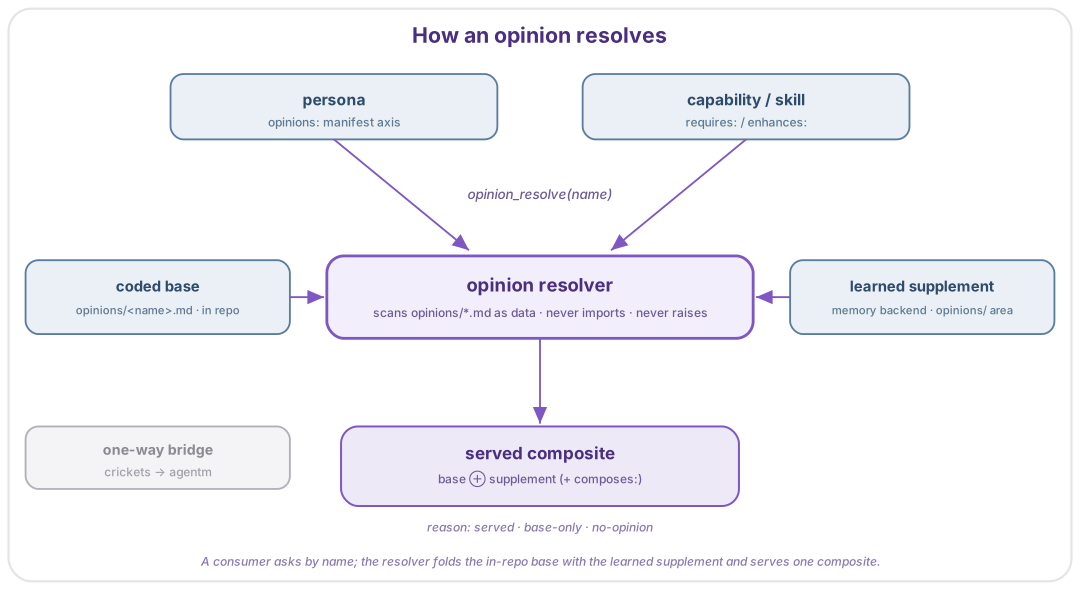
A consumer asks by name; the resolver folds the coded base (in-repo) with the learned supplement (memory backend) and serves one composite. It rides the one-way capability bridge: crickets depends on agentm in a single direction.
The registry is a resolver in agentm, built to mirror the two that already do this job for other markdown data: capability_resolver.py (the one-way capability bridge) and governs_resolver.py (resolve a target to its governing design by scanning wiki/designs/ frontmatter as data). The opinion resolver copies that template closely — it reads markdown as data, never imports it, and never raises.
The resolver exposes two functions, with a thin CLI shim over them:
opinion_resolve(name, *, root=None) -> dict   # rich form → {served, name, base_present, supplement_present, reason}
opinion_available(name) -> bool               # boolean surface (mirrors capability_available)
scripts/agentm-opinion.sh wraps opinion_resolver.py (exit 0 served · 1 unavailable · 2 usage), mirroring agentm-capability.sh and agentm-governs.sh.
Crickets reaches the resolver through a thin bridge that mirrors the crickets-side find_capability.py (in development-lifecycle) — path-fallback discovery, graceful-skip when agentm is absent. The direction is one-way: crickets depends on agentm in a single direction.
No opinion schema exists today, so this design defines the first one. Each opinion is a markdown file with YAML frontmatter, read as data exactly as governs_resolver reads a design's frontmatter:
---
name: good                 # the canonical request-by-name key
kind: opinion              # the primitive kind (mirrors kind: design / kind: persona)
question: "does it survive a hostile read?"   # the one-line standard the surface answers
serves: [code-review, "/review"]              # consumers, advisory — for discovery, not resolution
implements: crickets/code-review              # pointer to the built artifact carrying the standard today
composes: []               # optional — sub-providers folded into the served composite
---
The standard prose — the coded base of the opinion.
The served composite is the base body ⊕ the learned supplement, folded by the same mechanism crickets' style_resolver.py (in wiki's diataxis-author) already uses for the prose-style base⊕overlay. Two storage layers:
-
The coded base ships as
opinions/<name>.mdin the agentm repo — the durable seed, the same for every install, changed only by a check-in. -
The learned supplement lives in the memory backend through the storage seam — an
opinions/area beside the always-load conventions, written by Experience over time. The resolver reads it; it never writes it.
Opinion content does not live in the kernel config. The resolver reads markdown-as-data, the way governs_resolver does; the config plane stays out of the content path.
The names the resolver serves — the catalog the opinions pillar owns. The set is open; voice stays in the style_resolver sibling (a prose-style overlay).
| Opinion | is it…? | where the standard lives today |
|---|---|---|
| done | finished? | the check battery + the written conventions |
| good | survives a hostile read? | the adversarial-review contract (code-review) |
| efficient | as cheap as the job allows, above the good floor? | opusplan + heat_policy.py + the model×effort tier scale |
| how-we-engineer | the way we work? | the phase discipline + the bugfix track + the sizing ladder |
| recoverable | able to be undone? | the recoverability doctrine (developer-safety) |
| private | safe to commit / share? | the deterministic leak-floor (privacy) |
| ready | ready to ship to real users? | the launch-readiness gate (/launch) |
| simple | the simplest thing that works? | Chesterton's Fence + the Rule of 500 (/simplify) |
| worth-knowing | worth remembering / surfacing? | the relevance bar (research + Experience) |
recoverable, private, ready, and simple have a standard a capability already holds; worth-knowing is the relevance bar the Researcher persona leans on. Each is addressable by name once it has an entry.
build_index(root) scans opinions/*.md frontmatter into a name → OpinionEntry map (at most one base entry per name), reading and never importing. opinion_resolve(name) returns the composite plus a reason, fail-safe and never raising, in the resolver style (the governs_resolver pattern):
| Reason | Meaning |
|---|---|
served |
base present; supplement folded in if any |
base-only |
base present, no supplement yet (a bare install) |
no-opinion |
unknown name |
error |
the scan collapsed; degrade, don't crash |
Three invariants hold at the resolver boundary (the operator's ruling on the opinion-system invariants):
- The coded base is always recoverable and the supplement is fully discardable — the supplement extends the base, it never overwrites it, and the agent never rewrites the coded base.
- Opinion changes are revertable, unified with the revert-log the memory system already needs for its curated tier.
- The resolver surfaces served-with-supplement vs base-only, so a caller can tell a seasoned standard from a bare one.
Versioning is always-latest, no pin. A caller gets the current standard; reproducibility comes from recording the supplement revision in /review output. A missing name returns no-opinion and never raises — a soft consumer degrades to quiet absence; a hard consumer's gate is the layer that decides whether absence is fatal (below).
Opinions bind through the axes that already exist:
-
A persona declares the surfaces it leans on in its manifest
opinions:field — the rendered form is the roster's "Leans on" column. The registry is what that field resolves through; the binding resolves at persona-adoption time, riding the persona activation plumbing — which personas calls its unbuilt core, so this binding is co-blocked with that plumbing rather than riding an existing seam. This mirrors thetier:axis (itself designed-not-built): the persona declares the binding, the opinions pillar owns the surface, one-way. The registry is addressable by name through its CLI and the composition edges before persona-adoption resolution exists. -
A capability or a single skill declares through a dedicated
opinions:frontmatter list — the unambiguous anchor the honesty lint needs (a barerequires:/enhances:value can't tell an opinion reference from a same-named capability reference; disambiguation needs a field of its own). The existing composition edge still carries the strength:requires: opinionis hard — a gate needs the standard to run at all (e.g./review's gate needs what good looks like); the resolver returningbase-only/no-opinionis what that gate raises on.enhances: opinionis soft — the tool works without it and does more when it's present; absence is a quiet graceful-degrade.
The resolver supports sub-capability granularity: the caller can be a whole capability or a single primitive. privacy is the worked case — the capability provides the private standard (its deterministic leak-floor), while its privacy-review skill is the named sub-caller that consumes good.
Declaring opinions: says a caller depends on a standard; it doesn't say how the standard's text arrives there, and that differs by what the caller is.
Code with a render step — the caller constructs an artifact (an incident body, a dispatch announcement) — calls opinion_resolve(name) directly at runtime and folds the composite in. This is live: it sees a supplement the moment Experience writes one, and it degrades to base-only/no-section when agentm is unreachable, the same graceful-skip every crickets↔agentm bridge already uses. diagnostics (→ how-we-engineer) and development-lifecycle's routed-dispatch layer (→ efficient) are the two shipped instances.
A static markdown skill or command file has no runtime call site — the host loads it verbatim as a prompt, so there is nothing to hook opinion_resolve() into. Test which of two shapes it is using the opinion entry's own implements: pointer (the field already named as "the artifact carrying the standard today"):
-
Self-provider — the caller is the
implements:artifact (good'simplements: crickets/code-reviewandcode-reviewitself;done/how-we-engineer'simplements: crickets/development-lifecycleanddevelopment-lifecycleitself). The opinion's coded base was extracted from this caller's own prose — asking for it back resolves a reflection, not reuse. It stays hardwired, unchanged. What locks today is a drift check: the caller's prose is canonical, the opinion stub is its mirror, and the check flags the stub falling out of sync with the caller — always in that one direction, since the caller's prose stays canonical. No runtime request, no interpolation. -
Genuine cross-plugin reuse — the caller is not the
implements:artifact (designasking for good, whichcode-reviewowns). This has real dedup value, and the text must physically arrive in the caller's file. Because that file is generated once and read by installs that may have no agentm sibling at all — crickets ships its plugins standalone, no agentm required — the text is baked in at build time from a committed snapshot, never read live from agentm or the vault. A live cross-repo read can't survivegenerate.py check's determinism gate (a standalone-crickets CI has no agentm to read, so a fresh build and the committed one would diverge); a snapshot sidesteps that by being base-only by construction, matching a bare install'sreason: base-only. A parity gate (mirroringcheck-lib-parity/check-vault-lock-parity's shape) keeps the snapshot honest againstopinions/*.md, graceful-skipping when the agentm sibling isn't present to compare against. The snapshot's location and thegenerate.pywiring are crickets' own build pipeline to specify, in the composition design — this design locks the shape (committed snapshot, parity-gated, base-only), not the crickets-side mechanics. When Experience ships the supplement, a cross-plugin consumer gains a runtime overlay on top of the baked base (the existing bridge pattern) — additive, not a rewrite of the baked floor.
Classification is mechanical — grounding isn't. Whether a caller is self-provider or cross-plugin follows directly from the entry's implements: pointer, no judgment call needed. But landing in the cross-plugin class doesn't itself confirm a caller is build-ready: a future plan still needs to locate the actual prose site to interpolate into, or confirm none exists and drop the reference — the same discipline already applied to token-audit (see the corrected consumer table below).
A representative slice of the consumer set (the full map is the composition design + the persona roster), with the seam each one resolves through:
| Caller | Asks for | Strength | Seam |
|---|---|---|---|
diagnostics |
how-we-engineer | enhances | code, cross-plugin — shipped, resolves live |
development-lifecycle routed-dispatch |
efficient | enhances | code, cross-plugin — shipped, resolves live |
code-review / /review
|
good | requires (the gate needs it) | self-provider (good implements code-review itself) |
development-lifecycle (/work, /release) |
done | requires | self-provider (done implements development-lifecycle itself) |
development-lifecycle (/work, /release) |
recoverable | requires | markdown-prose, cross-plugin (recoverable implements developer-safety) |
development-lifecycle (/plan, /bugfix) |
how-we-engineer | enhances | self-provider (same artifact as the done row above) |
development-lifecycle finalize · CI |
private | requires | markdown-prose, cross-plugin (private implements privacy) |
/launch |
ready | requires | self-provider (/launch is a development-lifecycle skill; ready implements the same capability) |
/simplify |
simple | requires | self-provider (/simplify is a code-review skill; simple implements the same capability) |
design |
how-we-engineer · good | enhances | markdown-prose, cross-plugin (both) |
| Researcher persona | worth-knowing | enhances | persona axis, not this grammar (worth-knowing implements agentm/experience; binds via the persona opinions: manifest, co-blocked with persona activation) |
| Persona — Tech-Lead | done · good | adoption-time | persona axis |
| Persona — Engineer | done · efficient | adoption-time | persona axis |
| Persona — Reviewer | good | adoption-time | persona axis |
Two corrections from the pre-2026-07-06 table: token-audit is removed — it is efficient's measurement sub-provider via composes: (below), not a caller requesting efficient back; listing it as a consumer was a modeling error. maintenance and wiki were named as deferred bindings in a downstream build plan but were never in this design's own consumer map and have no located prose site — they stay absent pending a grounding pass, not added speculatively.
efficient is compound — the resolver assembles it from sub-providers via the entry's composes: field. It returns a cost budget with a quality floor: its model-routing lever is the model + effort routing tier scale and the measurement half comes from token-audit, so efficient composes: those two sub-payloads into the served composite.
Some opinions are provided by a capability that holds the standard. recoverable's standard lives in developer-safety's recoverability doctrine; private's deterministic leak-floor lives in privacy; ready's readiness gate lives in /launch; simple's lives in /simplify. The capability is the opinion's implements: artifact; the opinion makes that standard addressable by name to every other caller.
Surfaces that consume no opinion, each for its own reason (the honesty lint expects no binding from them): reporting (reports, doesn't judge — it follows the voice convention), github-projects (mirrors state), obsidian-vault (infrastructure below the substrate), conventions (the inverse — opinions cite it). developer-safety and privacy are providers of recoverable/private, not consumers.
The registry is kept honest by three gates that copy the capability-resolver pattern, plus a dedicated resolver test:
-
check-opinion-resolver-one-way.py(wired intocheck-all.sh) — an AST gate that fails ifopinion_resolver.pyusesimport_module/__import__/exec/evalor imports non-stdlib outside a reviewed sibling allowlist. The resolver discovers opinions; it never runs them. -
Update
check-capability-naming.py— its reservedOPINION_NAMESset is drifted (it reserves{efficiency, quality, good, done}while the canonical surfaces are the nine-opinion catalog). Reconcile it to the catalog names so no capability can shadow an opinion and the one-way capability→opinion rule stays whole. -
An honesty lint — every consumer-declared opinion name must resolve to a real
opinions/entry: a personaopinions:entry, or a capability/skill's ownopinions:frontmatter list (the dedicated field the consumer grammar below locks).check-opinion-honesty.pyships scanning the persona field only; extending it to the capability/skillopinions:field is the fast-follow this amendment unblocks. No orphan opinion references either way.
Plus test_opinion_resolver.py, copying test_governs_resolver.py (served / base-only / no-opinion / error, never-raise).
-
vs the capability resolver — that resolves a capability to its provider (one provider, a hard
CapabilityMismatchErroron the consumer side). The opinion resolver resolves a name to a composed standard (base⊕supplement fold, soft never-raise). It rides the capability bridge but is its own resolver, the waygoverns_resolveris. -
vs the persona tier — the
tier:axis is the structural precedent (manifest-declared, policy-owned, adoption-applied, one-way); opinions reuse the same manifest + validator + adoption pattern, bound to standards instead of model-effort. -
vs model + effort routing — that is a sub-provider folded into
efficient's composite. - vs the gate model — the registry serves the standard; enforcement stays with done's deterministic check battery and good's adversarial pass. The registry makes those addressable by name. Opinions carry no advisory/enforced state machine — that knob belongs to the experience design.
-
rides the one-way capability bridge — crickets'
find_capability.py→ agentm'scapability_resolver.py; the opinion lookup rides the same path crickets already uses to reach agentm. -
rides the style base⊕overlay fold — crickets'
style_resolver.py(wiki) is the compose precedent for base ⊕ supplement. -
rides the memory engine — the learned supplement is a memory entry in the
opinions/area, through the storage seam (memory system). -
binds through the persona
opinions:manifest axis (personas) and the compositionrequires:/enhances:edges (composition). -
efficientcomposes model + effort routing (the tier scale — itself[PENDING-IMPL]) andtoken-audit(the measurement). -
implements the
[PENDING-IMPL]in the opinions pillar; points up at the agentm HLD §Opinions.
-
Addressable before fully-extracted. Ship
opinions/<name>.mdas thin stubs first — frontmatter + animplements:pointer to the artifact that carries the standard today (done→check-all.sh+CI-Gates.md,good→code-review) + a short body — then deepen the bodies. This makes opinions addressable-by-name immediately, unblocking the per-capability wirings, without a risky one-shot extraction of every hardwired standard. -
The wirings flip as they consume. Each consumer moves from a private hardwired copy to
opinion_resolve(name)when its slice builds (the launched consumer designs call thisopinion_request— the same operation); the present-tense "compose with opinions" prose in the consumer designs is reconciled to as-built at the same time. -
At lift (docs): expand the opinions pillar's "opinions today" table to the nine-opinion catalog (its canonical home); add the
agentm/opinion-registryarea to the area taxonomy; repoint the pillar's "that code is what this design will govern once built" line to name this design as the governor ofopinion_resolver.py(the pillar stays discipline/area-only, the registry governs the code). -
At build: fix the drifted
OPINION_NAMESguard (a crickets code change), reserving all nine names; then buildopinion_resolver.py+agentm-opinion.sh+ the gates + the stub entries. -
The markdown-prose consumer grammar is now locked (see the new subsection above) — this closes the reconciliation
PLAN-wave-d-opinion-wiring(crickets) flagged as open for whoever owns agentm's wiki, after that plan shipped the 2 real code bindings and narrowed away from the 7 markdown-prose ones pending this design. Extendingcheck-opinion-honesty.pyto the capability/skillopinions:field, and the crickets-side snapshot + parity gate +generate.pywiring, are the fast-follow build work this unblocks.
- Buildability illusion. The registry sits under the github-projects ≥4-deep dependency stack (board-depth → Planner → persona activation → this registry); dependents read "designed" while leaning on it. As it builds, downgrade dependents' status language from "designed" to "blocked on the registry" until it exists.
-
Compound
efficientis partly blocked. Its full composite needs the model-effort-routing tier scale, which is itself[PENDING-IMPL]. Until that ships,efficientserves base + thetoken-auditmeasurement only; the routing lever folds in when its peer leader lands. - Schema-first risk. This is the first opinion schema; getting a field wrong forces a migration across every wiring later. The stub-first migration limits the blast radius.
-
The consumer syntax co-evolves. The persona-side
opinions:manifest field is itself[PENDING-IMPL], so the declaration grammar the resolver reads is not fully locked — co-design the manifest field and the resolver together. -
Re-audit triggers: flip the parent opinions design's request-by-name
[PENDING-IMPL]to as-built when this ships; fold the model-routing lever intoefficientwhen the tier scale lands; revisit the name-space when a new surface is authored (the catalog stands at nine). -
The shared snapshot is a second copy, not a single source of truth. Cross-plugin markdown consumers bake a committed snapshot of the opinion's base text into crickets' own
dist/at build time — a copy of whatopinions/*.mdalready holds, which is exactly what this registry's own pitch ("defined once, every caller asks") was meant to avoid. The parity gate is what makes the copy safe: it fails the moment the snapshot drifts from the coded base, and graceful-skips (rather than false-passes) when the agentm sibling isn't present to compare against. Experience has since shipped the supplement (Stages 2-3, 2026-07-25, PR #380) — re-audit whether a cross-plugin consumer's runtime overlay should compose with the baked base, not remove the need for the gate, when that consumer-side wiring is built.
-
Soft resolver, hard at the gate.
opinion_resolvealways returns a reason and never raises (thegoverns_resolverstyle). Fail-loud is pushed up to the hardrequires:consumer's gate, which raises if its required opinion came back base-absent. A bare install and a seasoned one are served the same way. -
Always-latest, no pin. Reproducibility comes from recording the supplement revision in
/reviewoutput (operator ruling). - Invariants committed at the boundary from the start — base always recoverable, supplement fully discardable, opinion changes revertable (operator ruling) — and both the supplement writer (the Experience loop, Stages 2-3 shipped 2026-07-25, PR #380) and the revert-log primitive it unifies with (shipped 2026-07-07, V6-4) are now built. The registry only reads the supplement, so it is unaffected; the revertability invariant is enforceable now that the memory-system revert-log has landed.
- The registry serves; gates enforce. No advisory/enforced state machine for opinions.
- The sharpening loop is out of scope — it is the Experience → Opinions loop (operator ruling); this design only specifies that the supplement is a memory entry the resolver folds, not how it gets written.
-
The coded base ships as thin stubs first (operator ruling) — each
opinions/<name>.mdstarts as frontmatter + animplements:pointer + a short body, deepened later, so opinions are addressable by name without a one-shot extraction. -
The name-space is the nine-opinion catalog (operator ruling, 2026-06-26) — the original four plus recoverable, private, ready, simple, and worth-knowing (see the catalog table). voice stays in the built
style_resolversibling (a prose-style overlay, not a behavioral opinion). The set stays open — a new surface needs an authored entry. -
worth-knowingis a first-class opinion (operator ruling, 2026-06-26) — the relevance bar the Researcher persona leans on, lifted from a roster-only surface into the catalog (this reverses the earlier "normalize as drift" call).recoverableandprivateare likewise promoted from folded sub-standards into peer opinions; their standards stay provided bydeveloper-safety/privacy. -
The markdown-prose consumer grammar is locked (operator ruling, 2026-07-06). A capability/skill declares via a dedicated
opinions:frontmatter list — the disambiguation a barerequires:/enhances:value can't provide. Delivery then splits on an objective test: is the caller the opinion's ownimplements:artifact? Self-provider stays hardwired in the caller's own prose, kept honest by a stub-tracks-plugin drift check, no runtime request. Genuine cross-plugin reuse bakes the coded base into the caller'sdist/atgenerate.pytime from a committed, parity-gated snapshot — never a live cross-repo or vault read. The learned supplement stays out of both today; it layers on as a runtime overlay for cross-plugin consumers now that Experience has shipped the writer (Stages 2-3, 2026-07-25, PR #380) — the consumer-side overlay wiring itself is still unbuilt. -
A runtime bridge (every markdown consumer calling
opinion_resolve()live) was considered and rejected for the reasons above, adversarially reviewed 2026-07-06. It would match the 2 shipped code bindings' live behavior and deliver the supplement the moment it exists, but it fails the audience the grammar most needs to serve: crickets ships its plugins standalone, and from a real host-plugin install the existing bridge's path-fallback resolves to nothing without a coincidental sibling clone at a hardcoded conventional path — so a runtime-only consumer would silently degrade to no-standard-at-all for exactly the users who never had agentm to begin with. The supplement it would carry was moot at review time (2026-07-06):opinion_resolver.py's CLI (main()) never passed asupplement_dir, so it never resolved one, and Experience — the supplement's writer — was itself[PENDING-IMPL]. Experience has since shipped the writer (Stages 2-3, 2026-07-25, PR #380); the CLI-wiring half of this rejection is unaffected and would need its own re-check before this alternative is revisited. -
Classification is mechanical; confirming a build site is not. A caller's self-provider/cross-plugin class follows directly from its opinion's
implements:pointer — no judgment call. Landing in the cross-plugin class is not itself confirmation that a caller is ready to wire: a future plan still needs to locate the real prose site to interpolate into, or drop the reference, the same disciplinetoken-auditand the persona-axis rows already got in the corrected consumer table.
-
The resolver precedents to copy: agentm
scripts/governs_resolver.py+test_governs_resolver.py(markdown-data resolve-by-name, never-raise) · agentmscripts/capability_resolver.pywith crickets'find_capability.py(the one-way bridge) · cricketsstyle_resolver.py(wiki / diataxis-author — the base⊕overlay fold) · agentmscripts/capability_version_match.py(graceful-degrade matching) -
The guard to reconcile: crickets
scripts/check-capability-naming.py(the reservedOPINION_NAMESset) -
The coded bases today:
AGENTS.md+harness/principles.md·scripts/check-all.sh+wiki/reference/CI-Gates.md(done) · cricketscode-review(good) ·harness/skills/memory/scripts/heat_policy.py+ opusplan (efficient levers) ·development-lifecycle(how we engineer) -
Up: opinions pillar (the
[PENDING-IMPL]this implements) · agentm HLD §Opinions - Consumers: composition (the capability wiring) · personas (the "Leans on" column)
- design-doc Forward plan — the Opinion slice (Phase 3 → 4), the migration this realizes
Newest first. Collapses to one ≤2-paragraph entry at finalization; git holds the granular history.
-
2026-07-25 — Risks + Locked design calls reconciled to Experience's Stages 2-3 ship (v9.3.0 release sweep, PR #380 / #381). Three places in this design still called the accumulate loop's writer
[PENDING-IMPL]after it shipped: the shared-snapshot risk's re-audit trigger, the "invariants committed at the boundary" locked call (which also called the revert-log primitive unbuilt — it shipped 2026-07-07, V6-4), and the rejected runtime-bridge alternative's reasoning. All three reconciled to as-built; no substance change to what was decided, only to what's now true. Left open on purpose: the cross-plugin consumer-side runtime-overlay wiring itself is still unbuilt — a separate task from Experience shipping the writer. Re-audit trigger: none — a tense reconciliation, not a decision. -
2026-07-07 — intro + Objective brought current with the Wave-B ship (G12 AG close-out sweep). The NOTE header and the Objective still read in the future tense ("This design specifies it"; "the one piece the opinions design leaves as
[PENDING-IMPL]") even though the resolver shipped 2026-07-06 (the "built (AG Wave B leader 2/5)" entry below). Reconciled both to past tense — the compose-and-serve request-by-name path is built (scripts/opinion_resolver.py); the registry is no longer a spec awaiting implementation. No substance change; the cross-references to the model-effort tier scale and the Experience supplement (both still[PENDING-IMPL]) are unaffected. Re-audit trigger: none — a tense reconciliation, not a decision. -
2026-07-06 — markdown-prose consumer grammar locked (AG Wave D follow-on). Wave D's
PLAN-wave-d-opinion-wiringbuild found only 2 of the 9 registered opinions had a real code binding with a runtime call site (diagnostics→how-we-engineer,development-lifecyclerouted-dispatch→efficient, both shipped); the other 7 are static markdown skill/command files with no runtime hook, exactly the gapcheck-opinion-honesty.py's own docstring flagged as deferred "until that grammar is locked." This closes it, superseding the "likely build-time interpolation" hypothesis the entry below queued as a follow-up. A capability/skill now declares via a dedicatedopinions:frontmatter list; delivery splits on the opinion's ownimplements:pointer into self-provider (the caller already is the standard's home artifact — stays hardwired, a stub-tracks-plugin drift check replaces any runtime request) and genuine cross-plugin reuse (baked into the caller'sdist/atgenerate.py-time from a committed, parity-gated snapshot — never a live cross-repo or vault read, so it survives crickets' standalone-install model and a vault-less, agentm-less CI). A runtime-bridge alternative (every markdown consumer resolving live, matching the 2 shipped code bindings) was adversarially reviewed and rejected: crickets ships plugins standalone, and the existing bridge's path-fallback doesn't resolve from a real host-plugin install without a coincidental sibling clone, so it would have silently degraded to nothing for the audience the grammar most needs — and the supplement it would carry is moot today regardless (the CLI doesn't fold one; Experience is unbuilt). The consumer table is corrected to match:token-auditremoved (it'sefficient's measurement sub-provider, not a consumer — the same modeling-error correction Wave D's plan already made crickets-side);development-lifecycle'sdone+recoverablerow split across two different seams (theirimplements:targets differ); the two shipped code bindings added.maintenance/wiki— named in Wave D's deferred-7 but never present in this design's own consumer map — are left out pending a grounding pass. The crickets-side build mechanics (snapshot location, the parity gate, thegenerate.pywiring) are the composition design's to specify, cross-repo. -
2026-07-06 — first two consumer wirings land (AG Wave D,
PLAN-wave-d-opinion-wiring); confirms the grammar gap this design already flagged.diagnostics(how-we-engineer) anddevelopment-lifecycle's routed-dispatch layer (efficient, replacing itsfind_capability-mediated read of token-audit's routing table) now callopinion_resolve()for real — both are code with a genuine render/read step to hook into. The other 7 originally-planned bindings (code-review,research,maintenance,wiki,design×2,development-lifecycle's own directdone/how-we-engineerbindings) stay hardwired: they're static markdown skill/command files with no runtime hook, and this design's own 07-06 entry above already named the underlying gap (a capability/skillrequires:/enhances:reference "stays undetectable until that grammar is co-designed").privacy'sprivacy-reviewbinding is deferred separately — the skill itself doesn't exist yet (picked up whenPLAN-wave-d-tokens-and-privacybuilds it);token-auditwas dropped from the consumer set entirely — it'sefficient's one-way measurement provider, not a consumer, and was a modeling error in the original wiring survey, not a real gap. A follow-up design task was queued (task_a2bed2b9) to lock the markdown-prose consumer grammar — the entry above is that follow-up landing. -
2026-07-06 — built (AG Wave B leader 2/5).
scripts/opinion_resolver.py+scripts/agentm-opinion.sh, mirroringgoverns_resolver.py's shape (pure frontmatter scan, never-raise, four reasons: served/base-only/no-opinion/error). The nine coded bases ship asopinions/*.mdthin stubs. Two enforcement gates:check-opinion-resolver-one-way.py(AST, no plugin imports) andcheck-opinion-honesty.py(no orphan personaopinions:references — scoped to the unambiguous persona-manifest field only; a capability/skillrequires:/enhances:opinion reference stays undetectable until that grammar is co-designed with persona activation, per Risks). The crickets-sideOPINION_NAMESdrift the readiness ledger flagged (agentmDesigns#9 / agentmExperience#6) is fixed in that repo.governs:now points at the resolver, the CLI, both gates, andopinions/**. -
2026-06-28 — lock-down sweep (operator review). Reviewed in the final AG design sweep — SVG already sized, no mermaid / ADR / grounding issues, the log already newest-first; nothing to change. Locked as a v5–v8 guidepost.
-
2026-06-26 — authored, reviewed, and finalized. The Bucket-A substrate sub-design specifying the request-by-name registry the opinions pillar leaves as
[PENDING-IMPL]— a dependency-leader that gates the per-capability opinion wirings and the persona roster's "Leans on" column. The registry is a resolver in agentm (opinion_resolver.py+agentm-opinion.sh) built to mirror the existinggoverns_resolver.py: it scansopinions/<name>.mdentries as data, resolves a name to the base ⊕ learned-supplement composite (via thestyle_resolverfold), reasonsserved/base-only/no-opinion/error, and never raises; crickets reaches it one-way through the capability bridge. It defines the first opinion-entry schema and binds through the existing personaopinions:axis + compositionrequires:/enhances:edges, kept honest by an AST one-way gate + the reconciled naming guard + an orphan-reference lint.Operator calls: soft resolver / hard at the gate; always-latest no-pin; invariants at the boundary; registry serves, gates enforce; sharpening loop out of scope; coded base ships thin-stubs-first. The catalog expands to nine — done · good · efficient · how-we-engineer · recoverable · private · ready · simple · worth-knowing — with
recoverable/privatepromoted from folded sub-standards to peer opinions provided bydeveloper-safety/privacy, andvoicekept in thestyle_resolversibling. Re-audit: flip the parent[PENDING-IMPL]at ship; fold the routing lever intoefficientwhen the tier scale lands; revisit the name-space when a new surface is authored.