msa database options - ajtruckle/meeting-schedule-assistant-support GitHub Wiki
Database Options
The Database Options window allows you to fine‑tune how Meeting Schedule Assistant handles congregation‑related data.
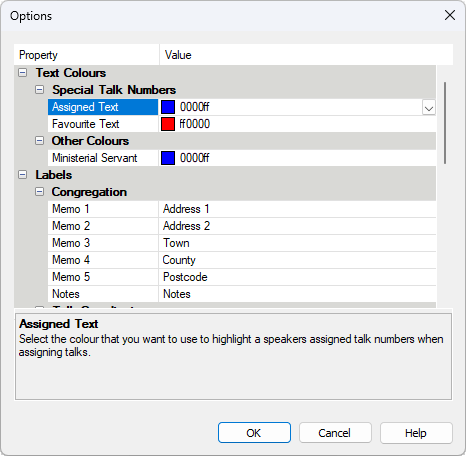
Figure 98. Database Options window
How to Access
You can open the Database Options window from:
- The Options button on the Congregation window
- The Database menu → Options
Using the Database Options Window
The window presents a property grid where each setting appears as a name/value pair:
- The left column shows the setting name.
- The right column is where you specify the value.
Settings are grouped into the following categories:
- Text Colours
- Labels
- Public Talks
- Start Up
Each category contains settings that control how data is displayed or how certain features behave. Select a setting to view its description in the information panel, then adjust the value as needed.
At the bottom of the window, an information panel displays a description of the currently selected setting. This panel provides helpful guidance beyond the brief overview in this topic.
Text Colours
Several areas of the application use colour to highlight specific types of information. You can customise these colours to suit your preferences.
| Type of Text | Purpose |
|---|---|
| Assigned | Highlights a speaker’s assigned talks when scheduling home and away talks. Helps avoid selecting talks a brother does not give. |
| Favourite | Highlights a speaker’s favourite talks. Using a different colour from Assigned helps you quickly identify preferred talks. |
| Ministerial Servant | Colours speakers who are appointed as Ministerial Servants in dropdown lists when assigning talks. |
Use the drop‑down arrow to choose a colour.
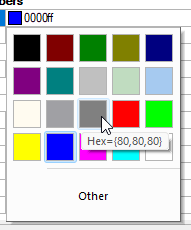
Figure 99. Choosing a preset or custom colour from the palette.
You may also select Other to define a custom colour using the colour picker.
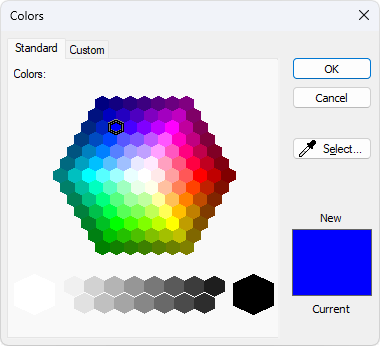
Figure 100. Custom colour selection window used to define precise colour values.
Labels
This section allows you to personalise the various label descriptions used throughout the application.
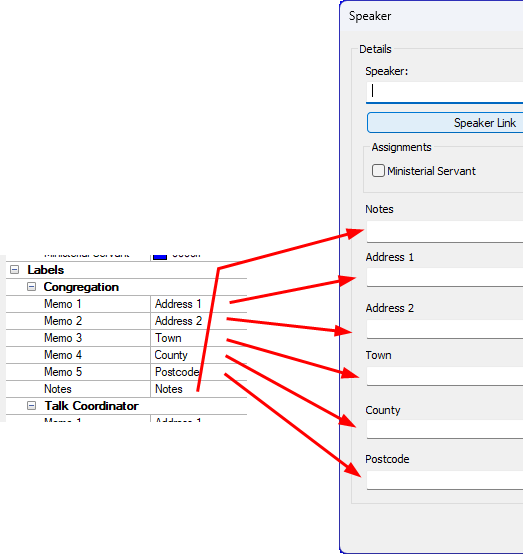
Figure 101. Example of how customised labels appear in related data‑entry fields.
Labels are grouped into three categories:
- Congregation
- Talk Coordinator
- Speaker
For each category, you can customise:
- 5 Memo labels
- 1 Notes label
This helps tailor the terminology to your congregation’s needs.
Public Talks
These settings define the default behaviour for public talk–related features.
| Setting | Description |
|---|---|
| Confirmed Status | Sets the default Confirmed Status for new schedules. Options: Yes, No. Default: Yes. |
Start Up
Meeting Schedule Assistant can perform certain tasks automatically when the application starts.
Confirm Status
Automatically checks the Confirmed Status for upcoming public talk exchanges.
| Setting | Description |
|---|---|
| Check | Enables or disables the Confirmed Status check. Options: Yes, No. Default: No. |
| Number of Meetings | Specifies how many upcoming meetings to check (1–4). Default: 1. Only available when Check is enabled. |
Sample pop‑up message:
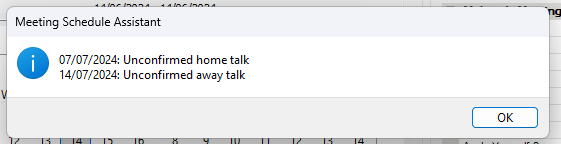
Figure 102. Example of a Confirm Status pop‑up listing unconfirmed public talks.
Related Topics
- Congregation Manager
- Public Talks Manager
- Speakers Manager
- Publishers Manager
- Field Service Group Manager
Navigation
- Parent topic: Database Menu
- Previous topic: Special Events
- Next topic: Finding Entries