units sindian_infantry - RTR-Imperium-Surrectum/ris-wiki GitHub Wiki
Class: light · Category: infantry · Men per unit: 60
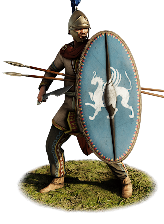
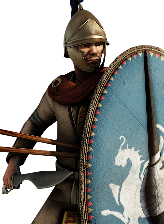
The Sindians are a people related to the Scythians who live in the western parts of the Maiotis (Taman peninsula), the peninsula across from the Taurike (Crimea). In the first half of the 4th century BC, Leukon I of the Kimmerian Bosporos conquered their lands and integrated the Sindians into his realm. Now, they fight in the Bosporan army, mostly as light infantry. Their primary weapons are javelins, but they also carry curved machaira swords for melee. Thanks to the introduction of the Celtic thureos shield, these Sindian warriors are now much better protected, and while some only wear their traditional caps, others sport Pseudo-Illyrian, Pseudo-Chalcidian or Konos helmets – all of them with cheek guards. Their tunics with long sleeves, cloaks, belts, trousers, and boots all show little influence of Hellenic styles and easily distinguish them from the Greek soldiers in the royal army. A few Sindian infantrymen have, however, bought themselves the useful linen cuirasses popular in the Aegean known as linothorakes. All in all, then, these Sindians can perform a dual-purpose role on the battlefield, being able to act both as skirmishers and as light swordsmen.
The best source for the history of an independent kingdom in the Sindike is found in the Strategemata by the 2nd century AD advocate and rhetorician Polyainos from Macedonia, who based himself on an older source. He tells the story of a war in the Sindian realm, in which Satyros I, ruler of the Kimmerian Bosporos from 433/432-389 BC, intervened:
“Tirgatao of Maiotis married Hekataios, king of the Sindi, a people who live a little above the Bosporos. Hekataios was expelled from his kingdom, but was reinstated in his throne by Satyros, tyrant of Bosporos. Satyros gave him his daughter in marriage, and urged him to kill his former wife. As Hekataios passionately loved the Maiotian, he could not think of killing her, but confined her to a strong castle; however, she found a way of making her escape from there. Fearing lest she should excite the Maiotians to war, Hekataios and Satyros made a strict search for her, which she skilfully eluded, travelling through lonely and deserted ways, hiding herself in the woods in the day, and continuing her journey in the night. At last she reached the country of the Ixomatai, where her own family possessed the throne. Her father was dead, and she afterwards married his successor in the kingdom. Then she roused the Ixomatai to war, and engaged many warlike nations around the Maiotis to join the alliance. The confederates first invaded the country of Hekataios, and afterwards ravaged the dominions of Satyros. Harassed by a war, in which they found themselves inferior to the enemy, they sent an embassy to sue for peace, accompanied by Metrodoros the son of Satyros, who was offered as a hostage. She granted them peace, on stipulated terms, which they bound themselves by oath to observe.” – (Polyain. 8.55)
The text illustrates the challenges of Bosporan attempts to control the northern Pontos region. Satyros probably intervened not least because Hekataios, with his Ionian name, may have been more open towards