units scytho_bosporan_horse_archers - RTR-Imperium-Surrectum/ris-wiki GitHub Wiki
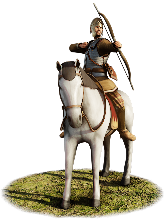
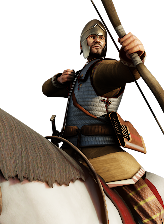
Class: missile · Category: cavalry · Men per unit: 32
A true Scythian watches the world from above: from the saddle of his horse. The wide, open world of the steppes is the home of the horse, and the Scythians learn to tame it from the youngest age. The most wonderful thing happens when they combine their love for horses and unique skill at riding with the one object that represents the societies of this world like no other: the bow. While anyone from anywhere in the ancient world can fight as a spearman, throw a javelin, or pick up a sword, only very few are able to master horse archery. Yet, the Scythians make it look as if they were born with bow in hand, gorytos around the waist, and a horse underneath them. These Scytho-Bosporan horse archers represent those men who live under the rule of the Bosporan kings, and yet stuck to their traditional art of war. Armed with powerful steppe composite bows and riding small, fast horses, they can outrange and outgun most enemies. Simple clothes, belts, pointed caps, and boots are enough for many of these warriors, but others wear helmets, greaves and/or cuirasses made from rawhides, linen or metal scales. While swords are mainly worn for decoration, their spears combined with the aforementioned armour allow them to charge light infantry or to defend themselves against its attacks in melee. And yet, the true realm of the horse archer is the ranged combat: on a good day, he will kill you before you even see him.
Scythians formed an important part of Bosporan history. From the earliest days of Greek settlement on the northern shores of the Black Sea, they were neighbours, enemies, allies, and subjects. Already by the time of Leukon I (r. 389-349 BC) – perhaps the greatest of all Bosporan rulers – Scythian warriors had become a regular part of Bosporan armies (Polyaen. 6.9.4). The Bithyno-Macedonian lawyer Polyainos (2nd century AD) tells us that the archon stationed Scythian bowmen behind his Greek hoplites so they could shoot them if they tried to run away. This indicates that Leukon trusted his Scythian soldiers more than the Greeks, perhaps because they were paid mercenaries instead of a citizen levy from half-autonomous poleis. Several decades later, Leukon’s grandsons Satyros II and Eumelos fought each other for the Bosporan throne. At the largest battle of the war, near the river Thatis in the Sindike, both armies were largely made up of allies from the steppes: Satyros commanded 2,000 Greek mercenaries, 2,000 Thracian mercenaries, 22,000 Scythian footmen, and 10,000 Scythian horsemen. On the other side, Eumelos was supported by Aripharnes, king of the Sarmatian Siraces, who brought 22,000 infantry and 20,000 cavalry to the battlefield (Diod. 20.22.4). Unsurprisingly, the Scythian and Sarmatian forces included very high numbers of horsemen, in clear opposition to the composition of Greek armies. Many of these men would fought as horse archers.
In the steppes, horses have roamed for millennia, and humans quickly found out that they could use them to ride and drive their livestock to greener pastures. The nomads in the Eurasian steppe regularly used the best suited routes for transhuman migrations (Hinds, Scythian and Sarmatians (2010), p. 12). Having learned how to control their horses by applying pressure with their knees and calves, they had their hands free to use short, powerful bows, the perfect weapon for a mounted man on a wide plain. Nearby settlements and their farms could be raided or forced to pay tribute, since their infantry levies were unable to ever catch the horse archers (Hinds (2010), p. 13). As Herodotos of Halikarnassos, the ‘father of history’, put it:
“I praise not the Scythians in all respects, but in this greatest matter they have so devised that none who attacks them can escape, and none can catch them if they desire not to be found. For when men have no established cities or fortresses, but all are house-bearers and mounted archers, living not by tilling the soil but by cattle-rearing and carrying their dwellings on waggons, how should these not be invincible and unapproachable?” (Hdt. 4.46.2-3).
Scythian archers usually used small bows and light arrows, which granted them a high fire rate even at the cost of sacrificing range. When moving on swift horses, this was easily made up for by their pace – and to make matters worse for their enemies, the arrows could be poisoned (Ashley, The Macedonian Empire (2004), p. 66). Furthermore, not all Scythian bows were small, and mounted archers could use bows with a length of 30-45 inches (Loades, Scythian Archery (2020), p. 258). The typical clothes, caps, and boots of the Scythians from Chersonesos Taurike (the Crimean Peninsula) and the adjacent lands can be seen on the Solokha comb and the Kul-Oba vase from the 4th century BC (Heinen, Antike am Rand der Steppe (2006), p. 25; Gajkudevič, Bosporanisches Reich (1971), p. 145 & fig. 11). The warriors depicted on these impressive works of art are armed with bows, short spears with big heads, or the Scythian akinakes type short swords.
Since horses were expensive, even in nomadic societies, many members of the cavalry would have belonged to the upper classes of society. As such, they could also afford helmets and armour. A complete set of metal scale armour was found at a burial not far from Olbia in Mykolaiv Oblast (Ukraine). It included helmet and leggings for a heavy horseman, but the cuirass itself was also used by horse archers (Cernenko, the Scythians 700-300 BC (2012), p. 3 & pl. D). Rawhide scale armour has also been found in Scythian contexts (Mielczarek, Bosporan Army (1999), p. 53 with n. 204). Furthermore, thanks to the influence of the Ionian Greeks in the Bosporan Kingdom, the linen linothorakes also found their way into Scythia, where these flexible cuirasses were regularly reinforced with bronze or iron scales (Mielczarek (1999), pp. 52-53). To complete their panoply, the Scythians around the northern Black Sea adopted many Hellenistic helmet types. The simple pilos is attested at several sites in the region and was useful for both footmen and horsemen (Symonenko, Sarmatian helmets (2014), fig. 9.1). A 4th century BC Chalcidian helmet was found in the kurgan of Kurdzhips on the Kuban (Rabinovich, Shlemy skifskogo perioda (1941), p. 144), while another had been buried with Scythian arrowheads and a sword in the Kukuvatskii kurgan in Crimea (id., pp. 124-143). Konos helmets were unearthed in Scythian Neapolis on Crimea (Symonenko (2015), fig. 9, no. 7), while Attico-Thracian types are known from the vicinity of Pantikapaion as well as from Apostolidi in the area of the Siraces east of the Sindike (Symonenko (2015), p. 283). Finally, bronze greaves were also well-known in the Bosporan Kingdom, and thus protect the legs of some of these horse archers (Mielczarek (1999), pp. 53-54; 57).
| Rank in roster | ||
|---|---|---|
| Men per unit | 32 |
██········ 23% |
| Attack | 13 |
██████···· 57% |
| Charge bonus | 23 |
████████·· 80% |
| Defence | 27 |
███······· 34% |
| · armour | 11 |
██████···· 64% |
| · defence skill | 16 |
███······· 28% |
| · shield | 0 |
█········· 0% |
| Morale | 13 |
███████··· 70% |
| Discipline | Normal | |
| Training | Trained | |
| Recruitment cost | 2,715 dn |
████████·· 76% |
| Upkeep per turn | 1,038 dn |
█████████· 90% |
| Turns to recruit | 2 |
| Primary | Secondary | |
|---|---|---|
| Attack | 13 | 9 |
| Charge bonus | 23 | 29 |
| Type | missile · archery | melee · blade |
| Damage | piercing | piercing |
| Projectile | arrow | — |
| Range | 170 | — |
| Ammunition | 30 | — |
| Primary | Secondary | |
|---|---|---|
| Total | 27 | — |
| Armour | 11 | — |
| Defence skill | 16 | — |
| Shield | 0 | — |
| Hit points | 1 |
| Mount | medium horse |
| Ground: scrub / sand / forest / snow | -2 / -1 / -8 / -1 |
| Charge distance | 40 |
| Formations | Square |
Technical stats
| Time between blows (primary / secondary) | 2.5 s / 2.5 s |
| Extra fatigue in hot climates | 3 |
| Spacing between men: close / loose | 2.2 × 5.2 m / 3.96 × 7.28 m |
| Default ranks | 5 |
In battle: Can form Cantabrian circle · Very good stamina
A core roster unit for one faction, which can raise it anywhere it holds the right building:
Any faction holding one of the provinces below can field it.
Exactly what a settlement must have, route by route (4)
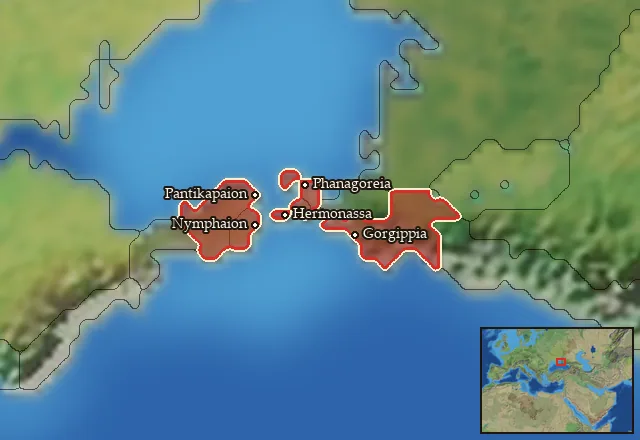
| Zone | Provinces |
|---|---|
| Scytho-bosporan | 5 |