units ptolemaic_machairaphoroi_cavalry - RTR-Imperium-Surrectum/ris-wiki GitHub Wiki
Class: heavy · Category: cavalry · Men per unit: 30
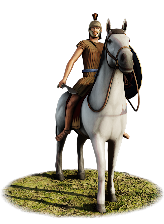
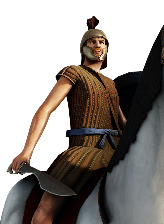
These horsemen are named after the machaira sword they are wielding. This bladed, single cutting-edge dagger, originally used by butchers and for religious sacrifices, was widely utilized in the Eastern Mediterranean since the 5th century BC. In Ptolemaic Egypt, the machairophoroi (literally, "machaira bearers") were a civil and royal guard unit which was mainly deployed for policing and as the protectors of high-ranking officials when they travelled within the empire. On the countryside, the mounted machairophoroi were especially feared and respected, as they guaranteed law and order and were used to suppress local rebellions and large criminal activities, while also repelling raids by the Libyan and Nubian nomads. Protected by round shields and helmets with plumes, but otherwise rather lightly armoured, they were famed for their speed and mobility.
The Machairophoroi cavalry were a mounted detachment of the Machairophoroi, which undertook various policing, guarding, and military duties. Primarily, they served as a paramilitary force, protected members of the imperial household, and acted as bodyguards for tax officials. Together with the Lonchophoroi, the Machairophoroi formed a regiment of the guard, but they were also registered on the active army list (cf. P.Ryl. IV 585, unknown provenance, early second century BC; P.Fay. 302, Philoteris, second century BC and P.Fay. 101, Euhemeria, c. 18 BC). Their upkeep was paid for by a special tax, the opsṓnion toû machairophórou (Ameling, Walter, s.v. Machairophoroi, in: DNP 2006). In the late Ptolemaic period, they may have been granted land in Egypt as one machairophoros was involved in a kleros transfer during the first century BC (PP II/VIII 4355 et BGU VIII 1770 (64/3 BC, Heracleopolite).
The Machairophoroi are documented since the 3rd century BC and remained an important element of Egyptian society throughout the Roman period. In the Augustan archive of Athenodoros Kananites (a stoic philosopher from Tarsos), machairophoroi are mentioned as guarding the sowing and the transport of grain along the Nile, as escorting officials, and as carrying letters and dispatches from one official to another (Livia Capponi, Augustan Egypt (2005), p. 59). Under Ptolemy IV the machairophoroi, as policemen, were included in the cleruchic system. Examples include a desert horseman (chersephippos) who received 30 arouras in Kerkeosiris and a desert guard (eremophylax) under Ptolemy V who was allotted 10 arouras.
Inscriptions show that the machairophoroi were mainly recruited from the Semitic population in Egypt, while most officers were probably Greeks or Macedonians. In No 737 of the Orientis Graeci Inscriptiones Selectae we find a group of Idumaeans honouring a certain Dorion, "strategos and priest of the machairophoroi", in 112/111 BC. Despite the Greek name, the commander might as well be a hellenised Idumaean or Jew, who is also named a philos ("friend") of Ptolemy IX, showing the reputation the machairophoroi enjoyed within the structure of the Ptolemaic Empire.
The equipment and horses of the Ptolemaic troops were supplied or paid for by the Ptolemaic state (Polyb. V.63.11; Fischer-Bovet (2014), p. 128). Officer and senior soldiers’ helmets probably bore plumes, as can be seen on the Palestrina Nile mosaic (Palestrina Nile Mosaic, c. 100 BC, Praeneste in central Italy - a Roman depiction). The Machairophoroi of the Kom Madi mural shows infantry machairophoroi equipped with aspides shields, quilted tunics and machairas, and the horsemen will have been similarly equipped.
| Rank in roster | ||
|---|---|---|
| Men per unit | 30 |
█········· 8% |
| Attack | 10 |
██········ 19% |
| Charge bonus | 19 |
███████··· 73% |
| Defence | 31 |
█████····· 46% |
| · armour | 12 |
███████··· 69% |
| · defence skill | 14 |
██········ 18% |
| · shield | 5 |
██████···· 57% |
| Morale | 9 |
███······· 26% |
| Discipline | Normal | |
| Training | Highly trained | |
| Recruitment cost | 1,522 dn |
██········ 18% |
| Upkeep per turn | 613 dn |
█████····· 46% |
| Turns to recruit | 2 |
| Primary | Secondary | |
|---|---|---|
| Attack | 10 | — |
| Charge bonus | 19 | — |
| Type | melee · blade | — |
| Damage | slashing | — |
| Primary | Secondary | |
|---|---|---|
| Total | 31 | — |
| Armour | 12 | — |
| Defence skill | 14 | — |
| Shield | 5 | — |
| Hit points | 1 |
| Mount | medium horse |
| Ground: scrub / sand / forest / snow | -1 / -1 / -4 / -1 |
| Charge distance | 40 |
| Formations | Square |
Technical stats
| Time between blows (primary / secondary) | 2.5 s / — |
| Extra fatigue in hot climates | 0 |
| Spacing between men: close / loose | 2 × 4.8 m / 3 × 7.2 m |
| Default ranks | 5 |
In battle: Very good stamina
A core roster unit for 3 factions, each able to raise it anywhere they hold the right building:
Egyptians · Ptolemaic Empire · Ptolemaic Rebels
Any faction holding one of the provinces below can field it.
Exactly what a settlement must have, route by route (4)
| Building | Also requires |
|---|---|
| Any settlement | Garrison Building or Tier 1 Military Industrial Complex · in a Ptolemaic region · Any Government (Dependency, Indirect Rule or Direct Rule) · Tier 2 Colony not built |
| Indirect Rule | Garrison Building or Tier 1 Military Industrial Complex · Tier 1 Colony |
| Direct Rule | Garrison Building or Tier 1 Military Industrial Complex · Tier 1 Colony |
| Homeland | Garrison Building or Tier 1 Military Industrial Complex |
| Zone | Provinces |
|---|---|
| Ptolemaic | 0 |