units pamphylian_slingers - RTR-Imperium-Surrectum/ris-wiki GitHub Wiki
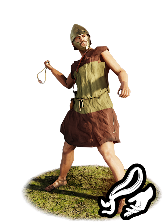

Class: missile · Category: infantry · Men per unit: 40
The free Anatolian people favoured the use of the sling in combat. These skirmishers’ leaden bullets can lay the groundwork for a great victory. Pamphylian Slingers just wear a simple chiton or exomis. For further protection, they wear bronze Phrygian or pilos helmets, which makes them slightly more durable in melee combat compared to Selgian or standard Greek slingers.
Aspendos was a prominent city in Pamphylia, traditionally regarded as a colony founded by the Argives on the River Eurymedon. Under Persian rule in the 5th century BC, the city began issuing coinage featuring military and athletic imagery. Its most distinctive later coin type depicts a slinger, a motif that became a consistent feature of Aspendian coinage (Foss, ‘A bullet of Tissaphernes’, in: The Journal of Hellenic Studies 95 (1975), p. 30). The slinger has sometimes been interpreted as a pun referencing the city’s name, since the Greek word ‘sphendone’ (σφενδόνη, “sling”) sounds similar to Aspendos. The Hallie Ford Museum of Art, for example, describes the slinger as possibly representing such a pun (Aspendos, Pamphylia Stater, Hallie Ford Museum of Art Exhibits). However, Clive Foss argues that this was probably a folk etymology: the Pamphylian indigenous name of the city was Estwedus/Estwediiys, which is also the name appearing on its coins. He therefore suggests that the slinger should instead be understood as reflecting the local importance of slingers and their military role. There is evidence that the region really prided itself on fielding good slingers. It is no coincidence that nearby Selge also had slingers depicted on its coins. And, thus, it was used as a common denominator (British Museum Dept. of Coins and Medals, A Catalogue of the Greek Coins in the British Museum, vol.XVIII (1897), pp. lxxii-lxxiv).
It is probably no coincidence that the oldest surviving leaden bullet is found in this region (Foss (1975), p.30). The bullet is almond-shaped and 36mm long. It is 22mm thick and weighs 40g. It contains a Greek inscription and can, thus, be attributed to the Greek colonists of Pamphylia who fought under the Persians as light-armed troops. Tissaphernes, a Persian satrap ruling the area, issued these leaden bullets between 401 and 395 BC. Xenophon and the Rhodians, as part of the famous Ten Thousand, first hit his army with leaden bullets (Anabasis, III,3.16-18). It is likely that after this experience, Tissaphernes will have copied the use of the more lethal ammunition (Foss (1975), p. 29).
Compared to their neighbours, as represented by the Selgian Slingers unit, in our mod these Pamphylians produce slightly less damage (even if still slightly more than standard Greek slingers), but are more durable in battle thanks to their being equipped with helmets of the Pilos and Phrygian types. When caught up in an undesirable melee, they will switch to their xiphos swords. On coins, the slinger is depicted naked or wearing a short chiton (Tekin, Aspendian 'Wrestlers': an iconographic approach (1997), p.160; SNG BN 47-9; SNG BnF 115 var). Other Pamphylian slingers wear the exomis, as this was the preferred Greek tunic used by most light infantry of this era. This type of clothing had the advantage that it did not encumber the right arm. As a result, these skirmishers have stats that are somewhat more useful in hand-to-hand combat than most other light infantry, even if they should still try to avoid such confrontations.
| Rank in roster | ||
|---|---|---|
| Men per unit | 40 |
███······· 30% |
| Attack | 7 |
█········· 6% |
| Charge bonus | 1 |
█········· 4% |
| Defence | 25 |
███······· 28% |
| · armour | 13 |
████████·· 75% |
| · defence skill | 12 |
█········· 9% |
| · shield | 0 |
█········· 0% |
| Morale | 7 |
█········· 10% |
| Discipline | Low | |
| Training | Untrained | |
| Recruitment cost | 1,392 dn |
█········· 12% |
| Upkeep per turn | 509 dn |
██········ 21% |
| Turns to recruit | 2 |
| Primary | Secondary | |
|---|---|---|
| Attack | 7 | 5 |
| Charge bonus | 1 | 3 |
| Type | missile · archery | melee · blade |
| Damage | blunt | piercing |
| Projectile | stone | — |
| Range | 150 | — |
| Ammunition | 35 | — |
| Primary | Secondary | |
|---|---|---|
| Total | 25 | — |
| Armour | 13 | — |
| Defence skill | 12 | — |
| Shield | 0 | — |
| Hit points | 1 |
| Ground: scrub / sand / forest / snow | 0 / -1 / 0 / -1 |
| Charge distance | 30 |
| Formations | Square |
Technical stats
| Time between blows (primary / secondary) | 2.5 s / 2.5 s |
| Extra fatigue in hot climates | 3 |
| Collision mass per man (1.0 is normal) | 1.22 |
| Spacing between men: close / loose | 1.2 × 2.8 m / 2.16 × 5.04 m |
| Default ranks | 5 |
In battle: Very good stamina
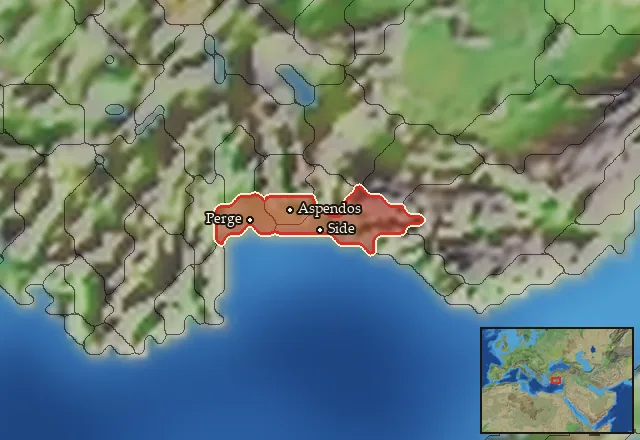
No faction has this on its core roster: it can be raised only in the provinces below.
Any faction holding one of the provinces below can field it.
Exactly what a settlement must have, route by route (1)
| Building | Also requires |
|---|---|
| Any settlement | Garrison Building or Tier 1 Military Industrial Complex · Pamphylian area of recruitment · Any Government (Dependency, Indirect Rule or Direct Rule) · Tier 2 Colony not built |
| Zone | Provinces |
|---|---|
| Pamphylian | 3 |