units italiote_hoplites - RTR-Imperium-Surrectum/ris-wiki GitHub Wiki
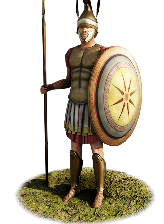
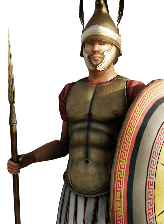
Class: spearmen · Category: infantry · Men per unit: 40
Italiote Hoplites represent the levies fielded by the various Greek cities in Southern Italy. These soldiers have confronted each other in battle as much as the surrounding native Italic tribes, which is reflected by their habit of pre-empting melee with a volley of javelins. On their heads they wear an Italic version of the Attic helmet type, as well as pilos, Italo-Corinthian, or Phrygian helmets. Their upper bodies are protected by linothorakes, muscle cuirasses, or the local style of pectoral-cuirasses called “kardiophylakes”. The Italiote Hoplites still bear the iconic aspis shields, typical for Greek hoplites, and along with their javelins, carry spears and xiphos swords into battle.
When Rome entered the South Italian political theatre at the end of the 4th and beginning of the 3rd century BC, it arrived in a region that had already been deeply involved with the major players of the Mediterranean world over the preceding centuries. If the campaign of RIS were set to start only a 100 years earlier, all Italiote cities would be well-deserving of their own faction and fully fledged rosters. It is not without reason that this region was called Megale Hellas, or Magna Graecia: Greater Greece.
Greek communities began to appear on the Italian peninsula in the 8th century BC, starting with Kyme and Pithekoussai in Campania, founded by Euboians around 750-725 BC. Between 725 and 700 BC Sybaris and Kroton were established by the Peloponnesian Achaians, Taras by the Spartans (c. 706 BC), and Rhegion by the Chalkidians (Fischer-Hansen, Nielsen, and Ampolo, Italia and Kampania (2004), p. 251). In the next century, Lokroi Epizephyrioi was created by the Lokrians, around 660 BC the city of Siris perhaps by the Kolophonians, and ca. 630 BC Metapontion by the Achaians, following an invitation from Sybaris. The last significant one was Thourioi in the later 440s BC, founded as part of a panhellenic expedition led by Athens (Fischer-Hansen, Nielsen, and Ampolo (2004), p. 251). Further minor colonies followed: Hipponion and Medma were established by Lokroi, Kaulonia and Terina by Kroton, Neapolis by Kyme, Laos and Poseidonia by Sybaris, and, lastly, Herakleia in 433/32 BC by both Taras and Thourioi, replacing Siris (Fischer-Hansen, Nielsen, and Ampolo (2004), p. 252).
All of these city states were embroiled in various complicated conflicts with one another, the native Italic tribes, or with greater powers outside of Magna Graecia, such as Syracuse, Carthage, Epeiros, and of course Rome. It is as part of these conflicts that we learn about these cities fielding their own militia armies. In 473 BC, Taras had issues with the native Iapygians, and in an event that Herodotos called “the greatest slaughter of Hellenes that is known to us”, a joint Tarantine-Rhegian army was destroyed by the Iapygians, though only the losses of Rhegion – around 3,000 men – are mentioned (Hdt. 7.170; Diod. 11.52). In the 6th century BC, an alliance of Lokroi and Rhegion defeated Kroton at the battle of Sagra, allegedly confronting 130,000 Krotoniates (Strab. 6.1.10). Around 510 BC, Sybaris, apparently with 30