units istrian_archers - RTR-Imperium-Surrectum/ris-wiki GitHub Wiki
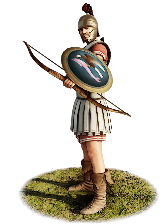
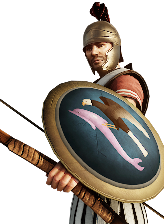
Class: missile · Category: infantry · Men per unit: 40
The wealthy polis of Istros has chosen its best men to fight as archers. They have been given composite bows for ranged combat and curved machaira swords for melee. Small, round pelte shields and various cuirasses and helmets protect them. The helmets are of Chalcidian, pilos, and the so-called Pseudo-Attic type, and therefore typical for the Black Sea Greeks. All of the cuirasses are made of leather, but while some are pure linothorakes, others are fitted with scale linings, a feature common in the Scytho-Sarmatian world. Living on the edge of the Greek world, the Istrians rely on their archers to defend their home town against Barbarian threats. Chosen from the bravest of Istros’ citizens, these men will guarantee that their polis will not fall!
The town of Istros or Istrie was founded by Milesian Greeks, allegedly in 657 BC, on the mouth of the river it was named after – the Istros, now known as the Danube (Hier. Chronik. B657; Hdt. 2.33.4; Euseb. Chron. 95b; Ps-Skymn. 941-952 suggests 630 BC). As such, it was one of dozens, if not hundreds of Milesian colonies around the Black Sea, and this Ionian identity would remain important throughout the city’s history. In the course of the 6h century BC, Istrie became an important harbour that was not only connected to Miletos, but also to Rhodes, Athens, Corinth, and Samos (Chera, Constantin/Buzoianu, Livia, Histria. Illustrated Guide [2009]). In 512 BC, Istros, like most other Greek cities and the native realms in Thrace, was subdued by the Persians (Burian, Jan, s.v. Istros [3], in: DNP online). The Achaemenid reverses at Marathon, Salamis, and Plataiai meant that Athenian influence in the region grew, however, and Istrie probably became a member of the Delian League (Hansen/Nielsen, An inventory of archaic and classical poleis (2004), p. 993). Istros significantly profited from its membership in the League, as its distance to Athens meant it could fully maintain its autonomy and still boost its trade volume. Accordingly, the urban settlement was extended, and three sub-colonies were established during this time: Istrianon Limen (''the harbour of the Istrians''), Nikonion, and Orgame (Arr. PME 20; Hansen/Nielsen (2004), p. 993).
During the 4th century BC, pressure from the Odrysians of Thrace and the Scythians increased, until both were brushed aside by successive Macedonian kings: Philip II, Alexander, and the diadoch Lysimachos all operated successfully in greater Thrace, and Istrie, too, had to recognise their overlordship (Diod. 19.73.2). In 313 BC, however, Kallatis, a colony of Herakleia Pontike also on the western coast of the Black Sea, rebelled against Lysimachos. It founded the Pontic Pentapolis, freed Istros, and united the local Scythian and Thracian rulers into a big coalition (Diod. 19.73.1-2). Lysimachos soon gathered his main army, took Odessos and Istros by storm, and defeated the Scythians and Thracians in a pitched battle (Diod. 19.73.3-5). When he laid siege to Kallatis, Antigonos Monophthalmos, his greatest rival, marched against him, and Kallatis held out (Diod. 19.73.6-10, 20.25.1). It was arguably only after the death of Lysimachos in 281 BC that the Pontic cities including Istros regained their full freedom (Burian, Istros). Therefore, in 270 BC, at the outset of the RIS campaign, Istrie is a wealthy harbour on the western end of the Black and the mouth of the river, which maintains close relations with its metropolis (''mother city'') Miletos (I.Histriae 62), the Pontic Pentapolis, and Olbia, the closest Ionian city to the northeast (I.Olbia 7).
Shortly before or around 275 BC, Nikonion was struggling. An inscription attests a famine in the town and its territory, but it tells us nothing about the reasons (SEG 49, 1051). It seems that there were more factors at play than a simple crop failure, for Istros reached out to Tyras, another Milesian apoikia (''colony'') in the region, to organise help for its sub-colony. The people of Tyras elected one Autokles to lead the expedition, which brought food from Istros to Nikonion. The problems went deeper, however, and Autokles subsequently oversaw the complete evacuation of Nikonion (Braund, Greater Olbia: Ethnic, Religious, Economic, and Political Interactions in the Region of Olbia, c. 600-100 BC [2007]). Was this the result of a natural catastrophe, of internal conflict, or of external attacks? Some of the existing evidence indicates that the latter reason may have been the most important, for it is exactly at this time that the Sarmatians established their hegemony over the steppes north of Istros, Olbia, and the Bosporan Kingdom; at the same time, the Royal Scythians re-emerged as a regional power (Podossinov, Am Rande der griechischen Oikumene (2002), p. 29). In line with these events, Istrie itself eventually fell under the ‘protection’ of a King Rhemaxos by 200 BC (ISM I no. 15 = SEG 24, 1095). At the same time, food had also become scarce in the territory of the city, just like in Nikanion decades earlier (ISM I.19). At some point, the desperate Istrians even enlisted the help of a Carthaginian merchant to buy grain from the Mediterranean (ISM I.20). Were Sarmatians and Scythians to blame, then, and who was King Rhemaxos?
Russu suggested that he was a Scythian ruler (Russu, Zoltes şi Rhemaxos [1967]), while Pippidi and Prokopov thought of him as a Getic monarch (Pippidi, Les rois gètes et les colonies grecques (1966), pp. 763-770; Prokopov, Die Silberprägung der Insel Thasos (2014), p. 35). The inscription in question (ISM I no. 15 = SEG 24, 1095) sheds some light on the context and the events – and on Istrian archers. Apparently, Istros was in debt to Rhemaxos, perhaps because it had lent money and food from the local king. This became an issue when the city was targeted by "Thracian" (probably Getic) raiders and pirates under a certain Zoltes. The Istrians suffered from the attacks and asked Rhemaxos for help, but since they were unable to pay their debt, he hesitated. Now, the envoy, Agathokles, personally stepped in with his own money (Vinogradov, Zur Klassifizierung der griechisch-barbarischen Abhängigkeitsverhältnisse (1996), p. 432). Rhemaxos then sent 100 of his horsemen, but these immediately broke when they met the numerically superior enemies. Soon after, Agathokles travelled to Rhemaxos' residence once more, and bribed the king's son, Phradmon, who took all of his 600 (Scythian? Getic?) horsemen to attack the (Thracian? Getic?) enemy. The Istrians now raised an elite regiment of archers to defend the city, chosen from the ablest and bravest citizens, and together these forces seem to have prevailed over Zoltes’ attackers (ISM I no. 15 = SEG 24, 1095).n
The episode is typical for Istrian history in this time, as two other decrees show. One of them, perhaps slightly older, describes how the Istrians convinced a King Zalmodegikos – the name suggests he, too, was Getic – to return hostages he had taken from Istrie and to give back the city's revenues he had confiscated (ISM I no. 8). Without further information, we may suppose that Zalmodegikos was a predecessor of Rhemaxos, and that Istros was also under his ‘protection’. The influences from Getae and Sarmatians and the need to counter their fast and light-armed troops explains why the Istrians themselves chose to develop their skirmishers and bowmen instead of heavy infantry (Todd, Richard, Greeks and Barbarians in Ancient Rumania. The Military Problem (1979/2023), pp. 8-9). Another threat were the Germanic Bastarnae, who had moved into the hinterland of the mouth of the Danube around 200 BC (Todd (2023), p. 7). Little is known about their fighting style, but well-trained archers stationed in fortresses or forts would have been useful to repulse any enemy, including these Germani. While these inscriptions have it seem as if Istros was under constant siege, another inscription demonstrates that the Istrians supported their ally Apollonia Pontike during the Mesembrian War in the mid 2nd century BC (Pippidi/Popescu, Les relations d'Istros et d'Apollonia du Pont [1959]). The Istrian troops not only successfully defended Apollonia against the Mesembrians, they then went on the attack and captured Anchialos (Todd (2023), p. 11). This expeditionary force probably included more than just archers, but since most Greeks did not specialise in archery, bowmen may have proved decisive in the encounters with the Mesembrians.
Under Scythian, Sarmatian, and Getic influence, there is no doubt that the Istrians would have used advanced composite bows, which gave them more stability and firepower. Their clothes are clearly Greek, and as an elite, they wear linothorakes with pteryges for better protection against enemy fire. Some of these linen cuirasses are lined with metal scales, reflecting Sarmatian influence (Hinds, Scythians and Sarmatians (2010), p. 48). Their shields are of the round pelte type, as is common for Hellenic archers (Du Plessis, Light Infantry of the Greek and Roman World (2024), pp. 129-130), and curved machaira swords, common around the Black Sea (Mielczarek, Bosporan Army (1999), pp. 46-47), serve as their weapon for melee. Archaeological finds from the area around Istros have mainly unearthed helmets of the Pilos, Chalcidian, and Pseudo-Attic types. While these were mostly imported from Greece and Asia Minor, they were also increasingly used by the Sarmatians, who appreciated the quality of Hellenic helmets (Symonenko, Sarmatian age helmets (2015), pp. 277-283). To conclude, these Istrian archers are heavy bowmen, armed with strong bows and effective swords, and reasonably armoured to be able to withstand enemy attacks. Use them wisely, and victory might be yours!
| Rank in roster | ||
|---|---|---|
| Men per unit | 40 |
███······· 30% |
| Attack | 11 |
███······· 34% |
| Charge bonus | 4 |
██········ 21% |
| Defence | 27 |
███······· 34% |
| · armour | 10 |
█████····· 54% |
| · defence skill | 15 |
██········ 23% |
| · shield | 2 |
███······· 25% |
| Morale | 8 |
██········ 19% |
| Discipline | Normal | |
| Training | Trained | |
| Recruitment cost | 1,720 dn |
███······· 32% |
| Upkeep per turn | 630 dn |
█████····· 49% |
| Turns to recruit | 3 |
| Primary | Secondary | |
|---|---|---|
| Attack | 11 | 7 |
| Charge bonus | 4 | 6 |
| Type | missile · archery | melee · blade |
| Damage | piercing | slashing |
| Projectile | arrow | — |
| Range | 170 | — |
| Ammunition | 30 | — |
| Primary | Secondary | |
|---|---|---|
| Total | 27 | — |
| Armour | 10 | — |
| Defence skill | 15 | — |
| Shield | 2 | — |
| Hit points | 1 |
| Ground: scrub / sand / forest / snow | 0 / -1 / 0 / -1 |
| Charge distance | 30 |
| Formations | Square |
Technical stats
| Time between blows (primary / secondary) | 2.5 s / 2.5 s |
| Extra fatigue in hot climates | 1 |
| Collision mass per man (1.0 is normal) | 1.05 |
| Spacing between men: close / loose | 1.1 × 2.6 m / 1.98 × 4.68 m |
| Default ranks | 5 |
In battle: Can hide in long grass · Very good stamina
A core roster unit for one faction, which can raise it anywhere it holds the right building:
Any faction holding one of the provinces below can field it.
Exactly what a settlement must have, route by route (5)
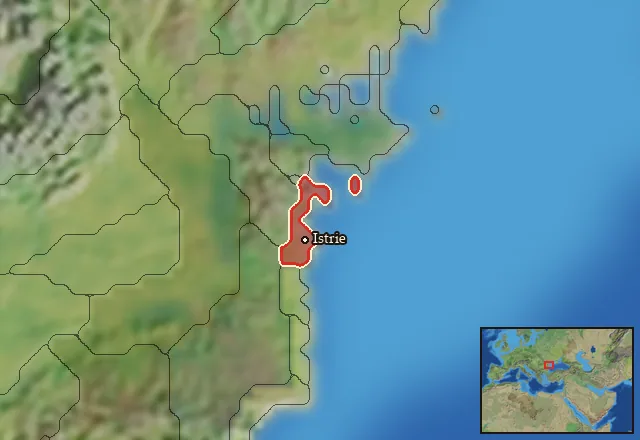
| Zone | Provinces |
|---|---|
| Istrian | 1 |