units bithynian_noble_cavalry - RTR-Imperium-Surrectum/ris-wiki GitHub Wiki
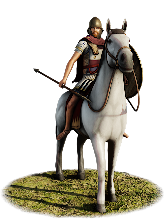
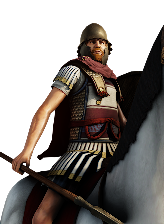
Class: heavy · Category: cavalry · Men per unit: 30
The wealthiest men of Bithynia can afford the best equipment and the sturdiest horses. Linothorakes, some of them with small metal scales, and big, flat, lavishly decorated aspis shields protect them both in melee and against missiles. Short, excellently woven chitones, red or dark blue chlamydes, and plumed or crested Bithynian, Bithynian konos, Attic, or Thracophrygian helmets symbolise the elevated position of these men in Bithynian society. As is the custom for heavy cavalry, they fight with long spears and can charge at an enemy formation. As the strongest horsemen in Bithynia’s army, they are incredibly valuable and can decide a whole battle in a single heartbeat.
Before the 3rd century BC, neither heavy cavalry nor horsemen with shields, nor a Bithynian nobility that could afford the necessary equipment existed in Bithynia (cf. Nefedkin, On the Origin of Greek Cavalry Shields in the Hellenistic Period (2009), pp. 356-358). Under Nikomedes I (r. 280-ca. 255 BC), the Bithynian kingdom expanded in alliance with the Northern League and a slow process of urbanisation began, centred on the foundation of Nikomedia as the new capital (see: description of Bithynian Thureophoroi). The first noble cavalry with shields may have originated in this era, but their number was probably very small. The size of both an affluent nobility and Bithynian heavy cavalry increased under Nikomedes’ son Ziaelas (r. ca. 254-228) and his grandson Prusias I (r. 228-182), when territories in Paphlagonia and Phrygia were conquered and the realm was further strengthened (see: descriptions of Bithynian Cavalry and Thracian Infantry Guard). Their role probably increased over time, and they would have been especially useful during the large-scale overland wars against the Attalids of Pergamon during the 2nd century BC. They were begun under Prusias I in the 180s, when Hannibal commanded the Bithynian fleet, but not the cavalry – a waste of his talents (Nepos, Hannibal 10-11). Soon after the war ended, Prusias passed away and was succeeded by his son Prusias II. The new king immediately approached Eumenes of Pergamon (r. 197-159/158 BC) to put their differences aside, for there was a bigger threat: Pharnakes I of Pontos (r. ca. 185-160 or 154 BC) had reduced the great city of Sinope and seemed ambitious to take over large parts of Anatolia.
The Pontic War of 182-179 BC pitted two great coalitions against each other: Pharnakes was supported by Mithradates of Armenia Minor and the Sinopians who were forced into his service. He wasted no time in taking these forces to invade Galatia and coerce some of the Galatian tetrarchs into a coalition (Polyb. 25.2.3). On the other side, Rhodian envoys to Rome, supported by Eumenes, had initially kickstarted a move to avenge the occupation of Sinope (Polyb. 23.9.2-3). Eumenes then found unexpected allies in Prusias and Ariarathes IV of Cappadocia (r. 220-163 BC), who were concerned by the pace of Pontic expansion (Polyb. 25.2.3). When Pharnakes now entered Paphlagonia (Polyb. 25.2.4-5), its prince, Morzios, held out in Gangra and asked the Pergamene alliance for help (Polyb. 25.2.8). The combined Attalid-Bithynian-Cappadocian army soon arrived to save Morzios, but further fighting was inconclusive, so that both sides sent to Rome for help (Polyb. 24.1.2-3). The Romans recommended peace, but Pharnakes’ agreement to their suggestion was a mere show (Polyb. 24.5.1-8, 14.1). Secretly, he sent envoys to Seleukos IV (r. 187-175) and offered 500 talents for a Seleucid army (Diod. 29.24; Polyb. fr. 96; Büttner-Wobst). Mindful of the peace treaty of Apameia with Rome, however, Seleukos only pretended to march against Cappadocia without actually going through with it.
Undeterred, Pharnakes invaded Cappadocia himself, while dispatching his general Leokritos to raid Galatia with 10,000 men (Polyb. 24.14.1-2). Prusias was slow to react, but Eumenes led the Pergamene army to Galatia, where he only found Kassignatos and Gaizatorix, two of the Galatian tetrarchs who had made a deal with Pharnakes and now promised to submit to the power of Eumenes (Polyb. 24.14.4-6). Eumenes ignored them, met the Cappadocian forces at Parnassos and prepared a direct attack on Pontos (24.7-9). At this moment, Roman envoys arrived, trying to broker another peace. Once again, they failed, and soon Eumenes himself quit Cappadocia to help his Rhodian allies in Lycia (24.10-25.13). Around the same time, Prusia and Eumenes turned to diplomacy and won Artaxias I of Armenia (r. 190-ca. 160 BC), an Anatolian dynast called Akysilaos, the Sarmatian king Gatalos (probably ruling a territory near Chersonesos), Kyzikos, Mesambria, and Herakleia Pontike with its colony Chersonesos for a new attack on Pharnakes’ position (Poyb. 25.2.11-13). This grand coalition mobilised a big army, which pushed all Pontic troops out of Paphlagonia and Galatia and attacked them from the sea (Polyb. 24.14.12, 25.2.1). Now, Pharnakes finally gave in, and since he was allowed to keep Sinope, he agreed to pay a hefty war indemnity (Polyb. 25.2.8-10, IOSPE I2 No. 402, ll. 1-10, IG XI 4, 1056b, ll.4-6).
Bithynian troops do not seem to have been crucial during the Pontic War, but heavy cavalry will have been extremely useful in the plains of Galatia and Paphlagonia. Prusias II’s army would not fight again for the next two decades before the monarch finally resumed the war against Pergamon in 156 BC. Shortly before the death of Eumenes in 160 BC, he had already accused him in front of the Senate for allegedly annexing villages on the Bithynian border (Polyb. 30.30.3), and after Eumenes’ brother Attalos II had assumed the throne, Galatia, Selge, and some minor fiefdoms supported Prusias’ claims (Polyb. 31.1.3, 32.1.4). Though the Romans did not side with Prusias, the Bithynians invaded the Attalid kingdom and won a stunning victory in the field (Polyb. 32.15.1). Prusias now sacked Nikephorion near Pergamon, but failed to take Elaia and retreated to Thyatheira, where he also had the temples plundered (Polyb. 32.15.2-13). His supplies soon ran out and his infantry suffered from hunger, since the remaining food was kept for the cavalry (Polyb. 32.15.14). Once again, the Bithynians now risked everything they had gained: when Roman envoys arrived to arrange a ceasefire – suggesting Prusias met Attalos only accompanied by 1,000 noble horsemen (App. Mithr. 1.3) – Prusias hunted them away (Polyb. 33.7.1-4). Meanwhile, Attalos secured alliances with Pontos and Cappadocia. The coalition assembled an army near Kadoi in Phrygia (Polyb. 33.12.1-2), but it was the navy who struck first: Rhodes, Pergamon, and Kyzikos attacked the positions of the Bithynians and their allies, which included Byzantion, on the Hellespont (Polyb. 33.12.8, 13.1-3). Around the same time, another Roman embassy arrived (13.4). Finally, Prusias II was ready to negotiate, and duly agreed to pay 100 talents for the damages he had caused in the Attalid kingdom, with the borders returning to the status quo ante bellum.
These wars and the mention of the 1,000 noble horsemen show the significance of heavy cavalry in the Bithynian army during the Mid-Hellenistic period. That the king was dependent on the growing number of nobles is also demonstrated by Prusias’ own end in 149/148 BC: his son Nikomedes, whom he had sent to live in exile in Rome, conspired against him, won the support of Attalos, who gave him an army to once more invade Bithynia. When they crossed over, the population and the elites in particular quickly went over to Nikomedes. Eventually, Prusias was killed by his own men and Nikomedes became king as Nikomedes II (App. Mithr. 1.4-7). Polybios (33.15.1-2) concludes:
“King Prusias was an ill-favoured man, and though possessed of fair reasoning power, was but half a man as regards his appearance, and had no more military capacity than a woman; for not only was he a coward, but he was incapable of putting up with hardship, and, to put it shortly, he was effeminate in body and mind through his whole life, a defect that no one, and least of all Bithynians, like to see in a king.”
The sexism aside, Polybios actually praises the warlike spirit of the Bithynians and emphasises the importance the army would have had in the kingdom. A king always rode with his cavalry, and thus the heavy cavalry was central to Bithynian success. The floor stele of a man called Mokazis from Tarsos in Bithynia (now Adliye Köy) shows Mokazis himself as such a warrior: wearing short chiton, chlamys and a linothorax, he fights with an overhand spear (Rumscheid/Held, Erinnerungen an Mokazis (1994)). The plumed helmet is a unique Bithynian design, but equally unusual is the aspis-like round shield. Horsemen with aspis shields were introduced in the Greek world in the 2nd century BC (see: Nefedkin, Origin of Cavalry Shields (2009) in detail), but did not usually form the heaviest part of the cavalry. Bithynian riders are regularly depicted with round shields, however, and it thus seems that the elite cavalry, too, used it from quite early on (Nefedkin (2009), p. 361). One of these men would have been Mokazis, who fought in the wars of Prusias I and the early campaigns of Prusias II, dying in his service (Held/Rumscheid (1994), p. 106). We may end by quoting from his epitaph:
"Tarsos (in Bithynia), your guarding spirit will defend the home town,
but the one who wants to take my home away from me, you shall totally and utterly
annihilate!" – Epitaph of Mokazis, ll. 11-13 (in: Held/Rumscheid (1994), p. 93)
| Rank in roster | ||
|---|---|---|
| Men per unit | 30 |
█········· 8% |
| Attack | 11 |
███······· 34% |
| Charge bonus | 29 |
█████████· 88% |
| Defence | 32 |
█████····· 49% |
| · armour | 11 |
██████···· 64% |
| · defence skill | 16 |
███······· 28% |
| · shield | 5 |
██████···· 57% |
| Morale | 13 |
███████··· 70% |
| Discipline | Normal | |
| Training | Trained | |
| Recruitment cost | 2,361 dn |
██████···· 63% |
| Upkeep per turn | 951 dn |
█████████· 86% |
| Turns to recruit | 4 |
| Primary | Secondary | |
|---|---|---|
| Attack | 11 | — |
| Charge bonus | 29 | — |
| Type | melee · blade | — |
| Damage | piercing | — |
| Primary | Secondary | |
|---|---|---|
| Total | 32 | — |
| Armour | 11 | — |
| Defence skill | 16 | — |
| Shield | 5 | — |
| Hit points | 1 |
| Mount | medium horse |
| Ground: scrub / sand / forest / snow | -2 / -1 / -8 / -1 |
| Charge distance | 40 |
| Formations | Square · Wedge |
Technical stats
| Time between blows (primary / secondary) | 2.5 s / — |
| Extra fatigue in hot climates | 2 |
| Spacing between men: close / loose | 2 × 4.8 m / 3 × 7.2 m |
| Default ranks | 5 |
In battle: Very good stamina
A core roster unit for one faction, which can raise it anywhere it holds the right building:
Any faction holding one of the provinces below can field it.
Exactly what a settlement must have, route by route (4)
| Building | Also requires |
|---|---|
| Any settlement | Tier 3 Military Industrial Complex · Bithynian area of recruitment · Any Government (Dependency, Indirect Rule or Direct Rule) · Tier 2 Colony not built · Requires resource horses or horses supplied factionwide |
| Direct Rule | Tier 3 Military Industrial Complex · Tier 2 Colony · Requires resource horses or horses supplied factionwide |
| Homeland | Tier 2 Military Industrial Complex |
| Any settlement | Tier 2 Military Industrial Complex · Bithynian area of recruitment · Dependency only · Tier 1 Colony not built |
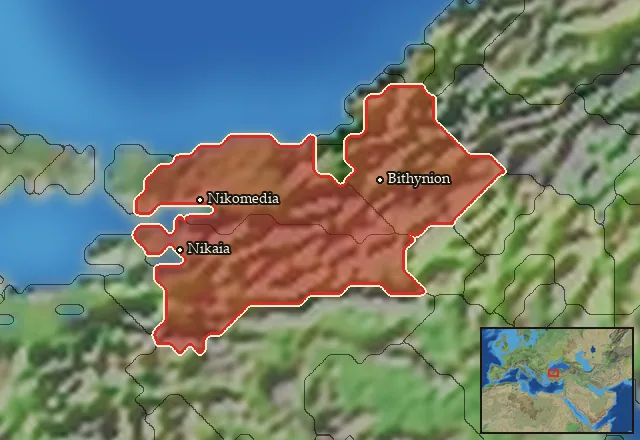
| Zone | Provinces |
|---|---|
| Bithynian | 3 |