units syracusan_neaniskoi - RTR-Imperium-Surrectum/ris-wiki GitHub Wiki
Class: missile · Category: infantry · Men per unit: 40
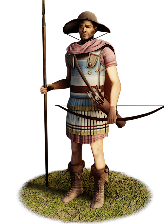
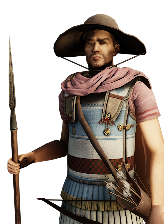
These young men (neaniskoi) are undergoing their basic military training for the polis of Syracuse on Sicily. They mainly train at archery and the usage of the dory, the hoplite spear. In cases of emergency, some of these teenagers can be called into battle, and for this purpose they are protected by Linothorax armour. Boots and hats complete their equipment, which is best suited for employment as light infantry. As sons of the proud citizens of Syracuse, the greatest Greek city in the west, these youngsters bear high expectations upon their shoulders and are of great value for the state. Use them wisely!
Hieron II was born in ca. 306 BC as the son of Hierokles, a citizen of Syracuse (Syll. 3.427). When Pyrrhos came to Sicily, Hieron bravely fought the Carthaginians as part of the Syracusan forces who supported the Epirote king. Pyrrhos, however, became frustrated when he could not take Lilybaion, and soon left the island for Italy. The reinvigorated Carthaginians acted swiftly and threatened Syracuse in 275/274 BC. Hieron rallied his friends and was elected as strategos with almost unlimited powers in order to organise the defence of the city, initially together with his friend Artemidoros (Polyb. 1.8.1 seq., Paus. 6.12.2). A marriage with Philistis, the daughter of Leptines, the most capable Syracusan nobleman, stabilised his position (Polyb. 1.9.3). The war with Carthage could soon be ended peacefully, and Hieron then got rid of dissatisfied mercenaries in a battle against the Mamertines, the Campanian mercenaries who had occupied Messana (Polyb. 1.9.4-5). Yet, the Mamertines were a genuine danger for Eastern Sicily, and Hieron now trained the citizens of Syracuse, possibly including many neaniskoi, for battle (Polyb. 1.9.7). He proceeded to lead this force to the river Longanos, where the Mamertines accepted battle. The Syracusans won a great victory and Hieron was declared basileus (king) (Syll.3 427 seq.).
In 264 BC, Hieron took the war to Messana to completely destroy the Mamertines, by now backed up by his former enemy Carthage (Diod. 23.1.2-4). At this point, however, the Romans intervened, and forced Hieron to retreat towards Syracuse. When Roman ambassadors offered the tyrant to retain all of his possessions if he went over to the Roman side, the pragmatic Hieron agreed (Diod. 23.4.1). For the next fifty years, he would rule the city and its domain as a loyal ally of the Republic who acquired considerable influence in Greece and Italy. During this period, Syracuse became a rich and flourishing Hellenistic kingdom. One part of Hellenistic culture was the extension and militarisation of the ephebeia, the institution for the training of young citizens (Pleket, Ephebes and Horses (2012), pp. 324-325). Hieron fetched the best teenagers directly from the gymnasia, where they had been prepared for war (Chankowski, Violence (2017), p. 44; against this cf.: Trümper, Eastern Sicily (2018), who thinks gymnasia are not well attested in the Hieronian kingdom). They were used to replace fallen soldiers or could form their own military units, mainly fighting as light infantry (Lalanne, Témoignage (2017), p. 160). That they were called Neaniskoi is attested, for instance, by an inscription from Neaiton, a city in Hieron's empire, where two gymnasiarchs, Ariston and Philistion, carved a dedication of their regiment of Neaniskoi into the wall of a small gymnasion that was built into a rock cave (IG XIV, 240).
In RIS, we have therefore decided to represent the Neaniskoi as a light infantry unit, wearing boots, hats and light linothorax armour and equipped with Greek bows, small, round pelte shields and hoplite spears (the dory). They are useful as missile or garrison troops, just like the real youngsters of Syracuse. May they never forget their Dorian ancestors and make Syracuse proud!
| Rank in roster | ||
|---|---|---|
| Men per unit | 40 |
███······· 30% |
| Attack | 8 |
█········· 9% |
| Charge bonus | 1 |
█········· 4% |
| Defence | 26 |
███······· 31% |
| · armour | 8 |
█████····· 47% |
| · defence skill | 18 |
████······ 37% |
| · shield | 0 |
█········· 0% |
| Morale | 6 |
█········· 6% |
| Discipline | Low | |
| Training | Untrained | |
| Recruitment cost | 1,319 dn |
█········· 10% |
| Upkeep per turn | 483 dn |
██········ 19% |
| Turns to recruit | 2 |
| Primary | Secondary | |
|---|---|---|
| Attack | 8 | 3 |
| Charge bonus | 1 | 1 |
| Type | missile · archery | melee · blade |
| Damage | piercing | piercing |
| Projectile | arrow | — |
| Range | 120 | — |
| Ammunition | 25 | — |
| Primary | Secondary | |
|---|---|---|
| Total | 26 | — |
| Armour | 8 | — |
| Defence skill | 18 | — |
| Shield | 0 | — |
| Hit points | 1 |
| Modifier against mounts | horse +3 · chariot +3 · camel +3 |
| Ground: scrub / sand / forest / snow | 0 / 0 / -2 / 0 |
| Charge distance | 30 |
| Formations | Square |
Technical stats
| Time between blows (primary / secondary) | 2.5 s / 2.5 s |
| Extra fatigue in hot climates | 0 |
| Collision mass per man (1.0 is normal) | 0.96 |
| Spacing between men: close / loose | 1.2 × 2.8 m / 2.16 × 5.04 m |
| Default ranks | 5 |
In battle: Very good stamina
A core roster unit for one faction, which can raise it anywhere it holds the right building: