units merc_cappadocian_skirmisher_cavalry - RTR-Imperium-Surrectum/ris-wiki GitHub Wiki
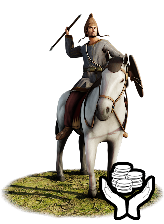
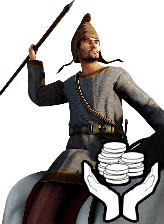
Mercenary. Hired from a regional pool, not recruited from a building.
Class: missile · Category: cavalry · Men per unit: 30
"As a horseman, I am a good horseman. As a bowman, I am a good bowman, both on foot and on horseback. As a spearman, I am a good spearman, both on foot and on horseback." – Tomb inscription DNb of the Persian King Darius I at Naqsh-e Rustam
Renowned throughout antiquity as the inhabitants of "the land of the beautiful horses", these Cappadocian Skirmisher Cavalry are fast missile horsemen designed for hit-and-run tactics, harassment of the enemy flanks, and scouting ahead of the army. They wear tunics, Galatian-style trousers, and traditional native headwear. Unhindered by heavy armour, their main weapons are bundles of throwing javelins, supported by a sidearm dagger or light lance for pursuing fleeing troops and small shields for defence, some of them decorated with local motifs. Their greater mobility allows these skirmishers to pelt infantry formations from a distance or to counter enemy skirmishers along the army's flanks. However, their light equipment also makes them fragile; if caught in close-quarters combat against heavy infantry or armoured cavalry, they will break, as this battle role should be fulfilled by the heavier Cappadocian cavalry, instead.
Cappadocia was well-known for its horses, and its cavalry remained significant over a long period of time (Strabo, 11.525; cf. Herodotus, 3.90; Xenophon, Cyropaedia 2.1.5; Arrian, Anabasis 3.11.7; Diodorus, 18.16; Plutarch, Eumenes 4). Indeed, the quality of Cappadocian horses was already well-recognised during the Achaemenid era, when the region was required to pay an annual tribute in horses directly to the Persian Great King to supply the royal armies: “The reports on the tributes paid agree with the size and the power of the country; for Cappadocia paid the Persians yearly, in addition to the silver tax, fifteen hundred horses, two thousand mules, and fifty thousand sheep” (Strabo, 11.13.8).
This cavalry tradition allowed local rulers to field massive cavalry contingents. In 322 BC, the satrap Ariarathes I mobilised an impressive force of 15,000 mounted soldiers to defend his realm against the Macedonian invasion (Diodorus Siculus, 18.16.2). Ariarathes “had amassed a great sum of money from the revenues and had formed a large body of native troops and mercenaries. He was thus ready to enter the lists against Perdikkas in defence of his kingdom with thirty thousand infantry and fifteen thousand cavalry. Perdikkas joined battle with him, and, defeating him in the conflict, slew men to the number of four thousand and took captive more than five thousand, among them Ariarathes himself”. Later, Eumenes of Kardia was also able to raise 6,300 local cavalry by offering gifts and tax exemptions to native estate holders. Plutarch tells us how Eumenes “raised a force of cavalry as a counterpoise to them by offering the natives of the country who were able to serve as horsemen immunity from contributions and tributes, and by distributing horses that he had bought among those of his followers in whom he placed most confidence; the spirits of these men, too, he incited by honours and gifts, and developed their bodies by exercise and discipline; so that a part of the Macedonians were amazed, a part emboldened, when they saw that in a short time he had assembled about him no fewer than sixty-three hundred horsemen” (Plutarch, Eumenes 4.3-4).
The prowess of Cappadocian horsemen was demonstrated on battlefields all over the Near East. At the Battle of Gaugamela (331 BC), Cappadocian cavalry spear-headed the attack against Alexander the Great’s left flank, successfully overwhelming his Asian and Greek mercenary cavalry before being halted by his veteran Thessalian horsemen (Arrian, Anabasis 3.7-16). Following the fall of Persia, Cappadocian kings preserved this Achaemenid style of mobile defence. As Weiskopf notes, the kingdom was protected in traditional Persian fashion through mobile cavalry forces operating from scattered mountain strongholds and estate fortresses: “The landscape was protected in Achaemenid fashion by cavalry and forts (for the former see Plutarch, Eumenes, 4.2, 6.4, 12.3; Livy, 37.40; Caesar, Civil War 3.43; Appian, Civil War 2.49; Cicero, Epistula ad familiares 15.4.6). The forts formed part of estates (at Mazaca, Strabo, 12.539) or were scattered about the kingdom (Tomisa on the Euphrates, ibid., 12.535; mountain strongholds, ibid., 12.537, cf. 12.540; the nature of the officers in charge is uncertain; Weiskopf, "CAPPADOCIA", in: Encyclopaedia Iranica IV [1990]). Throughout the Hellenistic dynastic conflicts and the Mithridatic Wars, this fast skirmisher cavalry remained essential for guarding border passes, patrolling high plateaus, and harassing invading armies.
| Rank in roster | ||
|---|---|---|
| Men per unit | 30 |
█········· 8% |
| Attack | 10 |
██········ 19% |
| Charge bonus | 15 |
██████···· 64% |
| Defence | 16 |
█········· 10% |
| · armour | 2 |
█········· 13% |
| · defence skill | 12 |
█········· 9% |
| · shield | 2 |
███······· 25% |
| Morale | 8 |
██········ 19% |
| Discipline | Impetuous (may charge without orders) | |
| Training | Highly trained | |
| Upkeep per turn | 547 dn |
███······· 28% |
| Primary | Secondary | |
|---|---|---|
| Attack | 10 | 6 |
| Charge bonus | 15 | 21 |
| Type | thrown · archery | melee · blade |
| Damage | piercing | piercing |
| Projectile | javelin | — |
| Range | 60 | — |
| Ammunition | 7 | — |
| Properties | Thrown | — |
| Primary | Secondary | |
|---|---|---|
| Total | 16 | — |
| Armour | 2 | — |
| Defence skill | 12 | — |
| Shield | 2 | — |
| Hit points | 1 |
| Mount | light horse |
| Ground: scrub / sand / forest / snow | 0 / 0 / -4 / 0 |
| Charge distance | 40 |
| Formations | Square |
Technical stats
| Time between blows (primary / secondary) | 2.5 s / 2.5 s |
| Extra fatigue in hot climates | 0 |
| Spacing between men: close / loose | 2.2 × 5.2 m / 3.96 × 7.28 m |
| Default ranks | 5 |
In battle: Can form Cantabrian circle · Very good stamina
Mercenaries are hired from a regional pool, not recruited from a building. This unit is offered by 2 pools covering 18 regions, at 3,712 dn to hire and 1 experience.
Mercenary pools: Cappadocia · Pontos
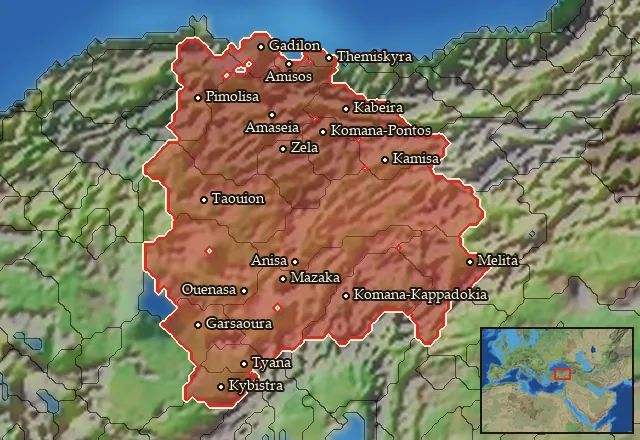
At least one of those pools sells to any faction that has an army in range, with no faction restriction.
The 18 regions where this unit appears in a mercenary pool
Gadilonitis · Garsaouritis · Hieratikos Pontos · Kamisene · Kappadokia · Kappadokike Kilikia · Kappadoxia · Kataonia · Melitene · Morimene-Chammanene · Phanaroia · Pimolisene · Pontos · Saramene · Saraouene-Laouiniasene · Themiskyra Pedion · Tyanitis · Zelitis