units illyrian_noble_spearmen - RTR-Imperium-Surrectum/ris-wiki GitHub Wiki
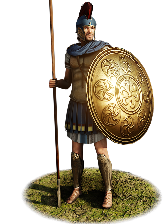
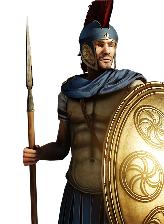
Class: spearmen · Category: infantry · Men per unit: 40
Illyrian Noble Spearmen are wealthy chiefs and leaders in their own right. These natural warriors are armed with Sibyna spears and short Illyrian ‘Krummschwerter’ swords. They are equipped with the finest that money can buy, including bronze muscle cuirasses, metal-reinforced linothorakes, metal greaves, as well as large leather round shields, similar to the Greek aspis, that are bolstered with bronze. These noble spearmen wear many types of bronze helmets, including some of older Illyrian- and crested types, as well as more modern Monounios and Chalcidian types.
Illyrian warfare had quite an impact upon the Greek and Hellenic psyche. Thukydides (4.126) records that the Spartan King Brasidas had to go to some lengths to try and dispel the fear they imparted: "Thus the present enemy [The Illyrians] might terrify an inexperienced imagination, they are formidable in outward bulk, their loud yelling is unbearable, and the brandishing of their weapons in the air has a threatening appearance”. The Illyrian way of war both confounded and irritated Thukydides (5.126), who continued: "But when it comes to real fighting with an opponent who stands his ground, they are not what they seemed; they have no regular order that they should be ashamed of deserting their positions when hard pressed; flight and attack are with them equally honourable”.
The Illyrian way of life, as well as their ferocious but somewhat idiosyncratic method of warfare, is most commonly connected to a tumulus-style burial culture. In earlier Illyrian history during the late Bronze and early Iron age, it appears that pastoral groups of herders evolved into greater societies led by warrior-chiefs. Later the Illyrian warrior-chiefs began holding dominion over a population of farmers, which was possible because the herders were better armed and experienced in fighting predators and human rivals (Hammond: The Kingdoms in Illyria (1966), p. 430).
The study of burial sites of warrior-rulers and their women have been one way to trace material culture and to give some idea of the groups of people living in an area. For example, in a cemetery uncovered in Trebeniste, warriors were buried with valuable possessions like swords, spears, and shields (Lewis et al., The Cambridge Ancient History: Illyrians and North-west (1994), p. 425.) A common practice for burying warriors was to leave them with three spears and a knife, and in the case of the richest ones, exported goods such as bronze greaves, Greek helmets, and even the odd bronze cuirass was placed in the grave too (Lewis (1994), p. 428). This would suggest a strong basis for an elite noble warrior class who were very well armed and equipped, with goods of fine quality and of Greek import. Textual evidence of the time supports the existence of well-equipped Illyrian infantry in Greek-supplied panoply. Diodorus Siculus (XV, 13, 2) states that they used 500 sets of Syracusan armour sent to them by Dionysios I along with 2,000 allied troops: "The Illyrians distributed the suits of armour among their choicest warriors and incorporated the soldiers among their own troops”.
The equipment of Illyrian Noble Spearmen in particular was inspired by finds such as the Illyrian helmet and crested helmets that were originally found at Glasinac from the 6th century as Greek imports, later produced by the Illyrians themselves until the 2nd century BC, found all across the Western Balkans (Stipčević (1977), p. 177); an image in the National Archaeological Museum in Tirana, which has depicted noble Illyrians with a large roundshield and crested Illyrian helmets; or convex leather shields strengthened with iron, as depicted on the Gradiste belt buckle, where they look like an Aspis with concentric patterns (Borsic et al., Liburnians and Illyrian Lembs (2021), pp. 46-48).
| Rank in roster | ||
|---|---|---|
| Men per unit | 40 |
███······· 30% |
| Attack | 12 |
█████····· 48% |
| Charge bonus | 18 |
███████··· 72% |
| Defence | 53 |
██████████ 99% |
| · armour | 10 |
█████····· 54% |
| · defence skill | 38 |
██████████ 99% |
| · shield | 5 |
██████···· 57% |
| Morale | 14 |
████████·· 79% |
| Discipline | Normal | |
| Training | Untrained | |
| Recruitment cost | 2,428 dn |
███████··· 66% |
| Upkeep per turn | 889 dn |
████████·· 84% |
| Turns to recruit | 4 |
| Primary | Secondary | |
|---|---|---|
| Attack | 12 | — |
| Charge bonus | 18 | — |
| Type | melee · blade | — |
| Damage | piercing | — |
| Properties | Light spear (braced against cavalry charges from the front) · +8 attack against cavalry | — |
| Primary | Secondary | |
|---|---|---|
| Total | 53 | — |
| Armour | 10 | — |
| Defence skill | 38 | — |
| Shield | 5 | — |
| Hit points | 1 |
| Ground: scrub / sand / forest / snow | -1 / -1 / -2 / -1 |
| Charge distance | 30 |
| Formations | Square |
Technical stats
| Time between blows (primary / secondary) | 2.5 s / — |
| Extra fatigue in hot climates | 1 |
| Collision mass per man (1.0 is normal) | 1.2 |
| Spacing between men: close / loose | 1 × 1.2 m / 2 × 2.4 m |
| Default ranks | 5 |
In battle: Can hide in long grass · Can sap · Very good stamina
A core roster unit for 3 factions, each able to raise it anywhere they hold the right building:
Ardiaei · Illyrian Kingdom · Labeatae
Exactly what a settlement must have, route by route (2)
| Building | Also requires |
|---|---|
| Direct Rule | Tier 3 Military Industrial Complex · Tier 2 Colony |
| Homeland | Tier 2 Military Industrial Complex |