units cappadocian_cataphracts - RTR-Imperium-Surrectum/ris-wiki GitHub Wiki
Class: heavy · Category: cavalry · Men per unit: 30
Reforms: Unlocked by Cappadocian Cataphract Reforms
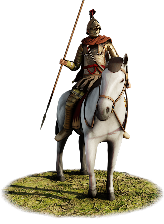
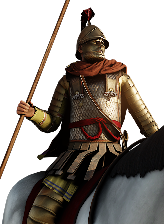
Cataphracts. The word alone evokes awe and fear among TW players. Would it have been the same in antiquity? Probably yes, at least for everyone who had to fight Parthians, Sarmatians, Cappadocians, or Seleucids. Oh, the horror of a cataphract charge. The long lances tearing you apart. The bearded helmets with their grotesque faces – do you still see them in your dreams? The scale cuirasses or scaled linothorakes, and cheires on both arms and legs, impossible to penetrate. The heavily armoured horse, like a terrible automaton created by Hephaistos himself. Reddish and yellow cloaks, colours you will never forget. Sharp xiphos and kopis swords hacking down your mates left and right. It is burned into your brain. Cappadocian cataphracts will never be defeated.
The kingdom of Cappadocia gained independence from the Seleucids in the mid-3rd century BC (Gabelko/Kuzmin, A case of Stratonices: Two Royal Women between Three Hellenistic Dynasties (2019), p. 221) and was autonomously ruled by the Ariarathid dynasty until the death of the young Ariarathes VIII in 96 BC (Iust. 38.2.2). Due to regular interventions by Mithridates the Great of Pontos and later by the Romans, the throne swung back and forth between Ariarathes IX, a son of Mithridates (and other Pontic candidates), on the one, and the local noble Ariobarzanes I, who was backed by the Romans, on the other hand, until the ultimate defeat of Mithridates in 63 BC (Iust. 38.1.10, 2.1-8; Plut. Pompey 37.1; Canepa, The Iranian Expanse (2018), pp. 107-108). The Ariobarzanids remained on the throne only until 36 BC, when Ariarathes X, son of Ariobarzanes III, was executed by Mark Antony (Dio 49.32.3). The triumvir replaced him with a Cappadocian-Greek nobleman called Archelaos Sisines, illegitimate son of Archelaos, the high priest of Komana in Kappadokia and the hetaira Glaphyra, whom Antony had 'visited' many times (Syme, Anatolica. Studies in Strabo (1995), pp. 144-148). Despite his rather dubious origin, Archelaos would outlast every other ruler of the time and only die in 17 AD.
The end of Cappadocia’s ultimate king was most unfortunate, however. Early in his reign, he had befriended the young Tiberius, who even defended him in court at Rome in 23 BC when one if his subjects accused Archelaos of mismanagement (Suet. Tiberius 8.1). Later, when Tiberius went into exile on Rhodes in 5 BC, Archelaos was told by his Roman contacts to stay clear of his former friend since the future emperor – Gaius Caesar or whoever might succeed Augustus – might suspect him of a conspiracy with a potential rival (Tac. Ann. 2.42.1). Yet, Tiberius eventually outlived all other candidates and took the throne himself in 14 AD. He had not forgotten the insult and asked his mother, Livia, to invite Archelaos to Rome, where he was charged for treason. Even though Archelaos was not convicted – perhaps because his rhetorical skills outmatched those of his accusers – he died three years later, either in Rome or on the trip back. Cappadocia was annexed and turned into a province (Tac. Ann. 2.42.2-4; Stein-Kramer, Die Klientelkönigreiche Kleinasiens (1988), pp. 172-173).
In this late phase of Cappadocian history, the royal army was heavily influenced by Mithridates VI of Pontos, whose army included cataphract style cavalry (Athen. 5.214A = Poseidonios of Apameia, FGrHist 87 F 36 = F 253 Edelstein/Kidd = F 247 Theiler). The emergence of the Parthian Empire on Cappadocia’s eastern border and the Parthian victory over the Romans at Carrhae in 53 BC with cataphracts may have been equally influential (Cf. Plut. Crassus 24.1; cf. 23.6). Horse armour had already been used by Persian cavalry (Sidnell, Warhorse (2007), p. 143) and the Ariarathids of Cappadocia were the bearers of the Achaemenid tradition. Thus, Cappadocian cavalry was fitted out with scaled cuirasses for the riders and metal or rawhide frontlets for the horses already when the kingdom was created in the early 3rd century BC (see the description of Cappadocian Cavalry). From there, it was an almost natural step for these horsemen to eventually become cataphracts. To scale armour cuirasses and metal headgear for the horses (as seen on Cappadocian coins like Simonetta 6; SNG von Aulock 6357; HGC 7, 795 or Simonetta 2a; HGC 7) skirt armour reaching around parts of the horse was added. Evidence for this comes from the 1st century BC relief of a Gotarzes from Bisotun in Persia (Kawami, Monumental Art of the Parthian Period (1987), fig. 1). So-called metal cheires – as found in Parthia and Bactria (Mielczarek, Cataphracti (1993), p. 59) protected arms and legs, and helmets with masks (some only with cheek guards) as used by Seleucid cataphracts (these are depicted on the Balustrade Relief of the temple of Athena Polias Nikephoros at Pergamon [Pergamon Museum, Pe 2.4.-1a]) completed their armour. Delicately woven cloaks in red, purple, or yellow signify the elite status of these warriors, while Hellenic xiphos and kopis swords are worn for use in melee and represent the intensive contact with the Greek world.
| Rank in roster | ||
|---|---|---|
| Men per unit | 30 |
█········· 8% |
| Attack | 13 |
██████···· 57% |
| Charge bonus | 39 |
██████████ 99% |
| Defence | 36 |
██████···· 61% |
| · armour | 20 |
██████████ 99% |
| · defence skill | 16 |
███······· 28% |
| · shield | 0 |
█········· 0% |
| Morale | 14 |
████████·· 79% |
| Discipline | Normal | |
| Training | Highly trained | |
| Recruitment cost | 3,061 dn |
█████████· 86% |
| Upkeep per turn | 1,232 dn |
██████████ 96% |
| Turns to recruit | 4 |
| Primary | Secondary | |
|---|---|---|
| Attack | 13 | 13 |
| Charge bonus | 39 | 29 |
| Type | melee · blade | melee · blade |
| Damage | piercing | slashing |
| Primary | Secondary | |
|---|---|---|
| Total | 36 | — |
| Armour | 20 | — |
| Defence skill | 16 | — |
| Shield | 0 | — |
| Hit points | 1 |
| Mount | horse cataphract |
| Ground: scrub / sand / forest / snow | -7 / -1 / -8 / -1 |
| Charge distance | 40 |
| Formations | Square · Wedge |
Technical stats
| Time between blows (primary / secondary) | 2.5 s / 2.5 s |
| Extra fatigue in hot climates | 5 |
| Spacing between men: close / loose | 2 × 4.8 m / 3 × 7.2 m |
| Default ranks | 5 |
In battle: Good stamina · Powerful charge
A core roster unit for one faction, which can raise it anywhere it holds the right building:
Exactly what a settlement must have, route by route (2)
| Building | Also requires |
|---|---|
| Direct Rule | Tier 3 Military Industrial Complex · Cappadocian Cataphract Reforms · Tier 2 Colony · Requires resource horses or horses supplied factionwide |
| Homeland | Tier 2 Military Industrial Complex · Cappadocian Cataphract Reforms |