units baktrian_chalkaspides - RTR-Imperium-Surrectum/ris-wiki GitHub Wiki
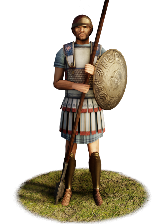

Class: spearmen · Category: infantry · Men per unit: 60
Reforms: No longer recruitable after Baktrian Reforms · Becomes a newer unit with Baktrian Reforms
Bactrian Chalkaspides (lit. "Bronze Shields" or "Brass Shields") are recruited among the Greek and Macedonian settlers in the land of thousand cities. Armed and armoured in the style of Alexander’s phalangites, they confront their foes with a bristling wall of sarissa lances. Protected by sturdy linothorax armour, pteryges, greaves, a combination of Bactrian and Konos helmets as well as the characteristic pelte shield, these men can be relied upon to hold the line in most battles. Notwithstanding their prowess, they are still but the anvil upon which Baktria’s mighty cavalry should break its foes, and should not be counted on to win battles against enemy infantry on their own.
While the phalanx seems to have been relatively less important to Alexander during his Bactrian campaigns, his continued use of phalangites is accounted for by Arrian (Arr. 4.4). Bactria was also a place where many of the older veterans of his army, though mostly from his Greek allies, were settled (Plut. Mor. 328). This makes it plausible that a tradition of phalanx-combat was established in these far-removed satrapies.
Some scholars even argue that Macedonian military tactics were used in central Asia as late as 36 BC. While fighting Chinese and allied forces, the defenders of an unnamed city assumed a "fish scale formation" with interlocking shields (Hanshu, 70.3b). This has been interpreted as both a Roman style testudo, possibly being performed by veterans of Crassus’ campaign (Ball, Rome in the East (2016), pp. 132-133) and as a Hellenistic Phalanx (Matthew, ‘Greek Hoplites’, Journal of Asian History, 45-1/2 (2011) pp. 17-37). It is, however, important to remember that a formation of interlocking shields, while possibly a phalanx in the Greek sense, is neither conclusive evidence of these men actually fighting as a traditional Hellenistic phalanx, nor for them to consider themselves culturally or ethnically Greek.
| Rank in roster | ||
|---|---|---|
| Men per unit | 60 |
█████████· 87% |
| Attack | 20 |
██████████ 98% |
| Charge bonus | 2 |
█········· 11% |
| Defence | 26 |
███······· 31% |
| · armour | 10 |
█████····· 54% |
| · defence skill | 13 |
█········· 13% |
| · shield | 3 |
████······ 37% |
| Morale | 11 |
████······ 39% |
| Discipline | Normal | |
| Training | Highly trained | |
| Recruitment cost | 2,007 dn |
█████····· 50% |
| Upkeep per turn | 735 dn |
███████··· 71% |
| Turns to recruit | 3 |
| Primary | Secondary | |
|---|---|---|
| Attack | 20 | 5 |
| Charge bonus | 2 | 2 |
| Type | melee · blade | melee · simple |
| Damage | piercing | piercing |
| Properties | Long spear (bonus against cavalry, penalty against infantry) · +8 attack against cavalry · very long pike (phalanx) | — |
| Primary | Secondary | |
|---|---|---|
| Total | 26 | — |
| Armour | 10 | — |
| Defence skill | 13 | — |
| Shield | 3 | — |
| Hit points | 1 |
| Ground: scrub / sand / forest / snow | -5 / -1 / -8 / -1 |
| Charge distance | 0 |
| Formations | Square · Phalanx |
Technical stats
| Time between blows (primary / secondary) | 2.5 s / 2.5 s |
| Extra fatigue in hot climates | -1 |
| Collision mass per man (1.0 is normal) | 1.11 |
| Spacing between men: close / loose | 1 × 1 m / 2 × 2.4 m |
| Default ranks | 5 |
In battle: Can sap · Very good stamina
A core roster unit for one faction, which can raise it anywhere it holds the right building:
Exactly what a settlement must have, route by route (3)
| Building | Also requires |
|---|---|
| Indirect Rule | Tier 2 Military Industrial Complex · not Baktrian Reforms · Tier 1 Colony |
| Direct Rule | Tier 2 Military Industrial Complex · not Baktrian Reforms · Tier 1 Colony |
| Homeland | Tier 2 Military Industrial Complex · not Baktrian Reforms |