units ankonitan_archers - RTR-Imperium-Surrectum/ris-wiki GitHub Wiki
Class: missile · Category: infantry · Men per unit: 40
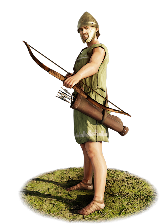
These men are a citizen force of archers from the small polis of Ankon, located on the Northern Adriatic coast of Italy. Their skill is unique on this peninsula, where archery is rarely encountered on the battlefield. In a Greek context, though, the storage of bows, bowstrings, and arrows in a city’s armoury is quite common, either in preparation of a siege, or to equip military vessels for naval warfare. Ankontian Archers are not as skilled as the more professional archers from Hellenistic armies. They lack the protective equipment of armour and shields of their Cretan counterparts, nor have the courage to act as reserve infantry in emergency situations. Nonetheless, their abilities suffice to provide cover for the infantry and cavalry contingents of their army, or to protect the walls of their home polis from enemy assaults.
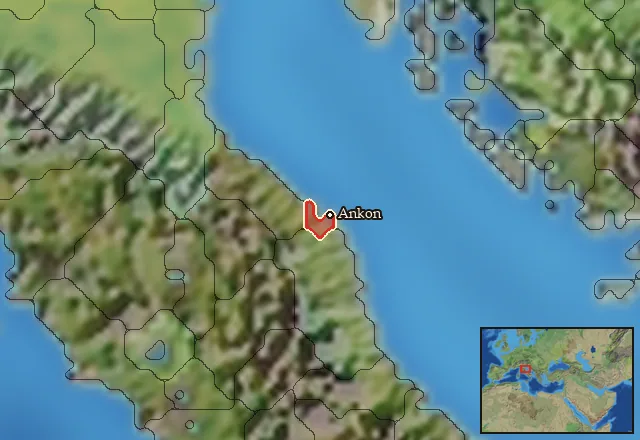
Coming from Sicily or Greece, approaching ancient Ankon (mod. Ancona) from the sea must have been a sight to behold. Sitting comfortably on top of the northern slopes of Monte Conero, it is well protected by the heavily forested limestone cliffs of the mountain, creating a large wall of white and green that gets illuminated in the morning by the golden sun when its rays touch the waves of the Adriatic. The promontory that is formed by the surrounding mountains and hills to the south and west stretches around a natural harbour in the shape of an elbow, giving the city its name (Greek: ankon = elbow). Here, around 387 BC, Syracusan refugees fleeing the tyranny of Dionysios I (c. 430 BC – 367 BC) must have thought they had discovered a safe haven in strange lands, fit for a new colony (Strab. 5.4.2). However, this explanation of Ankon’s foundation by Strabo remains contested, as the city could also have been part of Dionysios’ colonising efforts in the Adriatic, where he also founded several other cities like Issa, Lissos, and Pharos (Diod. Sic. 15.13.4; Wilkes and Fischer-Hansen, The Adriatic (2004), pp. 327-328). Pliny (HN 3.111) claims that Ankon and Numana were founded by the Sikeloi, corroborated by Catullus (36.13) and Juvenal (4.40), who claim that the city was a Doric foundation. Its commercial characteristics would speak for a planned colonisation, whereas the lack of a “well-defined urban layout” could possibly speak against it (Braccesi (1977), pp. 220–24, cited by: Wilkes and Fischer Hansen (2004), p. 327). Analysing the urban development of the whole Picentine region, however, Vermeulen concludes that Ankon, along with other pre-Roman centres, represents an accelerated ongoing centralisation processes among the indigenous population (Vermeulen, Assessing the Impact of Roman Colonization (2024), p. 322). Thus, the protective nature of the Monte Conero and its safe promontory would already have attracted trade fleets since the Mycenaean period. This might have led to a development of permanent emporia at Ancona and Numana since at least the 6th century BC, which acted as trading hubs for Greek and Etruscan merchants visiting Picentine and Umbrian communities in the hinterland as well as the newly arrived Celtic Senones. Their growth into a fully “urban” settlement, however, would only have been achieved under the Romans (Vermeulen (2024), p. 326–327).
Ankon’s significance grew, along with other urban centres in the area (like Asculum, Pisaurum, and Potentia) after the Second Punic War. Ankon in particular witnessed the development of monumental public architecture along with a “Hellenised” culture, reflecting its increased involvement in the commercial and military activities of the Romans in the Adriatic Sea and Illyria (Colivicchi, From Sea to Sea (2024), p. 290). Filling the large gap of ports between the Po valley and Southern Italy, Ankon acted as the central base for the two Roman Adriatic defence fleets of L. Cornelius (Ankon to Tarentum) and C. Furius (Ankon to Aquileia) during the Histrian War in 179 BC (Liv. 41.1). Eventually, thanks to its role as the major port of the region and as commercial centre for Italian-Illyrian trade, Traian developed the port and canals of the city, for which he was honoured with an arch that can still be visited today (Hülsen, in: RE Vol. I, 2 (1894), p. 2115).
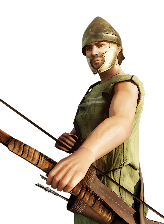
In its early phase, the Greek citizens of Ankon could perhaps have armed themselves as archers. Archers were not very common in Italic warfare and Rome often just employed archers from its foreign allies. However, during the Picene V phase (c. 475-375 BC), the Picentine people who inhabited the region around Ankon seem to have developed increased trade relations with Greek merchants, first at Numana, then at Ankon, changing their internal social structure away from a pure warrior aristocracy. Although the funerary equipment of warriors was not as rich as in previous phases, it now includes Greek pottery, swords, helmets, as well as javelins and bronze arrowheads (Museo Archeologico Nazionale delle Marche: inv. no. 25028 P; Menozzi and Ciarico, The Picentes / Piceni (2018), p. 594). Furthermore, archers were often found in Greek coastal poleis, both on ships – as they could be used to shoot at enemy crews from afar – and on the battlefield (Syracuse: Hdt. 7.158; Corinth and Korkyra: Thuk. 1.49; Athens: Pritchard (2018), The Archers of Classical Athens; decidedly putting archers on ships: Thuk. 7.62; Kamarina: Thuk. 6.67; 7.33). Syracuse in particular, the mother-city of Ankon, made great use of archers. As early as the Persian Wars, the tyrant Gelon of Syracuse (d. 478 BC) could offer the Spartans and Athenians 200 triremes, 20,000 hoplites, 2,000 horsemen and 2,000 archers, besides 4,000 other psiloi for support (Hdt. 7.158), as long as he was allowed to lead the army or navy (which was denied, making him recede his offer!). In 397 BC, during the siege of Motye, Dionysios I made great use of archers and slingers to cover the landing of his ships and prevent an assault from his opponent Himilko (Diod. Sic. 14.50.4). Lastly, during the Second Punic War, King Hiero II of Syracuse supported the Roman war preparations by sending 500 Cretans and 1,000 light infantry (Pol. 3.75.7; 1,000 archers and slingers in Liv. 22.37 and 600 Cretans in Liv. 24.30). The Ankonitan archers are armed with a bow, arrows, and a knife, standard equipment for an archer who is not expected to fight in melee. Their only protection consists of the occasional simple pilos helmet, depicted as a hat on an amber bow of a fibula showing Aphrodite with her lover Adonis (Metropolitan Museum, c. 500 BC: Bonfante, Mother and children (2013), p. 433) or Celtic Montefortino helmet, which were found extensively at Montefortino in the modern district of Ancona, occupied in antiquity by the Celtic Senones (Connolly, Greece and Rome at War (1991), p. 120; Paddock, The Bronze Italian Helmet Vol. 2 Roman helmets (1993) p. 570: Montefortino helmet with provenance in Ancona (Table 8, Musée du Louvre 1122 MNC, 1030)).
| Rank in roster | ||
|---|---|---|
| Men per unit | 40 |
███······· 30% |
| Attack | 9 |
█········· 13% |
| Charge bonus | 3 |
██········ 16% |
| Defence | 17 |
█········· 13% |
| · armour | 3 |
██········ 21% |
| · defence skill | 14 |
██········ 18% |
| · shield | 0 |
█········· 0% |
| Morale | 8 |
██········ 19% |
| Discipline | Normal | |
| Training | Trained | |
| Recruitment cost | 1,447 dn |
█········· 14% |
| Upkeep per turn | 530 dn |
██········ 24% |
| Turns to recruit | 3 |
| Primary | Secondary | |
|---|---|---|
| Attack | 9 | 4 |
| Charge bonus | 3 | 3 |
| Type | missile · archery | melee · simple |
| Damage | piercing | piercing |
| Projectile | arrow | — |
| Range | 120 | — |
| Ammunition | 25 | — |
| Primary | Secondary | |
|---|---|---|
| Total | 17 | — |
| Armour | 3 | — |
| Defence skill | 14 | — |
| Shield | 0 | — |
| Hit points | 1 |
| Ground: scrub / sand / forest / snow | 0 / 0 / 0 / 0 |
| Charge distance | 30 |
| Formations | Square |
Technical stats
| Time between blows (primary / secondary) | 2.5 s / 2.5 s |
| Extra fatigue in hot climates | 0 |
| Collision mass per man (1.0 is normal) | 0.83 |
| Spacing between men: close / loose | 1.1 × 2.6 m / 1.98 × 4.68 m |
| Default ranks | 5 |
In battle: Very good stamina
No faction has this on its core roster: it can be raised only in the provinces below.
Any faction holding one of the provinces below can field it.
Exactly what a settlement must have, route by route (1)
| Building | Also requires |
|---|---|
| Any settlement | Tier 2 Military Industrial Complex · Ankonitan area of recruitment · Dependency or Indirect Rule · Tier 1 Colony not built |
| Zone | Provinces |
|---|---|
| Ankonitan | 1 |