Water Balloon Bomber Weapon Profile - Herbertofury/Advent-of-Ascension GitHub Wiki
Water Balloon Bomber · a seaside carnival upgrade
Weapon overhaul · Illustrated armory · Cannon progression
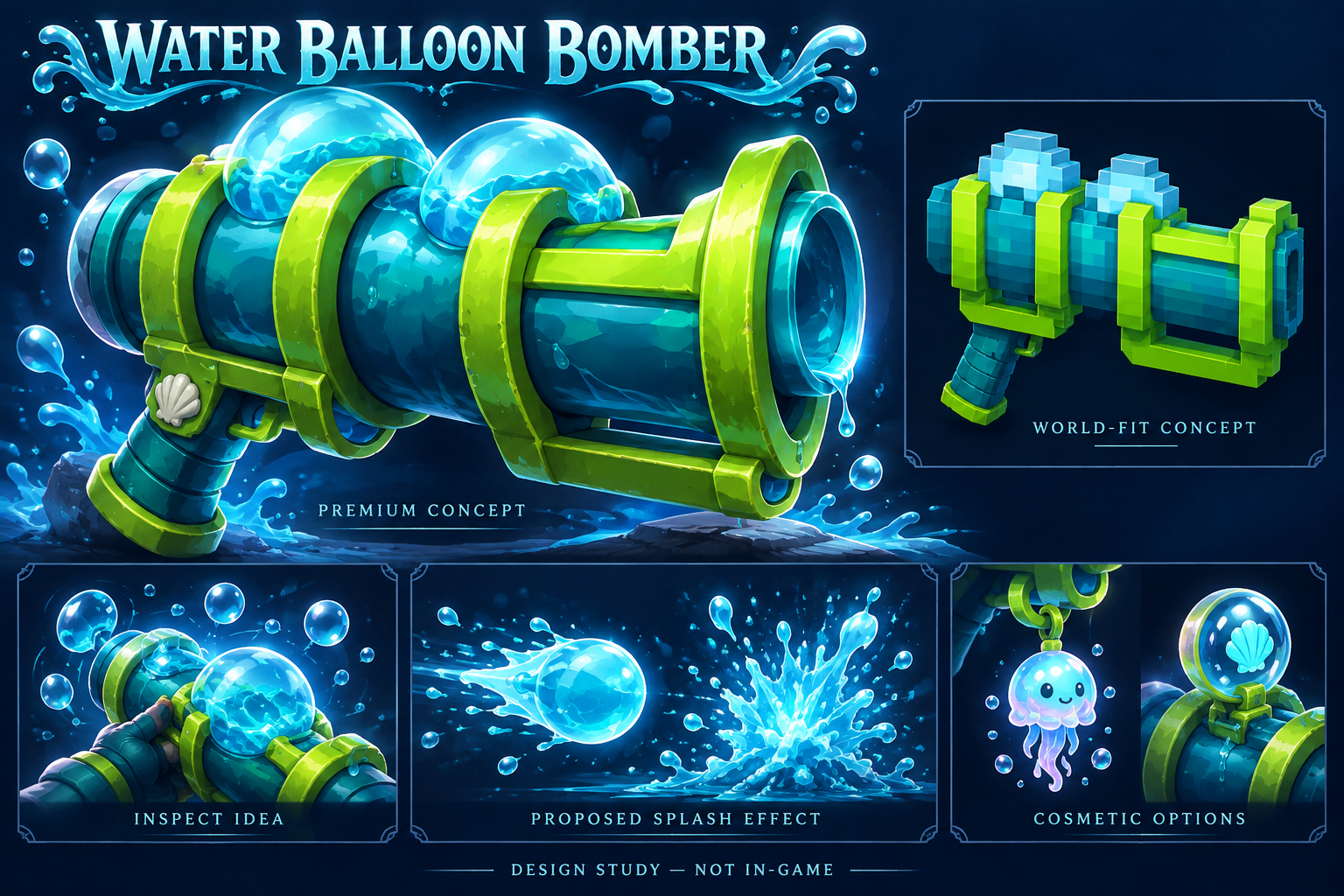
AoA 3.7.1 / Minecraft 1.20.1. Source profile and partial concept study, not a finished playable upgrade. The two finishes, inspection, splash and accessories pictured above are proposed art.
Original identity and verified lineage

The released sprite has a broad teal body, vivid lime bands and two raised cyan shapes. The premium concept develops these into watery domes and a polished carnival-like shell; the world-fit treatment preserves the same recognizable palette and broad silhouette. The shell ornament, liquid interior, grip treatment and jellyfish charm are new design proposals.
Its bundled upgrade is Balloon Bomber + Seaside Upgrade Kit. This establishes an upgrade lineage, not a canonical inventor, origin dimension or creation story. Do not invent ocean lore solely from the colors or kit name.
Released behavior
| Stored registration input | Value |
|---|---|
| Damage parameter | 20.5 |
| Durability | 855 |
| Firing delay | 24 ticks |
| Stored recoil constructor input | approximately 0.20 |
| Ammunition | Balloon |
| Firing sound | BALL_CANNON_FIRE |
The weapon overrides the normal Cannonball ammunition choice and creates WaterBalloonBombEntity. Its constructor requests a maximum age of 120, piercing value zero and damage multiplier 1. Gravity returns 0.1. These are source parameters, not a measured trajectory, guaranteed damage result or DPS figure.
It does more than a cosmetic splash
Both block and entity impact call the projectile's explode method. That method first requests an explosion with strength input 1.5 through WorldUtil. The helper chooses terrain interaction according to the owner and destructive-weapon/mob-griefing rules; the number alone does not establish a fixed radius or terrain outcome.
The subsequent water-placement path requires server side, destructive weapon physics enabled, an empty projectile-position block, a non-ultrawarm dimension and a successful placement permission check. It then searches downward through replaceable blocks and places a water block above the support it finds, subject to its Y-bound checks. This is a real world-change pathway. A prettier splash must not silently bypass those gates, create extra water, or confuse a cosmetic puddle with a placed fluid block.
Original projectile versus proposed feedback

The renderer uses the shared balloon_bomb.png texture and requests eight cyan SPARKLER particles per render invocation at the projectile position. The texture image is extracted evidence, not an in-game flight screenshot. Eight per render is not eight per simulation tick.
The concept proposes a translucent water-balloon form, a short readable droplet trail and a splash with an immediate clear center. Those effects are not the original implementation. Use bounded game-time emission, distance tiers and reduced-effects options; never make trail count scale without limit with FPS. Original flight, impact and fluid-placement footage still needs capture in the target build.
Make the upgrade at the Divine Station
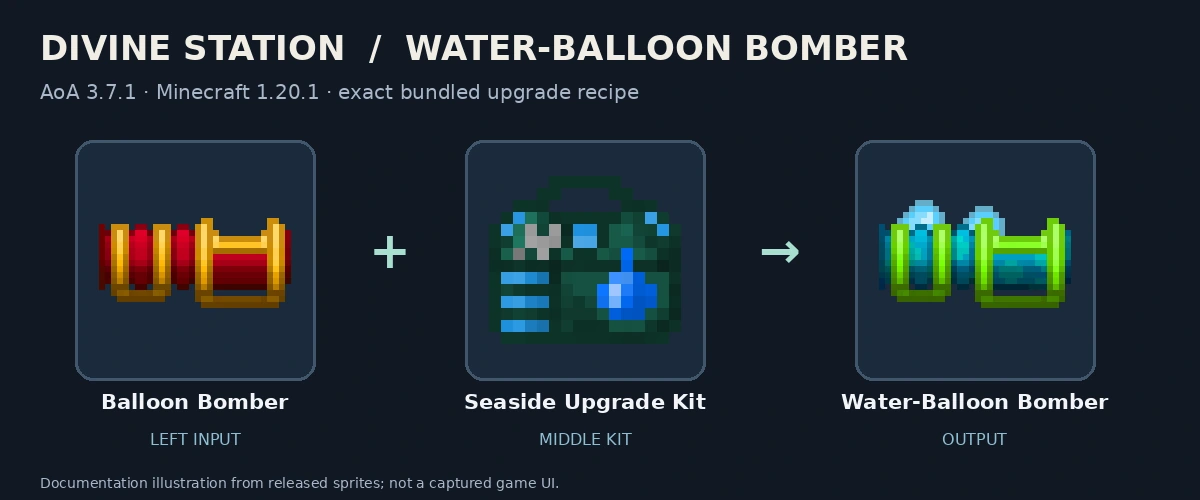
Open the exact interactive recipe
- Obtain the original Balloon Bomber.
- Use it with one Seaside Upgrade Kit in the Divine Station upgrade workflow.
- Confirm the output is Water Balloon Bomber in the effective installed recipe set. This is not a crafting-grid or Infusion Table recipe.
- Before changing a valued item, validate preservation of names, enchantments and custom extension data in the actual build. An illustrated recipe does not certify every property-transfer path.
Fun customization direction
- Default aquatic shell: recognizable lime bands, teal body and paired cyan domes in both detailed and world-fit material modes.
- Bubble sight: a restrained circular visual cue that stays readable while aiming; no targeting advantage is inferred from a cosmetic attachment.
- Jellyfish and shell charms: earned accessories with bounded secondary motion. Any perk-bearing variant needs explicit gameplay rules and a documented acquisition path.
- Alternate magical discharge styles: a focused stream, a wide splash and a bouncing bubble are possible separately crafted gameplay variants, with declared resource costs and server-authoritative behavior. None is a released feature demonstrated by this sheet.
- Handling and shell parts: fitted grips and visible trim variants; improvements must remain legible without losing the original silhouette. Check hands and the guard with actual first-person poses.
- Personal effects: configurable droplets, tracer styles, impact decals and an optional bubble-dissolve defeat effect. Decals and defeat visuals must not destroy world blocks or replace the actual reward/death logic.
- Stickers and emblems: static, glowing and animated placements on declared shell zones, with reduced-animation settings and no obstruction of sights or state indicators.
- Optional reload/recharge presentation: preserve the original Balloon resource contract by default. A loading animation cannot grant ammunition or introduce mandatory downtime merely because the model looks more elaborate.
Source quirks that must reach QA
The inspected downward search uses a literal Y=0 bound rather than the dimension's minimum build height. Treat below-zero worlds and custom-height dimensions as explicit regression cases, not as proven supported behavior. Also test claim protection at the final fluid destination: the shown permission check occurs at the projectile position before the lower target is resolved. These are source observations and test requirements, not claims that a fix has been implemented or a protection bypass reproduced.
Test both hands, player and non-player owners, empty/solid impacts, entities, ultrawarm worlds, destructive physics on/off, claimed areas, negative heights, save/reload and multiplayer. The rendered concept is not evidence for any of those cases.
Newer source is a different behavior contract
A separate comparison against the refreshed official 1.21 branch, pinned to 7919b5fe48599e6105c5740937ce36c36ef21d16, finds a different implementation. WaterBalloonBombEntity now uses a server-side explosion builder and shot context. The water-balloon explosion definition supplies radius 2, entity-damage input 4, block-damage input 3 and block-drop-chance input 0.1, with a cannon-dependent damage function. These are different API parameters; do not equate them directly with the older strength input of 1.5 or advertise a measured buff.
After the newer explosion, its callback checks server side, non-ultrawarm dimension and destructive weapon physics. If the explosion-position block is air, it places water there, then schedules a callback after 20 ticks that sets the same position to air. The older downward placement search and this newer temporary-water behavior are not interchangeable.
Preservation and safety requirements:
- Keep the selected release's behavior explicit. Importing a newer renderer must not silently change persistent water into temporary water, change impact location or alter damage/economy.
- Test a player or another mod replacing that temporary water before cleanup. The inspected scheduled callback does not itself check whether the block is still the water it placed. This is a source-level overwrite risk to investigate, not a reproduced loss report.
- Any new cleanup implementation should verify its own effect/state ownership before removing anything, and handle overlapping effects, chunk/dimension unloading and save/reload. A cosmetic effect must never delete a later player block.
- Audit protection hooks at the actual destination in both versions. Validate fluid spreading and its cleanup policy rather than assuming one removed source block restores the entire world.
Version-comparison evidence · Newer projectile source · Newer explosion definitions
This comparison is source analysis only. Neither version has been natively exercised by this study, and no automatic semantic merge is approved by these facts.
Full production gates
- Match mesh silhouette and both material modes to the original and approved concept from both sides and first-person views.
- Validate full-hand clearance, guard interaction, charm motion and all attachment/animation collisions.
- Author equip, holster, idle, aim, fire/recover, inspection and any optional loading states with interrupt-safe transitions.
- Expand separate muzzle, flight, impact, decal and defeat-effect boards with original-versus-proposed labels.
- Build and balance craftable variants, handling parts, charms, stickers and skins; preserve reversible item data.
- Capture native original projectile and water-placement behavior, including the height and protection cases above.
- Qualify native export, multiplayer authority, optional integrations and equivalent-work performance.
Evidence
Structured registration, class and recipe evidence · Pinned weapon source · Pinned projectile source · Pinned renderer
Original AoA identity belongs to Tslat and contributors. Concept art is an authored upgrade exploration. No upgraded native weapon acceptance is promoted here.
Recoil interpretation
For this pinned 1.20.1 release, the stored constructor recoil input is not the inherited modifier getter: the inspected BaseGun.getRecoilModifier() returns approximately 0.35. The per-shot method and later client application determine the actual recoil path. Do not infer a stronger or weaker measured kick from the constructor column alone. This clarification does not change the original values, weapon balance or acceptance state. Resolved method routing.