REST V2 Usage - turalf/evergreen GitHub Wiki
Table of contents
- General Functionality
-
Resources
- Task
- Task Annotations
- Test
- Manifest
- Host
- Patch
- Build
- Version
- Project
- Distro
- Key
- Status
- Status Message
- TestStats
- TaskStats
-
TaskReliability
- Objects
-
Endpoints
- Fetch the Task Reliability score for a project
- Examples
- Get the current daily task reliability score.
- Get the daily task reliability score for a specific day.
- Get the daily task reliability score from after date to today.
- Get the current weekly task reliability score.
- Get the current monthly task reliability score.
- Get the task reliability score trends.
- Notifications
- Permissions
- Users
Many of the these REST endpoints do not require authentication to access, but some do. These will return a 404 if no authentication headers are sent, if the username is invalid, or if the API key is incorrect. Use the "user" and "api_key" fields from the https://evergreen.mongodb.com/settings page to set two headers, Api-User and Api-Key.
The API accepts and returns all results in JSON. Some resources also allow URL parameters to provide additional specificity to a request.
When an error is encountered during a request, the API returns a JSON object with the HTTP status code and a message describing the error of the form:
{
 "status": <http_status_code>,
 "error": <error message>
}
API Routes that fetch many objects return them in a JSON array and support paging through subsets of the total result set. When there are additional results for the query, access to them is populated in a Link HTTP header. This header has the form:
"Link" : <http://<EVERGREEN_HOST>/rest/v2/path/to/resource?start_at=<pagination_key>&limit=<objects_per_page>; rel="next"

<http://<EVERGREEN_HOST>/rest/v2/path/to/resource?start_at=<pagination_key>&limit=<objects_per_page>; rel="prev"
Date fields are returned and accepted in ISO-8601 UTC extended format. They contain 3 fractional seconds with a ‘dot’ separator.
A returned object will always contain its complete list of fields. Any field that does not have an associated value will be filled with JSON's null value.
The API has a series of implemented objects that it returns depending on the queried endpoint.
The task is a basic unit of work understood by evergreen. They usually comprise a suite of tests or generation of a set of artifacts.
| Name | Type | Description |
|---|---|---|
task_id |
string | Unique identifier of this task |
create_time |
time | Time that this task was first created |
dispatch_time |
time | Time that this time was dispatched |
scheduled_time |
time | Time that this task is scheduled to begin |
start_time |
time | Time that this task began execution |
finish_time |
time | Time that this task finished execution |
version_id |
string | An identifier of this task by its project and commit hash |
branch |
string | The version control branch that this task is associated with |
revision |
string | The version control identifier associated with this task |
priority |
int | The priority of this task to be run |
activated |
boolean | Whether the task is currently active |
activated_by |
string | Identifier of the process or user that activated this task |
build_id |
string | Identifier of the build that this task is part of |
distro_id |
string | Identifier of the distro that this task runs on |
build_variant |
string | Name of the buildvariant that this task runs on |
depends_on |
array | List of task_ids of task that this task depends on before beginning |
display_name |
string | Name of this task displayed in the UI |
host_id |
string | The ID of the host this task ran or is running on |
restarts |
int | Number of times this task has been restarted |
execution |
int | The number of the execution of this particular task |
order |
int | The position in the commit history of commit this task is associated with |
status |
string | The current status of this task |
display_status |
string | The status of this task that is displayed in the UI |
status_details |
status_object | Object containing additional information about the status |
logs |
logs_object | Object containing additional information about the logs for this task |
time_taken_ms |
int | Number of milliseconds this task took during execution |
expected_duration_ms |
int | Number of milliseconds expected for this task to execute |
previous_executions |
[Task] | Optional. Contains previous executions of the task if they were requested, and available. May be empty. |
parent_task_id |
string | Optional. The ID of the task's parent display task, if requested and available |
| Name | Type | Description |
|---|---|---|
| agent_log | string | Link to logs created by the agent process |
| task_log | string | Link to logs created by the task execution |
| system_log | string | Link to logs created by the machine running the task |
| all_log | string | Link to logs containing merged copy of all other logs |
| Name | Type | Description |
|---|---|---|
| status | string | The status of the completed task |
| type | string | The method by which the task failed |
| desc | string | Description of the final status of this task |
| timed_out | boolean | Whether this task ended in a timeout |
GET /builds/<build_id>/tasks
List all tasks within a specific build.
| Name | Type | Description |
|---|---|---|
| start_at | string | Optional. The identifier of the task to start at in the pagination |
| limit | int | Optional. The number of tasks to be returned per page of pagination. Defaults to 100 |
| fetch_all_executions | boolean | Optional. Fetches previous executions of tasks if they are available |
| fetch_parent_ids | boolean | Optional. Fetches the parent display task ID for each returned execution task |
GET /projects/<project_name>/revisions/<commit_hash>/tasks
List all tasks within a commit of a given project
| Name | Type | Description |
|---|---|---|
| start_at | string | Optional. The identifier of the task to start at in the pagination |
| limit | int | Optional. The number of tasks to be returned per page of pagination. Defaults to 100 |
GET /tasks/<task_id>
Fetch a single task using its ID
| Name | Type | Description |
|---|---|---|
| fetch_all_executions | any | Optional. Fetches previous executions of the task if they are available |
POST /tasks/<task_id>/restart
Restarts the task of the given ID. Can only be performed if the task is in progress.
POST /tasks/<task_id>/abort
Abort the task of the given ID. Can only be performed if the task is in progress.
PATCH /tasks/<task_id>

Change the current execution status of a task. Accepts a JSON body with the new task status to be set.
| Name | Type | Description |
|---|---|---|
| activated | boolean | The activation status of the task to be set to |
| priority | int | The priority of this task's execution. Limited to 100 for non-superusers |
For example, to set activate the task and set its status priority to 100, add the following JSON to the request body:
{
  "activated": true,
  "priority": 100
}
Task Annotations give users more context about task failures.
| Name | Type | Description |
|---|---|---|
| task_id | string | Identifier of the task that this annotation is for |
| task_execution | int | The number of the execution of the task that the annotation is for |
| metadata | map[string]interface{} | Structured data about the task. Since this is user-given json data, the structure can differ between annotations |
| note | note_object | Comment about the task failure |
| issues | []issue_link | Links to tickets definitely related |
| suspected_issues | []issue_link | Links to tickets possibly related |
| Name | Type | Description |
|---|---|---|
| message | string | Comment about the task failure |
| source | source_object | The source of the note |
| Name | Type | Description |
|---|---|---|
| author | string | The author of the edit |
| time | time | The time of the edit |
| requester | string | The source of the request (api or ui) |
| Name | Type | Description |
|---|---|---|
| url | string | The url of the ticket |
| issue_key | string | Text to be displayed |
| source | source_object | The source of the edit |
GET /tasks/<task_id>/annotations
Returns a list containing the latest annotation for the given task, or null if there are no annotations.
| Name | Type | Description |
|---|---|---|
| fetch_all_executions | boolean | Optional. Fetches annotations for all executions of the task if they are available |
| execution | int | Optional. The 0-based number corresponding to the execution of the task the annotation is associated with. Defaults to the latest execution. |
PUT tasks/{task_id}/annotation
Creates a task annotation, or updates an existing task annotation, overwriting any existing fields that are included in the update. The annotation is created based on the annotation specified in the request body. Task execution must be provided for this endpoint, either in the request body or set as a url parameter. If no task_execution is specified in the request body or in the url, a bad status error will be returned. Note that usage of this endpoint requires that the requesting user have security to modify task annotations. The user does not need to specify the source, it will be added automatically. Example request body:
| Name | Type | Description |
|---|---|---|
| execution | int | Optional. Can be set in lieu of specifying task_execution in the request body. |
{
  "task_id": "my_task_id",
  "task_execution": 4321,
  "note": {
     "message": "this is a note about my_task_id's failure",
  },
  "issues":[
      {
         "url": "https://link.com",
         "issue_key": "link-1234"
      },
  ]
}
GET /builds/<build_id>/annotations
Fetches the annotations for all the tasks in a build.
| Name | Type | Description |
|---|---|---|
| fetch_all_executions | boolean | Optional. Fetches annotations for all executions of the task if they are available |
GET /versions/<version_id>/annotations
Fetches the annotations for all the tasks in a version.
| Name | Type | Description |
|---|---|---|
| fetch_all_executions | boolean | Optional. Fetches annotations for all executions of the task if they are available |
PUT /tasks/<task_id>/created_ticket
If a file ticket webhook is configured for a project, this endpoint should be used to let evergreen know when a ticket was filed for a task so that it can be stored and displayed to the user. The request body should include the ticket url and issue_key. Note that usage of this endpoint requires that the requesting user have security to modify task annotations. The user does not need to specify the source of the ticket, it will be added automatically. Example request body:
{
    "url": "https://link.com",
    "issue_key": "link-1234"
 }
A test is a sub-operation of a task performed by Evergreen.
| Name | Type | Description |
|---|---|---|
| task_id | string | Identifier of the task this test is a part of |
| Status | string | Execution status of the test |
| test_file | string | Name of the test file that this test was run in |
| logs | test_log | Object containing information about the logs for this test |
| exit_code | int | The exit code of the process that ran this test |
| start_time | time | Time that this test began execution |
| end_time | time | Time that this test stopped execution |
| Name | Type | Description |
|---|---|---|
| url | string | URL where the log can be fetched |
| line_num | int | Line number in the log file corresponding to information about this test |
| url_raw | string | URL of the unprocessed version of the logs file for this test |
| log_id | string | Identifier of the logs corresponding to this test |
GET /tasks/<task_id>/tests
Fetches a paginated list of tests that ran as part of the given task. To filter the tasks, add the following parameters into the query string (reference Pagination to see this format).
| Name | Type | Description |
|---|---|---|
| start_at | string | Optional. The identifier of the test to start at in the pagination |
| limit | int | Optional. The number of tests to be returned per page of pagination. Defaults to 100 |
| status | string | Optional. A status of test to limit the results to. |
| execution | int | Optional. The 0-based number corresponding to the execution of the task. Defaults to 0, meaning the first time the task was run. |
| test_name | string | Optional. Only return the test matching the name. |
A manifest is a representation of the modules associated with a version.
| Name | Type | Description |
|---|---|---|
| _id | string | Identifier for the version. |
| revision | string | The revision of the version. |
| project | string | The project identifier for the version. |
| branch | string | The branch of the repository. |
| modules | map[string]*Module | Map from the Github repository name to the module's information. |
| is_base | bool | True if the version is a mainline build. |
| Name | Type | Description |
|---|---|---|
| repo | string | The name of the repository. |
| branch | string | The branch of the repository. |
| revision | string | The revision of the head of the branch. |
| owner | string | The owner of the repository. |
| url | string | The url to the GitHub API call to that specific commit. |
GET /tasks/<task_id>/manifest
Fetch the manifest for a task using the task ID.
The hosts resource defines a running machine instance in Evergreen.
| Name | Type | Description |
|---|---|---|
| host_id | string | Unique identifier of a specific host |
| distro | distro_info | Object containing information about the distro type of this host |
| started_by | string | Name of the process or user that started this host |
| host_type | string | The instance type requested for the provider, primarily used for ec2 dynamic hosts |
| user | string | The user associated with this host. Set if this host was spawned for a specific user |
| status | string | The current state of the host |
| running_task | task_info | Object containing information about the task the host is currently running |
| Name | Type | Description |
|---|---|---|
| distro_id | string | Unique Identifier of this distro. Can be used to fetch more informaiton about this distro |
| provider | string | The service which provides this type of machine |
| Name | Type | Description |
|---|---|---|
| task_id | string | Unique Identifier of this task. Can be used to fetch more informaiton about this task |
| name | string | The name of this task |
| dispatch_time | time | Time that this task was dispatched to this host |
| version_id | string | Unique identifier for the version of the project that this task is run as part of |
| build_id | string | Unique identifier for the build of the project that this task is run as part of |
GET /hosts
Returns a paginated list of all hosts in Evergreen
| Name | Type | Description |
|---|---|---|
| start_at | string | Optional. The identifier of the host to start at in the pagination |
| limit | int | Optional. The number of hosts to be returned per page of pagination. Defaults to 100 |
| status | string | Optional. A status of host to limit the results to |
GET /users/<user_id>/hosts
Returns a list of hosts spawned by the given user.
| Name | Type | Description |
|---|---|---|
| start_at | string | Optional. The identifier of the host to start at in the pagination |
| limit | int | Optional. The number of hosts to be returned per page of pagination. Defaults to 100 |
| status | string | Optional. A status of host to limit the results to |
GET /hosts/<host_id>
Fetches a single host using its ID
POST /hosts
Spawns a host. The host must be of a distro which is spawnable by users (see Distro).
| Name | Type | Description |
|---|---|---|
distro |
string | Distro name to spawn |
keyname |
string | Key name to use |
POST /hosts/<host_id>/terminate
Immediately terminate a single host with given ID. Users may only terminate hosts which were created by them, unless the user is a super-user.
Hosts which have not been initialised yet will be marked as Terminated.
Trying to terminate a host which has already been terminated will result in an error.
All other host statuses will result in an attempt to terminate using the provider's API
A response code of 200 OK indicates that the host was successfully terminated
All other response codes indicate errors; the response body can be parsed as a rest.APIError
POST /hosts/<host_id>/change_password
Immediately changes the RDP password of a Windows host with a given ID. Users may only change passwords for hosts which were created by them, unless the user is a super-user.
A response code of 200 OK indicates that the host's password was successfully terminated
Attempting to set the RDP password of a host that is not a Windows host or host that is not running will result in an error.
All other response codes indicate errors; the response body can be parsed as a rest.APIError
| Name | Type | Description |
|---|---|---|
| rdp_pwd | string | New RDP password; must meet RDP password criteria as provided by Microsoft at: https://technet.microsoft.com/en-us/library/cc786468(v=ws.10).aspx and be between 6 and 255 characters long |
POST /hosts/<host_id>/extend_expiration
Extend the expiration time of a host with a given ID. Users may only extend expirations for hosts which were created by them, unless the user is a super-user
The expiration date of a host may not be more than 1 week in the future.
A response code of 200 OK indicates that the host's expiration was successfully extended.
Attempt to extend the expiration time of a terminated host will result in an error
All other response codes indicate errors; the response body can be parsed as a rest.APIError
| Name | Type | Description |
|---|---|---|
| add_hours | int | Number of hours to extend expiration; not to exceed 168 |
A patch is a manually initiated version submitted to test local changes.
| Name | Type | Description |
|---|---|---|
| name | string | Name of build variant |
| tasks | string[] | All tasks available to run on this build variant |
GET /projects/<project_id>/patches
Returns a paginated list of all patches associated with a specific project
| Name | Type | Description |
|---|---|---|
| start_at | string | Optional. The create_time of the patch to start at in the pagination. Defaults to now |
| limit | int | Optional. The number of patches to be returned per page of pagination. Defaults to 100 |
GET /users/<user_id>/patches
Returns a paginated list of all patches associated with a specific user
| Name | Type | Description |
|---|---|---|
| start_at | string | Optional. The create_time of the patch to start at in the pagination. Defaults to now |
| limit | int | Optional. The number of patches to be returned per page of pagination. Defaults to 100 |
GET /projects/<project_id>/patches
Fetch a single patch using its ID
GET /patches/<patch_id>/raw
Fetch the raw diff for a patch
| Name | Type | Description |
|---|---|---|
| module | string | Optional. A module to get the diff for. Returns the empty string when no patch exists for the module. |
POST /patches/<patch_id>/abort
Aborts a single patch using its ID and returns the patch
POST /patches/<patch_id>/configure
Update the list of tasks that the specified patch will run. This works both for initially specifying a patch's tasks, as well as for adding additional tasks to an already-scheduled patch.
The request body should be in the following format:
{
  "description": "this is my patch",
  "variants": [
    {
       "id": "variant-1",
       "tasks": ["task1", task2"]
    },
    {
       "id": "variant-2",
       "tasks": ["task2", task3"]
    }
  ]
}
| Name | Type | Description |
|---|---|---|
| description | string | Optional, if sent will update the patch's description |
| variants | array of variant objects | Required, these are the variants and tasks that the patch should run. Each variant object is of the format { "variant": "<variant name>", "tasks": ["task name"] }. This field is analogous in syntax and usage to the "buildvariants" field in the project's evergreen.yml file. Names of display tasks can be specified in the tasks array and will work as one would expect. For an already-scheduled patch, any new tasks in this array will be created, and any existing tasks not in this array will be unscheduled. |
POST /patches/<patch_id>/restart
Restarts a single patch using its ID then returns the patch
PATCH /patches/<patch_id>
Sets the priority and activation status of a single patch to the input values
| Name | Type | Description |
|---|---|---|
| priority | int | Optional. The priority to set the patch to |
| status | bool | Optional. The activation status to set the patch to |
The build resource represents the combination of a version and a buildvariant.
| Name | Type | Description |
|---|---|---|
| project_id | string | The identifier of the project this build represents |
| create_time | time | Time at which build was created |
| start_time | time | Time at which build started running tasks |
| finish_time | time | Time at which build finished running all tasks |
| version | string | The version this build is running tasks for |
| branch | string | The branch of project the build is running |
| gitspec | string | Hash of the revision on which this build is running |
| build_variant | string | Build distro and architecture information |
| status | string | The status of the build |
| activated | bool | Whether this build was manually initiated |
| activated_by | string | Who initiated the build |
| activated_time | time | When the build was initiated |
| order | int | Incrementing counter of project's builds |
| tasks | string[] | The tasks to be run on this build |
| time_taken_ms | int | How long the build took to complete all tasks |
| display_name | string | Displayed title of the build showing version and variant running |
| predicted_makespan_ms | int | Predicted makespan by the scheduler prior to execution |
| actual_makespan_ms | int | Actual makespan measured during execution |
| origin | string | The source of the patch, a commit or a patch |
| status_counts | Object | Contains aggregated data about the statuses of tasks in this build. The keys of this object are statuses and the values are the number of tasks within this build in that status. Note that this field provides data that you can get yourself by querying tasks for this build. |
| task_cache | Object | Contains a subset of information about tasks for the build; this is not provided/accurate for most routes (get versions for project is an exception). |
GET /builds/<build_id>
Fetches a single build using its ID
POST /builds/<build_id>/abort
Aborts a single build using its ID then returns the build
POST /builds/<build_id>/restart
Restarts a single build using its ID then returns the build
PATCH /builds/<build_id>
Sets the priority and activation status of a single build to the input values
| Name | Type | Description |
|---|---|---|
| priority | int | Optional. The priority to set the build to |
| status | bool | Optional. The activation status to set the build to |
A version is a commit in a project.
| Name | Type | Description |
|---|---|---|
create_time |
time | Time that the version was first created |
start_time |
time | Time at which tasks associated with this version started running |
finish_time |
time | Time at which tasks associated with this version finished running |
revision |
string | The version control identifier |
author |
string | Author of the version |
author_email |
string | Email of the author of the version |
message |
string | Message left with the commit |
status |
string | The status of the version |
repo |
string | The github repository where the commit was made |
branch |
string | The version control branch where the commit was made |
build_variants_status |
[]buildDetail | List of documents of the associated build variant and the build id |
requester |
string | Version created by one of "patch_request", "github_pull_request", "gitter_request" (caused by git commit), "trigger_request", "merge_test", "ad_hoc" |
activated |
boolean or null | Will be null for versions created before this field was added. |
GET /versions/<version_id>
Fetches a single version using its ID
POST /versions/<version_id>/abort
Aborts a single version using its ID then returns the version
POST /versions/<version_id>/restart
Restarts a single version using its ID then returns the version
GET /versions/<version_id>/builds
Fetches a list of builds associated with a version
| Name | Type | Description |
|---|---|---|
| variant | string | Optional. Only return the build with this variant (using Distro identifier). |
Returns a list of Builds.
PUT /versions
Creates a version and optionally runs it, conceptually similar to a patch. The main difference is that the config yml file is provided in the request, rather than retrieved from the repo.
| Name | Type | Description |
|---|---|---|
| project_id | string | Required. This is the project with which the version will be associated, and the code to test will be checked out from the project's branch. |
| message | string | Optional. A description of the version which will be displayed in the UI |
| activate | boolean | Optional. If true, the defined tasks will run immediately. Otherwise, the version will be created and can be activated in the UI |
| is_adhoc | boolean | Optional. If true, the version will be indicated as coming from an ad hoc source and will not display as if it were a patch or commit. If false, it will be assumed to be a commit. |
| config | string (yml) | Required. This is the yml config that will be used for defining tasks, variants, and functions. |
Returns the version object that was created
A project corresponds to a single repository.
| Name | Type | Description |
|---|---|---|
| admins | []string or null | Usernames of project admins. Can be null for some projects (EVG-6598). |
| delete_admins | []string | Usernames of project admins to remove |
| batch_time | int | Unique identifier of a specific patch |
| branch_name | string | Name of branch |
| commit_queue | CommitQueueParams | Options for commit queue |
| deactivate_previous | bool | List of identifiers of tasks used in this patch |
| display_name | string | Project name displayed to users |
| enabled | bool | Whether evergreen is enabled for this project |
| identifier | string | Internal evergreen identifier for project |
| notify_on_failure | bool | Notify original committer (or admins) when build fails |
| owner_name | string | Owner of project repository |
| patching_disabled | bool | Disable patching |
| pr_testing_enabled | bool | Enable github pull request testing |
| private | bool | A user must be logged in to view private projects |
| remote_path | string | Path to config file in repo |
| repo_name | string | Repository name |
| tracks_push_events | bool | If true, repotracker is run on github push events. If false, repotracker is run periodically every few minutes. |
| revision | string | Only used when modifying projects to change the base revision and run the repotracker. |
| triggers | []TriggerDefinition | a list of triggers for the project |
| aliases | []APIProjectAlias | a list of aliases for the project |
| variables | ProjectVars | project variables information |
| subscriptions | []Subscription | a list of subscriptions for the project |
| delete_subscriptions | []string | subscription IDs. Will delete these subscriptions when given. |
| Name | Type | Description |
|---|---|---|
| enabled | bool | Enable/disable the commit queue |
| merge_method | string | method of merging (squash, merge, rebase) |
| patch_type | string | type of patch (PR, CLI) |
| Name | Type | Description |
|---|---|---|
| definition_id | string | unique ID |
| project | string | project ID |
| level | string | build or task |
| variant_regex | string | matching variants will trigger a build |
| task_regex | string | matching tasks will trigger a build |
| status | string | status to trigger for (or "*") |
| config_file | string | definition file |
| command | string | shell command that creates task json file |
| Name | Type | Description |
|---|---|---|
| _id | string | The id for the alias. If the alias should be deleted, this must be given. |
| alias | string | Required. Alias to use with the CLI. May be specified multiple times. |
| variant | string | Required. Variant regex for alias. |
| task | string | Task regex for alias. Will use the union of task and tags. Either task or tags required. |
| tags | []string | Tags for alias. Will use the union of task and tags. Either task or tags required. |
| delete | bool | If the given alias for the project should be deleted, set this to true. |
| Name | Type | Description |
|---|---|---|
| vars | map[string]string | Map of the variable to its value (if private, value is not shown) |
| private_vars | map[string]bool | Indicates whether that variable should be private, i.e. the value will not be shown (NOTE: once a variable has been set to private this cannot be undone) |
| restricted_vars | map[string]bool | Indicates whether that variable should be restricted, i.e. only used by commands that are guaranteed to not leak the values (currently s3.put and s3.get) |
| vars_to_delete | []string | Only used to remove existing variables. |
| Name | Type |
|---|---|
| type | string |
| data | string |
| Name | Type |
|---|---|
| type | string |
| target | interface{} |
GET /projects
Returns a paginated list of all projects. Any authenticated user can access this endpoint, so sensitive information such as variables are omitted.
| Name | Type | Description |
|---|---|---|
| start_at | string | Optional. The id of the project to start at in the pagination. Defaults to empty string |
| limit | int | Optional. The number of projects to be returned per page of pagination. Defaults to 100 |
GET /projects/<project_id>
Returns the project (restricted to project admins). Includes public variables, aliases, and subscriptions. Note that private variables are always redacted. If you want to use this to copy project variables, see instead the "Copy Project Variables" route.
PATCH /projects/<project_id>
Modify an existing project (restricted to project admins). If enabling the project, will attempt to enable webhooks, and enable PR testing and the commit queue if specified. For lists, if there is a complementary "delete" field, then the former field indicates items to be added, while the "delete" field indicates items to be deleted. Otherwise, the given list will overwrite the original list.
POST /projects/<project_id>/copy?new_project=<new_project_id>
Restricted to admins of the original project.
Create a new project that is identical to indicated project--this project is initially disabled (PR testing and CommitQueue also initially disabled). The unique identifier is passed to the query parameter new_project and is required.
Project variables, aliases, and subscriptions also copied. Returns the new project (but not variables/aliases/subscriptions).
POST /projects/<source_project>/copy/variables
Restricted to admins of the source project and the destination project. Copies variables from projectA to projectB.
| Name | Type | Description |
|---|---|---|
| copy_to | string | Required. ProjectID to copy source_project variables to. |
| include_private | bool | If set to true, private variables will also be copied. |
| overwrite | bool | If set to true, will remove variables from the copy_to project that are not in source_project. |
| dry_run | bool | If set to true, route returns the variables from source_project that will be copied. (If private, the values will be redacted.) |
If dry_run is set, then the route does not complete the copy, but returns OK if no project variables in the source project will be overwritten (this concerns all variables in the destination project, but only redacted variables in the source project). Otherwise, an error is given which includes the project variable keys that overlap.
if dry_run is not set, the copy is completed, and variables could be overwritten.
GET /projects/<project_id>/versions
Returns a paginated list of recent versions for a project. Parameters should be passed into the JSON body (the route still accepts limit and start as query parameters to support legacy behavior).
| Name | Type | Description |
|---|---|---|
| skip | int | Optional. Number of versions to skip. |
| limit | int | Optional. The number of versions to be returned per page of pagination. Defaults to 10. |
| start | int | Optional. The version order number to start after, for pagination. |
| requester | string | Returns versions for this requester only. Defaults to gitter_request. |
| include_builds | bool | If set, will return some information for each build in the version. |
| by_build_variant | string | If set, will only include information for this build, and only return versions with this build activated. Must have include_builds set. |
| include_tasks | bool | If set, will return some information for each task in the included builds. This is only allowed if include_builds is set. |
| by_task | string | If set, will only include information for this task, and will only return versions with this task activated. Must have include_tasks set. |
| Name | Type | Description |
|---|---|---|
create_time |
time | Time that the version was first created |
start_time |
time | Time at which tasks associated with this version started running |
finish_time |
time | Time at which tasks associated with this version finished running |
revision |
string | The version control identifier |
author |
string | Author of the version |
message |
string | Message left with the commit |
status |
string | The status of the version |
errors |
[]string | List of errors creating the version |
build_variants_status |
[]buildDetail | List of documents of the associated build variant and the build id (this won't be populated if include_builds is set) |
builds |
[]APIBuild | List of builds for the version (only populated if include_builds is set). If include_tasks is set, then the task_cache is populated. |
PUT /projects/variables/rotate
Restricted to superusers due to the fact it modifies ALL projects.
| Name | Type | Description |
|---|---|---|
| to_replace | string | Required. Variable value to search and replace. |
| replacement | string | Required. Value to replace the variables that match to_replace. |
| dry_run | bool | If set to true, we don't complete the update |
If dry_run is set, the route doesn't update but returns a map of projectId to a list of keys that will be replaced.
if dry_run is not set, route returns a map of projectId to a list of keys that were replaced.
GET /projects/<project_id>/recent_versions
Returns a paginated list of recent versions for a project. NOTE that this route is legacy, and is no longer supported.
| Name | Type | Description |
|---|---|---|
| offset | int | Optional. Zero-based offset to return results from. |
| limit | int | Optional. The number of versions to be returned per page of pagination. Defaults to 10 |
| Name | Type | Description |
|---|---|---|
| rows | object | The keys of this object are build variant identifiers. The values are BuildList objects from below. These are the builds contained in the recent versions, but grouped by build variant rather than version. |
| versions | Array of APIVersions objects | This array contains the recent versions for the requested project, in reverse chronological order. |
| build_variants | Array of strings | The deduplicated display names for all the build variants in the rows parameter |
| Name | Type | Description |
|---|---|---|
build_variant |
string | the identifier of each of the build variant objects below (all are the same variant) |
builds |
object | The keys of this object are build IDs. The values are the full build objects: https://github.com/evergreen-ci/evergreen/wiki/REST-V2-Usage#id12 |
| Name | Type | Description |
|---|---|---|
rolled_up |
boolean | if true, these are inactive versions |
versions |
Array of Version objects | If rolled_up is true, this will contain multiple version objects, none of which ran any tasks. Otherwise, this will contain a single version object, of which at least 1 task ran |
GET /projects/<project_id>/parameters
Returns a list of parameters for the project.
| Name | Type | Description |
|---|---|---|
| key | string | The name of the parameter. |
| value | string | The default value of the parameter. |
PUT /projects/<project_id>
Create a new project with the given project ID. Restricted to super users.
GET /projects/test_alias?version=<version_id>&alias=<alias>&include_deps=<true|false>
Checks a specified project alias in a specified project against an Evergreen configuration, returning the tasks and variants that alias would select. Currently only supports passing in the configuration via an already-created version.
| Name | Type | Description |
|---|---|---|
| version | string | Required. The ID of the version (commit or patch) from which to retrieve the configuration as well as the project ID |
| alias | string | Required. The name of the alias to test against the configuration. The special aliases __commit_queue, __github, and __git_tag can be used here |
| include_deps | boolean | Optional. If true, will also select the tasks that are dependencies of the selected tasks, even if they do not match the alias definition. Defaults to false. |
A distro is an Evergreen host type. This isn't necessarily a Linux distribution - Mac and Windows host types are other possibilities.
GET /distros
Fetches distros defined in the system.
| Name | Type | Description |
|---|---|---|
| name | string | The unique name of the public key |
| key | string | The public key, (e.g: 'ssh-rsa ...') |
GET /keys
Fetch the SSH public keys of the current user (as determined by the Api-User and Api-Key headers) as an array of Key objects.
If the user has no public keys, expect: []
POST /keys
Add a single public key to the current user (as determined by the Api-User and Api-Key headers) as a Key object. If you attempt to insert a key with a duplicate name, it will fail
Both name and key must not be empty strings, nor strings consisting entirely of whitespace
If the key was successfully inserted, the server will return HTTP status code 200 OK
If the a key with the supplied name already exists, the key will not be added, and the route will return status code 400 Bad Request.
Any other status code indicates that the key was not successfully added.
DELETE /keys/{key_name}
Delete the SSH public key with name '{key_name}' from the current user (as determined by the Api-User and Api-Key headers).
If a public key with name '{key_name}' was successfully deleted, HTTP status code 200 OK will be returned.
If a public key with name '{key_name}' does not exist, HTTP status code 400 Bad Request will be returned.
Any other code indicates that the public key was not deleted
Status
| Name | Type | Description |
|---|---|---|
client_config |
APIClientConfig | Client version/URLs |
ignore_update |
bool | If true, degraded mode for clients is enabled, and the client should treat their version as up-to date |
| Name | Type | Description |
|---|---|---|
| latest_revision | string | a string representing the client version |
| client_binaries | [APIClientBinary] | Array of APIClientBinary objects |
| Name | Type | Description |
|---|---|---|
| arch | string | architecture of the binary; must be a valid GOARCH |
| os | string | OS of the binary; must be a valid GOOS |
| url | string | URL where the binary can be fetched |
GET /status/cli_version
Fetch the CLI update manifest from the server
If you cannot find an endpoint, it may not be documented here. Check the defined endpoints in evergreen source: https://github.com/evergreen-ci/evergreen/blob/master/rest/route/service.go
GET /admin/banner

{
  "banner": "Evergreen is currently unable to pick up new commits or process pull requests due to a GitHub outage",
  "theme": "warning"
}
Test stats are aggregated test execution statistics for a given project. The statistics can be grouped by time period and by test, task, variant, distro combinations.
| Name | Type | Description |
|---|---|---|
test_file |
string | The test file |
task_name |
string | Name of the task the test ran under. Omitted if the grouping does not include the task. |
variant |
string | Name of the build variant the test ran on. Omitted if the grouping does not include the build variant. |
distro |
string | Identifier of the distro that the test ran on. Omitted if the grouping does not include the distro. |
date |
string | The start date ("YYYY-MM-DD" UTC day) of the period the statistics cover. |
num_pass |
int | The number of times the test grouping passed during the target period. |
num_fail |
int | The number of times the test grouping failed during the target period. |
avg_duration_success |
float | The average duration, in seconds, of tests that passed during the target period. |
GET /projects/<project_id>/test_stats
Returns a paginated list of test stats associated with a specific project filtered and grouped according to the query parameters.
| Name | Type | Description |
|---|---|---|
after_date |
string | The start date (included) of the targeted time interval. The format is "YYYY-MM-DD". The date is UTC. |
before_date |
string | The end date (excluded) of the targeted time interval. The format is "YYYY-MM-DD". The date is UTC. |
group_num_days |
int | Optional. Indicates that the statistics should be aggregated by groups of group_num_days days. The first group will start on after_date, the last group will end on the day preceding before_date and may have less than group_num_days days. Defaults to 1. |
requesters |
[]string or comma separated strings | Optional. The requesters that triggered the test execution. Accepted values are mainline, patch, trigger, and adhoc. Defaults to mainline. |
tests |
[]string or comma separated strings | Optional if tasks is specified. The test files to include in the statistics. |
tasks |
[]string or comma separated strings | Optional if tests is specified. The tasks to include in the statistics. |
variants |
[]string or comma separated strings | Optional. The build variants to include in the statistics. |
group_by |
string | Optional. How to group the results. Accepted values are test_task_variant, test_task, test. By default the results are not grouped, i.e. are returned by combination of test + task + variant + distro. |
sort |
string | Optional. The order in which the results are returned. Accepted values are earliest and latest. Defaults to earliest. |
start_at |
string | Optional. The identifier of the test stats to start at in the pagination |
limit |
int | Optional. The number of test stats to be returned per page of pagination. Defaults to 1000. |
Task stats are aggregated task execution statistics for a given project. The statistics can be grouped by time period and by task, variant, distro combinations.
| Name | Type | Description |
|---|---|---|
task_name |
string | Name of the task the test ran under. |
variant |
string | Name of the build variant the task ran on. Omitted if the grouping does not include the build variant. |
distro |
string | Identifier of the distro that the task ran on. Omitted if the grouping does not include the distro. |
date |
string | The start date ("YYYY-MM-DD" UTC day) of the period the statistics cover. |
num_success |
int | The number of times the task was successful during the target period. |
num_failed |
int | The number of times the task failed during the target period. |
num_total |
int | The number of times the task ran during the target period. |
num_timeout |
int | The number of times the task ended on a timeout during the target period. |
num_test_failed |
int | The number of times the task failed with a failure of type test during the target period. |
num_system_failed |
int | The number of times the task failed with a failure of type system during the target period. |
num_setup_failed |
int | The number of times the task failed with a failure of type setup during the target period. |
avg_duration_success |
float | The average duration, in seconds, of the tasks that passed during the target period. |
GET /projects/<project_id>/task_stats
Returns a paginated list of task stats associated with a specific project filtered and grouped according to the query parameters.
| Name | Type | Description |
|---|---|---|
after_date |
string | The start date (included) of the targeted time interval. The format is "YYYY-MM-DD". The date is UTC. |
before_date |
string | The end date (excluded) of the targeted time interval. The format is "YYYY-MM-DD". The date is UTC. |
group_num_days |
int | Optional. Indicates that the statistics should be aggregated by groups of group_num_days days. The first group will start on after_date, the last group will end on the day preceding before_date and may have less than group_num_days days. Defaults to 1. |
requesters |
[]string or comma separated strings | Optional. The requesters that triggered the task execution. Accepted values are mainline, patch, trigger, and adhoc. Defaults to mainline. |
tasks |
[]string or comma separated strings | The tasks to include in the statistics. |
variants |
[]string or comma separated strings | Optional. The build variants to include in the statistics. |
distros |
[]string or comma separated strings | Optional. The distros to include in the statistics. |
group_by |
string | Optional. How to group the results. Accepted values are task_variant, task. By default the results are not grouped, i.e. are returned by combination of task + variant + distro. |
sort |
string | Optional. The order in which the results are returned. Accepted values are earliest and latest. Defaults to earliest. |
start_at |
string | Optional. The identifier of the task stats to start at in the pagination |
limit |
int | Optional. The number of task stats to be returned per page of pagination. Defaults to 1000. |
Task Reliability success scores are aggregated task execution statistics for a given project. Statistics can be grouped by time period (days) and by task, variant, distro combinations.
The score is based on the lower bound value of a Binomial proportion confidence interval.
In this case, the equation is a Wilson score interval:
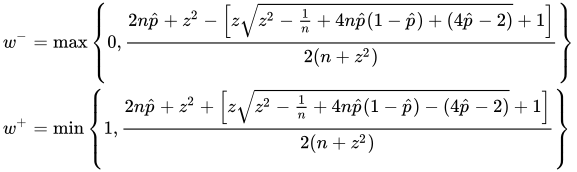
In statistics, a binomial proportion confidence interval is a confidence interval for the probability of success calculated from the outcome of a series of success–failure experiments (Bernoulli trials). In other words, a binomial proportion confidence interval is an interval estimate of a success probability p when only the number of experiments n and the number of successes nS are known.
The advantage of using a confidence interval of this sort is that the computed value takes the number of test into account. The lower the number of test, the greater the margin of error. This results in a lower success rate score for the cases where there are fewer test results.
During the evaluation of this algorithm, 22 consecutive test passes are required before a success score of .85 is reached (with a significance level / α of 0.05).
| Name | Type | Description |
|---|---|---|
task_name |
string | Name of the task the test ran under. |
variant |
string | Name of the build variant the task ran on. Omitted if the grouping does not include the build variant. |
distro |
string | Identifier of the distro that the task ran on. Omitted if the grouping does not include the distro. |
date |
string | The start date ("YYYY-MM-DD" UTC day) of the period the statistics cover. |
num_success |
int | The number of times the task was successful during the target period. |
num_failed |
int | The number of times the task failed during the target period. |
num_total |
int | The number of times the task ran during the target period. |
num_timeout |
int | The number of times the task ended on a timeout during the target period. |
num_test_failed |
int | The number of times the task failed with a failure of type test during the target period. |
num_system_failed |
int | The number of times the task failed with a failure of type system during the target period. |
num_setup_failed |
int | The number of times the task failed with a failure of type setup during the target period. |
avg_duration_success |
float | The average duration, in seconds, of the tasks that passed during the target period. |
success_rate |
float | The success rate score calculated over the time span, grouped by time period and distro, variant or task. The value ranges from 0.0 (total failure) to 1.0 (total success). |
GET /projects/<project_id>/task_reliability
Returns a paginated list of task reliability scores associated with a specific project filtered and grouped according to the query parameters.
| Name | Type | Description |
|---|---|---|
before_date |
string | The end date (included) of the targeted time interval. The format is "YYYY-MM-DD". The date is UTC. Defaults to today. |
after_date |
string | The start date (included) of the targeted time interval. The format is "YYYY-MM-DD". The date is UTC. Defaults to before_date. |
group_num_days |
int | Optional. Indicates that the statistics should be aggregated by groups of group_num_days days. The first group will start on the nearest first date greater than after_date, the last group will start on before_date - group_num_days` days. Defaults to 1. |
requesters |
[]string or comma separated strings | Optional. The requesters that triggered the task execution. Accepted values are mainline, patch, trigger, and adhoc. Defaults to mainline. |
tasks |
[]string or comma separated strings | The tasks to include in the statistics. |
variants |
[]string or comma separated strings | Optional. The build variants to include in the statistics. |
distros |
[]string or comma separated strings | Optional. The distros to include in the statistics. |
group_by |
string | Optional. How to group the results. Accepted values are task, task_variant, and task_variant_distro. By default the results are grouped by task. |
sort |
string | Optional. The order in which the results are returned. Accepted values are earliest and latest. Defaults to latest. |
start_at |
string | Optional. The identifier of the task stats to start at in the pagination |
limit |
int | Optional. The number of task stats to be returned per page of pagination. Defaults to 1000. |
GET /projects/mongodb-mongo-master/task_reliability?tasks=lint
GET /projects/mongodb-mongo-master/task_reliability?tasks=lint&before_date=2019-06-15
GET /projects/mongodb-mongo-master/task_reliability?tasks=lint&before_date=2019-06-15&after_date=2019-06-15
GET /projects/mongodb-mongo-master/task_reliability?tasks=lint&after_date=2019-06-15
GET /projects/mongodb-mongo-master/task_reliability?tasks=lint&group_num_days=7
GET /projects/mongodb-mongo-master/task_reliability?tasks=lint&group_num_days=28
Project is mongodb-mongo-master, task is lint. Assuming today is 2019-08-29 then 2019-03-15 is 6 months ago.
GET /projects/mongodb-mongo-master/task_reliability?tasks=lint&after_date=2019-03-15
GET /projects/mongodb-mongo-master/task_reliability?tasks=lint&after_date=2019-03-15&group_num_days=7
GET /projects/mongodb-mongo-master/task_reliability?tasks=lint&after_date=2019-03-15&group_num_days=28
Create custom notifications for email, slack, JIRA comments, and JIRA issues.
| Name | Type | Description |
|---|---|---|
from |
string | Optional. The email sender. |
recipients |
[]string | The email recipient. |
subject |
string | Optional. The email subject. |
body |
string | Optional. The email body. |
is_plain_text |
string | Optional. Specifies the Content-Type of the email. If true, it will be "text/plain"; otherwise it is "text/html". |
headers |
map[string][]string | Optional. Email headers. |
| Name | Type | Description |
|---|---|---|
target |
string | Required. The name of the recipient. |
msg |
string | Required. The message for the notification. |
attachments |
[]SlackAttachment | Optional. Array of attachments to a message. |
| Name | Type | Description |
|---|---|---|
title |
string | Optional. The attachment title. |
title_link |
string | Optional. A URL that turns the title into a link. |
text |
string | If fallback is empty, this is required. The main body text of the attachment as plain text, or with markdown using mrkdwn_in. |
fallback |
string | If text is empty, this is required. A plain text summary of an attachment for clients that don't show formatted text (eg. IRC, mobile notifications). |
mrkdwn_in |
[]string | Optional. An array of fields that should be formatted with markdown. |
color |
string | Optional. The message color. Can either be one of good (green), warning (yellow), danger (red), or any hex color code (eg. #439FE0). |
author_name |
string | Optional. The display name of the author. |
author_icon |
string | Optional. A URL that displays the author icon. Will only work if author_name is present. |
fields |
[]SlackAttachmentField | Optional. Array of SlackAttachmentFields that get displayed in a table-like format. |
| Name | Type | Description |
|---|---|---|
title |
string | Optional. The field title. |
value |
string | Optional. The field text. It can be formatted as plain text or with markdown by using mrkdwn_in. |
short |
string | Optional. Indicates whether the field object is short enough to be displayed side-by-side with other field objects. |
This corresponds with documentation for the Slack API for attachments.
| Name | Type | Description |
|---|---|---|
issue_key |
string | Optional. |
project |
string | Optional. The project name. |
summary |
string | Optional. The summary text. |
description |
string | Optional. The issue description. |
reporter |
string | Optional. The issue reporter. |
assignee |
string | Optional. The issue assignee. |
type |
string | Optional. The issue type. |
components |
string | Optional. The project components. |
labels |
string | Optional. The issue labels. |
fields |
map[string]interface{} | Optional. Arbitrary map of custom field values. |
This corresponds with the documentation in the JIRA API for creating issues.
| Name | Type | Description |
|---|---|---|
issue_id |
string | Optional. The ID of the issue where the comment should be posted. |
body |
string | Optional. The comment text. |
This corresponds with the documentation in the JIRA API for adding comments.
POST /notifications/<type>
The type can be "email", "slack", "jira_issue", or "jira_comment".
GET /permissions
Returns a static list of project and distro permissions that can be granted to users. The format is
{
   projectPermissions: [
     {
       key: "permission_key",
       name: "My Permission",
       levels: [
         {
           description: "Edit this permission",
           value: 10,
         }
       ]
     }
   ]
 distroPermissions:[
     {
       key: "permission_key",
       name: "My distro Permission",
       levels: [
         {
           description: "Edit this permission",
           value: 10,
         }
       ]
     }
   ]
}
POST /users/<user_id>/permissions
Grants the user specified by user_id the permissions in the request body. Note that usage of this endpoint requires that the requesting user have security to modify roles. The format of the body is:
{
  "resource_type": "project",
  "resources": ["project1", "project2"],
  "permissions": {
     "project_tasks: 30,
     "project_patches": 10
  }
}
- resource_type - the type of resources for which permission is granted. Must be one of "project", "distro", or "superuser"
- resources - an array of strings representing what resources the access is for. For a resource_type of project, this will be a list of projects. For a resource_type of distro, this will be a list of distros.
- permissions - an object whose keys are the permission keys returned by the /permissions endpoint above, and whose values are the levels of access to grant for that permission (also returned by the /permissions endpoint)
GET /users/<user_id>/permissions
Retrieves all permissions for the user (ignoring basic permissions that are given to all users). The format of the response is:
[
  {
    "type": "project",
    "permissions": {
      "project1": {
       "project_tasks": 30,
       "project_patches": 10
      },
      "project2": {
       "project_tasks": 10,
       "project_patches": 10
      }
    }
  }
  {
    "type": "distro",
    "permissions": {
      "distro1": {
       "distro_settings": 10
      }
    }
  }
]
- type - the type of resources for which the listed permissions apply. Will be "project", "distro", or "superuser"
- permissions - an object whose keys are the resources for which the user has permissions. Note that these objects will often have many keys, since logged-in users have basic permissions to every project and distro. The values in the keys are objects representing the permissions that the user has for that resource, identical to the format of the permissions field in the POST /users/<user_id>/permissions API.
GET /users/permissions
Retrieves all users with permissions for the resource, and their highest permissions, and returns this as a mapping. This ignores basic permissions that are given to all users.
The format of the body is:
{
  "resource_type": "project",
  "resource_id": "project_id"
}
The format of the response is:
{
      "username_1": {
         "project_tasks": 30,
         "project_patches": 10
        },
      "username_2": {
         "project_settings": 20,
         "project_patches": 10
      }
    }
DELETE /users/<user_id>/permissions
Deletes all permissions of a given type for a user by deleting their roles of that type for that resource ID. This ignores the Basic Project/Distro Access that is given to all MongoDB employees.
Note that usage of this endpoint requires that the requesting user have security to modify roles. The format of the body is:
{
  "resource_type": "project",
  "resource_id": "project_id",
}
- resource_type - the type of resources for which to delete permissions. Must be one of "project", "distro", "superuser", or "all". "all" will revoke all permissions for the user.
- resource_id - the resource ID for which to delete permissions. Required unless deleting all permissions.
GET /roles/<role_id>/users
Gets a list of users for the specified role. The format of the response is:
{
    "users": ["list", "of", "users"]
}
POST /users/<user_id>/roles
Adds the specified roles to the specified user. Attempting to add a duplicate role will result in an error. If you're unsure of what roles you want to add, you probably want to POST To /users/user_id/permissions instead. Note that usage of this endpoint requires that the requesting user have security to modify roles. The format of the body is:
{
  "roles": [ "role1", "role2" ],
  "create_user": true,
}
- roles - the list of roles to add for the user
- create_user - if true, will also create a shell user document for the user. By default, specifying a user that does not exist will error
POST /users/offboard_user
Marks unexpirable volumes and hosts as expirable for the user, and removes the user as a project admin for any projects, if applicable. This returns the IDs of the hosts/volumes that were unexpirable and modified.
This route expects to receive the user in a json body with the following format:
{
  "email": "[email protected]"
}
- email - the email of the user
The format of the response is:
{
  "terminated_hosts": [ "i-12345", "i-abcd" ],
  "terminated_volumes": ["volume-1"],
}
| Name | Type | Description |
|---|---|---|
| dry_run | bool | If set to true, route returns the IDs of the hosts/volumes that would be modified. |