Execution Notes readonly execNotesReadonly Modernized - sebiboga/testlink-upgraded GitHub Wiki
The legacy read-only Execution Notes viewer (lib/execute/getExecNotes.php +
gui/templates/dashio/execute/getExecNotes.tpl) was replaced by a modern Dashio
standalone screen backed by a REST BFF. The legacy controller was a
non-mutating shim and has since been deleted (Refs #1139, cleanup of the
Execution History chain): a browser navigation went straight to the modern
screen, and every byte of the AJAX fragment the old url2load() call sites
relied on was produced in-process by the BFF with the same authorization,
escaping and status codes. The ?action=fragment route itself is kept
(same-origin gated) so the contract survives, but no in-repo caller reaches it
any more.
Deep link: gui/templates/execute/execNotesReadonly.html?exec_id=<execution id>
Refs: #1807 (screen), #1808 (security fix of the legacy controller)
- Modern UI:
gui/templates/execute/execNotesReadonly.html(Dashio shell, context meta grid, no Smarty, no web editor) - BFF API:
api/execnotesreadonly/index.php?action=view&exec_id=N(JSON) and?action=fragment&exec_id=N(escapedtext/html) - Legacy shim:
lib/execute/getExecNotes.php— deleted in Refs #1139 (it only ever 302'd browser navigations here andrequired this BFF in-process for the XHR fragment) - Canonical action:
$actions->execNotesReadonlyinlib/functions/common.php - i18n: 29
enro.*keys in all ten bundlesgui/templates/i18n/{en,ro,de,fr,es,it,pt,ru,ja,zh}.json
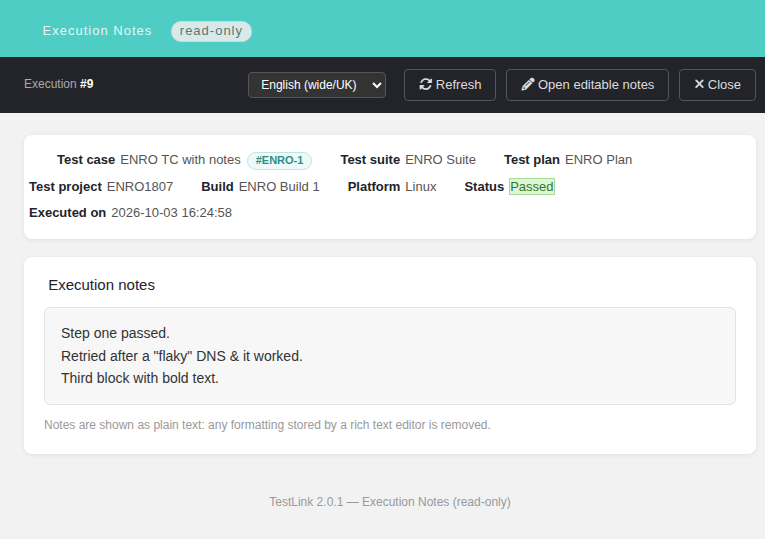
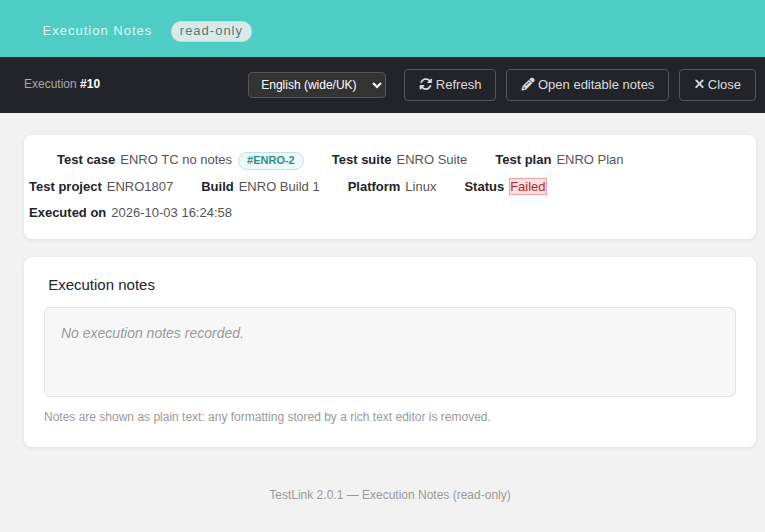
- Renders the note together with its context: test case name +
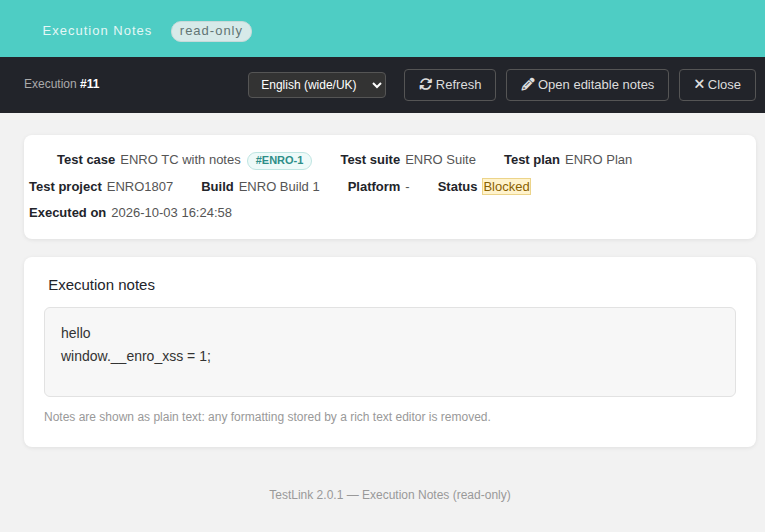
#PREFIX-Nchip, suite, test plan, test project, build, platform, execution status badge and execution timestamp. The note is never shown without knowing which execution it belongs to. - The stored RichEdit blob is flattened server-side to plain text
(
<br>and block ends become newlines, everything else is stripped, entities are decoded once) and lands in the page viatextContent, so formatting stored by the rich editor is removed and a stored payload can never execute. - Buttons: Refresh reloads the note; Open editable notes opens the existing
editable popup (
execNotes.html?exec_id=N) and is enabled only when the BFF reportedcan_editfor the owning project; Close closes the window. - Locale switcher translates every chrome label; the note text itself is data and is never translated.
- Explicit state cards, keyed off the BFF
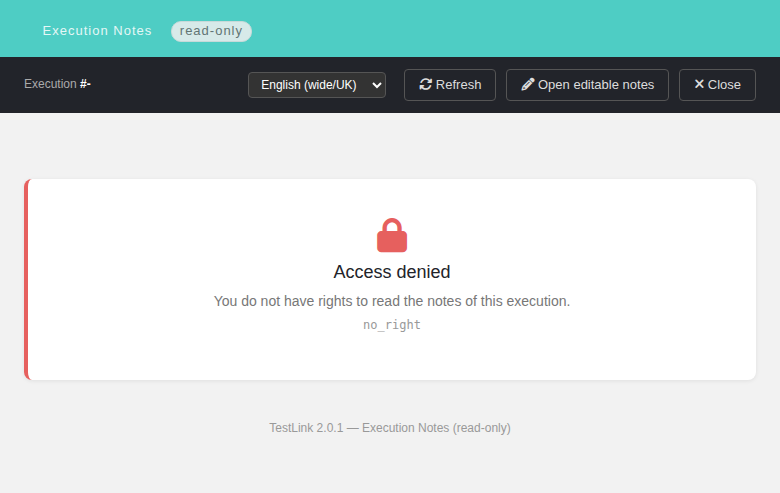
codeand never off the English message: missingexec_id, session expired, not authenticated, access denied, execution not found, bad request, backend unreachable.
- The right is enforced on the owning test project, resolved by walking
executions -> testplans -> testprojectand never from a client-supplied id. Granted byexec_ro_access,exec_edit_notesortestplan_execute— identical toapi/execnotes, so the standalone viewer and the in-page popup can never disagree. - If the owning test plan cannot be resolved the endpoint fails closed with 404 instead of falling back to the session project (that would be a confused-deputy read).
- The executed test case version is proved to live in the execution's own project by
walking
nodes_hierarchy.parent_idup to thenode_type_id = 1root; a foreign or orphan version yields 404 rather than a foreign test case name next to the note. -
exec_idmust be a strictly positive integer (the legacyINT_Naccepted0and negatives, which then matched nothing and dereferenced$map[0]anyway). - Empty note → "No execution notes recorded."; the context grid is still rendered.
- No ASIDE entry: without an
exec_idthe screen can only render a "pick an execution" state, so a menu link would be a dead end. The screen is deep-linked instead; an execution-picker route is a follow-up.
The 1.9.20 controller called only testlinkInitPage($db) — a session, no right and
no ownership — then handed a bare ?exec_id= straight to the view. Consequences:
- any authenticated user (role 3
<no rights>included) could read the notes of any execution on any test project by enumerating?exec_id=; -
$map[0]['notes']was dereferenced with no guard → E_WARNING + fatal 500 on an unknown id; - the stored RichEdit blob was rendered by the web editor, i.e. a stored payload executing with the app origin's privileges.
All three now live in the BFF. The shim additionally requires a same-origin caller
for the fragment branch, because the legacy call sites assign the answer into
innerHTML (URL/Referer are validated authoritatively and the X-Requested-With
hint never overrides a foreign Origin, issue #1679).
Investigating the above re-opened the security question, and the requirement turned out to be attached to only one of the two entry points that emit the identical fragment.
api/execnotesreadonly/index.php exposes ?action=fragment as a first-class public route — it is
documented in the file's own header and is the whole reason the shim exists. But the same-origin
check lived only inside lib/execute/getExecNotes.php, so the same request against the BFF's own
route answered 200 + the notes:
Request (as admin) |
lib/execute/getExecNotes.php?readonly=1&exec_id=1 |
api/execnotesreadonly/index.php?action=fragment&exec_id=1 |
|---|---|---|
Origin: http://evil.example |
403 cross_origin |
200 + the note |
no Origin at all |
403 cross_origin |
200 + the note |
Root cause. bffSameOriginGuard() (api/_guard.php:102-106) starts with
if ($method === 'GET' || $method === 'HEAD' || $method === 'OPTIONS') { return; }It is a write-verb CSRF guard, keyed on the verb rather than on the response shape. On this
endpoint enro_require_safe_verb() has already narrowed the verb set to GET|HEAD, so the call at
api/execnotesreadonly/index.php:52 always returned on its first statement — it was structurally
unreachable. The protection therefore depended on which URL a caller happened to use, one rename
away from being gone.
Fix. enro_require_same_origin_fragment() in the BFF, scoped to action=fragment only, with
the same semantics the shim already used — a present Origin/Referer is authoritative
(unparseable → 403 unparseable_origin, foreign → 403 cross_origin, and the
X-Requested-With hint never overrides it, issue #1679); neither header → the XRW fallback that a
same-origin $.ajax sends; otherwise 403. It runs before the user row is resolved and before
bffEnforceSession(), so a foreign caller learns nothing and cannot keep a stale session alive.
action=view is deliberately not gated: it is JSON, its only caller is the same-origin
$.getJSON at execNotesReadonly.html:169, and the endpoint sends no
Access-Control-Allow-Origin, so it is already unreadable cross-origin. Gating it would have meant
editing a guard shared by 100+ BFF endpoints.
Scope, stated honestly. The fragment body is htmlspecialchars-escaped and no CORS header is
sent, so the pre-fix 200 was not a readable cross-origin disclosure and nothing executed with it
— the invariant was broken, not the confidentiality of that one route. What changed is that the
innerHTML-sink requirement now holds regardless of which of the two URLs a caller uses.
The mandatory subagent review returned no blockers and 5 minor items. Applied:
-
?action[]=fragment/?exec_id[]=1wrote an E_WARNING into the Event Viewer. A bare(string)cast on an array emits "Array to string conversion", andwatchPHPErrors()(lib/functions/logger.class.php:1483) routes that into theeventstable — unauthenticated, since the parameter parse runs before the session check. Both parameters are nowis_scalar()-guarded. A non-scalar is refused outright rather than coerced to'':''falls through to theif ($action === '') { $action = 'view'; }default and would silently serve the view payload for a malformed parameter. That regression was introduced by the first attempt and caught by the new group-10 test, which measured200with the note body before the correction. The repo-wide pattern (~12 remaining call sites) is filed as #1810. -
enro_forbid_origin()gained theheaders_sent()guard its siblingsenro_fail()andbffRejectForbidden()already have, so a refusal can never degrade into a200should the bootstrap ever emit output first. -
The "IDENTICAL to the shim" claim was false and has been corrected. The shim requires every
present header to match; the gate returns on the first match, matching the shared guard at
api/_guard.php:126-145. The only divergent combination is a same-originOriginpaired with a foreignReferer— measured on both endpoints as group 10.6/10.7 — where the shim runs first and is the stricter one, so the effective verdict never changes and no legacy call site can break.
Accepted but not applied: the gate runs after the DB connect, so a request destined for 403
still costs one. Reordering it would disturb the documented verb-check sequence for a cosmetic gain.
Verified — the 8-case origin matrix passes 8/8, and all 15 status codes of the pre-existing
rights / id-validation / no-session / POST / 302 probes are unchanged (captured before and after the
change and diffed programmatically). In headless Chrome the stored
<img src=x onerror=alert(1)> + <script> payload arrives as one text node with 0 injected
elements and no console errors. The events table gained no Error/Warning row — a refused read is
logged AUDIT on purpose, so ordinary denials never pollute the Event Viewer. Suite
Issue #1808 in tmp/TLU_Test_Cases.md.
The shim requires the BFF in-process rather than proxying it over HTTP: the
fragment must keep the same session cookie, status codes and body, and a nested
self-request is not available (the dev server is single-threaded, so it deadlocks
into a 502).
Regression Suite #1807 (30 cases) covers: both BFF routes, id validation (400/404/405/401/403), cross-project fail-closed, the role-3 refusal on both the modern and the legacy-fragment path, the shim's 302 vs fragment split, the same-origin gate, XSS inertness on the fragment and on the page, the missing-id and not-found cards, the edit button being correctly enabled/disabled, the Romanian locale switch, all ten bundles validating, and a clean Event Viewer. All PASS.