Bug Severity - sebiboga/testlink-upgraded GitHub Wiki
Bug Severity (Test Strategy)
Bug Severity is a part of the Test Strategy in TestLink 2.0.1: the severity/priority levels of a test effort are not hard-coded UI labels — they are defined in the Test Strategy of each test project and drive how defects found during test execution are classified and prioritised.
TestLink splits the classic "bug severity" concept into three coordinated levels that together form the project's severity model:
| Level | Where it lives | Values |
|---|---|---|
| Priority (importance) | test case version (tcversion.importance) |
High (3) / Medium (2) / Low (1) |
| Urgency | test-plan ↔ test-case link (testplan_tcversions.urgency) |
High (3) / Medium (2) / Low (1) |
| Execution priority | computed = importance × urgency |
High / Medium / Low (thresholds from urgencyImportance config) |
The toggle that turns this model on per test project is the Enable
Priority project option (testPriorityEnabled) — the first place the
severity level scheme is "defined" in the strategy. When enabled, TestLink
shows Importance / Urgency / Priority columns in the Test Case
Specification and the execution-oriented screens; when disabled, the whole
severity layer is hidden.

1. Where the severity levels are defined
1.1 Project level — Enable Priority
The Test Strategy of a project is configured on Test Project Management >
Create/Edit Test Project (gui/templates/projects/projectEdit.html, BFF
api/projects/index.php). The Features section holds the
Enable Priority checkbox:
- ON → the project's test cases carry an Importance and can be assigned Urgency inside a test plan; priority-aware reports and columns activate.
- OFF (default) → severity/priority is not tracked on this project.
Server-side write path: api/projects/index.php:209-210
($options->testPriorityEnabled = isset($input['optPriority'])).
1.2 Test case version — Importance
Each test case version stores an Importance (tcversion.importance):
3 = High, 2 = Medium, 1 = Low. This is the per-test-case severity the author
assigns while writing the test (how severe is the defect this case is meant
to catch).
Modern screens exposing it:
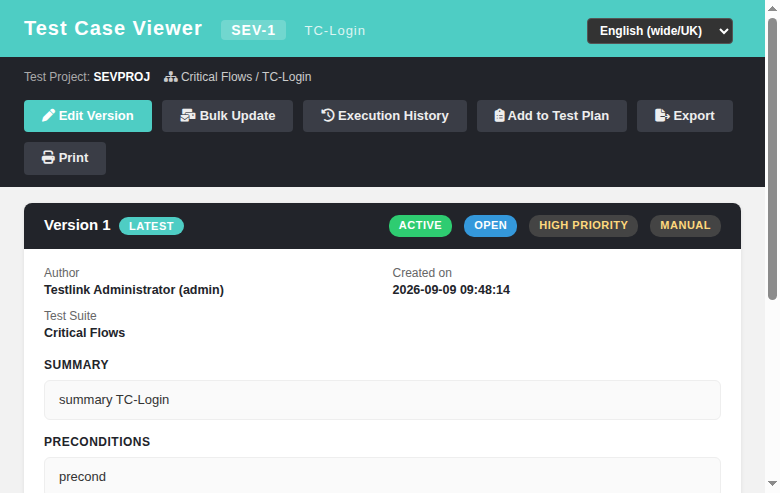
- Test Case Viewer (
gui/templates/testcases/tcView.html) renders the value as a badge (tcview.importanceHigh/Medium/Low, mapping intcView.html:248-250): "HIGH PRIORITY" / "MEDIUM PRIORITY" / "LOW PRIORITY".
- Test Specification (
tspec.importance*), Search (search.importance), My Test Case Assignments (tcPerUser.colImportance), TC Assignment Overview (tca.colPriority), Set Test Urgency (turg.colImportance).
Set programmatically via testcase::setImportance() (lib/functions/testcase.class.php:7709).
1.3 Test plan link — Urgency
When a test case version is added to a test plan, the strategy may assign
an Urgency to the link (testplan_tcversions.urgency), again High /
Medium / Low. Urgency answers "how urgently must this test be executed" and is
managed from:
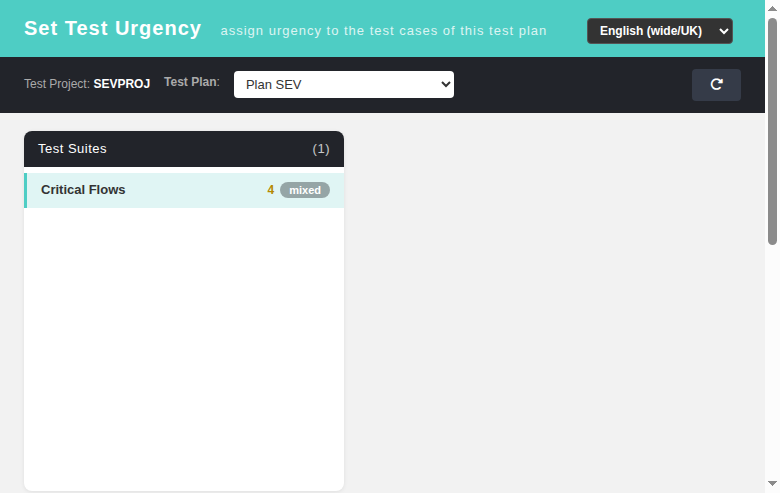
- Set Test Urgency (
gui/templates/plans/testUrgency.html, BFF routesGET/POST /urgency,/urgency/suite,/urgency/tcasesinapi/plans/index.php), legacylib/plan/planUrgency.php.
Write paths: testPlanUrgency::setTestUrgency() / setSuiteUrgency()
(lib/functions/testPlanUrgency.class.php:33,65).
1.4 Computed execution priority
The final severity-driven priority is the product of the two strategy levels:
priority = importance × urgency
Level thresholds come from the global Test Strategy configuration
(config.inc.php:2041-2048):
$tlCfg->urgencyImportance = new stdClass();
$tlCfg->urgencyImportance->threshold['low']  = 3;
$tlCfg->urgencyImportance->threshold['high'] = 6;
priority_to_level() (lib/functions/common.php:766-781):
priority >= 6→ HIGHpriority < 3→ LOW- otherwise → MEDIUM
Example (credit-card banking flows): a High-importance × High-urgency case
scores 9 and gets HIGH priority; a Low-importance × Low-urgency case
scores 1 and gets LOW. Reports that slice results by priority
(e.g. "Results by priority", rgm.priority in the REST BFF
api/reports/index.php priority rows) rely on exactly these levels.
2. Priority grid
| Importance \ Urgency | High (3) | Medium (2) | Low (1) |
|---|---|---|---|
| High (3) | High (9) | High (6) | Medium (3) |
| Medium (2) | High (6) | Medium (4) | Low (2) |
| Low (1) | Medium (3) | Low (2) | Low (1) |
3. Bug severity in the defect-report flow
The severity level of an actual bug is defined once the test fails and a
defect is filed. In TestLink 2.0.1 the execution screen
(gui/templates/execute/execTest.html) links or creates bug/issue IDs
against the configured Issue Tracker (exe.bugId, exe.createBugDone):
the tracker (GitHub, JIRA, Redmine, Bugzilla, Mantis ...) owns the
bug severity field (Critical / High / Medium / Low etc.). TestLink keeps the
priority model (Importance × Urgency) so the test strategy severity
aligns with what the team then files in the tracker.
4. Rights model
- Changing test project "Enable Priority" requires the project management
rights enforced by
api/projects/index.phpon the create/edit routes. - Setting Urgency on a plan requires
testplan_planning(testPlanUrgency.phplegacy parity), enforced server-side on every/urgency*route. - The urgency menu entry keeps the
testplan_set_urgent_testcasesgrant gate.
5. Legacy parity
| Legacy 1.9.20 | Modern 2.0.1 |
|---|---|
tcversion.importance 3/2/1 |
unchanged schema; displayed via tcview.* / tspec.* labels |
testplan_tcversions.urgency 3/2/1 |
unchanged schema; managed by the modern Set Test Urgency screen |
priority_to_level() thresholds (urgencyImportance) |
the modern BFF prioLevel() (api/tcassignments/index.php:103, api/execassignment/index.php:110) uses simplified hardcoded thresholds (<=2 low, <=4 medium, >4 high) — functionally similar to the config thresholds (low=3 high=6) but diverging at priority value 5 |
testPriorityEnabled project option |
still stored on the project; exposed/edited in projectEdit.html |
6. Test cases
Suite in tmp/TLU_Test_Cases.md — Task — Issue #1291: Document Bug Severity (see the repository test-case document for steps and results).
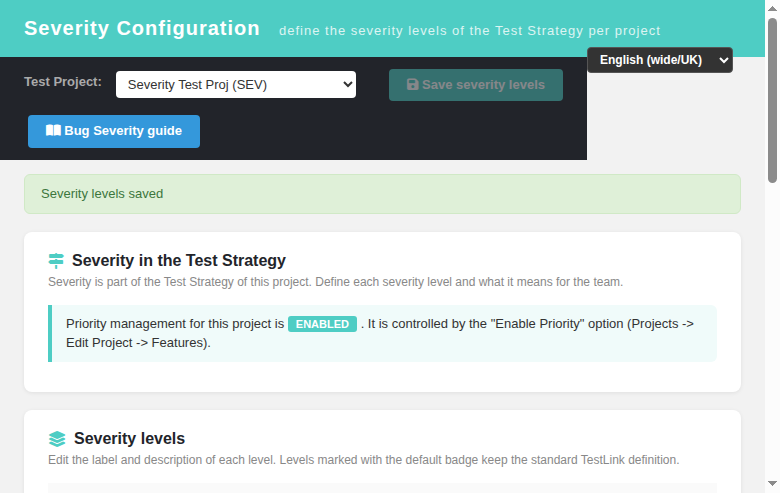
7. Modern Severity Configuration screen (severityConfig, Refs #1294)
The per-project Severity Configuration screen (gui/templates/projects/ severityConfig.html + api/severityconfig/index.php, ASIDE → Product →
Severity Configuration) is a Dashio modern screen where the Test Strategy
severity scale is defined:
- Project selector lists all projects; the current
tproject_idURL param preselects a project. - Severity in the Test Strategy card shows whether the project's
Enable Priority (
testPriorityEnabled) option is ENABLED/DISABLED. - Severity levels card: one row per level (LOW/MEDIUM/HIGH/CRITICAL) with a custom label (max 40 chars) and description (max 300 chars). Editing marks the scale dirty and enables the Save buttons; the default badge is shown next to a customized level.
- Severity / priority preview grid renders the computed mapping
importance × urgency→ severity level live (as you type): products<3→ LOW,>=6→ HIGH/CRITICAL, otherwise MEDIUM;3×3=9→ CRITICAL. - Save persists the scale into the project
optionsblob under theseverityLevelsproperty viatestproject::update()and logs an AUDIT event (severityConfig_saved, objectTypetestprojects). - Reset to defaults drops the
severityLevelsproperty so the default scale is served again. - The toolbar Bug Severity guide link opens
documentation/bugSeverity.html.
API contract (api/severityconfig/index.php):
GET ?action=projects— accessible project list (id/name/prefix) for the selector; authenticated session only.GET ?tproject_id=N— returnsproject,priorityEnabled,levels(default scale when none stored, merged scaffold otherwise),canEdit(mgt_modify_product); 401 anon, 404 unknown project.POST/PUT ?tproject_id=Nbody{levels:[{level,code,label,description}]}— 403 withoutmgt_modify_product; 400 no/invalid levels, 404 unknown project; emptylevelsarray = reset-to-defaults; writes the AUDIT event.
Rights: writes gated on mgt_modify_product (403 with a no-rights
user); reads require only a valid session (401 anon). This mirrors the
project-edit surface.
i18n: sevcfg.* (36 keys) + footers.severityConfig in all 10 locale
bundles.
Regression suite: Suite 1294 in tmp/TLU_Test_Cases.md — 11/11 PASS
(load, ENABLED badge, preview grid, custom-label save + DB persistence,
reset-to-defaults, 401/403 gates, i18n completeness, Event Viewer clean).