2.Architecture - sagarpattar005/apb_avip GitHub Wiki
APB AVIP Testbench Architecture
The accelerated VIP has divided into the two top modules as HVL and HDL top as shown in the fig 2.1. The whole idea of using Accelerated VIP is to push the synthesizable part of the testbench into the separate top module along with the interface and it is named as HDL TOP. and the unsynthesizable part is pushed into the HVL TOP it provides the ability to run the longer tests quickly. This particular testbench can be used for the simulation as well as the emulation based on mode of operation.
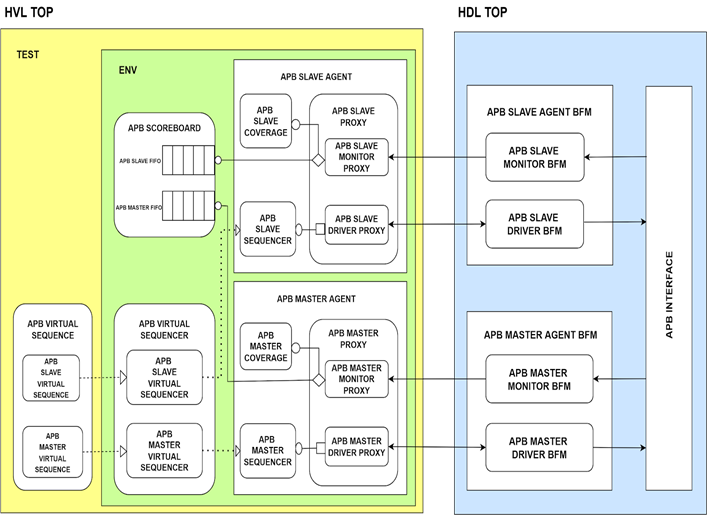
Fig.2- APB_AVIP Architecture
HVL TOP has the design which is untimed and the transactions flow from both master virtual sequence and slave virtual sequence onto the APB I/F through the BFM Proxy and BFM and gets the data from monitor BFM and uses the data to do checks using scoreboard and coverage. HDL TOP consists of the design part which is timed and synthesizable, Clock and reset signals are generated in the HDL TOP. Bus Functional Models (BFMs) i.e synthesizable part of drivers and monitors are present in HDL TOP, BFMs also have the back pointers to its proxy to call non-blocking methods which are defined in the proxy. Tasks and functions within the drivers and monitors which are called by the driver and monitor proxy inside the HVL. This is how the data is transferred between the HVL TOP and HDL TOP. HDL and HVL uses the transaction based communication to enable the information rich transactions and since clock is generated within the HDL TOP inside the emulator it allows the emulator to run at full speed.