Teamcrafter - quitters/synthograsizer GitHub Wiki
Teamcrafter
AI-made work for the Synthograsizer: instruments, image-prompt engines, Glitcher looks, workflows, chat-room tools and agent companies. Claude wrote part of it. Crews of Gemini agents, running in the same chat engine as the Agent Studio, wrote the rest. Every piece was checked by a machine before it went in: a harness plays each instrument in real Chrome, a validator checks each engine, the Glitcher itself renders each look.
Status: merged into the repository's main branch (#25 and #26: instruments, engines, looks, workflows and chat-room tools; #27 and #28: agent companies and owner sign-in). The templates, looks and workflows come with the app built from main. The chat-room tools and agent companies run on a local install: the hosted service does not include the chat room.
Nothing here was picked out of a larger batch to hide a weak template; what you see is what the template makes. The images on this page were looked at one by one, and a few draws were left out because the image model had written a real brand or a real person's name into them. The engines now tell it not to.
Eighteen instruments
Play them in the Synthograsizer under Templates → P5 (four to seven dials each, all of them live), and on The Commons wall, where they join the p5 library. Ten were made first (six by Claude, four by agent crews). Eight more were brainstormed and built by Gemini agents with nobody at the keyboard: four voices proposed 24 concepts, a curator picked eight with different engines, and eight crews built them.
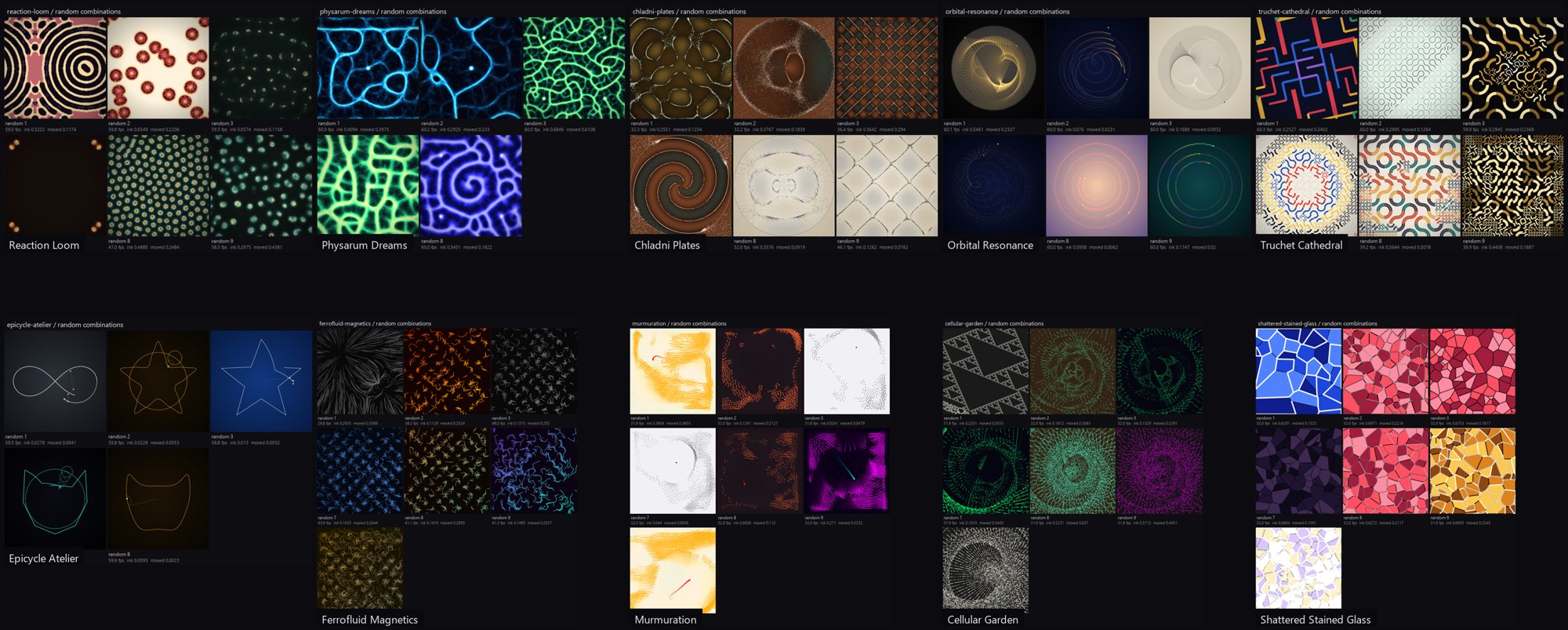
The harness's own contact sheet: several random combinations of each instrument's dials, with the frame rate and how much of the canvas is drawn.
| Instrument | What it is | Written by |
|---|---|---|
| Reaction Loom | a Gray–Scott reaction-diffusion field | Claude |
| Physarum Dreams | slime-mould agents laying and following trails | Claude |
| Chladni Plates | sand finding the nodal lines of a vibrating plate | Claude |
| Orbital Resonance | bodies in resonance weaving figures, from the Venus pentagram to golden drift | Claude |
| Truchet Cathedral | multi-scale Truchet tilings that re-knot in waves | Claude |
| Epicycle Atelier | closed curves drawn by chains of turning circles | Claude |
| Ferrofluid Magnetics | magnetic field lines | an agent crew |
| Murmuration | a flock chased by a predator | an agent crew |
| Cellular Garden | Wolfram rules as polar-warped textures | an agent crew |
| Shattered Stained Glass | a Voronoi window that cracks and leaks light | an agent crew |
| Kinematic Drafting Rig | a linkage whose pen nibs draw machine-made figures | an agent crew |
| Boiling Voids | circle packing that swells and pops | an agent crew |
| Aperiodic Stained Glass | a warped radial window of coloured cells (a tunnel, not a true aperiodic tiling, and labelled so) | an agent crew |
| Camshaft Pillars | isometric pistons riding cam profiles | an agent crew |
| Torn Phosphor Fabric | a cloth of glowing threads that tears and knits itself back together | an agent crew |
| Cathedral of Light | beams of light through silhouettes, cast by a 2D ray tracer | an agent crew |
| Chaos Ribbons | strange attractors drawn as a few luminous ribbons | an agent crew |
| Hyperbolic Fractal Eye | circle inversions: luminous rings round a dark void | an agent crew |
The crews were given a numeric gate (no errors, not blank, not frozen, fast enough). Two attempts that were not shown what the gate had seen passed every number and looked wrong: a stained glass of flat primary colours, and a pond of black-and-white moiré (the pond was not shipped). Shown the harness's picture of their own output, the crew fixed the glass. The second wave's sampled gate accepted all eight; a sweep of every value of every dial, and a look at the pictures, then sent five back for a second pass (a value that froze, a value that drew almost nothing, a scribble where ribbons were promised). See What the agents taught us.
Nine image-prompt engines
An engine is a prompt template with enough depth that every random draw is a different, coherent, striking image: five or six variables, eight to twelve values each, bundled so that things that depend on each other cannot disagree. They are small invented archives. Find them under Templates → Prompt.
| Engine | The archive |
|---|---|
| Lost Cinema | stills from films that do not exist |
| Tape Shelf | covers of rental tapes nobody released |
| Impossible Objects | museum and excavation photographs of objects that cannot exist |
| Civic Notices | public notices from invented authorities |
| Arcade Archaeology | cabinets for games nobody made |
| Brutalist Utopias | brutalist projects for impossible places |
| Arcana Machina | tarot cards for the machine age (22 arcana, so a whole deck holds together) |
| Specimen Plates | natural-history plates of invented creatures |
| Sanatorium Dispatch | pneumatic dispatch stations in an alpine sanatorium (designed by an agent crew) |

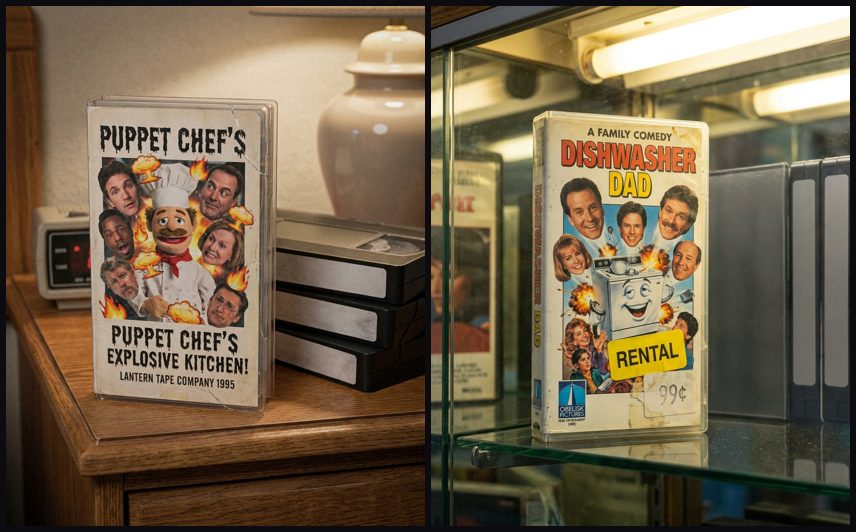
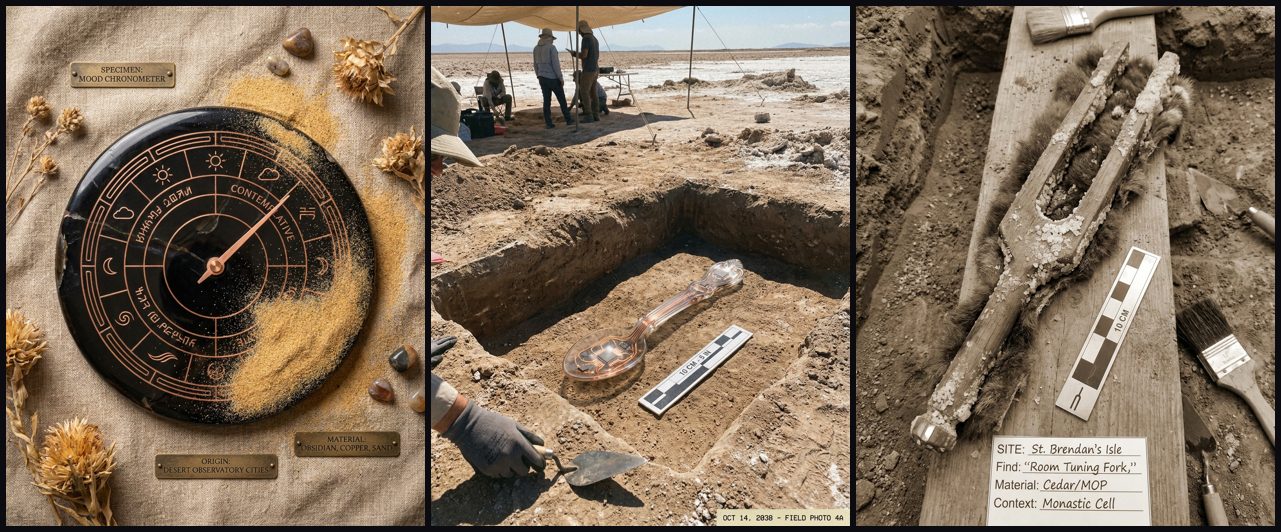

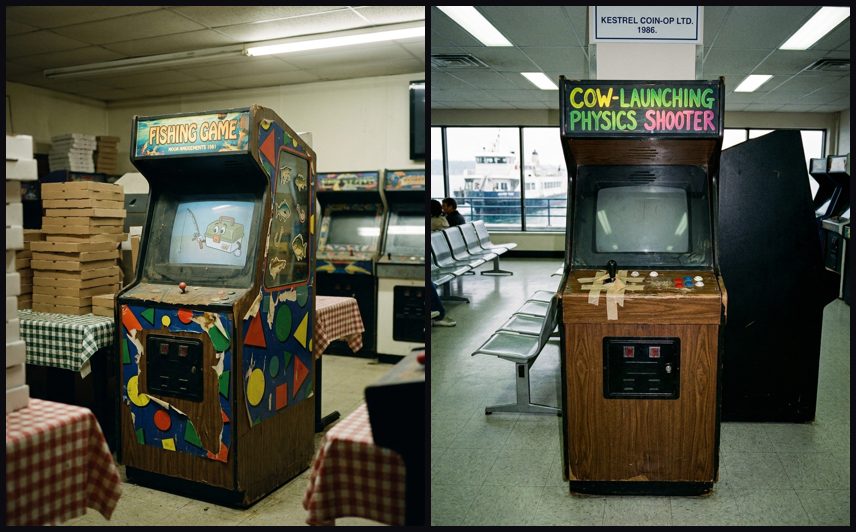

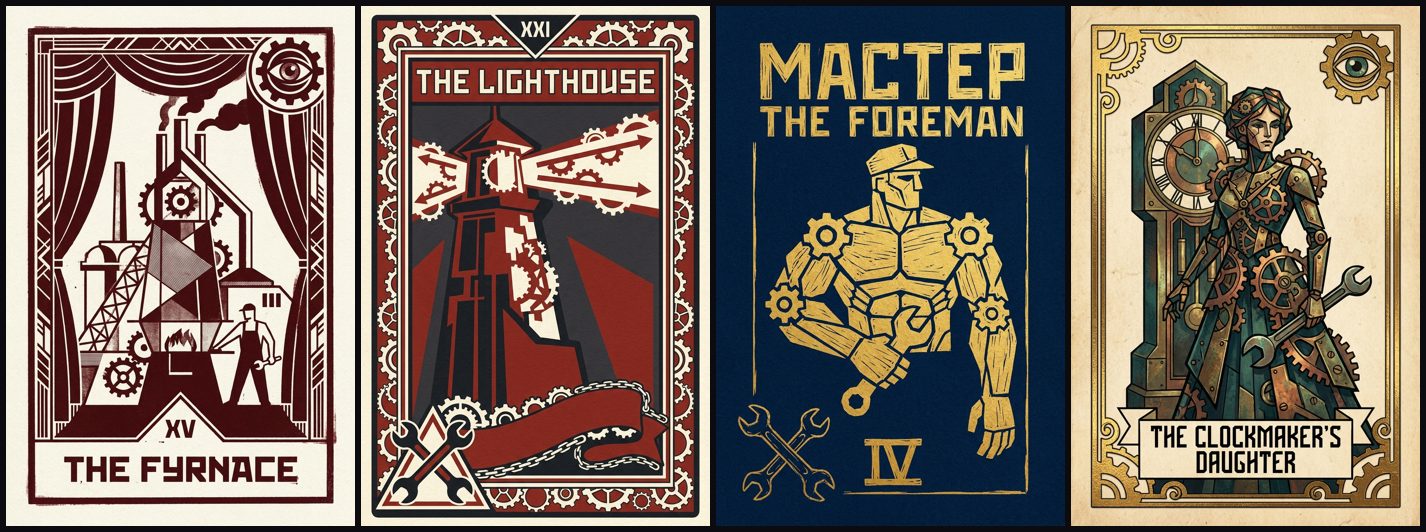
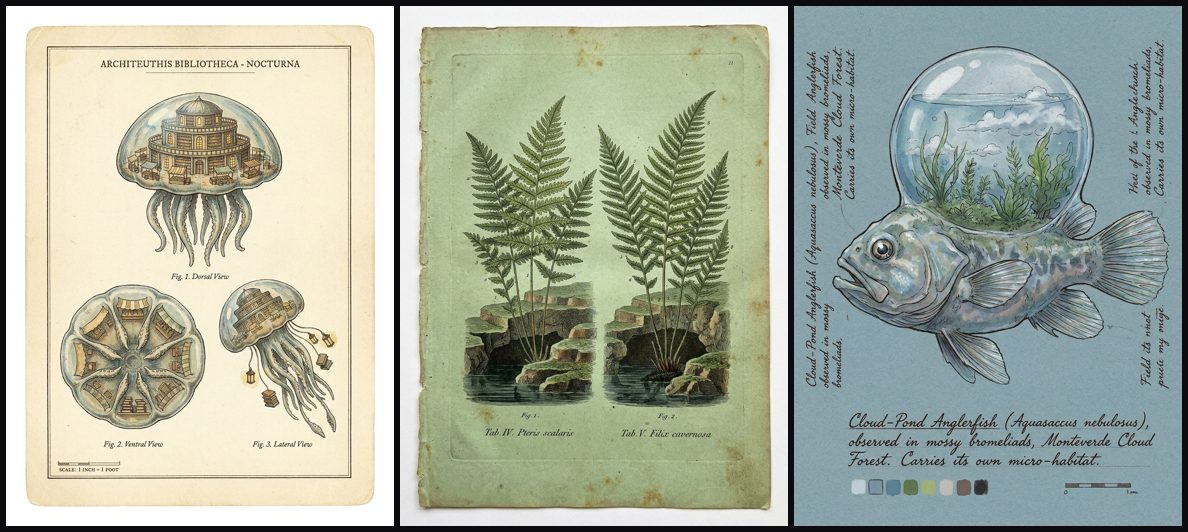
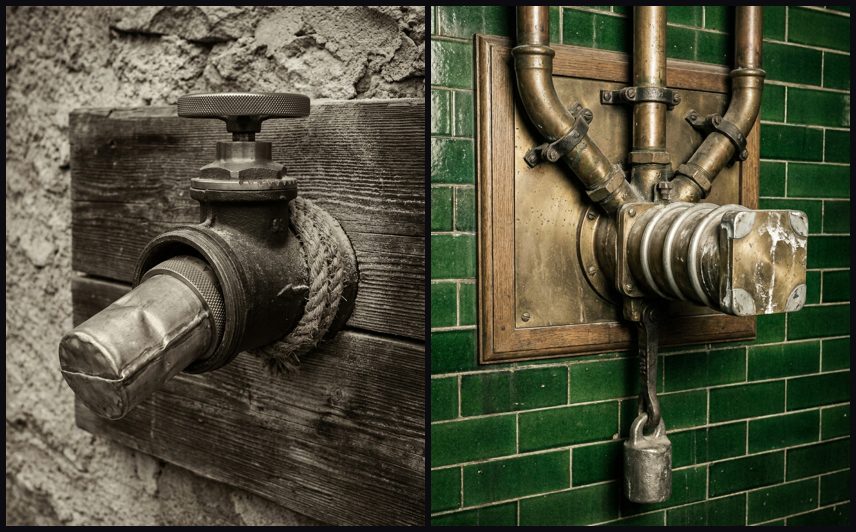
Draws on the Pro image model. Each is one random combination of the engine's values.
Rules that came out of looking at the first draws (and are now in the template generator's prompts): bundle values that depend on each other; end with "no captions, titles or lettering anywhere in the frame" unless lettering is the point; say that background items are generic or unlabelled; phrase organisations as trades, not institutions; invent, do not borrow.
Glitcher looks
The Glitcher's effect-stack header has a Looks button: 24 ready-made stacks in four packs, plus your own saved stacks.
- Glitch classics: four stacks that keep degrading while they play.
- Archive damage: how a record gets old (nitrate film, rental tape, a faded poster, a projector). They age the whole picture and never run away.
- Deep Survey and Deep sea: twelve looks written by agent crews and checked in the Glitcher (two were retuned by hand afterwards: one turned pictures to confetti, one barely changed them). A look marked whole image covers the picture instead of wandering regions.
Workflows
- Look-locked deck: one reference card, N more drawn with it as a style reference (with the clause that keeps its look and not its subject).
- Storyboard to film: approved frames and a motion line each, animated clip by clip with Veo, joined in order, with an optional score mixed under. Only the Veo step costs real money.
In the chat room and Agent Studio
- Saved sessions: every conversation is saved to disk as it happens (local installs), reopened, downloaded, or loaded from a file.
- Done when: checks the server runs before it lets a session end (a file exists, a regex, JSON of the right shape, an address that answers). An agent saying the work is done is not enough.
- An independent critic that scores pictures 1 to 10 seeing only the pictures, and a way to show the room what an agent made: renders of templates, instruments and pages.
- Lead-closes-the-room is the default ending, with an optional minimum and maximum number of turns.
- A room pauses when someone repeats themselves. One live room spent 38 turns waiting on a tool that could not answer while two people sent near-identical messages; no limit saw it, because every turn "worked". Now one person's last three messages being almost the same, with no file saved and no picture made, pauses the room for its owner, who resumes it or sends a message. On by default; "Pause on repeats" in the settings turns it off.
- A turn the model service declines is final in every room: nobody is asked again, and the room is told.
- A step in a workflow takes
retries(a Veo step defaults to none, since a blocked request would be charged twice).
Agent companies
A company is a set of rooms of invented people working under one policy. It is made from one sentence, runs on a local install, and is created paused: nothing runs, spends or publishes until its owner says go, and nothing leaves a room until the owner approves it.
- Limits no setting can change: six hard limits (nothing sexual involving minors, no real person's likeness or impersonation, nothing built to deceive, no private information about real people, no targeted harassment or hate, no operational instructions for serious harm); a stricter floor for anything published (no copyrighted characters, no living artist as a style target); human approval of every publication; and an AI-generated label on everything exported (in a manifest, in a note beside the work, and inside the file itself: a line in text and code; in a PNG or JPEG, XMP metadata with the IPTC "made by a generative model" value, written without touching the pixels).
- An independent screen reads every turn before it is shown or acted on (more permissive for drafts, stricter for publishing); a turn it will not pass is withheld, and repeated holds pause the room for a person. Tools are least-privilege, spend has a ceiling, and the operator chooses which models the agents may run on (a hosted instance defaults to the default and the deliberate one, leaving out the cheapest, which the red team found weakest).
- People: a roster of invented people cast by code to meet diversity targets, a writer for each sheet with checks, memory that is checked against what the server saw, and a shared space (mail, forums, a workspace and a board) where they work between rooms.
- The owner's console at
/companyand, for who the owner is, a key for local use or Google sign-in for a website. - A live red team attacked the layer with 45 framings on three models; it is a baseline, not a certification, and the notes say where it is weak.
Design, defences and results: docs/COMPANY_SAFETY_LAYER.md, docs/COMPANY_CREATION_FLOW.md and docs/OWNER_SIGN_IN.md in the repository.
What the agents taught us
- A lead agent ends rooms less prematurely than a vote. On the brief that had failed before: the vote ended with an invalid deliverable in 5 of 8 sessions, the lead in 1 of 8. A lead is not a verifier, though: it once believed a block with the wrong count. Only a machine check removes that.
- Numbers cannot see taste. Crews that could see their own output fixed a pond made of moiré, a stained glass of flat primaries and a Glitcher look that turned pictures to confetti; the same crews without a picture shipped them.
- A gate that samples misses what a sweep finds. The in-room gate played 14 random combinations and accepted eight of eight instruments; a sweep of every value of every dial found a frozen value, a value that drew almost nothing or a slow combination in five. Told only the symptom, a crew moved the defect to another value; told the cause, it fixed it.
- Telling a loop from work needs real examples. A first idea for "is this person repeating themselves?" would have paused the rooms where a coder re-posted a revised sketch: those messages were 84 to 92 percent alike. Leaving code out of the comparison, and counting a saved file or a picture as progress, left only the two real loops in 71 saved conversations.
- A critic is honest alone and agreeable in a room. Alone, even the smallest model scored a photograph that had drifted into a painting 2 to 3 out of 10 against about 9 for good frames; the supervisor inside the room said "match". A 1-to-10 score discriminates where a checklist makes every model reject nearly everything.
- Agents chase noise even when told it is noise. A frame rate read 32 or 57 for the same code, and a music model's loudness for one score varied by up to 12 dB between recordings. The harness now repeats, reports the range, and says which differences are real.
- A machine that sleeps stops the work. One slept for about two hours in the middle of a batch; long jobs now ask the operating system not to.
Where it lives
The instruments and engines are ordinary templates in static/synthograsizer/templates/; the contract test, docs/ENGINE_DESIGN.md and the chat-room documentation (chatroom/README.md) describe how they are made and checked.