Intermittent Access Two Bottle Choice (IA2BC) - neuropsytox/Documentation GitHub Wiki
Psilantrolab protocol adapted from Simms et al., (2008)
The procedure of intermittent access two bottles choice at 20% of alcohol in Wistar rats is briefly described below.
IA2BC model
| Materials | |
|---|---|
| 1 | Alcohol at 96% (EtOH) |
| 2 | Purified water from the biotherium of INB |
| 3 | Laboratory wrapping film (Parafilm) |
| 4 | 21 G needle |
| 5 | Digital scale |
| 6 | Logbook |
| 7 | Reversed light cycle room (7 am-7pm) |
| 8 | Rat housing boxes |
| 9 | Redkit drinkers of 125 ml |
| Measures |
|---|
| Main intake of alcohol: Measurement of 24-hour alcohol intake with units of g/kg/24hrs |
| ADE |
| BINGE drinking |
- Rats 21 days postnatal (P21) were housed in groups of 4 per polycarbonate box, in a 12-hour reverse cycle (dark/light).
- In P35 they are housed individually since it is reported that social isolation increases alcohol consumption in IA2BC in rats (Weiner et al., 2013). Also, the habituation to 2 bottles (Reddit 125 ml drinkers) with non-drip metal sprout also begins.
- The IA2BC paradigm begins at the age of 45 days (P45) and has a total duration of 45 days (6 weeks 3 days) where 20 sessions (EtOH sessions) of 24 hours are presented intermittently (Monday - Wednesday - Friday) with unlimited access to the choice of 2 bottles with a volume of 100 ml of 20% alcohol solution (96% v/v) and 100 ml of water.
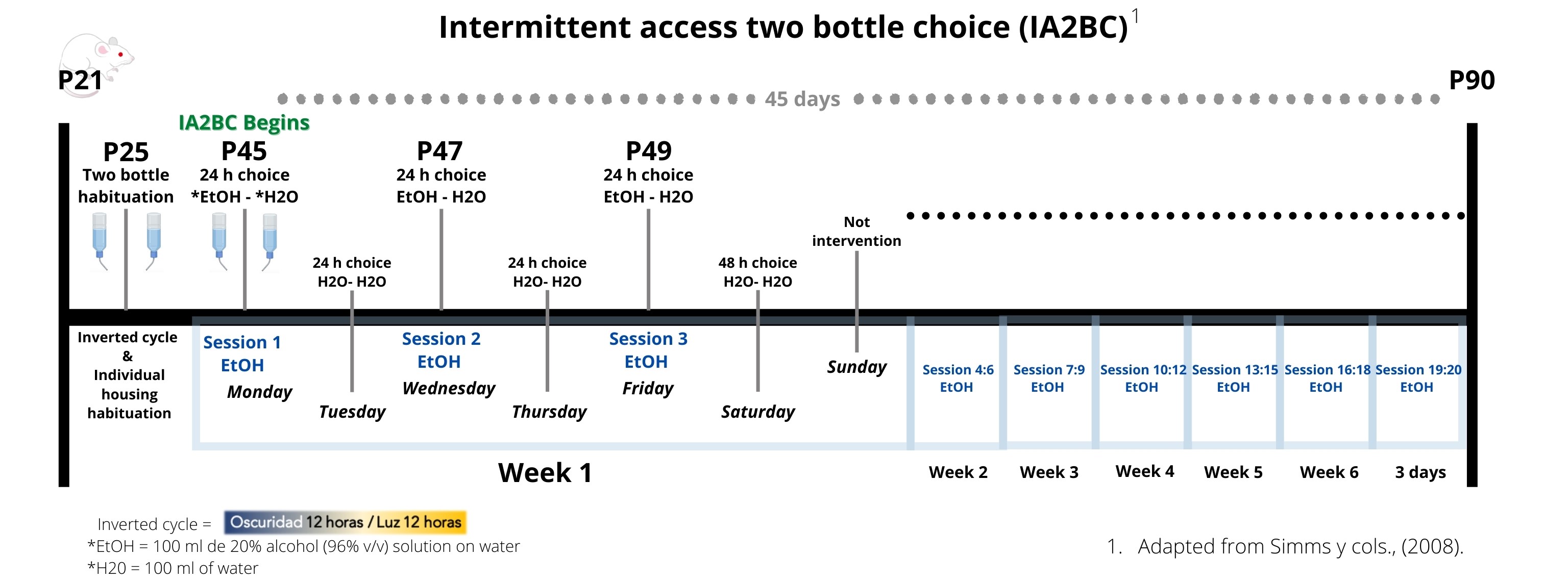
What to do in a session?
Alcohol session (Monday - Wednesday - Friday)
- Wait until the cycle change and remove the two bottles.
- Time is running, you have 15 minutes to place one bottle with 100 ml of 20% alcohol and one with 100 ml of water.
- Prepare each bottle and before placing the cap, close it with the help of parafilm, you must stretch the parafilm and place it around the mouth of the bottle. Then with the help of the needle, make a hole in the center of the parafilm.
- Close the bottle, weigh it and write it down in the logbook.
- If there are still 15 minutes to go, start doing something else, such as recording the weights of the bottles you removed. If the time is already close to 15 minutes, wait in front of the housing room for the time to expire.
- Place the bottles as appropriate for each rat, in the position that the counterbalance tells you (the ETOH bottle near or far from the food).
- Leave the housing room and wait for 30 min. It is important to ask that no one enters during these 30 minutes, as the rats are expected to reach a state of intoxication compared to humans.
- After 30 minutes, weigh the bottles and obtain the other required metrics, such as rat weight and food. Replace the boxes and also check for missing food or improperly closed bottles.
Water session (Tuesday, Thursday, Saturday)
- Wait until the cycle change and remove the two bottles.
- Time is running, you have 15 minutes to place two bottles with 100 ml of water each.
- Prepare each bottle and before placing the cap, close it with the help of parafilm, you must stretch the parafilm and place it around the mouth of the bottle. Then with the help of the needle, make a hole in the center of the parafilm.
- Close the bottle, weigh it and write it down in the logbook.
- If there are still 15 minutes to go, start doing something else, such as recording the weights of the bottles you removed. If the time is already close to 15 minutes, wait in front of the housing room for the time to expire.
- Place the bottles as appropriate for each rat, in the position that the counterbalance tells you (the ETOH bottle near or far from the food).
- Obtain the other required metrics, such as rat weight and food. Check for missing food or poorly closed bottles.
Try not to change the conditions of the rats, the same two or four bottles (pair available for a change) with which they were habituated on P35 should remain until P155, including abstinence. Also, avoid using perfumes or making excessive noise in their housing rooms. Additionally, avoid exposing them to light cycle changes.
References
Simms, J. A., Steensland, P., Medina, B., Abernathy, K. E., Chandler, L. J., Wise, R., & Bartlett, S. E. (2008). Intermittent access to 20% ethanol induces high ethanol consumption in Long–Evans and Wistar rats. Alcoholism: Clinical and Experimental Research, 32(10), 1816-1823.