Experiment outline IA2BC - neuropsytox/Documentation GitHub Wiki
In-Vivo
Extract from thesis MD. MSc Alejandra Lopez-Castro
Models with other animal species to study substance use disorders, such as alcohol, base their validity on the fact that
they share neurochemical and neuroanatomical substrates present in humans.  One of the evidence of the study in other species
are the pharmacological therapeutic interventions for alcohol use disorder, whose findings were transferred to the human medical
clinic (Spanagel, R. 2017).  Lester and Freed (1973) and later McBride and Li (1998) propose criteria for considering a model of
chronic alcohol use in other non-human species, and they are as follows:

1. Oral self-administration of alcohol under free-choice conditions.
2. The amount of alcohol consumed should lead to pharmacologically relevant blood alcohol concentrations (BAC).
3. Alcohol should be positively reinforced so that the animal will work to access it.
4. It should be self-administered so that its pharmacological effects are postponed.
5. Chronic consumption leads to metabolic and functional tolerance.
6. After the withdrawal of the substance physical signs of withdrawal will appear.
7. After chronic use followed by a prolonged state of deprivation, behaviors associated with relapse will be exhibited.

In the proposals for models that can meet the above criteria, several interventions have been designed,
one of the biggest challenges being to mimic the transition from low, moderate to excessive and chronic consumption
(Carnicella, Ron and Barak., 2014). Likewise the proposal by Koob, G., (2016) describes alcohol abuse as a closed cycle of
intoxication, withdrawal, craving and relapse. Alcohol intake procedures developed during the 1970s (Wayner et al., 1972; Wise, 1973)
showed that repeated cycles of choice of alcohol consumption and a period of abstinence lead to escalation of alcohol consumption.
In relation to meeting the criteria, free and cyclic drinking allows the fulfillment of criteria1, 4, 5, 6. (2008) and Carnicella et al. (2009)
found that the consumption of rats in the first thirty minutes of alcohol exposure manifested in a blood concentration of > 80 mg%,
which corresponds to the National Institute on Alcohol Abuse and Alcoholism (NIAAA) criteria for acute intoxication or binge drinking,
fulfilling criterion 2.
Experiment outline
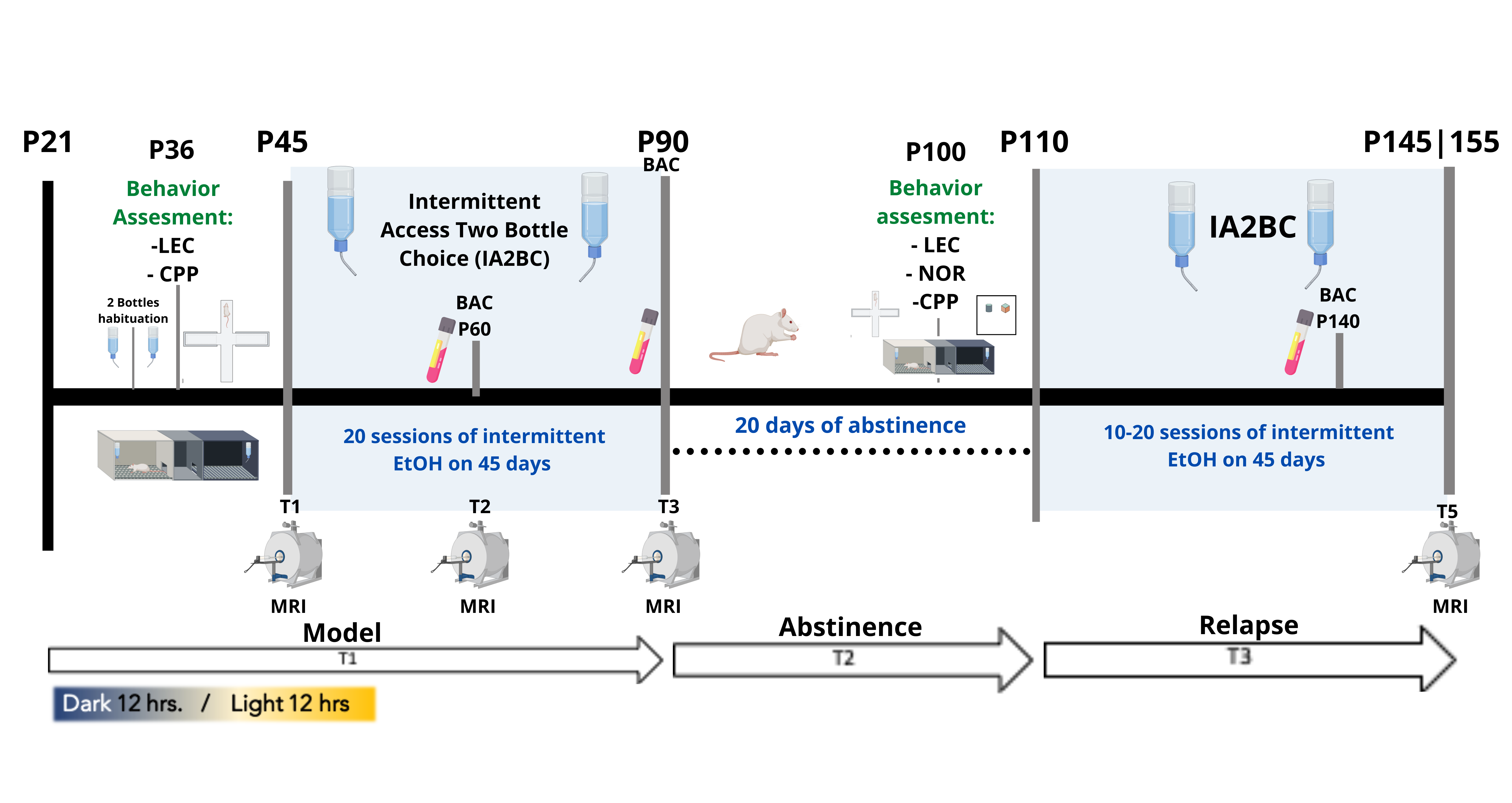
| Time | Alcohol intake |
|---|---|
| T1 | IA2BC (P45 - P90) |
| T2 | Abstinence (P91 - P110) |
| T3 | Relapse (ADE) (P111 - P145/155) |
| T4 | ExVivo |
| Time | Behavior assessment |
|---|---|
| T1 | CPP (P35), EPM |
| T2 | CPP, NOR, EPM |
| T3 | EPM |
| Time | MRI |
|---|---|
| T1 | T1 (P45) T2 (P60) |
| T2 | T3 (P90) |
| T3 | T5(P145\155) |
| Time | BAC |
|---|---|
| T1 | P60, P90 |
| T3 | P140 |
Proper management of the rats decreases the presence of unexpected variables. It is important to remember that rats are living beings whose care and training depend on the experimenter.
How to handle rats?
Take them by placing your hand around their thorax under the armpits, if you are performing habituation and therefore need to handle them for a few minutes, remember to offer them a surface where they can put their 4 paws. When the rat is very young or unfamiliar, gently hold its tail to prevent it from jumping or running.
Ex-VIVO
| Time | |
|---|---|
| T6 | Fixed brains for MRI |
| T6 | MRI ExVivo |
| T6 | Immunofluorescence |