anatomy - morinim/ultra GitHub Wiki
Abstract: this paper presents an extended specification for the Ultra evolutionary framework. Architectural choices are detailed and their conceptual significance is discussed. Key implementation aspects are also covered.
Ultra implements an object-oriented layered architecture, built on the base of five classes:
-
basic_searchandevolution; -
problem; -
layered_population; -
parameters.
classDiagram
note "High level logical view"
namespace ultra {
  class basic_search {
    +run()
  }
  class evolution
  class layered_population
  class parameters
  class problem {
    +params : parameters
    +sset : symbol_set
  }
}

evolution "1" <-- "1" basic_search
layered_population "1" <-- "1" evolution
problem "1" <-- "1" basic_search
problem "1" *-- parameters
The purpose of the layered architecture is to clearly separate foundational concepts, such as the internal structure of individuals, from higher-level abstractions more directly related to the evolutionary process.
This is the minimal skeleton of a program using the Ultra framework:
ultra::basic_search<a_given_evolutionary_strategy> s(a_problem_instance, a_fitness_function);
s.run();
The basic_search class allows users to select the evolutionary strategy to employ and provides unified interface for different types of search. In most cases, users can simply rely on ultra::search, a convenient instantiation of ultra::basic_search that implements a general-purpose evolutionary strategy:
ultra::search s(a_problem_instance, a_fitness_function);
s.run();
There are various specialisations of the ultra::basic_search for different tasks (de::search for Differential Evolution, ga::search for Genetic Algorithms, hga::search for Heterogeneous Genetic Algorithms and src::search for Symbolic Regression and Classification).
All strategies, regardless of the specific search class, rely on ultra::problem or one of its specialisations, to access problem parameters / constraints (via the params data member), and the building blocks for individuals (via the sset data member).
classDiagram
note "Problem logical view"
namespace ultra {
  class problem {
    +params : parameters
    +sset : symbol_set
  }
  class symbol
  class symbol_set {
    +insert(symbol, weight)
  }
  class w_symbol {
    +sym : symbol
    +weight : unsigned
  }
}

symbol_set "1" *-- "*" w_symbol
problem "1" *-- "1" symbol_set
w_symbol "1" *-- "1" symbol
Being an evolutionary framework, Ultra performs its work with the help of the ultra::evolution and ultra::population classes.
classDiagram
note "Problem in-depth view"

class problem {
  +params : parameters
  +sset : symbol_set
}
class symbol
class symbol_set {
  +insert(symbol, weight)
}
class w_symbol {
  +sym : symbol
  +weight : unsigned
}

class `de::problem` {
  +problem(dimensions, interval)
  +problem(intervals)
  +insert(interval, category)* real
}

class `ga::problem` {
problem(dimensions, interval)
  +problem(intervals)
  +insert(interval, category)* integer
}

class `hga::problem` {
  +insert(...)* terminal
}

class `src::problem` {
  +problem(dataframe)
  +problem(filepath)
  +problem(input_stream)
  +setup_symbols()
  +setup_terminals()
}


symbol_set "1" *-- "*" w_symbol
problem "1" *-- "1" symbol_set
w_symbol "1" *-- "1" symbol
problem <|-- `de::problem`
problem <|-- `hga::problem`
problem <|-- `ga::problem`
problem <|-- `src::problem`
Specialisations of the problem class simplify the setup of the evolutionary environment and the evaluation of individuals. For instance:
ultra::de::problem prob(5, {-5.12, 5.12});
ultra::de::search search(prob, function_to_be_optimized);
const auto result(search.run());
defines a five-dimensional search space where each variable ranges over the interval
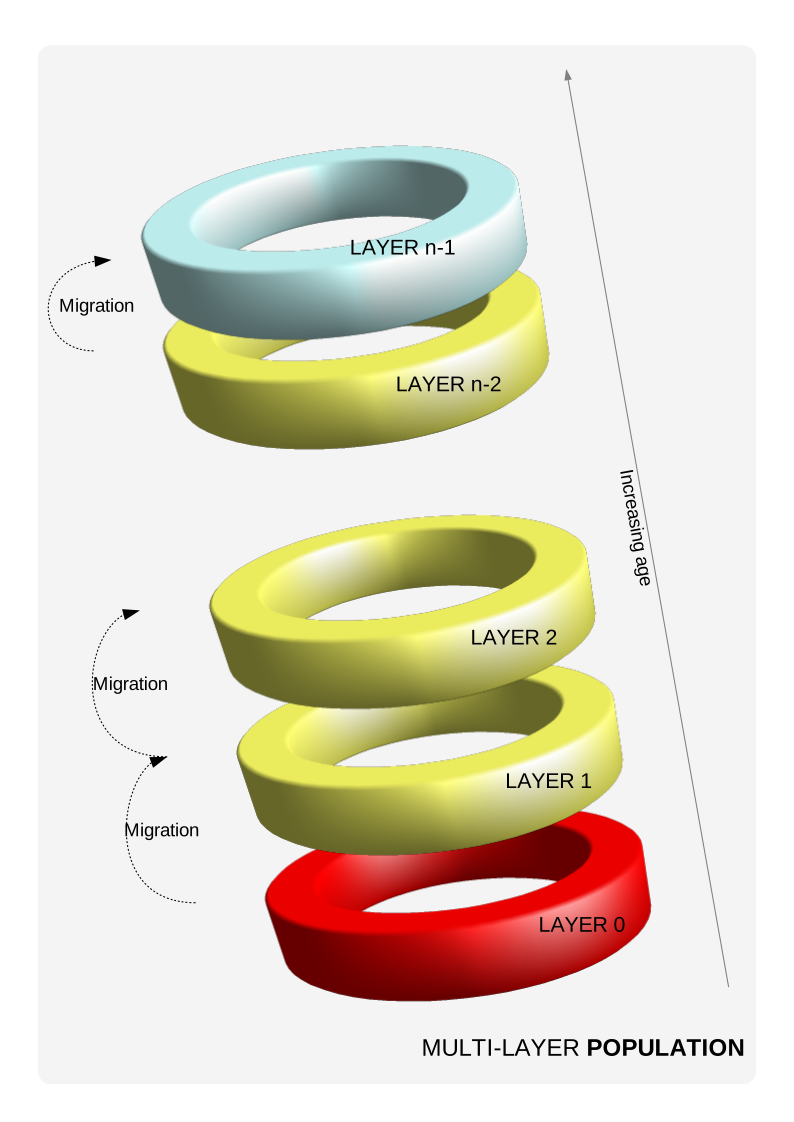
The default population is organized in multiple subgroups or layers. In the picture, each subgroup is represented as a torus to mark the fact that many evolutionary strategies may use a Trivial Geography scheme, where individuals are viewed as having a 1-dimensional spatial structure, essentially a circle, where the first and last positions are considered adjacent. The production of an individual for location i is permitted to involve only parents from i's local neighborhood.

This behaviour can be disabled by setting parameters::population::mate_zone to a sufficiently large value. Each layer is implemented in the linear_population class.
The global population is implemented in the layered_population class. The first and last layers are highlighted in distinct colours to reflect their special handling in some algorithms. Notably, the ALPS algorithm segregates individuals based on their ages:
- the first layer contains the youngest individuals;
- upper layers contain progressively older individuals;
- the last layer contains the oldest individual (without an age limit).
In contrast, the standard evolutionary strategy treats each layer in the same way.
Regardless of the chosen strategy, all layers are are evolved in parallel. Possible interactions among layers depend on the strategy. For example, using the standard evolutionary strategy and the differential evolutionary strategy, there is no direct interaction; with ALPS the i-th layer may sometimes access the i-1-th layer for selection / recombination and upper layers for replacement.
The linear_population class provides a mutex via the method ([[nodiscard]] auto &mutex() const) which must be used to coordinate access in multi-threaded environments.
classDiagram
note "Individuals"

class individual {
  +age() age_t
  +inc_age()

  +signature() hash_t

  +load(stream) bool
  +save(stream) bool

  -load_impl(stream)* bool
  -save_impl(stream)* bool
  -hash()* hash_t

  #signature_ : hash_t
  -age_ : age_t
}

class `gp::individual` {
  +genome : matrix~gene~
  +mutation()
  +crossover()
  +exons()
  +is_valid() bool
}
class `de::individual` {
  +genome : vector~double~
  +crossover()
  +apply_each()
  +is_valid() bool
}
class `ga::individual` {
  +genome : vector~int~
  +mutation()
  +crossover()
  +apply_each()
  +is_valid() bool
}
class `hga::individual` {
  +genome : vector~value_t~
  +modify()
  +mutation()
  +crossover()
  +is_valid() bool
}

individual <|-- `gp::individual` : Inheritance
individual <|-- `de::individual` : Inheritance
individual <|-- `ga::individual` : Inheritance
individual <|-- `hga::individual` : Inheritance
In ULTRA, an individual denotes a single candidate solution within an evolutionary process. Although different search strategies (GP, GA, DE, HGA) encode solutions differently, they all share a common architectural treatment that reflects ULTRA's layered design: a semantic base class expresses shared capabilities, while specialised derived classes encode representation-specific details.
At the core of the individual hierarchy sits a minimal, abstract class ultra::individual. This base class defines the identity and persistence semantics common to all individuals:
- a structural signature that uniquely represents the inherent (genomic) form of the individual. Logically equivalent yet syntactically distinct individuals map to the same signature, enabling efficient comparison, hashing, and diversity metrics;
classDiagram
note "Logically equivalent individuals share the same signature"

class individual {
  +signature() hash_t
  #signature_ : hash_t
  -hash()* hash_t
}

class derived_individual {
  -genome
  +is_valid()

  -hash() hash_t  -- final
}

individual <|-- derived_individual
- an age attribute tracking how long the individual has persisted in a population;
-
serialization support via a non-virtual interface (NVI) pattern (
load/saveforwarding toload_impl/save_impl), keeping derived implementations focused on representation specifics.
classDiagram
note "Base class enforces invariants and postconditions"

class individual {
  +load(stream) bool
  +save(stream) bool

  -load_impl(stream)* bool
  -save_impl(stream)* bool
}

class concrete_individual {
  -load_impl(stream) bool
  -save_impl(stream) bool
}

individual <|-- concrete_individual
The base type deliberately does not define a genome container or variation operators. Those are the responsibility of the derived classes, consistent with the separation between foundational concepts and evolutionary strategy layers in the overall architecture.
Each evolutionary domain within ULTRA implements its own individual type, inheriting from ultra::individual and enriching it with representation and operator semantics appropriate to the underlying algorithm:
-
GP individual (
ultra::gp::individual)Represents a straight-line program whose genome is a sequence of
geneelements arranged in a matrix-like structure. It provides program-centric iterators (exon views), specialised crossover variants (e.g. tree crossover), and validity checking tailored to symbolic structures; -
GA individual (
ultra::ga::individual)Encodes a combinatorial solution as a vector of integers. Standard genetic operators such as crossover and mutation are provided, and iteration and element access follow the usual container model.
-
DE individual (
ultra::de::individual)Uses a vector of real numbers to represent a point in a continuous search space. Differential evolution-specific crossover and parameterised operations are supported, with convenience methods for applying transforms across genes.
-
HGA individual (
ultra::hga::individual)Offers a heterogeneous genome, typically a vector of a generic value type. It uses a modify proxy to control mutation, enabling fine-grained and representation-aware modification while preserving encapsulation.
Despite their differing genomes and operators, all concrete individual types share:
- a common signature interface (from the base) for structural equivalence and hashing;
- consistent serialization entry points via base class hooks;
- value semantics: individuals are copyable and inexpensive to reason about, with thread safety delegated to the caller at the algorithm or population level rather than enforced internally.
This architecture balances generalisation and specialisation.
The base class encapsulates identity and persistence without imposing a genomic format. Derived classes implement all representation-specific logic, keeping variation and container semantics local to the individual type.
Generic algorithms and populations can reason about identities and lifecycles uniformly, while still taking advantage of the full expressive power of each representation.
By separating foundational concerns from representation details, ULTRA achieves a modular and extensible model for individuals across evolutionary strategies, enabling new representations to be added without perturbing the core framework.
In the symbolic regression / GP (genetic programming) domain within Ultra, individuals are encoded as Straight Line Program (SLP) genomes, a linear, tabular representation of a program without loops or branches. Unlike traditional tree-based GP, where programs are expressed as hierarchical trees, an SLP consists of a sequence of instructions that compute values in terms of previously computed results, terminals and functions. This structure enables efficient reuse of intermediate computations and lends itself naturally to genetic operators defined over fixed-length linear genomes.

In Ultra's gp::individual:
- the genome is stored in a
matrix<gene>, indexing both program position and category. Each row corresponds to a locus (instruction) and each column corresponds to a symbolic category type; - each gene contains a function symbol plus arguments. Arguments may be terminals, constants or backward addresses into previously defined rows. This enforces a directed acyclic evaluation order: each instruction can only refer to earlier results.
- the SLP encoding allows the individual to describe potentially complex expressions as a sequence of simple, ordered computations. By evaluating from the last locus back to the start, the full expression is reconstructed and executed.
The class maintains strong semantic invariants:
- only valid function symbols and categories are used;
- all backward references point to already computed loci;
- the evaluation order is implicit in the linear genome;
- a canonical hash is computed via
pack()to uniquely represent the semantic content of the individual for comparison and caching purposes.
classDiagram
note "Straight Line Program individual"

class `gp::individual` {
  -genome_ : matrix~gene~
  -active_crossover_type_ : crossover_t

  +parameters() unsigned
  +categories() unsigned
  +empty() bool
  +clear()
  +pack(sink) hash_t
  +is_valid() bool
  +exons() exon_view
  +cexons() const_exon_view
  +mutate(random_engine)
  +crossover()
}

class gene {
  +func : function
  +args : vector~value_t~

  +category() unsigned
}

class value_t {
  terminal
  constant
  address
}

class exon_view {
  +begin()
  +end()
}

class hash_sink {
  +write(bytes)
  +final() hash_t
}

class matrix~T~ {
  +rows()
  +cols()
  +operator()(row,col)
}

matrix~gene~ --> gene : contains
gene --> value_t : uses
`gp::individual` --> exon_view : exposes
`gp::individual` --> hash_sink : UID via pack()
`gp::individual` --> matrix~gene~ : stores
To manipulate these individuals in an evolutionary context, the implementation provides:
- a suite of recombination operators (one-point, two-points, uniform, tree-based crossover) tailored to the SLP structure;
- a mutation operator that selectively perturbs active expressions while preserving SLP validity;
- exon views to iterate over active parts of an individual without exposing introns or structural details.
This representation blends the compactness and simplicity of linear genomes with the expressive power needed for symbolic regression and in practice can outperform traditional GP tree representations on a variety of regression tasks.
The interpreter (generic ultra::interpreter, specialised ultra::src::interpreter) is the component responsible for executing a GP individual. It provides the runtime environment in which genes (functions) are evaluated and supplies their arguments on demand.
Conceptually, the interpreter plays the same role as an execution engine in a programming language: it traverses the program structure, evaluates expressions and produces a final value.
In ULTRA, execution is structural rather than linear: genes reference one another through addresses, forming a directed acyclic graph (or, more generally, a graph with controlled sharing). The interpreter resolves these references dynamically during evaluation.
Execution always starts from a locus, which identifies both:
- the index of the gene to evaluate;
- the category (domain) in which the evaluation takes place.
Calling interpreter::run() initialises the execution state, resets any cached values, sets the instruction pointer to the chosen locus and evaluates the corresponding gene.
This design allows:
- full evaluation of an individual;
- partial evaluation of sub-programs;
- reuse of the same interpreter logic for different entry points.
The interpreter maintains an instruction pointer (IP) identifying the gene currently being evaluated.
When a gene requires the value of one of its arguments:
- if the argument is an address, the interpreter temporarily moves the instruction pointer to the referenced locus and evaluates that gene;
- once evaluation completes, the instruction pointer is restored automatically.
This mechanism enables recursive descent through the program structure without requiring an explicit call stack in the gene representation.
Arguments are evaluated lazily. A function only evaluates the arguments it actually needs and only when requested. This is exposed through the function::params interface, which the interpreter implements.
From the point of view of a function:
- arguments behave like values;
- are computed only on demand;
- may trigger recursive evaluation of other genes.
This allows efficient handling of conditional logic, short-circuit operators and other constructs where not all arguments are always required.
When referential transparency is assumed, the interpreter memoises the result of evaluating a gene at a given locus.
If the same sub-expression is required multiple times during execution, its value is computed once and reused. This significantly reduces redundant work in programs with shared sub-structures. Caching is applied only when arguments are accessed through fetch_arg. When side effects are possible or recomputation is required, fetch_opaque_arg bypasses the cache and forces re-evaluation.
This dual mechanism allows ULTRA to support both:
- pure functional evaluation;
- controlled side-effectful behaviour (e.g. agent simulations).
During evaluation, an argument may represent:
- an immediate value (integer, double, string, vector...);
- an address of another gene;
- a nullary symbol;
- a variable bound to the current execution context.
The interpreter resolves each category appropriately, ensuring that values, references and executable symbols are handled uniformly from the function's perspective.
sequenceDiagram
    participant User
    participant Interpreter
    participant Gene
    participant Function
    participant Cache

    User->>Interpreter: run(locus)
    Interpreter->>Cache: invalidate all entries
    Interpreter->>Interpreter: set IP = locus
    Interpreter->>Gene: current_gene()
    Gene->>Function: eval(params)

    loop for each argument requested
        Function->>Interpreter: fetch_arg(i)

        alt argument is address
            Interpreter->>Cache: lookup(locus_of_argument)
            alt cached value exists
                Cache-->>Interpreter: value
            else not cached
                Interpreter->>Interpreter: fetch_opaque_arg(i)
                Interpreter->>Interpreter: save IP
                Interpreter->>Interpreter: IP = target locus
                Interpreter->>Gene: current_gene()
                Gene->>Function: eval(params)
                Function-->>Interpreter: value
                Interpreter->>Interpreter: restore IP
                Interpreter->>Cache: store value
            end
        else argument is immediate / nullary / variable
            Interpreter->>Interpreter: fetch_opaque_arg(i)
        end

        Interpreter-->>Function: argument value
    end

    Function-->>Interpreter: result value
    Interpreter-->>User: result value
This execution model deliberately separates:
- program structure (genes and their connections);
- execution state (instruction pointer, cache);
- evaluation semantics (functions and their arguments).
As a result GP individuals remain lightweight and immutable, execution behaviour is centralised and explicit, optimisation strategies (such as memoisation) are localised to the interpreter.
This separation is key to ULTRA's flexibility: alternative interpreters, evaluation strategies or execution policies can be introduced without changing the program representation.
In ULTRA, an evaluator is the component responsible for assigning a fitness value to an individual. Conceptually, it represents the problem-specific objective function of an evolutionary run.
Rather than prescribing a concrete base class, ULTRA models evaluators through the Evaluator concept: any callable object that, given an individual, returns a value satisfying the Fitness concept. This approach keeps evaluators lightweight, composable and easy to customise, while allowing the library to enforce the required semantic constraints at compile time.
flowchart LR
    Individual -->|evaluated by| Evaluator
    Evaluator -->|wrapped by| EvaluatorProxy

    EvaluatorProxy --> Cache
    EvaluatorProxy -->|delegates to| Evaluator

    classDef core fill:#eef,stroke:#333,stroke-width:1px
    classDef infra fill:#f8f8f8,stroke:#666,stroke-width:1px

    class Evaluator core
    class Individual core
    class EvaluatorProxy infra
    class Cache infra
Evaluators are required to be const-invocable, reflecting the fact that fitness evaluation is typically a read-only operation on the individual and that evaluators are often accessed through logically-const interfaces or shared across threads. When internal state is needed (for statistics, counters, or heuristics), it must be made explicit through logical constness or externalised into auxiliary components.
ULTRA supports optional evaluator capabilities without imposing additional interfaces:
-
Persistence. Evaluators may optionally provide
load(std::istream &)andsave(std::ostream &) constmember functions. When present, these are automatically detected and invoked; otherwise, persistence is treated as a no-op. -
Fast evaluation. Evaluators may optionally provide a
fast(const individual &)member function that computes an approximate or heuristic fitness. This is useful for pre-filtering, speculative evaluation or guiding search without incurring the full evaluation cost.
These capabilities are detected at compile time and integrated transparently, allowing simple evaluators to remain minimal while enabling more advanced use cases when needed.

While evaluators define how fitness is computed, evaluator_proxy defines how evaluators are used within the evolutionary engine.
sequenceDiagram
    participant EA as Evolutionary algorithm
    participant Proxy as evaluator_proxy
    participant Cache
    participant Eva as evaluator

    EA->>Proxy: operator()(individual)
    Proxy->>Cache: lookup(signature)

    alt cache hit
        Cache-->>Proxy: cached fitness
        Proxy-->>EA: fitness
    else cache miss
        Proxy->>Eva: operator()(individual)
        Eva-->>Proxy: fitness
        Proxy->>Cache: insert(signature, fitness)
        Proxy-->>EA: fitness
    end
evaluator_proxy acts as a surrogate for an evaluator, augmenting it with infrastructure-level concerns that should not be embedded in the evaluator itself:
- memoisation of fitness values via an internal cache;
- transparent reuse of fitness values for semantically equivalent individuals;
- optional persistence of both evaluator state and cached results;
- access to fast (approximate) evaluation when supported.
Fitness values are cached using the individual's signature as a key. When caching is enabled, repeated evaluation of identical or equivalent individuals is avoided, significantly improving performance for expensive evaluators. Cache mutation is treated as logically const, ensuring that the observable semantics of the evaluator remain unchanged.
Importantly, evaluator_proxy preserves the original evaluator interface: from the perspective of the evolutionary algorithm, it behaves exactly like an evaluator, while silently providing caching, persistence and fast-evaluation support when available.
flowchart TD
    StreamIn["std::istream"] --> ProxyLoad["evaluator_proxy::load"]
    ProxyLoad -->|optional| EvaLoad["evaluator::load"]
    ProxyLoad --> CacheLoad["cache::load"]

    ProxySave["evaluator_proxy::save"] --> StreamOut["std::ostream"]
    EvaSave["evaluator::save"] --> ProxySave
    CacheSave["cache::save"] --> ProxySave

    EvaLoad -.->|"only if provided"| EvaSave
This separation of responsibilities keeps evaluators focused on problem semantics and allows ULTRA to manage performance, scalability, and reproducibility concerns in a centralised and consistent way.

These evaluators are dataset-aware, policy-based and designed to support both regression and classification problems with minimal duplication.
At a high level, an evaluator:
- receives an individual;
- applies it to a dataset through an oracle;
- measures the discrepancy between predicted and target values.
- aggregates this discrepancy into a fitness score where greater is better and the maximum value is typically
0.
flowchart TD
    A[Individual P] --> B[Evaluator]
    B --> C[Create oracle]
    C --> D[Iterate over dataset]
    D --> E[Apply oracle to example]
    E --> F[Error functor]
    F --> G[Incremental average]
    G --> H[Negate error]
    H --> I[Fitness value]
All evaluators derive (directly or indirectly) from the src::evaluator<D> base class. This class abstracts access to the underlying dataset and transparently supports both:
- plain datasets;
-
multi_dataset, where only the currently selected dataset is exposed.
This design allows evaluators to be written once and reused across single-task and multi-task scenarios without conditional logic in user code.
classDiagram
note "Evaluators for regression and classification"

  namespace src {
    class evaluator {
      #data()*
    }

    class sum_of_errors_evaluator {
      +operator()(P)
      +fast(P)
      +oracle(P)
    }

    class mae_evaluator {
    }

    class rmae_evaluator {
    }

    class mse_evaluator {
    }

    class count_evaluator {
    }

    class gaussian_evaluator {
    }

    class binary_evaluator {
    }
  }

  evaluator <|-- sum_of_errors_evaluator
  sum_of_errors_evaluator <|-- mae_evaluator
  sum_of_errors_evaluator <|-- rmae_evaluator
  sum_of_errors_evaluator <|-- mse_evaluator
  sum_of_errors_evaluator <|-- count_evaluator
  evaluator <|-- gaussian_evaluator
  evaluator <|-- binary_evaluator
Most regression and classification evaluators in ULTRA are specialisations of sum_of_errors_evaluator<P, F, D>
where:
-
Pis the individual type; -
Fis an error functor applied to a single training example; -
Dis the dataset type.
The evaluator iterates over the dataset, applies the error functor to each example and computes the average error using a numerically stable incremental scheme. The returned fitness is the negated average error, ensuring that:
- higher fitness values are better;
- the theoretical maximum fitness is
0; - results from full and approximate evaluations are directly comparable.
A faster approximation mode is also provided, evaluating only one example every few steps while preserving the same scale.
Error functors encapsulate how an error is computed for a single training example. They own an oracle initialised from the individual and are responsible for handling illegal or undefined outputs.
ULTRA provides several standard error functors, including:
- Mean absolute error (MAE). Robust to outliers.
- Relative mean absolute error (RMAE). Scale-invariant and bounded.
- Mean squared error (MSE). Sensitive to large deviations.
- Count error. Exact-match classification metric.
This separation allows new metrics to be introduced without modifying evaluator logic.
For classification tasks, ULTRA provides specialised evaluators that do not follow the simple "sum of errors" pattern:
- Gaussian evaluator. Uses class-conditional Gaussian models to derive probabilistic predictions. Correct predictions are rewarded proportionally to confidence, while incorrect ones are strongly penalised;
- Binary evaluator. Optimised for two-class problems. Incorrect predictions are penalised based on both misclassification and confidence.
Both evaluators still follow the same overarching contract: greater fitness is better and values are comparable across individuals.
Fitness is a scalar/vector value assigned to an individual which reflects how well the individual solves the task.
The literature identifies (at least) four distinct measures of fitness:
- raw fitness
- standardized fitness
- adjusted fitness
- normalized fitness
but we are mostly interested in the first two.
The raw fitness is the measurement of fitness that is stated in the natural terminology of the problem itself, so the better value may be either smaller or larger.
For example in an optimal control problem, one may be trying to minimize some cost measure, so a lesser value of raw fitness is better.
Since raw fitness is defined in problem-specific terms, its interpretation may vary significantly across domains. Therefore, Ultra adopts standardized fitness as the primary measure, ensuring consistency across tasks. The only requirement for standardized fitness is that bigger values represent better individuals (this may differ in other frameworks).
In Ultra many of the fitness functions (see class src::evaluator and its specialisations) define the optimal fitness as the scalar value 0, or the vector (0, ... 0), and use negative values for sub-optimal solutions. However, this is not mandatory.
Often, excluding the simplest cases, fitness alone is not enough to understand goodness and flaws of the candidate solution.
The evolution component is ULTRA's core engine for evolutionary search. It encapsulates the process of iteratively refining a population of candidate solutions according to an evaluation strategy, stopping criteria and optional callbacks or logging.
The ultra::evolution class progressively evolves a population over a series of generations, guided by an evolution strategy. At each generation, new individuals are generated and evaluated, stronger individuals are retained and optional hooks allow external control or observation of the process.
flowchart LR
  Problem[problem]
  Evaluator[Evaluator]
  Evolution[evolution]
  Strategy[Evolution strategy]
  Population[layered_population]
  Summary[summary]
  Logger[search_log]
  Callback[after_generation]

  Problem --> Evolution
  Evaluator --> Evolution
  Evolution --> Population
  Evolution --> Strategy
  Strategy --> Population
  Population --> Strategy
  Evolution --> Summary
  Evolution -. optional .-> Logger
  Evolution -. optional .-> Callback
Key concepts
-
Population. A layered structure of individuals maintained by
layered_population; - Evaluator. A user-supplied object that defines how individuals are assessed and compared;
-
Evolution strategy. A template parameter controlling how new offspring are produced (
ES<E>). - Stop conditions. A combination of planned generations, external stop source and user interrupts.
- Callbacks. User hooks for per-generation actions, such as logging or custom environment adjustments.
flowchart TD
  Check[Check stop condition]
  Planned[Planned generations reached]
  User[User stop request]
  External[External stop_source]

  Check --> Planned
  Check --> User
  Check --> External

  Planned --> Stop[Request stop]
  User --> Stop
  External --> Stop
The ultra::evolution class acts as the orchestrator of a search process. It harmonises strategy, evaluation, concurrency, logging and external control, yielding a flexible and robust framework for evolutionary computation.
template<Evaluator E> class evolution
{
public:
  explicit evolution(const problem &, E &);

  template<template<class> class ES> summary<individual_t, fitness_t> run();
};
The constructor initialises the population based on a problem specification and stores a reference to the evaluator.
The run method executes the evolutionary loop using the specified evolution strategy (ES). The loop continues until:
- the number of generations exceeds the configured limit;
- an external stop signal is received;
- the user requests termination (e.g. via console).
The method returns a summary that includes the best found solution, elapsed time and other metrics. During execution, evolution can:
- show progress on the console with generation counts and best fitness;
- log snapshots via a
search_log; - trigger a user-provided callback at the end of each generation.
Progress reporting adjusts behaviour based on the current logging level, ranging from minimal discrete updates to verbose output.
stateDiagram-v2
    [*] --> Initialisation
    Initialisation --> StrategyInit : strategy.init(population)
    StrategyInit --> GenerationLoop

    GenerationLoop --> Shake : optional shake_function
    Shake --> ParallelEvolution
    ParallelEvolution --> Monitoring
    Monitoring --> StopCheck
    StopCheck --> GenerationLoop : continue
    StopCheck --> Finalisation : stop condition met

    Finalisation --> [*]
- An evolution strategy instance (
ES<E>) is created. - Strategy-specific initialisation (
init) is called on the population. - At each generation:
- optionally apply the
shakefunction; - launch parallel tasks to evolve subpopulations;
- monitor completion and handle termination requests;
- update the best-so-far summary and log if required;
- invoke strategy-specific and user-provided callbacks.
- optionally apply the
- On exit, record elapsed time and return the summary.
sequenceDiagram
    participant Evolution
    participant Pool as thread_pool
    participant Strategy
    participant Population
    participant Logger
    participant Callback

    Evolution->>Strategy: operations(population, layer)
    Evolution->>Pool: submit evolve_subpop tasks
    Pool->>Strategy: generate offspring
    Strategy->>Population: update individuals
    Evolution->>Evolution: monitor progress / stop
    Evolution->>Population: analyse population
    Evolution->>Logger: save_snapshot (optional)
    Evolution->>Strategy: after_generation
    Evolution->>Callback: after_generation callback (optional)

ULTRA separates evolution orchestration from evolutionary behaviour. While the evolution class controls when and how often the population is evolved, evolution strategies define how individuals are selected, combined and replaced.
flowchart LR
  Evolution[evolution]
  Strategy[evolution_strategy]

  EvolutionTasks["generation control, concurrency, stopping, logging"]
  StrategyTasks["selection, recombination, replacement, ageing, stagnation handling"]

  Evolution --> EvolutionTasks
  Strategy --> StrategyTasks
This separation allows different evolutionary algorithms to be expressed as compile-time strategies without introducing runtime polymorphism or virtual dispatch.
classDiagram
  class evolution
  class evolution_strategy

  class std_es
  class alps_es
  class de_es

  evolution --> evolution_strategy : uses

  evolution_strategy <|-- std_es
  evolution_strategy <|-- alps_es
  evolution_strategy <|-- de_es
The evolution strategy system is built around the following ideas:
- static polymorphism. Strategies are selected at compile time through templates, ensuring zero runtime overhead;
- template method pattern. The overall structure of evolution is fixed, while specific steps (selection, recombination, replacement) are delegated to strategy objects;
-
separation of concerns.
-
evolutionmanages generations, concurrency, logging, and stopping conditions. -
evolution_strategydefines the algorithmic skeleton. - Concrete strategies implement specific evolutionary algorithms.
-
evolution_strategy is a lightweight base class that defines the common structure shared by all strategies.
At this level, a strategy may:
- shape or override evolution parameters before execution;
- perform initial population setup;
- apply per-generation bookkeeping or accelerated termination logic.
The base implementation already provides:
- population ageing;
- stagnation detection;
- automatic layer reset when evolution stalls.
sequenceDiagram
  participant Evolution
  participant Strategy
  participant Population

  Evolution->>Strategy: operations(population, layer, status)
  Strategy-->>Evolution: callable step
  loop evolutionary steps
    Evolution->>Population: apply step()
  end
  Evolution->>Strategy: after_generation(population, summary)
Concrete strategies can extend or refine this behaviour.
ULTRA provides several ready-to-use evolution strategies, each implemented as a class derived from evolution_strategy.
flowchart LR
  Evolution[evolution]
  Strategy[evolution_strategy]

  Std[std_es]
  Alps[alps_es]
  De[de_es]

  Population[layered_population]
  Evaluator[evaluator]
  Summary[summary]

  Evolution --> Strategy
  Evolution --> Population
  Evolution --> Evaluator
  Evolution --> Summary

  Std --> Strategy
  Alps --> Strategy
  De --> Strategy
A classical steady-state evolutionary algorithm:
- parents are selected via tournament selection;
- offspring are created by recombination;
- weak individuals are replaced immediately.
This strategy is simple, efficient and suitable for many problems where population diversity can be maintained naturally.
An implementation of Age-Layered Population Structure (ALPS) by Greg Hornby.
Key characteristics:
- the population is divided into multiple age layers;
- individuals age as evolution progresses;
- older individuals are gradually pushed into higher layers;
- layers may be merged, resized or reset dynamically.
sequenceDiagram
  participant Evolution
  participant Strategy as alps_es
  participant Population
  participant Layer as Age layer
  participant Selector
  participant Recombiner
  participant Replacer

  Evolution->>Strategy: operations(population, layer, status)
  Strategy-->>Evolution: evolutionary step (callable)

  loop evolutionary steps
    Evolution->>Selector: select parents (current + younger layers)
    Selector-->>Evolution: parent set

    Evolution->>Recombiner: recombine parents
    Recombiner-->>Evolution: offspring

    Evolution->>Replacer: replace in current layer
    Replacer->>Population: insert offspring
  end

  Evolution->>Strategy: after_generation(population, summary)

  Strategy->>Population: increment individual ages
  Strategy->>Population: merge or shrink converged layers
  Strategy->>Population: add new layer or move individuals up
ALPS improves diversity and helps prevent premature convergence, especially in long-running or difficult searches.
An implementation of Differential Evolution tailored to ULTRA's infrastructure.
In this strategy:
- selection identifies a target individual and suitable difference vectors;
- recombination generates a trial individual;
- replacement compares the trial against the target.
This approach is particularly effective for continuous or real-valued optimisation problems.
Each strategy provides an operations() function that returns a callable object encapsulating a single evolutionary step.
flowchart TD
  Start[Start evolution]
  Init["init(population)"]
  Loop[Generation loop]
  Ops["operations()"]
  After["after_generation()"]
  Stop{Stop condition?}
  End[End evolution]

  Start --> Init
  Init --> Loop
  Loop --> Ops
  Ops --> After
  After --> Stop
  Stop -- no --> Loop
  Stop -- yes --> End
This callable:
- selects parent individuals from one or more sub-populations;
- generates offspring via recombination;
- inserts offspring back into the population using a replacement policy.
The evolution class executes these operations repeatedly and in parallel across sub-populations.
A dedicated Strategy concept ensures that only valid evolution strategies can be used. This guarantees at compile time that:
- the strategy derives from evolution_strategy;
- required hooks and interfaces are present.
As a result, incorrect or incompatible strategies are rejected early, without runtime checks.
ULTRA is designed around value semantics and explicit ownership. Thread safety is therefore addressed at the algorithm and population level, not by making individual core types internally synchronised.
- Parallelism in ULTRA is achieved by operating on distinct objects (e.g. different individuals or populations).
- Core types such as individuals, genomes, and operators are not internally thread-safe.
- Sharing mutable objects across threads is considered an advanced use case and must be handled explicitly by the caller.
Most ULTRA core types are designed as value types:
- copyable and movable;
- inexpensive to reason about;
- free of hidden shared state.
To preserve these properties, internal synchronisation primitives (such as mutexes) are intentionally avoided.
All observable state (including structural signatures and hashes) is maintained eagerly and updated as part of well-defined mutation operations (modify, apply_each, load, recombination operators).
As a consequence:
-
constmember functions do not perform lazy computation; -
constfunctions do not modify internal state; - concurrent calls to
constmember functions on the same instance are safe provided no concurrent mutation occurs; - external synchronisation is required only when an object may be mutated concurrently with reads.
This design enforces clear object invariants and predictable behaviour, while avoiding the complexity and overhead of internal lazy caches.
When concurrent access to the same object is required (for example during migration, statistics collection, or logging), synchronisation must be applied outside the object:
- at the population level;
- at the algorithm or scheduler level;
- via an explicit user-provided lock.
ULTRA does not attempt to make individual objects safe for arbitrary concurrent use. This approach avoids hidden performance costs.
An ultra::interpreter (or ultra::src::interpreter) instance is not thread-safe. It maintains mutable execution state (instruction pointer and evaluation cache) and must not be accessed concurrently from multiple threads. Parallel execution must be achieved by using one interpreter instance per thread.
The lack of thread safety is by design, not a flaw. Making the interpreter thread-safe would require:
- locking around cache access;
- locking or thread-local IP;
- copy-on-write semantics;
all of these would:
- add overhead to a hot execution path;
- complicate the execution model;
- likely reduce performance for the common case.
The current design optimises for fast single-threaded evaluation, with parallelism achieved by replication.