prototype - marcelstoltz00/Photosyntech GitHub Wiki
Prototype Pattern
1. Responsibility
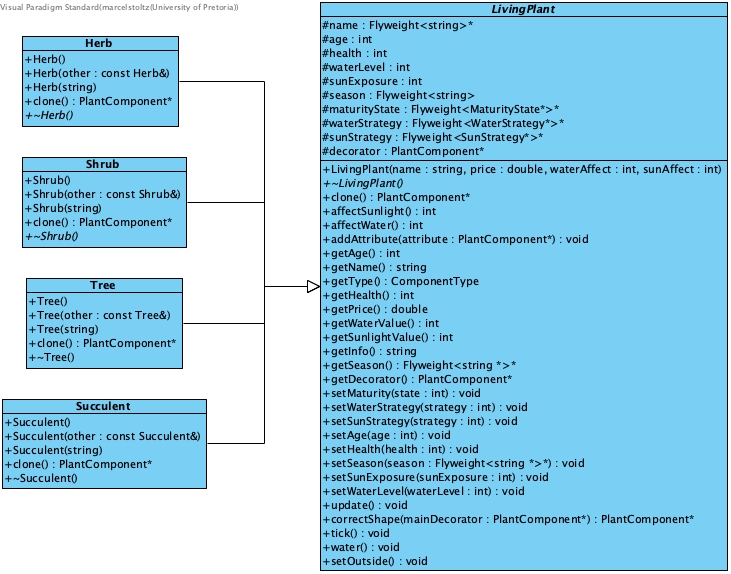
Specifies the kinds of objects to create using a prototypical instance, and creates new objects by copying this prototype. In this system, it allows for the efficient creation of new, fully-configured plant instances by cloning an already-configured object, preserving its internal state, strategies, and decorators.
2. File Structure
prototype/
├── LivingPlant.h/.cpp  # Abstract prototype, defines the clone interface and base copy logic
├── Herb.h/.cpp         # Concrete prototype
├── Shrub.h/.cpp        # Concrete prototype
├── Succulent.h/.cpp    # Concrete prototype
└── Tree.h/.cpp         # Concrete prototype
3. Participant Mapping
| Pattern Role | Photosyntech Class(es) | Responsibility |
|---|---|---|
| Abstract Prototype | LivingPlant |
Defines the clone() interface and provides the core copy-constructor logic that handles the shallow copy of all shared flyweight objects (strategies, states, name, etc.). |
| Concrete Prototype | Herb, Shrub, Succulent, Tree |
The four base plant types. They implement clone() by calling their own copy constructor, which in turn delegates the core copying work back to LivingPlant. |
| Client | Builder |
The primary client. After configuring a complex plant object (a LivingPlant wrapped in decorators), the builder's getResult() method calls clone() on the final object to produce identical copies for the inventory. |
4. Functional Requirements
Primary Requirements
- FR-2: Plant Type Cloning: Directly enables the creation of new plant instances by copying existing, fully-configured plant objects, ensuring all properties (base type, decorations, strategies, and state) are preserved.
Supporting Requirements
- NFR-4: Scalability/Memory Efficiency: The prototype's copy mechanism is designed to be highly efficient. It performs a shallow copy of pointers to shared flyweight objects (strategies, states, seasons), ensuring that creating thousands of clones has a minimal memory footprint.
5. System Role & Integration
The Prototype pattern is the system's engine for mass-producing plants, integrating tightly with several other patterns:
-
Builder Pattern: The Builder's primary role is to construct a single, complex, fully-configured plant object. The Prototype pattern then takes over; the builder calls
clone()on this finished object to stamp out identical copies for the inventory. -
Decorator Pattern: The cloning process is a deep copy of the decorator chain. When
clone()is called on the outermost decorator, it clones itself and then recursively callsclone()on the component it wraps, all the way down to the baseLivingPlant. This ensures each cloned plant has a new, independent decorator chain. -
Flyweight Pattern: The
LivingPlantcopy constructor, which is at the heart of the clone operation, is designed to support the Flyweight pattern. It performs a shallow copy of all flyweight pointers (name,season,waterStrategy,sunStrategy,maturityState). This is critical for memory efficiency, as it ensures all cloned plants share the same immutable state and strategy objects.
The Cloning Process in Detail
When a client needs a copy of a fully built plant (e.g., a Rose with decorators for thorns and flowers), the process is simple and powerful:
- The client calls
clone()on the outermost object (e.g., theThornsdecorator instance). - The
Thornsdecorator'sclone()method creates anew Thorns()and, in its copy constructor, callsclone()on the object it wraps (theFlowersdecorator). - This process cascades downwards through the decorator chain until the
LivingPlant::clone()method is called. LivingPlant::clone()calls its copy constructor, which performs a shallow copy of all its members, including the pointers to the shared flyweight objects.- The result is a brand new, fully independent
PlantComponentthat is an exact replica of the original, with a deep-copied decorator chain and shallow-copied flyweight data.
6. Design Rationale
The Prototype pattern was chosen for plant replication because:
- Performance: Cloning a pre-configured plant is significantly faster than repeatedly using the Builder to construct each new plant from scratch.
- Configuration Preservation: It guarantees an exact, faithful copy of a complex object without needing to know the details of its construction.
- Memory Efficiency: The shallow-copy approach for flyweights is essential for scalability, preventing massive memory consumption when creating thousands of plant instances.
- Simplicity for the Client: The client (the
Builder) does not need to know how to construct a complex object; it only needs a singleclone()call to get a perfect copy.