Home - krazybeastx1/omenhound GitHub Wiki
OmenHound
A BloodHound-style Active Directory attack-path tool, rewritten from scratch in Go.
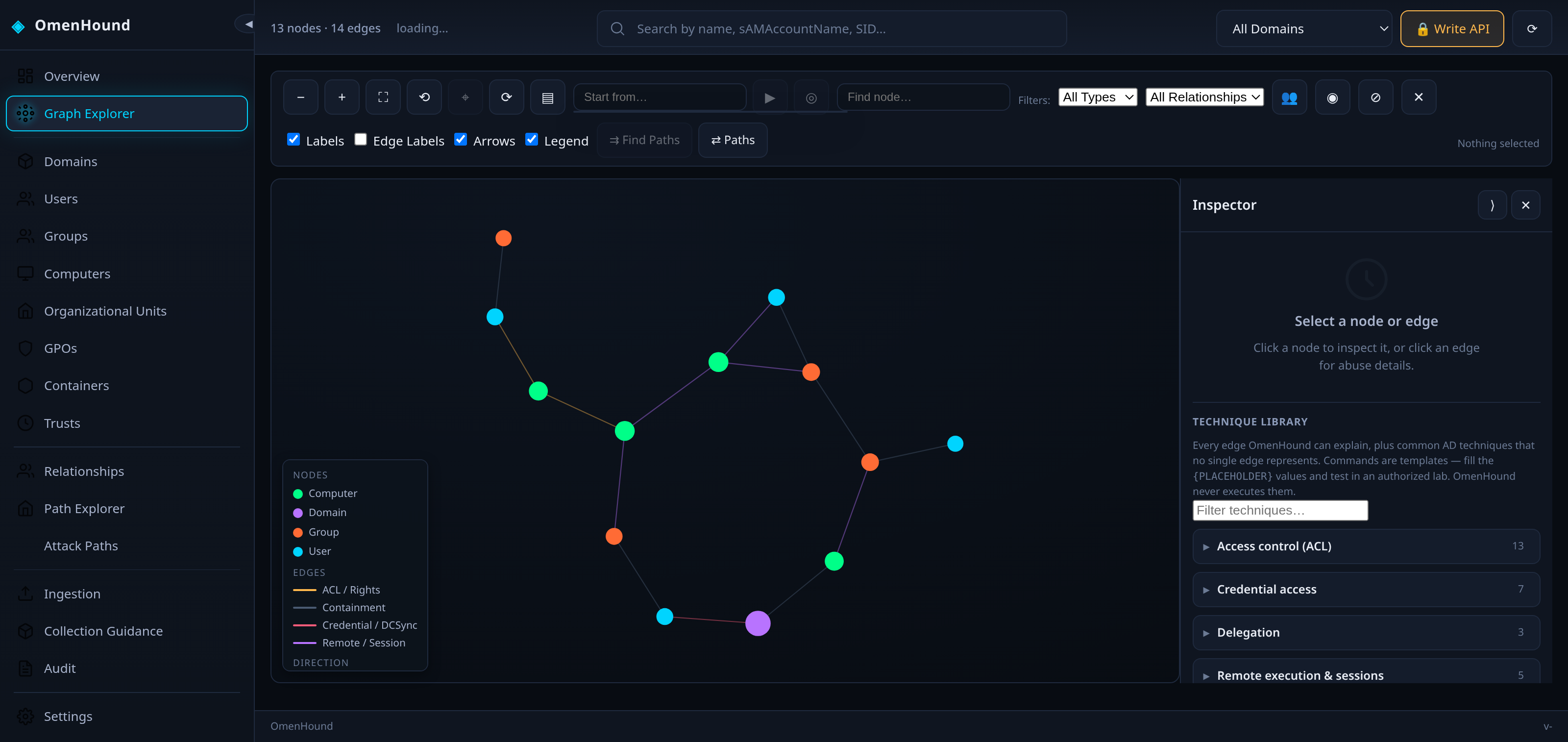
OmenHound collects AD objects over LDAP/LDAPS, stores them in a graph that uses the BloodHound CE schema (Neo4j), renders dynamic abuse commands with OPSEC notes for every edge, and serves a dependency-free web UI — all from a single static binary.
collector ──Graph JSON──▶ ingest ──▶ Store ──▶ Neo4j (BloodHound CE schema)
(ldap/sample)                         │
                                      └──▶ API ──▶ Web UI (canvas attack-path graph)
                                              └──▶ abuse engine (edge → command + OPSEC)
[!WARNING] OmenHound is dual-use offensive security tooling. It enumerates Active Directory, maps attack paths to Domain Admin, and optionally changes AD account passwords over LDAPS. Use it only against systems you own or have explicit written authorization to test. Unauthorized use is illegal.
Start here
| If you want to… | Read |
|---|---|
| Install it and see something work in 60 seconds | Getting Started |
| Understand the design | How It Works |
| Learn the web UI | Web UI Guide |
| Browse the offence library | Technique Library |
| Know what is safe / gated / logged | Operations & Hardening |
| Use the HTTP API | API Reference |
| Run BloodHound Cypher against OmenHound data | Neo4j Schema & Attack Paths |
Keep using bloodhound-ce-python |
Coming from BloodHound.py |
| See what is next | Roadmap |
Install it with Go 1.26+:
go install github.com/krazybeastx1/omenhound/cmd/omenhound@latest
What it is (in one table)
| Piece | Command | What it does |
|---|---|---|
| Collector | omenhound collect |
Enumerates AD over LDAP/LDAPS (users, groups, computers, membership) and emits Graph JSON. |
| Importer | omenhound import |
Parses BloodHound CE / BloodHound.py --zip output into Graph JSON, or pushes it straight into a running server. |
| Graph backend | omenhound serve |
Stores nodes/edges in Neo4j using the BloodHound CE schema (in-memory store for demos/tests). |
| Ingestion API + UI | omenhound serve |
HTTP service that ingests graphs and serves a force-directed attack-path UI. |
| Abuse engine | (in the UI/API) | For every edge, renders a copy-pasteable command from real node properties, plus OPSEC and Windows event IDs. |
| Gated credential ops | (off by default) | Optional unicodePwd password change over LDAPS behind token + per-action approval + audit. |
| Attack-path analytics | omenhound serve |
Fourteen canned queries (Kerberoastable, AS-REP, DCSync, LAPS, delegation, AdminTo, high-value…) at /api/v1/analytics and the Attack Paths UI view — each result lists its evidence and flags missing data. |
Screenshots
| Attack-path graph | Dynamic abuse panel | Write-API auth gate |
|---|---|---|
 |
 |
 |
Quickstart (no domain required)
git clone [email protected]:krazybeastx1/omenhound.git
cd omenhound
make build                                   # -> bin/omenhound

./bin/omenhound collect --collector sample --out graph.json
./bin/omenhound serve   --collector sample --addr 127.0.0.1:8080
# open http://127.0.0.1:8080 — click a node, then an edge
The sample collector produces a deterministic fake domain, so the entire pipeline
runs with no AD, no Neo4j, and no credentials.
Repository docs
README.md— overview and CLI.docs/ARCHITECTURE.md— components and contracts.docs/ATTACK-PATHS.md— every edge, with abuse + detection.docs/THREAT-MODEL.md— STRIDE, trust boundaries, residual risk.
License
MIT (see LICENSE). Schema
compatibility with BloodHound CE (Apache-2.0).
No BloodHound code is vendored; see NOTICE.