2. Apparatus - johndempster/OBSIM GitHub Wiki
The tissue under study is immersed in a small 10 ml volume organ bath containing a physiological salt solution, Krebs-Henseleit (K-H), which approximates the extracellular fluids normally bathing the tissue in vivo. The organ bath is contained within a Perspex bath that contains tap water maintained at a temperature close to the normal body temperature of the animal (37°C) by a heater and thermostat.
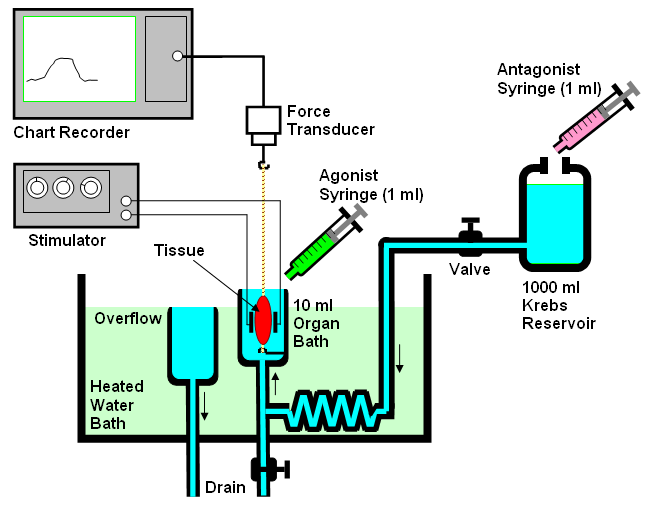
Drugs can be applied to the tissue by pipetting small volumes of drug-containing solution directly into the the organ bath and removed by flushing the organ bath with fresh solution from a reservoir containing K-H solution. Opening the reservoir tap allows physiological solution to flow through the warming coil into the organ bath. A mixture of oxygen (95%) and carbon dioxide (5%) is bubbled into both the reservoir and organ bath to provide oxygen and maintain the pH of the tissue. The tissue can also be stimulated electrically using a stimulator attached to a pair of electrodes placed on either side of the tissue within the organ bath.
The tissue is attached to a force transducer which generates an electrical signal proportional to the contractile force generated by the tissue when a drug is applied. This is connected to an amplifier that boosts the small voltages produced by the transducer to a level suitable for measurement by the computer. The amplified signal is then fed into an analogue-to-digital (A/D) converter which digitises the signal and stores it in the computer, under the control of a digital chart recording program.