Digitization in Healthcare Context - hmislk/hmis GitHub Wiki
Introduction
Digitization, digitalization, and digital transformation are terms that have become increasingly popular since the late 2000s. They are often used interchangeably, sometimes incorrectly, and frequently without fully understanding what they actually mean.
You may have heard people say “we are digitizing our hospital” or “we are going through digital transformation” — but are they really talking about the same thing?
While these concepts are closely related, they represent different stages of digital maturity. Each one builds on the previous, and none of them can exist in isolation. Together, they form a clear journey from paper-based operations to fully digital healthcare systems.
Before exploring advanced ideas like AI hospitals, telemedicine, and smart healthcare, it is essential to understand the most basic and foundational concept of all:
Digitization.
Everything starts here.
Digitize, Digitalise, and Digital Transformation – How They Are Related
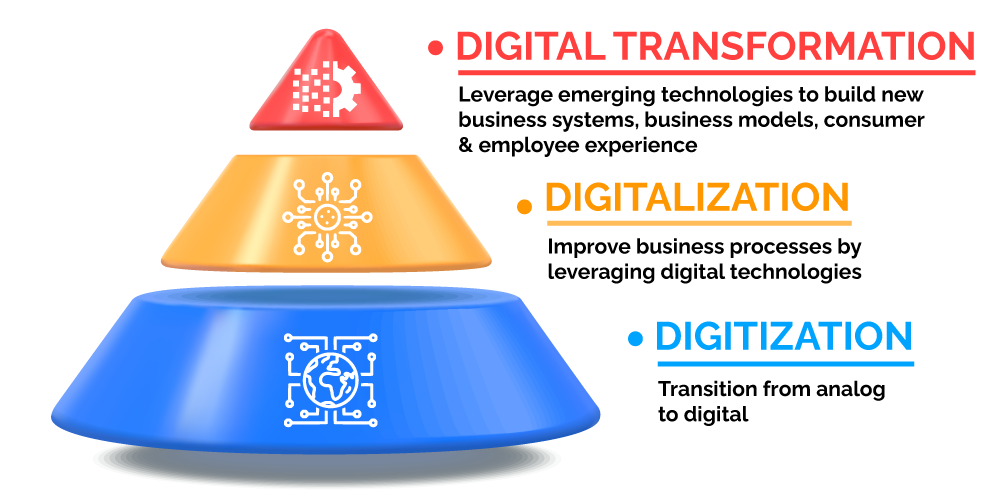
These three terms describe three stages of digital maturity/evolution :
| Term | What It Means | Example in Hospital |
|---|---|---|
| Digitize | Convert analog data to digital format | Scan patient files |
| Digitalise | Improve processes using digital tools | Online appointments |
| Digital Transformation | Redesign healthcare delivery using digital | Telemedicine, AI diagnosis |
They always happen in this order:
Digitize ➡ Digitalise ➡ Digital Transformation
You cannot digitalise or transform something that is still on paper.
Without digitization, the other two simply cannot exist.
So digitization is the foundation of everything.
What Does Digitization Mean in Healthcare?
In healthcare, digitization means:
Converting medical information from physical or manual form into electronic format, without changing the process itself.
Only the format changes, not the workflow.
Paper becomes data.
Folders become databases.
Handwriting becomes typed records.
Nothing more. Nothing less.
Digitization and HIMS (Hospital Information Management System)
A Hospital Information Management System (HIMS) is the primary platform used to digitize a hospital.
Before HIMS:
- Paper-based patient records
- Physical prescription books
- Manual registers
- Manual billing
- Printed lab reports
After HIMS:
- Electronic Health Records (EHR)
- Digital prescriptions
- Automated billing systems
- Online lab reports
- Searchable databases
In simple terms:
| HIMS is the digital container of a hospital’s information.
What Exactly Gets Digitized in a Hospital?
-
Patient Records
Paper file ➡ Electronic patient profile -
Prescriptions
Doctor handwriting ➡ Digital prescription form -
Lab Results
Printed report ➡ Uploaded digital record -
Billing
Manual invoice ➡ Billing system entry -
Appointments
Appointment book ➡ Online scheduler
Same work. Same people. Just no paper.
Digitizing Drug Information
Before Digitization
Drug data exists as:
- Printed drug catalogs
- Physical formularies
- Manual Excel sheets
Example:
“Amoxicillin 500mg capsule”
Exists only as text in books or documents.
After Digitization
The same drug becomes:
| Field | Digital Value |
|---|---|
| Drug ID | D123456 |
| Name | Amoxicillin |
| Strength | 500mg |
| Form | Capsule |
| Manufacturer | Pfizer |
| Category | Antibiotic |
| Status | Prescription only |
Now the drug is:
- A database record
- Searchable
- Standardized
- Usable by software
This is exactly what systems like NHS dm+d, FDA NDC, SNOMED, RxNorm do.
A Simple Digitization Workflow
Before Digitization
Doctor writes notes ➡ File stored in cabinet ➡ Nurse searches physically ➡ Photocopy sent to lab ➡ Admin files again
After Digitization
Doctor types notes in HIMS ➡ Saved in database ➡ Nurse searches by patient ID ➡ Shared instantly with lab ➡ Stored centrally
Same process.
Just faster, searchable, and safer.
What Digitization Does NOT Do
Digitization does not:
- Automate decisions
- Improve clinical logic
- Replace doctors
- Use AI
- Redesign workflows
It only:
| Converts information into digital form.
Everything else comes later.
Why Digitization is Critical in Healthcare
Digitization enables:
| Benefit | Impact |
|---|---|
| Safety | Fewer medical errors |
| Speed | Faster access to data |
| Compliance | Easier audits |
| Continuity | Long-term records |
| Integration | Systems can communicate |
Without digitization:
| Digital healthcare cannot exist.
Where Digitization Ends
Digitization ends when:
| All key healthcare information exists in digital format.
From that point:
- Digitalization improves processes
- Digital transformation reinvents care
But digitization is the foundation layer.