sticky pads - diglet48/restim GitHub Wiki
Sticky pads have a rather curious construction, which reduces the concentration of current along the edges/corners. I will dissect a few models for measurements.
Coyote pads
These are a generic pads I got with an order of the coyote 2.0.
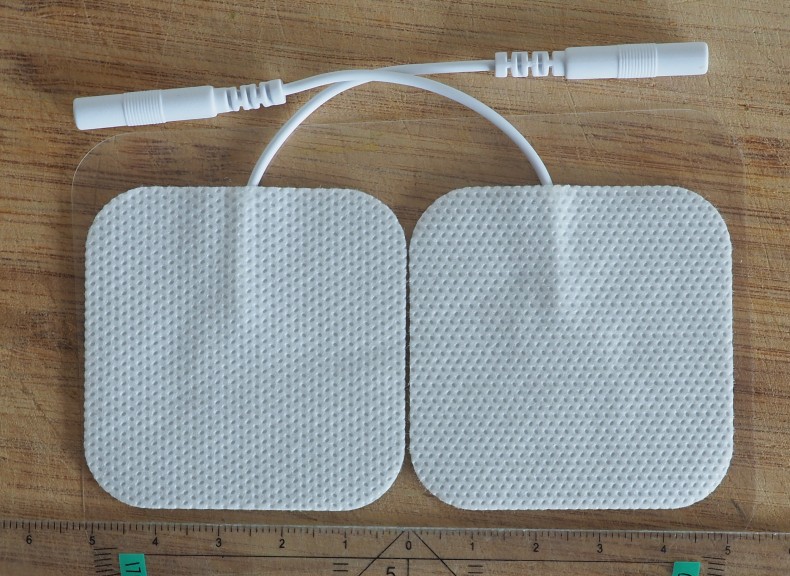
I removed the gel for ease of measurements. Below is the resistance (in $\Omega$ DC) from surface to wire.
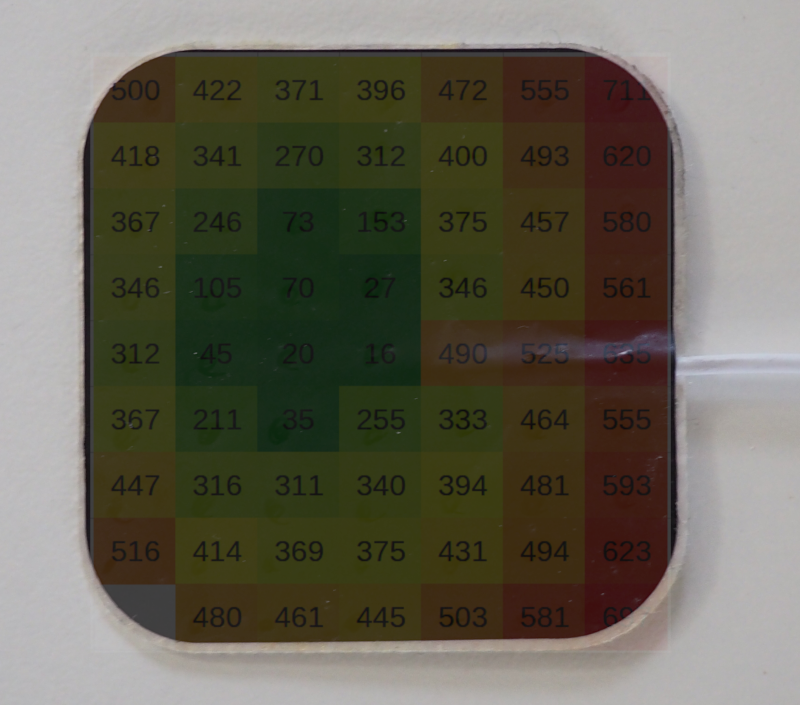
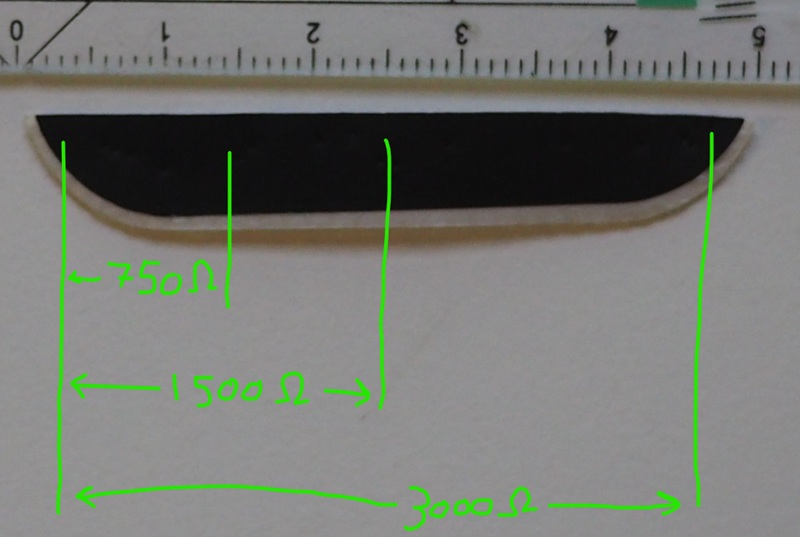
I calculate a sheet resistance of about $450 \Omega / \square$
Small round pads
Generic round, from aliexpress.
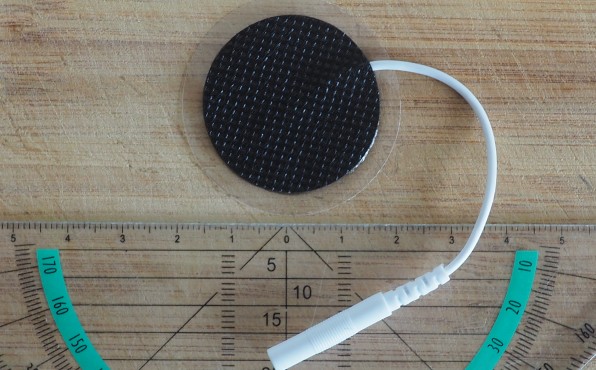
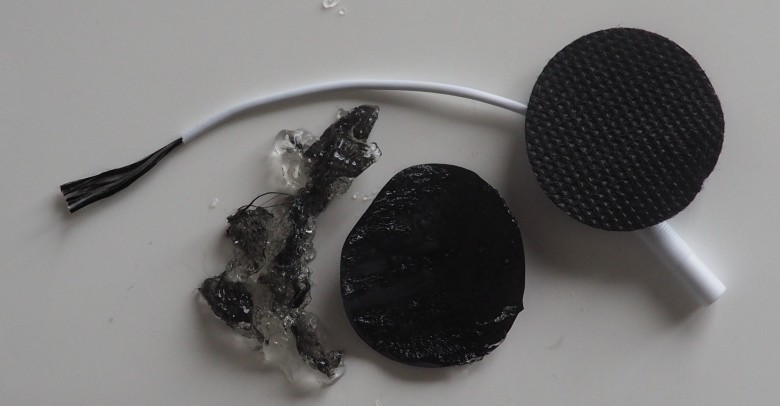
There is a small section in the center where the resistance is about zero.
With the gel removed, the center to edge resistance is about $400 \Omega$, and edge to edge $700 \Omega$.
A thin strip 3mm x 25mm has a resistance of $2300 \Omega$, giving a sheet resistance of about $280 \Omega / \square$
I had difficulty measuring the resistance with the gel on. The gel is mixed with non-conductive fibrous material, when probing with the multimeter, it is easy to hit the fibers instead of the conductive backing film. I detached the wire when trying to remove the gel, so don't pull on it too hard.
Large rectangular pad
More sturdy-looking and thick pads.
Unlike other models, they are made from conductive rubber instead of thin film.
There's no zone under the connector that has zero resistance. But the connector also is a bit close to the edge.
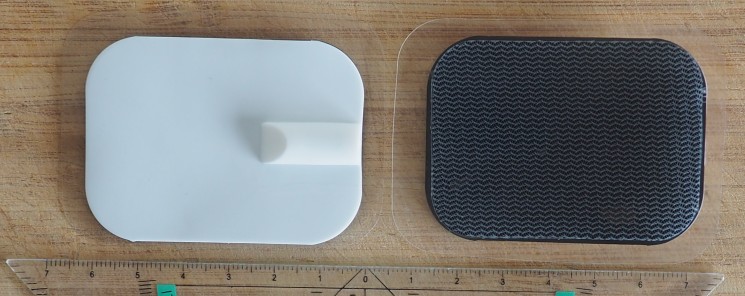
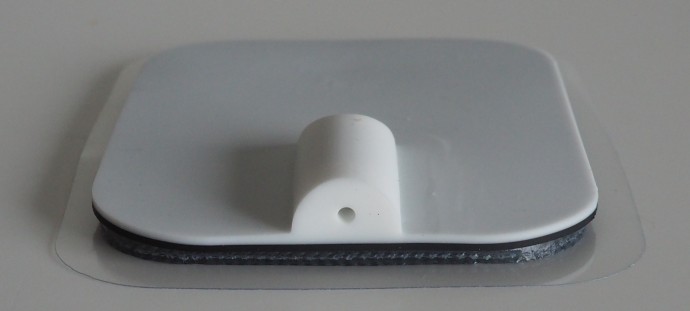
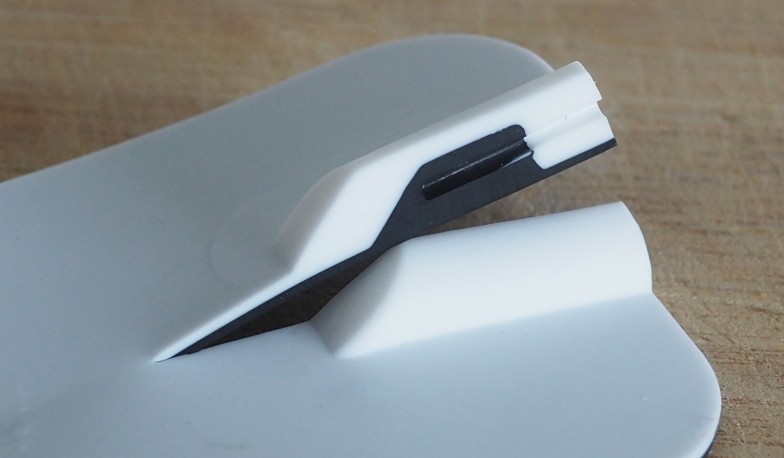
From connector to surface, I measure $200 \Omega$ except for a small area near the connector where the resistance drops to $100 \Omega$. Point-to-point measurements follow a similar pattern. Even with the probes almost touching, resistance does not drop below $100 \Omega$.
A thin strip of material (5mm) has a resistance of $1400 \Omega$ over 44mm. Giving a sheet resistance of about $160 \Omega/\square$. Estimated volume resistivity of $0.1 \Omega*m$.
Conductive rubber pads
Joanne sells flat sheets of conductive rubber, omega rubber. This rubber has a fairly low resistance, about 460 ohm per meter with 1khz signal and 525 ohm per meter DC. Sheet resistance is about $15 \Omega / \square$.

With typical cut length of 3cm, corner-to-corner resistance is at least one order of magnitude below that of sticky pads. For most purposes, these can be considered similar to metal electrodes