fhkA - dictyBase/community-annotations GitHub Wiki
According to Goldberg et al PLoS Genetics 2, e38, (2006) the rad53 family is expanded in Dicty. Rad53, whose human otholog is the CHK2 checkpoint kinase, plays a critical role in the stabilization of replication forks in the presence of DNA damage (review: Segurado and Diffley, Genes Dev 22 (2008). In yeast, Rad53 is known to interact with phosphorylated Rad9, the main subunit of the 9-1-1 PCNA-family sliding clamp which is loaded in the presence of DNA damage and initiates many DNA damage responses locus/S000006074.
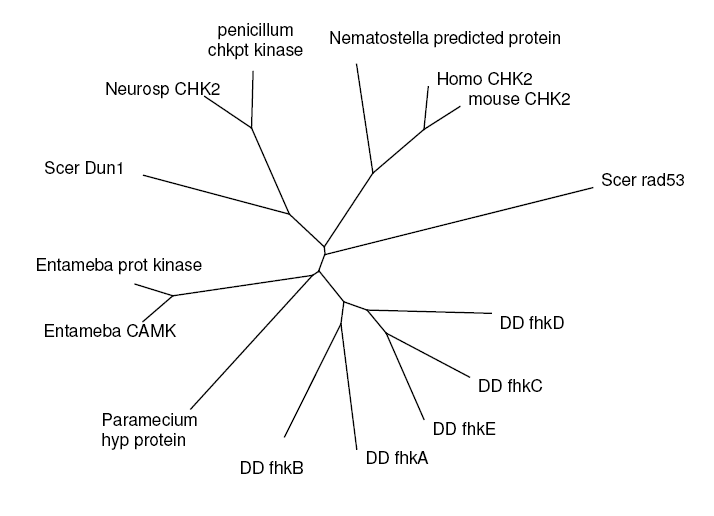
In Dicty there are five proteins in the rad53 family, fhkA,B,C,D,and E. A tree was constructed from the highest-significance Blast hits of the Dicty proteins in other organisms (below). According to this tree, none of the Dicty sequences appears to be the unique ortholog of CHK2/rad53.
https://user-images.githubusercontent.com/1349602/163185721-71de7dcb-7217-4da8-9677-e82864b7d3db.png
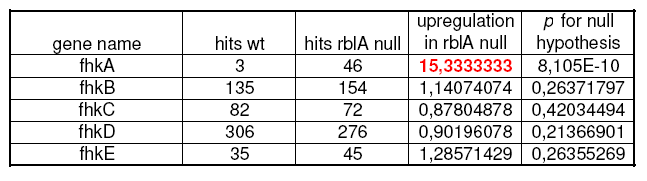
The five fhk-X genes differ substantially in their response to the disruption of the retinoblastoma-like gene rblA.
FhkA is substantially and highly signficantly upregulated in the ko strain, while none of the other genes show major changes. Consistent with its regulation, the fhkA promoter contains a putative E2F-type binding site (TTTGCGCCTTTT).
https://user-images.githubusercontent.com/1349602/163186015-1a18d423-4795-4136-8297-657372f7afee.png
Virtually all genes associated with replication fork progression are upregulated in the rblA disruptant; these include cdc45, all mcm genes, all gins genes, all rfc genes, four polA subunits, three polD subunits, two putatitive polE subunits, PCNA, the single-strand binding protein rfa1, the flap endonuclease repG, as well as DNA ligase-1 and topoisomerase-2. All these genes show overexpression factors ranging from 4 to 15.
This suggests that among the fhk-X genes, fhkA may play the major role of replication fork protection in Dicty. The other fhk-X genes presumably play other, or subsidiary roles.
Harry MacWilliams, June 2010
return to fhkA Gene Page