Simon electronic game - daviddellarossa/CM3025-virtual-reality GitHub Wiki
The electronic game Simon is named for Simon Says. Instead of having to listen to the presence of the instruction phrase, the player has to repeat a short sequence of button presses after demonstration by the device.
The original version was manufactured and distributed by Milton Bradley and later by Hasbro after it took over Milton Bradley.
The device creates a series of tones and lights and requires a user to repeat the sequence. If the user succeeds, the series becomes progressively longer and more complex. Once the user fails or the time limit runs out, the game is over.
Simon was launched in 1978 at Studio 54 in New York City and was an immediate success, becoming a pop culture symbol of the 1970s and 1980s.

Many variants of Simon have been made since Hasbro acquired Milton Bradley in the 1980s, building on the possibilities offered by advances in technology.
The original Super Simon was reinvented in the late 1990s as a hexagonal unit with six buttons.

2000 saw Simon Squared (or Simon2), a unit with the four traditional buttons on one side, and a set of eight smaller buttons on the other.
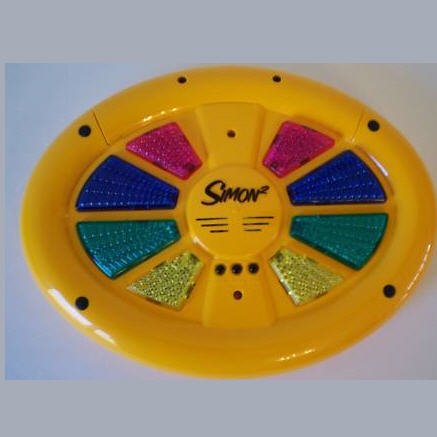
In 2004, Hasbro released the Simon Stix. The game features two electronic sticks (modeled after drumsticks), an emphasis on the musical part of the game.

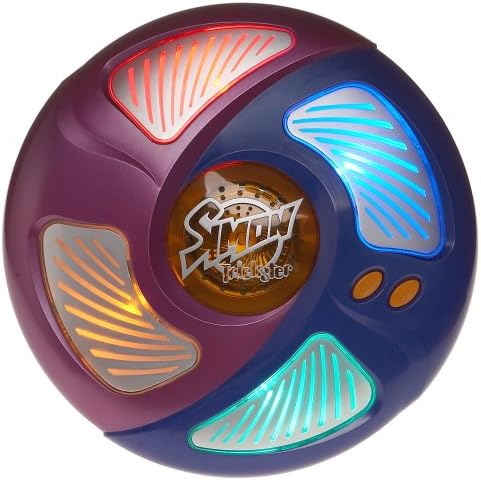
In 2005, Hasbro released Simon Trickster (also known as Simon Tricks in Europe and in the UK, and as Simon Genius in Brazil), which features four game modes, in a similar fashion to another Hasbro game, Bop It, and colored lenses instead of buttons:
- "Simon Classic" mode plays up to 35 tones (notes).
- "Simon Bounce" is similar to "Simon Classic", but instead the colors of the lenses change.
- "Simon Surprise" is one of the most difficult games in the unit. Every lens becomes the same color and the player has to memorize the location.
- "Simon Rewind" requires the player to memorize the sequence backwards.
In 2011, Hasbro introduced Simon Flash. In this version, the game is played with four cube-shaped electronic modules that the player must move around depending on the game mode.

In 2013, Hasbro reinvented Simon once again with Simon Swipe. The game features four game modes, called "Levels" (the main game), "Classic", "Party" and "Extreme". The player has to go through all sixteen levels to beat the game. "Classic", "Party" and "Extreme" levels focus on one pattern getting longer and longer until the player is out.

In 2016, Hasbro launched the follow-up to Simon Swipe with Simon Air. This version of Simon uses motion sensors, similar to those in Mattel's Loopz line of games. The game has three game modes: "Solo", "Classic" and "Multiplayer". A button-pressing version of Simon was also released in the US, with an aesthetic recalling that of the 1970s and 1980s models.
