The Coleman-Weinberg mechanism is a phenomenon by which a theory that
at tree level appears to have a symmetric vacuum actually undergoes
spontaneous symmetry breaking as a result of radiative quantum
corrections.
A common example for illustrating spontaneous symmetry breaking
is the theory of a real scalar field $\phi$ with a potential of the form
\begin{equation}
\label{phi4L}
\end{equation}
This Lagrangian is symmetric under the transformation $\phi\rightarrow
- \phi$. The standard lore is that this is a symmetry of the vacuum
if $\mu^2$ is positive, but that the symmetry is spontaneously broken
if $\mu^2$ is negative. (In order that the energy be bounded from
below, $\lambda$ must be positive.).
The borderline between these two cases, $\mu^2=0$, bears further
inspection. Classically, the positivity of the quartic term would be
sufficient to guarantee a symmetric vacuum. In a quantum field
theory, however, the vacuum energy includes the zero-point energies of
the various fields that enter the theory. If these zero-point
energies depend upon the value of $\phi$, they can potentially
change the situation (Coleman and Weinberg, 1973).
A natural tool for investigating this issue is the effective potential,
$V_{\rm eff}$(Goldstone, Salam and Weinberg, 1962), which can be defined as
follows (Jona-Lasinio, 1964). First, we add to the Lagrangian a
term $J(x)\phi(x)$ that gives a coupling to a classical source $J(x)$.
We then define a quantity $W[J]$ by
\begin{equation}
e^{iW[J]} = \langle 0^+| 0^-\rangle_J
\label{expW}
\end{equation}
where the quantity on the right-hand side is the amplitude for going
from the vacuum in the far past to the vacuum in the far future in the
presence of the external source $J$. Perturbatively, $W$ is the
generating functional
\begin{equation}
\label{Jeq}
\end{equation}
this corresponds to a stationary point of the effective action
and, assuming spatial homogeneity, a stationary point of the
effective potential.
It follows from the above definitions that $V_{\rm eff}$ is given
perturbatively as the sum of one-particle-irreducible graphs,
with its $n$th derivative being obtained from
the sum of all such graphs with $n$ external $\phi$ lines, each
carrying zero momentum. More physically, $V_{\rm eff}(\phi_c)$ is the
minimum expectation value of the energy density among those states
$|\Psi\rangle$ for which the expectation value of the quantum field,
$\langle \Psi|\phi({\bf x})|\Psi \rangle$, is equal to $\phi_c$.
Massless scalar quantum electrodynamics
Let us enlarge the theory of Eq. \ref{phi4L} by making $\phi$ complex, with
real and imaginary parts $\phi_1$ and $\phi_2$, and
coupling it to electromagnetism. Setting $\mu^2 =0$ gives the Lagrangian
\begin{equation}
\label{QED-Lag}
\end{equation}
Classically, this describes massless scalar electrodynamics.
To explore the quantum theory we evaluate the effective potential.
This calculation can be simplified by noting that $V_{\rm eff}$
can only depend on $\phi_c^2 = \phi_{1c}^2 + \phi_{2c}^2$. Hence,
it is sufficient to calculate the graphs with only external $\phi_1$-lines
and replace $\phi_{1c}^2$ by $\phi_c^2$ at the end of the calculation.
The leading approximation to the effective potential is obtained by
summing the contributions from the tree and one-loop diagrams. In
Landau gauge the latter divide into two classes — those
with only internal $\phi$-lines and those with only internal $A_\mu$-lines. We obtain
\begin{equation}
\label{VfromI}
\end{equation}
where
\begin{equation}
     I(a^2) = i \int{d^4k \over (2\pi)^4 }\sum_{n=1}^\infty {1 \over 2n}
           \left( {a^2 \over k^2 + i \epsilon} \right)^n  \, .
\label{IasSum}
\end{equation}
In Eq. \ref{VfromI}
the first term arises from the single tree diagram, the next three
from the graphs with
internal $\phi_1$-loops, $\phi_2$-loops, and photon loops,
respectively, and the last from counterterms that must be
determined. Note that the loop graphs with $n$ vertices have $2n$
external $\phi$-lines and thus factors of $\phi_c^{2n}$.
The graphs with two and four external $\phi$'s are quadratically and
logarithmically divergent, respectively. These divergences will be
canceled by the counterterms. Also, the loop graphs with $n\ge 4$
vertices have infrared divergences that become increasingly severe as
$n$ gets larger. Indeed, it is just because of these divergences
that these graphs must be included even though they would appear to be
suppressed by increasing powers of the small couplings. As we will see,
these infrared divergences at small $k^2$ combine to give a divergence
at small $\phi_c$. Evaluating the sum in Eq. \ref{IasSum}, we obtain
\begin{equation}
\label{IasLogInt}
\end{equation}
The evaluation of the integral is relatively straightforward.
Performing a Wick rotation and using a simple momentum-space cutoff
$\Lambda$ (which is sufficient for our purposes here), we obtain
\begin{equation}
\label{Iofa}
\end{equation}
where terms that vanish as $\Lambda^2 \rightarrow \infty$ have been
omitted.
Substituting this result into Eq. \ref{VfromI} gives an expression
with quadratic and logarithmic divergences that must be canceled by
the counterterms. Requiring that
\begin{equation}
\label{RenCond}
\end{equation}
determines $B$ and eliminates the quadratic divergence. We can fix
$C$ by imposing a condition on the fourth derivative of $V_{\rm eff}$.
However, this cannot be imposed at $\phi_c=0$, because there is a
logarithmic infrared singularity. Our Lagrangian has only
dimensionless parameters, so there is no natural alternative choice.
Instead, we must choose some arbitrary point $\phi_c=M$ and require
that
\begin{equation}
\label{VeffIntM}
\end{equation}
Different choices of $M$ correspond to different definitions of
$\lambda$, but these are different parameterizations of the same
theory, related by the renormalization group. Imposing these
renormalization conditions, we obtain
\begin{equation}
Let us examine this result. Because the logarithm of a small number
is large and negative, the minimum of the tree-level potential at
$\phi=0$ has become a local maximum, indicating that there is a
minimum at some nonzero value $\langle\phi\rangle$. The suggests that
we set $M = \langle\phi\rangle$ in Eq. \ref{VwithM}. Requiring for
consistency that the derivative of $V_{\rm eff}$ actually vanish at
this point gives the relation
\begin{equation}
\label{lambdaEq}
\end{equation}
Consistency of our perturbative calculation requires that $\lambda$ be
small, which in turn means that we can drop the $\lambda^2$ term on
the right-hand side and set
\begin{equation}
\lambda = {33 e^4\over 8 \pi^2} \, .
\label{lambdaFormula}
\end{equation}
We then obtain our final expression for the one-loop effective potential,
\begin{equation}
\label{finalV}
\end{equation}
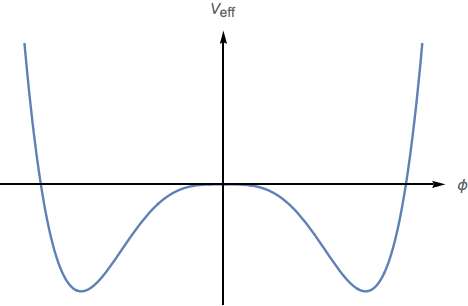
which is shown in <figref>Coleman-Weinberg-1.gif</figref>.
Because $\lambda$ is of the same order as $e^4$, the one-photon-loop
contributions are comparable in size to the tree-level potential, and
have given rise to spontaneous symmetry breaking. Expanding about the
asymmetric vacuum in the usual manner, we find that instead of a
massless photon and a massless complex scalar, as suggested by the
tree-level analysis, we have a massive vector and a massive
neutral scalar. The ratio of their masses is
\begin{equation}
Note that $V_{\rm eff}$ is rather flat around the maximum at $\phi=0$.
It was for this reason that the one-bubble new inflationary cosmology
was first proposed in the context of a Coleman-Weinberg type
potential (Linde, 1982; Albrecht and Steinhardt 1982).
Zero-point energy and the effective potential
The connection with the zero-point energies of the quantum fields is
somewhat obscured in the covariant calculation outlined above. It can
be made clearer by rewriting the integral in Eq. \ref{IasLogInt} as
\begin{equation}
I(a^2) = \int {d^3{\bf k} \over (2\pi)^3 }K(a^2)
\label{IntOfa}
\end{equation}
where
\begin{eqnarray}
\label{Kofa}
\end{eqnarray}
The third line is obtained from the second by dropping the surface
terms from the integration by parts and then evaluating the remaining
integral by contour integration. Thus, we see that the symmetry
breaking in "massless" scalar electrodynamics can be traced to the
zero-point energies of the three polarizations of the now-massive
vector meson.
Dimensional transmutation
At the beginning of our analysis, the theory was described by two
dimensionless parameters, $\lambda$ and $e$, and no manifest
dimensionful ones. However, there was also a hidden quantity with
dimensions of mass, namely the renormalization point $M$. This
doesn't really add an extra parameter, because any change in the value
of $M$ can be compensated by changes in the values of $\lambda$ and
$e$. However, it offers the possibility of exchanging the
dimensionless parameter $\lambda$ for a dimensionful one,
$\langle\phi\rangle$, that can be viewed as defining the unit of mass.
This phenomenon is known as dimensional transmutation. In this
example the net result is that a theory that at first sight appears to
depend on two arbitrary parameters actually depends on only one.
Perhaps more dramatic is the case of quantum chromodynamics with massless quarks,
where the dimensionless gauge coupling constant can be exchanged for,
e.g., the nucleon mass, leaving a theory with no free parameters at
all.
Adding a scalar mass term
Although the original calculation was for a theory with a superficially
massless scalar, radiative corrections can also drive spontaneous
symmetry breaking when a small positive mass term is present.
If a mass term
\begin{equation}
\label{massTerm}
\end{equation}
is added to the Lagrangian of Eq. \ref{QED-Lag}, with $\lambda$ still much
less than $e^2$ so that $\phi$-loops can be ignored, the one-loop
effective potential takes the form
\begin{equation}
With $\beta$, and thus $\mu^2$, positive, there is a symmetric
minimum at the origin, $\phi_c=0$. However, there is also an
asymmetric minimum at $\phi_c = \langle \phi \rangle \ne 0$. For $0 <
\beta < 2$, the asymmetric minimum is lower, and thus represents a
stable symmetry-breaking vacuum. At $\beta=2$ the two vacua are
degenerate, and for $2 < \beta <4$ the symmetric vacuum is lower while
the asymmetric one is metastable and can decay by the nucleation of
bubbles of the symmetric vacuum. [If]
In the asymmetric vacuum the masses of the scalar and vector are related by
\begin{equation}
Before taking the radiative corrections into account, it seemed that
the theory with a symmetric vacuum went over smoothly to the
symmetry-breaking one as $\mu^2$ went from positive to negative. This behavior
is reminiscent of a continuous second-order phase transition. We see here that the
effect of the radiative corrections is to replace this by a discontinuity similar that which
characterizes a first-order transition.
Complexity and convexity
In the discussion above it was assumed that the scalar self-coupling
was small enough that the scalar-loop contribution to the effective
potential could be neglected. If this is not the case, then one must
also include a term of the form
\begin{equation}
\label{scalarLoop}
\end{equation}
where the value of $M^2$ is determined by the renormalization
conditions. If the tree-level potential $V$ displays spontaneous
symmetry breaking, there will be a range of $\phi_c$ for which $V$
is negative. The logarithm will then have an imaginary part, rendering
$V_{\rm eff}$ complex. This is in conflict with the statement that
$V_{\rm eff}(\phi_c)$ is the (manifestly real) minimum expectation
value of the energy density among states for which the expectation
value of the quantum field $\phi$ is $\phi_c$.
A second puzzle is the observation that the effective potential,
having been defined via a Legendre transform, should be everywhere
convex (Iliopoulos, Itzykson and Martin, 1975). With a negative $V$ the scalar-loop contribution does not
satisfy this requirement. Indeed, even the effective potential of
Eq. \ref{finalV} fails this convexity condition.
These two puzzles have a common resolution (Weinberg and Wu, 1987). In a theory with
two degenerate vacua, say at $\phi=\pm \sigma$, a state degenerate
with these, but with $-\sigma < \langle \phi({\bf x}) \rangle < \sigma$ can
be obtained by taking an appropriate linear combination of the
original two vacuum states. This is the state whose (real) energy
is given by the true effective potential. The latter takes
the form indicated by the solid curve in <figref>Coleman-Weinberg-2.gif</figref>,
and is manifestly convex.
The effective potential for a theory with tree-level symmetry breaking. The
solid line indicates the exact effective potential. In the region between the two minima, the effective potential obtained by perturbation theory
is complex. Its real part is shown by the dashed and dotted curves, with the former indicating the region corresponding to
classical instability and the latter the region of nonperturbative quantum instability.
However, this is not the state addressed by the perturbative
calculation. Instead, that calculation focuses on states
$|\Psi\rangle$ that not only have $\langle \Psi| \phi({\bf x})|
\Psi\rangle = \phi_c$, but that also satisfy the further requirement
that their wave functional be concentrated on configurations with
$\phi({\bf x}) \approx \phi_c$. The minimum value of $\langle \Psi| H
| \Psi\rangle$ among such states gives the real part of the
perturbative effective potential. The
imaginary part reflects the instability of these states, even when an
external source is applied to maintain the condition $\langle \Psi|
\phi({\bf x}) | \Psi\rangle = \phi_c$. Classically, it would be
energetically advantageous for a configuration with a spatially
uniform field to break up into an inhomogeneous mixture of domains,
with the same overall average value of $\phi({\bf x})$, provided that
the energy gained by reducing $V(\phi)$ was greater than the cost in
gradient energy at the domain boundaries. This is the case
if $V(\phi_c)$ is negative, which is precisely the situation where
the one-loop effective potential becomes complex. In fact, one can
show that the imaginary part of the perturbative effective potential
agrees quantitatively with an independent calculation of the decay
rate of the initial state.
The region with negative $V(\phi_c)$ corresponds to the existence of a
classical instability. There is also the possibility of a quantum
instability, with the spreading of the initially homogeneous state
driven by quantum bubble nucleation, even when $V(\phi_c) >0$. This
gives a nonperturbative contribution to the imaginary part
over the entire region between the classical minima, as indicated in
<figref>Coleman-Weinberg-2.gif</figref>.
The relation between the exact effective potential and the one addressed
by perturbation theory is quite analogous to that between the exact
free energy obtained by a Maxwell construction and the analytic
continuation of the free energy that describes a metastable phase.
Gauge-dependence of the effective potential
The calculation of the one-loop effective potential of scalar
electrodynamics given in Eq. \ref{finalV} was performed in Landau gauge.
It is not obvious that working in another gauge would give the same
result (Jackiw, 1974). Indeed, although the leading,
$O(e^4)$, approximation is gauge-independent, gauge dependence appears
at $O(e^6)$(Dolan and Jackiw, 1974). Although this may appear troubling at first sight, it
should not be, and can be readily understood. The scalar field
$\phi(x)$ is itself gauge-dependent, as is even a statement that
$\phi$ is spatially uniform. Hence, asking for the value of the
effective potential at a given value of $\phi_c$ is not a well-defined
question until the gauge is fixed. What is required is that
physically measurable quantities be gauge-independent. Thus, the
existence of a symmetry-breaking minimum and the difference in energy
density between this minimum and the symmetric state should be
gauge-independent. Identities that show that physical quantities such as these are indeed gauge-invariant have been
derived (Nielsen, 1975; Fukuda and Kugo, 1976).
The gauge independence of the scalar-vector mass ratio
of Eq. \ref{massRatio} has been verified by explicit calculation (Kang, 1974). Similarly, the
rate at which a metastable symmetric vacuum decays by the
nucleation of bubbles of asymmetric true vacuum — a calculation
that requires some care (Weinberg, 1993) — can be
shown to be gauge-invariant (Metaxas and Weinberg, 1996).