Andronov Hopf bifurcation - davidar/scholarpedia GitHub Wiki
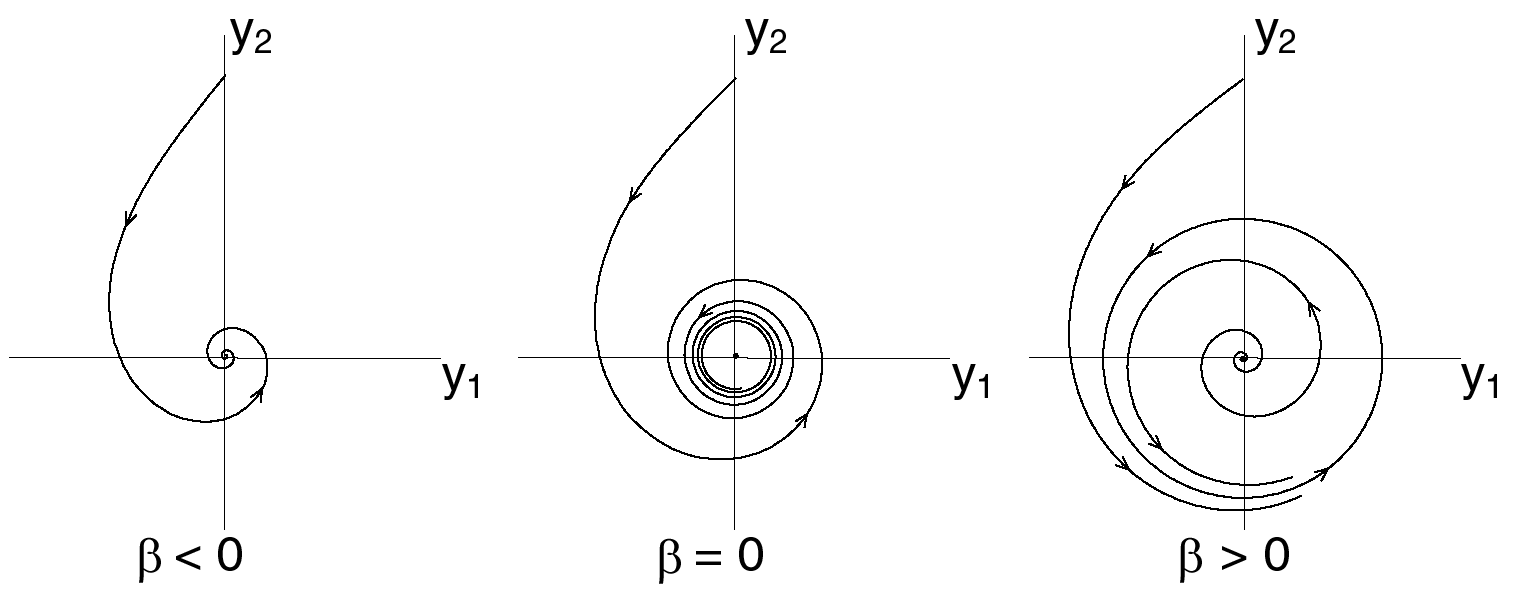
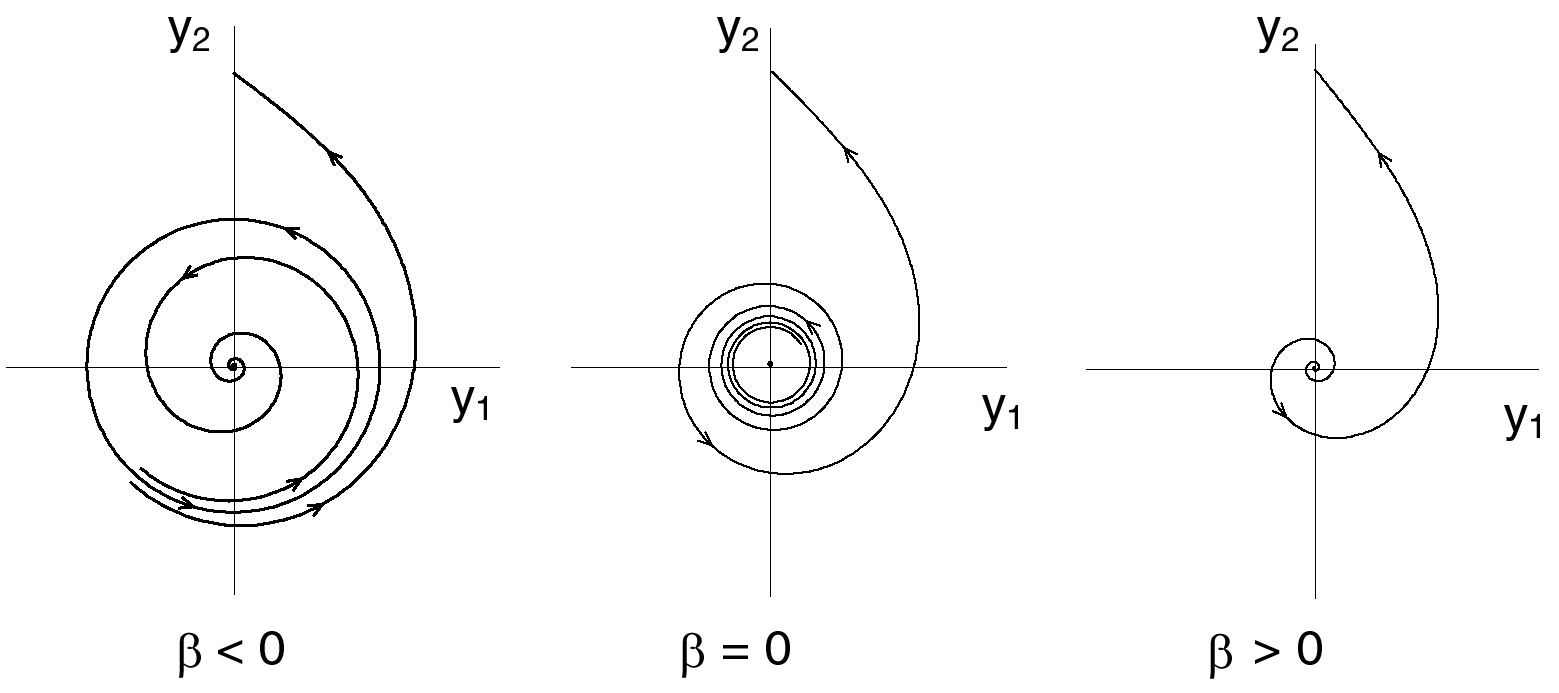
Andronov-Hopf bifurcation is the birth of a limit cycle from an equilibrium in dynamical systems generated by ODEs, when the equilibrium changes stability via a pair of purely imaginary eigenvalues. The bifurcation can be supercritical or subcritical, resulting in stable or unstable (within an invariant two-dimensional manifold) limit cycle, respectively.
Consider an autonomous system of ordinary differential equations (ODEs)
- <math>
- Suppose that for all sufficiently small <math>|\alpha|</math> the system has a family of equilibria <math>x^0(\alpha)\ .</math>
- Further assume that its Jacobian matrix <math>A(\alpha)=f_x(x^0(\alpha),\alpha)</math> has one pair of complex eigenvalues
- <math>
To describe the bifurcation analytically, consider the system above with <math>n=2\ ,</math>
- <math>
- <math>
- (AH.1) <math>l_1(0) \neq 0\ ,</math> where <math>l_1(\alpha)</math> is the first Lyapunov coefficient (see below);
- (AH.2) <math>\mu'(0) \neq 0\ ,</math>
- <math>
- <math>
- If <math>\sigma=-1\ ,</math> the normal form has an equilibrium at the origin, which is asymptotically stable for <math>\beta \leq 0</math> (weakly at <math>\beta=0</math>) and unstable for <math>\beta>0\ .</math> Moreover, there is a unique and stable circular limit cycle that exists for <math>\beta>0</math> and has radius <math>\sqrt{\beta}\ .</math> This is a supercritical Andronov-Hopf bifurcation (see <figref>SuperHopf.gif</figref>).
- If <math>\sigma=+1\ ,</math> the origin in the normal form is asymptotically stable for <math>\beta<0</math> and unstable for <math>\beta \geq 0</math> (weakly at <math>\beta=0</math>), while a unique and unstable limit cycle exists for <math>\beta <0\ .</math> This is a subcritical Andronov-Hopf bifurcation (see <figref>SubHopf.gif</figref>).
In the <math>n</math>-dimensional case with <math>n \geq 3\ ,</math> the Jacobian matrix <math>A_0=A(0)</math> has
- a simple pair of purely imaginary eigenvalues <math>\lambda_{1,2}=\pm i \omega_0, \ \omega_0>0\ ,</math> as well as
- <math>n_s</math> eigenvalues with <math>{\rm Re}\ \lambda_j < 0\ ,</math> and
- <math>n_u</math> eigenvalues with <math>{\rm Re}\ \lambda_j > 0\ ,</math>
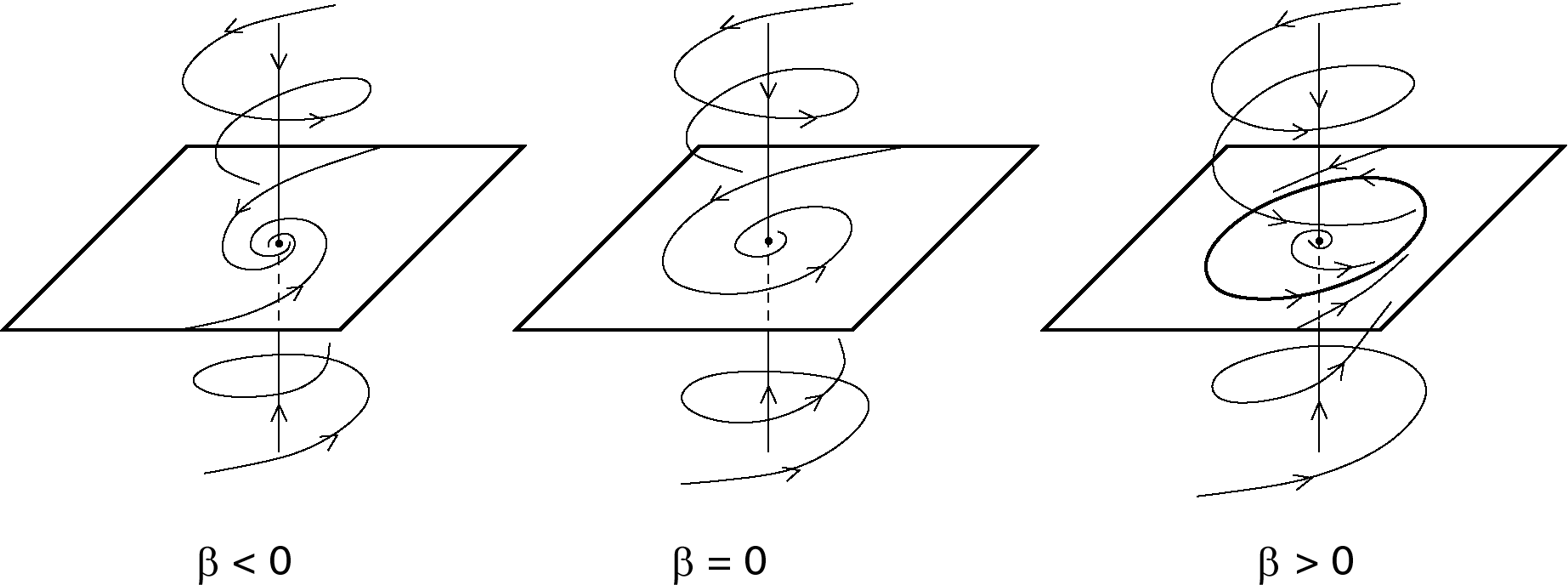
Moreover, under the non-degeneracy conditions (AH.1) and (AH.2), the <math>n</math>-dimensional system is locally topologically equivalent near the origin to the suspension of the normal form by the standard saddle, i.e.
- <math>
- <math>
- <math>
- <math>
Whether Andronov-Hopf bifurcation is subcritical or supercritical is determined by <math>\sigma\ ,</math> which is the sign of the first Lyapunov coefficient <math>l_1(0)</math> of the dynamical system near the equilibrium. This coefficient can be computed at <math>\alpha=0</math> as follows. Write the Taylor expansion of <math>f(x,0)</math> at <math>x=0</math> as
- <math>
- <math>
- <math>
- <math>
For planar smooth ODEs with
- <math>
- <math>
- <math>\ \ \ \ +\frac{1}{8\omega_0^2}\left[P_{uv}(P_{uu}+P_{vv})],
The first Lyapunov coefficient can be found easily in some simple but important examples (Izhikevich 2007). Here <math>a,b>0</math> are positive parameters and all derivatives should be evaluated at the critical equilibrium.
-
System Condition <math>{\rm sign\ }l_1(0)</math> - <math>
- <math>
- <math>F'=0</math>
- <math>{\rm sign\ }F</math>
- <math>
- <math>
- <math>F'=a</math> and <math>b>a</math>
- <math>{\rm sign}\left[F+(F)^2/(b-a)\right]</math>
- <math>
- <math>
- <math>F'=a</math> and <math>G'>a</math>
- <math>{\rm sign}\left[F+F(F-G)/(G'-a)\right]</math>
Andronov-Hopf bifurcation occurs also in infinitely-dimensional ODEs generated by PDEs and DDEs, to which the Center Manifold Theorem applies. An analogue of the Andronov-Hopf bifurcation - called Neimark-Sacker bifurcation - occurs in generic dynamical systems generated by iterated maps when the critical fixed point has a pair of simple eigenvalues <math> \mu_{1,2}=e^{\pm i \theta} \ .</math>
- A.A. Andronov, E.A. Leontovich, I.I. Gordon, and A.G. Maier (1971) Theory of Bifurcations of Dynamical Systems on a Plane. Israel Program Sci. Transl.
- V.I. Arnold (1983) Geometrical Methods in the Theory of Ordinary Differential Equations. Grundlehren Math. Wiss., 250, Springer
- J. Guckenheimer and P. Holmes (1983) Nonlinear Oscillations, Dynamical systems and Bifurcations of Vector Fields. Springer
- E.M. Izhikevich (2007) Dynamical Systems in Neuroscience: The Geometry of Excitability and Bursting. The MIT Press.
- Yu.A. Kuznetsov (2004) Elements of Applied Bifurcation Theory, Springer, 3rd edition.
- J. Marsden and M. McCracken (1976) Hopf Bifurcation and its Applications. Springer
- Willy Govaerts, Yuri A. Kuznetsov, Bart Sautois (2006) MATCONT. Scholarpedia, 1(9):1375.
- James Murdock (2006) Normal forms. Scholarpedia, 1(10):1902.
- Jeff Moehlis, Kresimir Josic, Eric T. Shea-Brown (2006) Periodic orbit. Scholarpedia, 1(7):1358.
- Philip Holmes and Eric T. Shea-Brown (2006) Stability. Scholarpedia, 1(10):1838.
Bifurcations, Center Manifold Theorem, Dynamical Systems, Equilibria, MATCONT, Ordinary Differential Equations, XPPAUT