12 Agile Principles - allikvaleria/Phyton GitHub Wiki
12 Agile Principles
Theoretical Part:
VUCA is an acronym that stands for Volatility, Uncertainty, Complexity, and Ambiguity. It represents the challenging and unpredictable conditions that are common in many modern project environments, especially in a rapidly changing world. Here’s a breakdown of each term in the VUCA framework:
| Element | Description | Example | Adaptation |
|---|---|---|---|
| Volatility | The environment changes rapidly and unexpectedly. | The price of raw materials fluctuates, or new technologies emerge, shifting the market landscape. | Preparedness through contingency plans, quick responses, and continuous monitoring of changes. |
| Uncertainty | Forecasting the future is difficult, and changes occur unexpectedly. | In projects, there’s uncertainty about whether the end result will meet customer needs. | Flexible strategies, incremental planning, and a mindset of continuous learning and adaptation. |
| Complexity | Projects are influenced by many interrelated factors that are hard to manage simultaneously. | An international project involves multiple teams, technologies, and cultural factors. | Systems thinking, managing dependencies, prioritizing tasks, and ensuring effective coordination. |
| Ambiguity | Key aspects are unclear, and situations can be interpreted in multiple ways. | Ambiguity about the most appropriate technology solution for a project. | Experimental approach, small-scale tests, iterative feedback loops, and flexible decision-making. |
1.2 VUCA Importance of Working in the World
The use of VUCA analysis allows project managers and teams to assess the environment and adapt to change. Agile and Scrum are popular methodologies because they support teams to work in such unstable and unpredictable environments.
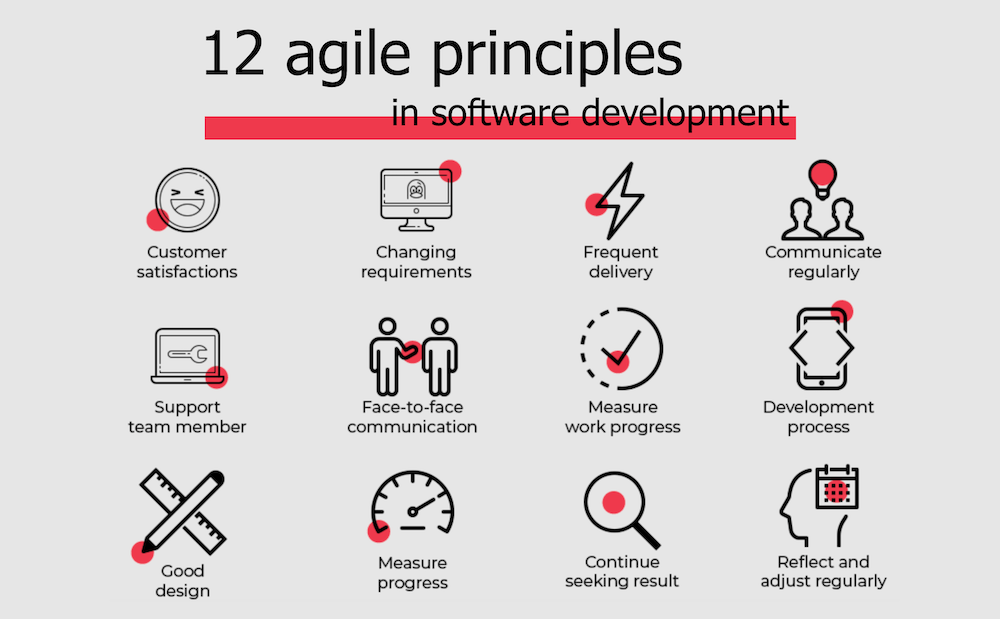
The 12 Principles of Agile
Agile Core Principles:
-
Customer satisfaction through continuous delivery
Agile prioritizes meeting customer needs by delivering software early and continuously, allowing for prompt feedback and better ROI.
Example: An e-shop receives regular updates, improving the user experience with each release and gathering customer feedback. -
Embrace changes, even late in development
Agile teams are flexible and open to changes, even at late stages, to deliver more value to customers.
Example: The team quickly adjusts the plan to improve the website’s user experience based on new requirements. -
Frequent value delivery
Agile teams deliver value in short, frequent cycles to reduce planning time and increase development speed.
Example: New features for a mobile app are rolled out every few weeks, so users can enjoy new updates regularly. -
Collaboration across cross-functional teams
Agile encourages collaboration between teams to ensure smooth development and clear communication.
Example: Marketing and development teams meet daily to align on campaigns and features, ensuring coherence in their strategies. -
Motivated teams are key to success
Project success depends on the motivation and trust of the team, giving them the freedom to make decisions.
Example: A team of professionals works independently, trusted to make decisions that lead to high-quality results. -
Face-to-face communication is most effective
The fastest and most efficient way to communicate is through direct interaction or quick communication channels.
Example: Remote teams use daily video calls to solve problems and make decisions, replacing lengthy email chains. -
Working software as a measure of success
The success of development is measured by the functionality of the software, not deadlines or bug counts.
Example: The mobile app team focuses on delivering a usable product, ensuring every feature works well. -
Maintain a sustainable work pace
Agile processes support a steady work pace, avoiding overload while promoting continuous improvement.
Example: The team works at a consistent pace, ensuring no one is overworked and everyone can sustain long-term productivity. -
Focus on technical quality and design
Ensuring quality in engineering and design makes development more sustainable and adaptable.
Example: The development team ensures code quality to maintain project structure, preventing errors and aiding future updates. -
Simplicity and speed
Agile prioritizes simplicity, aiming to do only what is necessary and avoiding unnecessary features.
Example: An e-shop focuses on displaying only essential product details to avoid clutter and complexity. -
Self-managed teams add the most value
Empowered teams create the most value by making decisions that align with customer needs.
Example: The development team independently determines the next features, as they best understand the client’s needs. -
Continuous reflection and adaptation
Agile teams regularly reflect on their work to identify areas for improvement and adapt their processes.
Example: After each project, the team evaluates their performance, identifying lessons to enhance future work.
Flexible methodologies vs Traditional methodologies
| Characteristic | Flexible Methodologies | Traditional Methodologies |
|---|---|---|
| Adaptability | Highly adaptable, allowing quick changes during the project | Follows a fixed sequence, less adaptable to changes |
| Customer Engagement | Close collaboration with customers throughout the project | Customer involvement is mainly at the beginning |
| Development Process | Iterative, broken into small cycles with frequent feedback | Linear, with planning at the beginning and phased implementation |
| Team Dynamics | Emphasis on self-regulation, collaboration, and flexibility | Hierarchical organization, with a clear division of roles |