How to Create a Custom Star System in WSSG - Vector-Graphics/walkersysgen GitHub Wiki
If you're using a version before v0.4.0 of WSSG, it's likely that there isn't a customization UI built into the software. In that case, to create a star system, you need to modify a .wssg file in a spreadsheet editor. (Note: you may need to rename the file from ____.wssg to ____.csv to open it in a spreadsheet editor)
What is a .wssg file?
A .wssg file is a CSV file storing the information of a system or systems in WSSG. They are laid out like this:
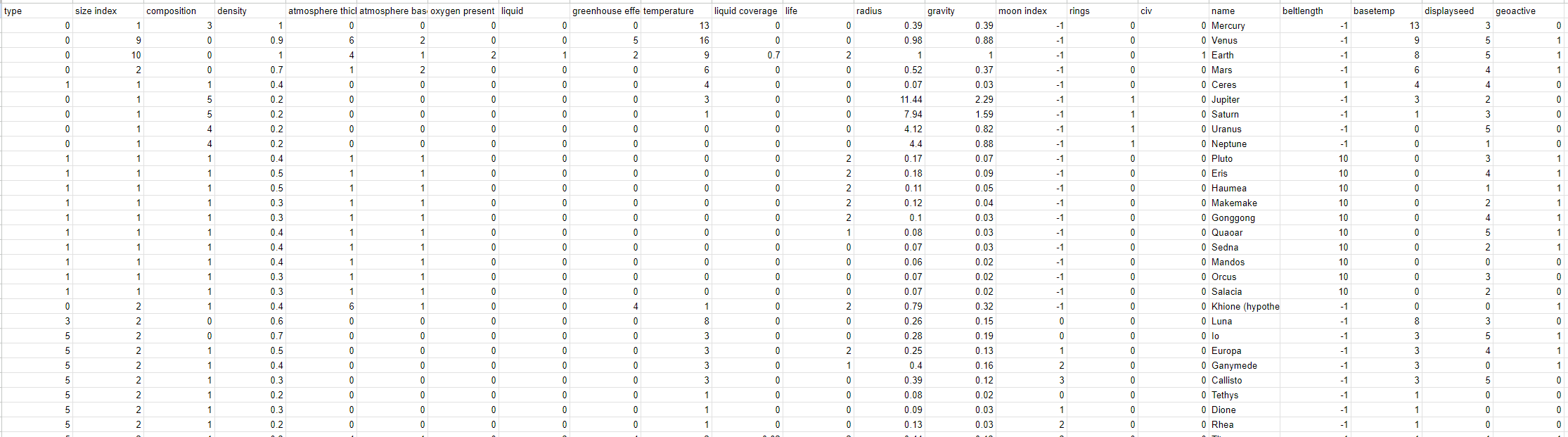
Each planet is a row in the file, and each different property is a column.
What do all of the things mean?
System properties
These should be the same for all planets in the system, and represent properties of the system as a whole (like star data, the system age, etc)
System index
A continuous block of planets with the same system index will belong to the same system. By default, system indices count up from 0, but can be anything, as long as all planets belonging to the same system are right next to each other and have the same system index.
Star types (primary, close companion, distant companion)
There are 7 star types simulated by WSSG: white dwarf (0), red dwarf (1), K-type main sequence star (2), G-type main sequence star (3), F-type main sequence star (4), A-type main sequence star (5), B-type main sequence star (6). O-type stars are too rare to bother with, and red giant stars would be hell to simulate the temperatures for (pun intended). So, only the 7 most common types are used.
Close companion exists, distant companion exists
The primary star always exists in any given system. The close companion exists in some systems, and is part of the same planetary system as the primary star, with the planets orbiting both stars (like Tatooine orbits Tatoo I and II). The distant companion also exists in some systems (and can exist in systems with a close companion, creating a triple system). The distant companion has its own planetary system, and the two stars may be visible as particularly bright specks of light from each other's systems (like Alpha Centauri A and B).
Note that the Alpha Centauri star system would be simulated as two separate star systems, one for Rigil Kent and Toliman, and one for Proxima.
Star names (primary, close companion, distant companion)
Each star has a name, which can be any string. "Peepee poopoo", "THE LARGEST STAR EVAR", "Zeta Reticuli", whatever. By default, any stars that don't exist in the system are named 'bepis' (as a placeholder) and any that do exist are given the same randomly generated name with a suffix indicating the star's position. The primary suffix is A or Aa (if distant companion), the close companion suffix is Ab (if distant companion) or B, and the distant companion suffix is B. Note that if only the primary exists, no suffix is added. (For example, Tatoo A and Tatoo B, or Harmondis Aa, Harmondis Ab, and Harmondis B, but the solo Sol is solely Sol.)
System age
The age of the system. By default, this is a random value around up to 10 billion years old. F-type stars last about 8 billion years, A-type stars about 3 billion, and B-type stars on the scale of hundreds of millions.
Luminosities (primary, close companion, distant companion)
The luminosities of each star in the system in solar luminosity. These determine the distances of the planets. White dwarfs should have the luminosity that they would have as a main sequence star.
Planetary properties
These vary between planets and describe the planet itself (like its radius, mass, etc)
ID
Each planet has a numerical ID, which should count up from zero with each planet. In a system, planets are ordered like so:
- Major planets and dwarf planets
- In any order, as long as dwarf planets in the same belt are together
- Satellite planets
- In any order, as long as satellite planets orbiting the same parent body are together
Parent Star(s)
This refers to the star system that the planet belongs to: 1 for the primary system, 2 for the distant companion system.
Parent Body
If this planet orbits another planet, this is the ID of the parent body planet, stored in the satellite as a reference. This value is -1 if the planet is not a satellite.
Orbit
This is the orbit that the planet is in. Discrete orbital zones are used to simplify the addition of belts to the system and to make planet spacing more realistic. Valid orbits range from 0 to 41. Orbits 5 to 10 represent the aquatic goldilocks zone, the orbital region around a main sequence (e.g. not a white dwarf) star that liquid water can exist on the surface in given Earth's atmospheric conditions. Since people apparently care about that, even though not every planet has Earth's atmospheric conditions.
Distance
This value is not actually loaded into the software! It is only exported for the sake of making distances easier to read if you were to use WSSG to export a CSV file for, say, an RPG. The software automatically generates the correct distance based on the orbit index into this array:
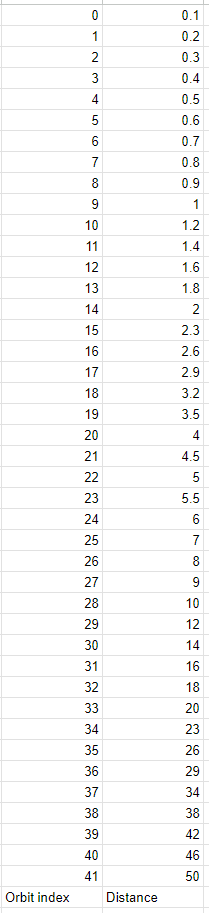
Distance values are measured in AU☉. An AU☉ is a measure of orbital distance, where for any given star, Earth would need to orbit 1 AU☉ from that star in order to maintain its current surface conditions. This means the aquatic goldilocks zone is always 0.6 to 1.2 AU☉, regardless of the star's brightness.
Size
This is the MASS of the planet, not the radius or volume. This represents the planet's mass in units of Earth masses. Size can be any positive number. Planets larger than size 12 are usually gas giants or ice giants. You can calculate the radius of a planet with Earth's density and a given size by taking the cube root of the size, which will yield the radius in Earth radii.
Type
A planet's "type" refers to its classification as a major planet (0), dwarf planet (1), moon of a dwarf planet (2), moon of a small major planet (3), moon of a medium major planet (4), or moon of a large major planet (5). There is no functional difference between 3, 4, and 5 in the way they are loaded, the distinction is purely internal and used to generate sizes when generating a new system.
Size index
A planet's size index is another internal value, and doesn't matter. In v2.0.0, I will remove this from the format.
Composition
A planet's composition is what it is made of. There are six different composition values: 0 (rocky), 1 (icy), 2 (carbonaceous), 3 (metallic), 4 (ice giant), and 5 (gas giant).
Density
A planet's density in relation to Earth density. A density of 1.0 is typical of a rocky planet with a large iron core. A density of 0.2 to 0.4 is typical for icy objects, and a density of 0.2 is typical for ice giants and gas giants.
Atmosphere Thickness
The thickness of the planet's atmosphere. There are 7 atmosphere thickness classes: no atmosphere (0); very thin, tenuous atmosphere (1); moderately thin atmosphere (2); somewhat thin atmosphere (3); medium atmosphere (4); thick atmosphere (5); very thick, dense atmosphere (6).
Primary Atmospheric Gas
There are two possible base gas types for an atmosphere, based on the two base gases observed in the Solar System: nitrogen, the more common of the two, and carbon dioxide, which is rarer, but causes very strong greenhouse effects.
Oxygen
This controls whether there is oxygen in the atmosphere, which is usually caused by photosynthetic organisms.
Liquid
This controls what liquid is on the planet. There are 5 options: 0 (no liquid), 1 (water), 2 (liquid ammonia), 3 (liquid methane), 4 (liquid nitrogen). Nitrogen, methane, and ammonia are liquid only in very cold environments, though ammonia less so than methane, and methane less so than nitrogen.
Greenhouse Effect
This is how much the planet is warmed by the atmosphere, and is usually caused by a lot of carbon dioxide in the atmosphere (note: greenhouse effects can happen with nitrogen atmospheres, if there is some proportion of greenhouse gases like water, carbon dioxide, or methane, for example on Earth). There are 6 different settings, ranging from no greenhouse effect to runaway greenhouse effect.
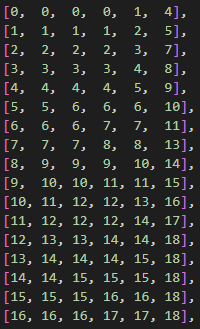
This is how greenhouse effect interacts with base temperature to produce the temperature proper of the planet. Base temperature is determined by the planet's orbit.
Proper Temperature
The planet's average surface temperature, after application of greenhouse effect. Ranges from 0 (frigid) to 9 (temperate) to 18 (torrid).
Liquid coverage
Despite being a decimal, this only has a few valid values: 0, 0.02, 0.05, 0.1, 0.3, 0.7, 0.8, 0.9, 0.97, 1, and -1 which represents a planet with a very deep global ocean. Using other values will cause the liquid to not render properly.
Life
The status of life on the planet. 0 means no life, and 1 and 2 differ in that 2 indicates the presence of complex ecosystem and complex organisms, while 1 means only unicellular, pre-Phanerozoic life. Life requires a liquid somewhere (either on the surface of the planet or inside an icy planet) and geologic activity to exist.
Radius and Gravity
Like the orbital distance in AU☉, these two values are automatically calculated each time the system is loaded and need not be modified manually.
Moon Index
The index of a satellite in a moon system, starting at 0 for the first moon. This is -1 for non-satellites, and is used as part of planet names.
Rings
1 indicates the presence of rings. Terrestrial planets sometimes have rings, dwarf planets often have rings, and gas giants always have rings.
Civilization
1 indicates that a planet is the homeworld of a civilization (like Earth).
Name
The planet's name, which can be any string, like the star names.
Belt Length
If the planet is a dwarf planet, this is how many dwarf planets are in the belt it belongs to, and is necessary for displaying belts correctly. Otherwise this value is -1.
Base Temperature
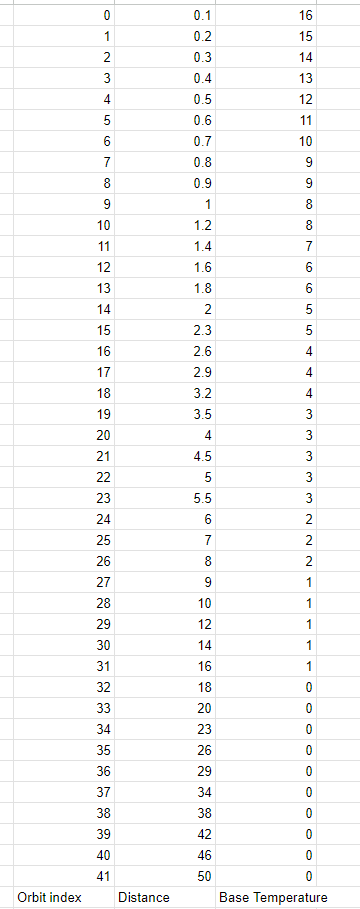
The base temperature of the planet, without the greenhouse effect. This and the greenhouse effect determine the temperature proper. Base temperature is derived from the planet's orbit according to this table.
Visual Style
Which of 6 different image variations to use for the planet, from 0 to 5.
Geologically Active
Whether the planet is geologically active. 1 for yes, 0 for no.
More detailed tables for certain things:
... star type:
star type |
Meaning |
|---|---|
| -1 | not present |
| 0 | white dwarf |
| 1 | M dwarf |
| 2 | K dwarf |
| 3 | G dwarf |
| 4 | F dwarf |
| 5 | A dwarf |
| 6 | B dwarf |
parent body:
parent body |
Meaning |
|---|---|
| -1 | orbits star(s) |
composition:
composition |
Meaning |
|---|---|
| 0 | rocky |
| 1 | icy |
| 2 | carbonaceous |
| 3 | metallic |
| 4 | ice giant |
| 5 | gas giant |
type:
type |
Meaning |
|---|---|
| 0 | uberplanet |
| 1 | unterplanet |
| 2 | moon of unterplanet |
| 3 | moon of uberplanet with size index between 0-11 |
| 4 | moon of uberplanet with size index between 12-23 |
| 5 | moon of uberplanet with size index between 24-35 |
atmosphere thickness:
atmosphere thickness |
Meaning |
|---|---|
| -1 | jovian |
primary atmospheric gas:
primary atmospheric gas |
Meaning |
|---|---|
| -1 | jovian |
| 0 | no atmosphere |
| 1 | nitrogen |
| 2 | carbon dioxide |
liquid:
liquid |
Meaning |
|---|---|
| 0 | no liquid |
| 1 | water |
| 2 | ammonia |
| 3 | methanum |
| 4 | nitrogen |
proper temperature:
proper temperature |
Meaning |
|---|---|
| 0 | 50K |
| 1 | 70K |
| 2 | 100K |
| 3 | 120K |
| 4 | 150K |
| 5 | 170K |
| 6 | 190K |
| 7 | 220K |
| 8 | 250K |
| 9 | 280K |
| 10 | 310K |
| 11 | 340K |
| 12 | 375K |
| 13 | 425K |
| 14 | 500K |
| 15 | 600K |
| 16 | 750K |
| 17 | 900K |
| 18 | 1200K |
liquid coverage:
liquid coverage |
Meaning |
|---|---|
| -1 | superoceanic |
life:
life |
Meaning |
|---|---|
| 0 | no life |
| 1 | unicellular |
| 2 | multicellular |